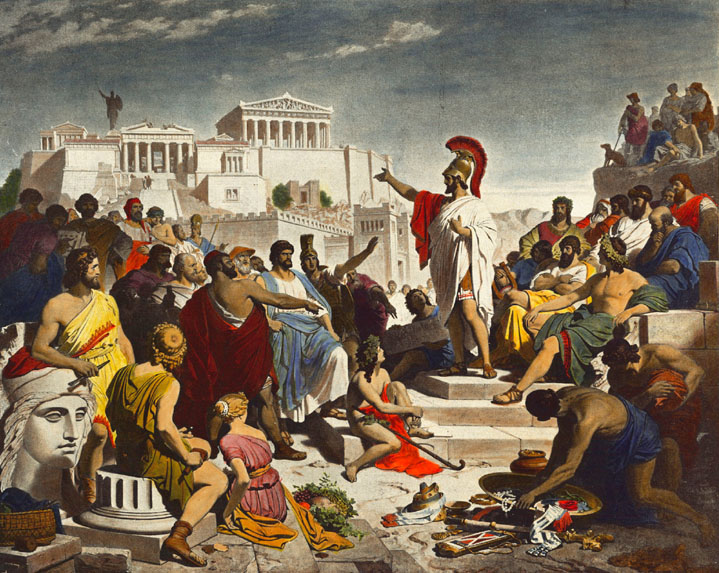
In 430 B.C., the Athenian statesman Pericles delivered a “Funeral Oration” to commemorate those who had died in war. His speech exalted Athens as a free, beautiful, and courageous city, illustrating the need to articulate higher principles and kindle hope in times of trouble.
The Greatest Statesman of Athens
The 5th century B.C. is often called Greece’s “Golden Age.” Democracy became a legal and political reality, Greek city states successfully deterred a massive Persian invasion and secured two centuries of independence, and philosophers like Socrates began asking probing philosophical questions that continue to concern humanity.
Playwrights Aeschylus, Sophocles, Aristophanes, and Euripides wrote some of the most famous dramas to this day, while the physician Hippocrates laid the foundations for modern medicine and the traveling bard Herodotus turned history into an intellectual discipline in its own right.
 “An Audience in Athens During ‘Agamemnon’ by Aeschylus,” 1884, by William Blake Richmond. Oil on canvas; 84 3/5 inches by 10 feet. Birmingham, England. (Public Domain)
Pericles was involved in all these pivotal ventures. The son of wealthy, aristocratic parents, he was born into the elite world of artists, politicians, and military chiefs. As a young man he preferred privacy and quiet study, but he eventually became an outspoken statesman. He promoted peace treaties with Persia and spearheaded the expansion and beautification of Athens, devising plans for such iconic buildings as the Parthenon.
A lover of music and philosophy, Pericles sponsored the live production of Aeschylus’s tragedy “Persians,” which recounts the downfall of Xerxes, the megalomaniac king who sought to conquer Greece. The Athenian even established a public fund to subsidize people’s attendance at theater festivals. His role in making Athens a cultural epicenter and naval superpower was so decisive that the Golden Age is sometimes nicknamed the “Age of Pericles.”
The Second Peloponnesian War
Formidable leader though he was, Pericles was criticized for inciting the large-scale conflict between Athens and Sparta known as the Second Peloponnesian War (431–404 B.C.). He knew his native Athens had the potential to become the ruling force in the eastern Mediterranean, and he tried stubbornly to expand its dominion.
He escalated small conflicts by sending unnecessarily large reinforcements and even put into effect one of the earliest trade embargoes in history. It prevented the neighboring Greek city of Megara from trading in the Athenian market.
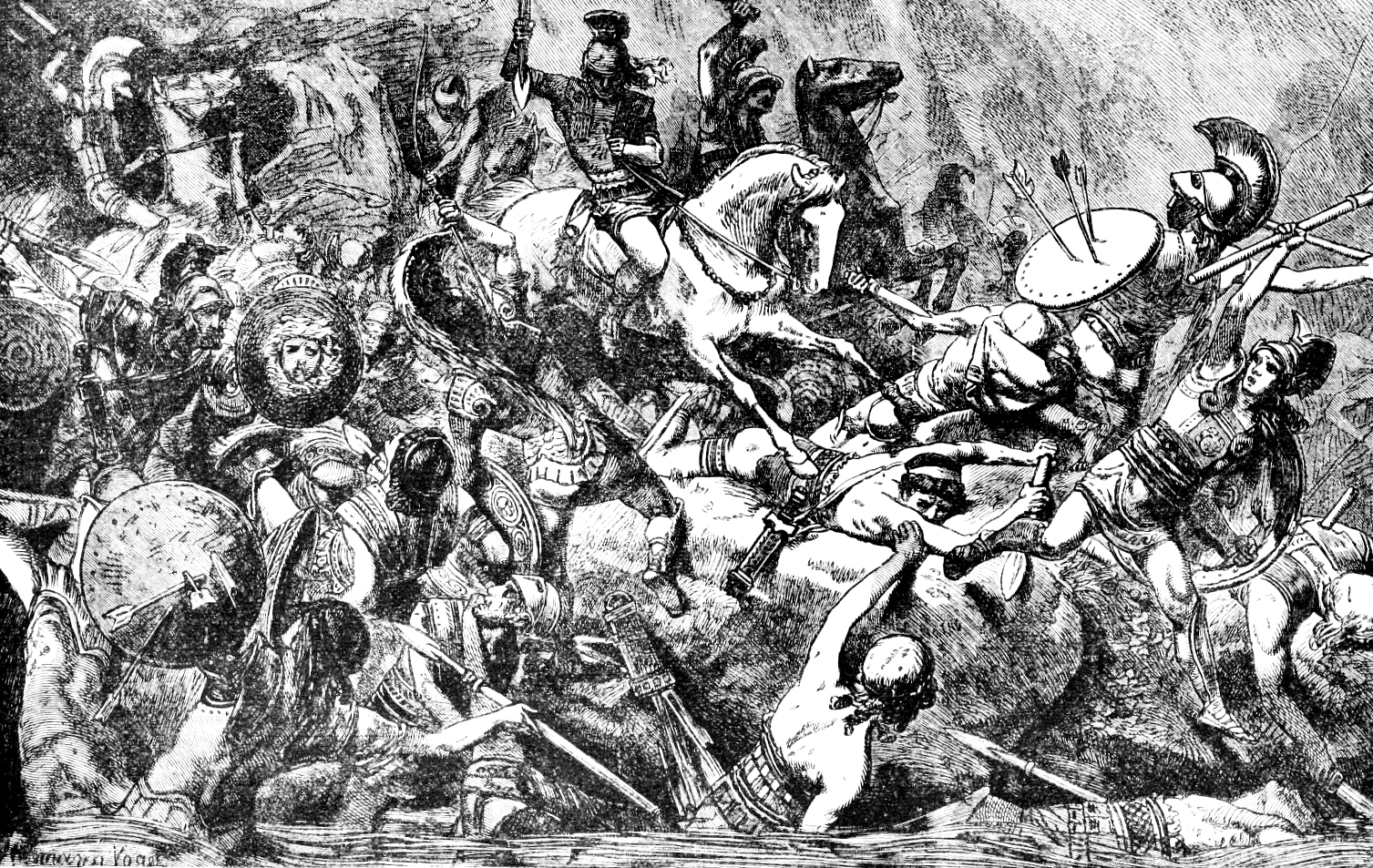 The fall of the Athenian army in Sicily during the Peloponnesian War in 413 B.C. as depicted in an 1893 illustration by J.G. Vogt. (Public Domain)
Athens’s aggressive foreign policy sparked fear in Sparta and its allies. In 431 B.C., the Spartans invaded the Athenian countryside. To their surprise, they found no one. Pericles had ordered Athens’s rural population to retreat into the city walls, enabling the Athenian army to protect its people. Even though this strategy prevented many Athenian casualties, the war raged on in land and naval skirmishes. In the first year alone, thousands of soldiers lost their lives.
The Funeral Oration
In Athens, the war dead were commemorated annually in a city-wide funeral that began with a formal speech by one of the city’s foremost leaders. The text of Pericles’s oration was recorded by the Greek historian Thucydides in “The History of the Peloponnesian War,” an account of the 27-year war and one of the world’s first history books. Since many lesser known funeral orations exist, historians generally agree that Thucydides’s text closely resembles what Pericles actually said.
Pericles began by acknowledging the custom of offering formal praise to the dead, but admitted the task’s difficulty: “It is hard to speak properly upon a subject where it is even difficult to convince your hearers that you are speaking the truth.” He paid tribute to Athenian ancestors and the sacrifices they made to gain and reinforce Athens’s independence. But instead of dwelling on individual deeds or familiar narratives about past military achievements, Pericles shifted his audience’s attention to broader themes.
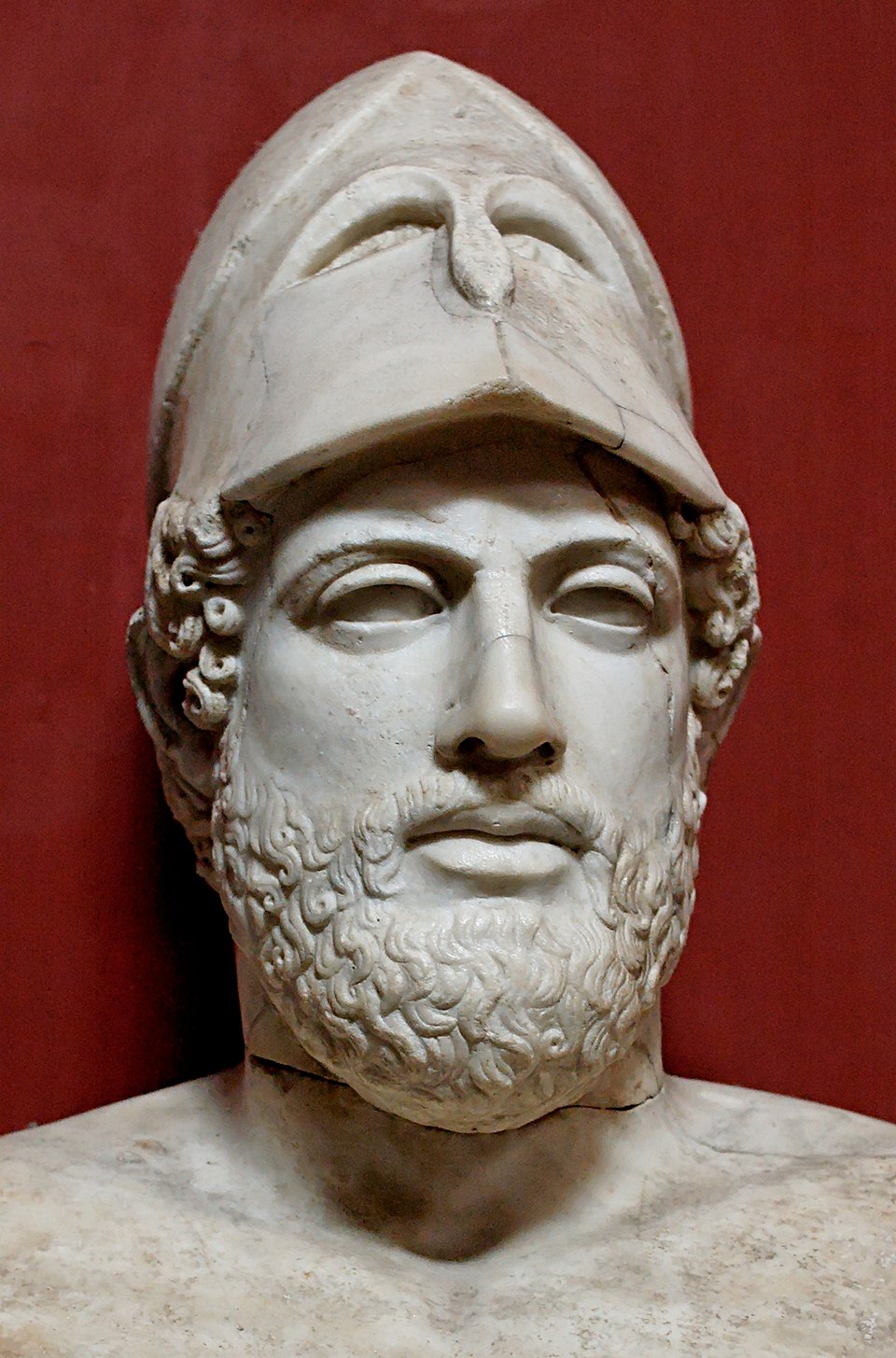 A bust of Pericles with the inscription “Pericles, son of Xanthippus, Athenian.” Marble, Roman after original Greek bust, 430 B.C. (Public Domain)
He praised the Athenian constitution, which he believed was unique in the world thanks to its promise of “equal justice to all in their private differences.” He applauded Athens’s preference for competence and merit over social standing. He also commended his people’s willingness to choose courage not by compulsion, but by will. In his words, Athens was “the school of Greece,” an example for all to admire and emulate.
These general remarks allowed Pericles to portray the soldiers’ brave sacrifice not just as heroism, but as an incontrovertible proof of their commitment to a shared and noble vision. “Thus choosing to die resisting, rather than to live submitting,” he said, “they fled only from dishonor, but met danger face to face.” They died for personal glory, but they also died for their community, which couldn’t exist without their efforts: “The Athens that I have celebrated is only what the heroism of these and their like have made her.”
Although Pericles pitied the orphans and widows left behind, he encouraged them to remember their loved ones’ dedication to the Athenian vision. He consoled them, but challenged them to honor the memory of their kin by deeds instead of words. What should have been a mournful declaration of grief and loss became a powerful exhortation to remember the ideals that made Athens special. For Pericles, the city was a living monument, and its people the sustaining pillars.
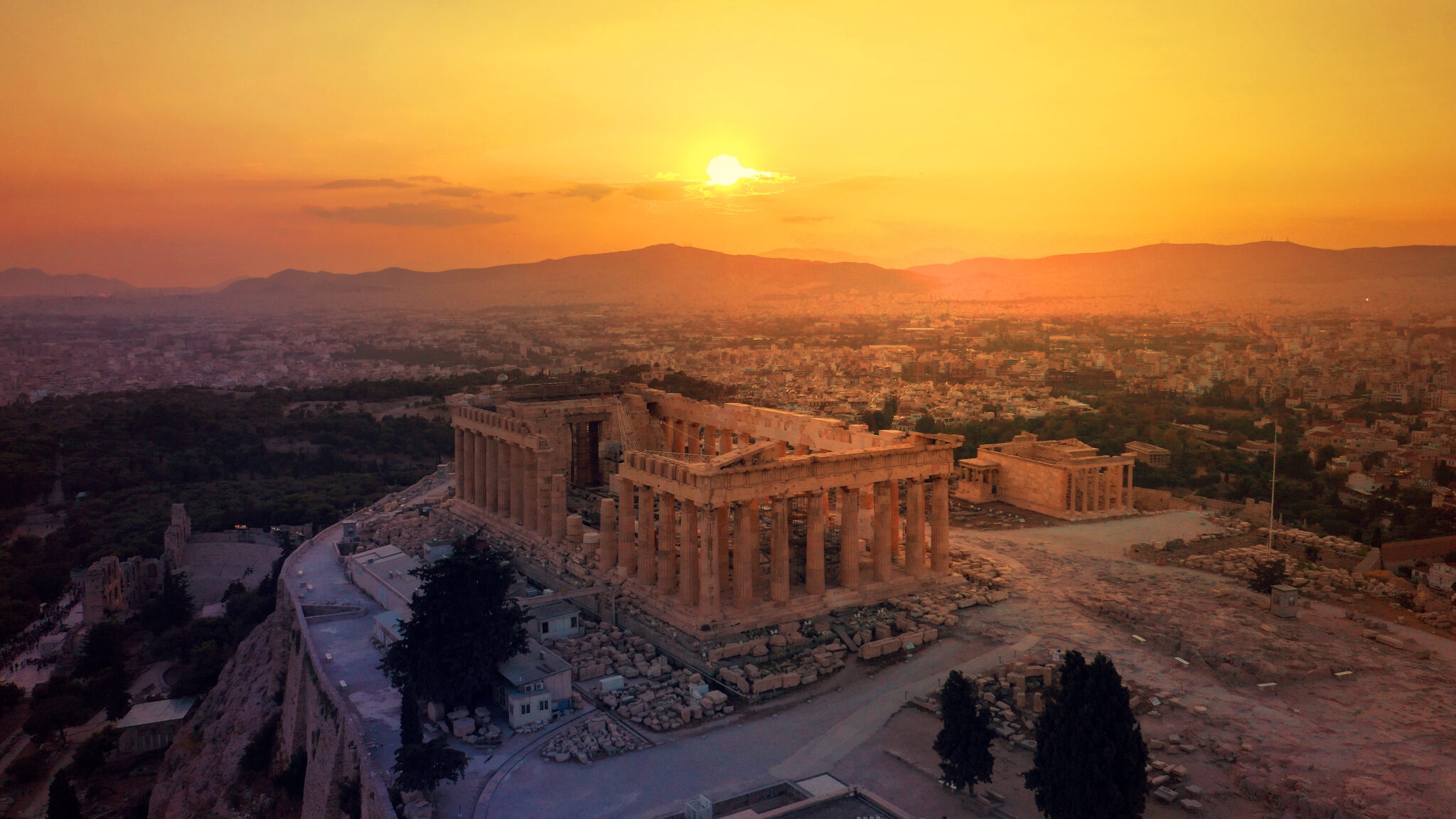 Atop the Acropolis hill sits the Parthenon, just part of the rich cultural heritage of Athens. (Aerial-motion/Shutterstock)
The War Continued
Thucydides appreciated the need for sharing inspiring and instructive content with his readers, hence his occasional insertions of polished speeches in factual accounts of the war. A skilled historian, he also knew he shouldn’t romanticize the past. In just a few pages, the grandeur of Pericles’s speech fades dramatically. As the war continued in neighboring territories, Athens’s supply lines diminished. Although Pericles’s defensive strategy had saved tens of thousands of people, it had also strained the city’s waning resources. Widespread hunger aggravated poor sanitation, which weakened the Athenians’ already feeble immune systems.
In 430 B.C., a devastating plague broke out. It killed almost a fourth of the population, making victory and peace distant possibilities.
 “Plague in an Ancient City,” circa 1652 and circa 1654, by Michiel Sweerts. Oil on canvas; 46 3/4 inches by 67 1/5 inches. Los Angeles Museum of Art. (Public Domain)
Paranoia and lawlessness ensued. Some Athenians speculated that Sparta had poisoned their water supply, while others sought comfort in supernatural explanations. Pericles himself died from the disease, whose origin still puzzles epidemiologists. As Thucydides noted, “The catastrophe was so overwhelming that men, not knowing what would happen next to them, became indifferent to every rule of religion or law.” Historians still struggle to explain how Athens survived these circumstances.
A Clarion of Hope
Yet, despite impending doom, Athens persisted. Resources waned and manpower dwindled, but its principles endured. Freedom, democracy, the good, the true, the beautiful—Athenians remained anchored to higher values, which made their struggles worth bearing.
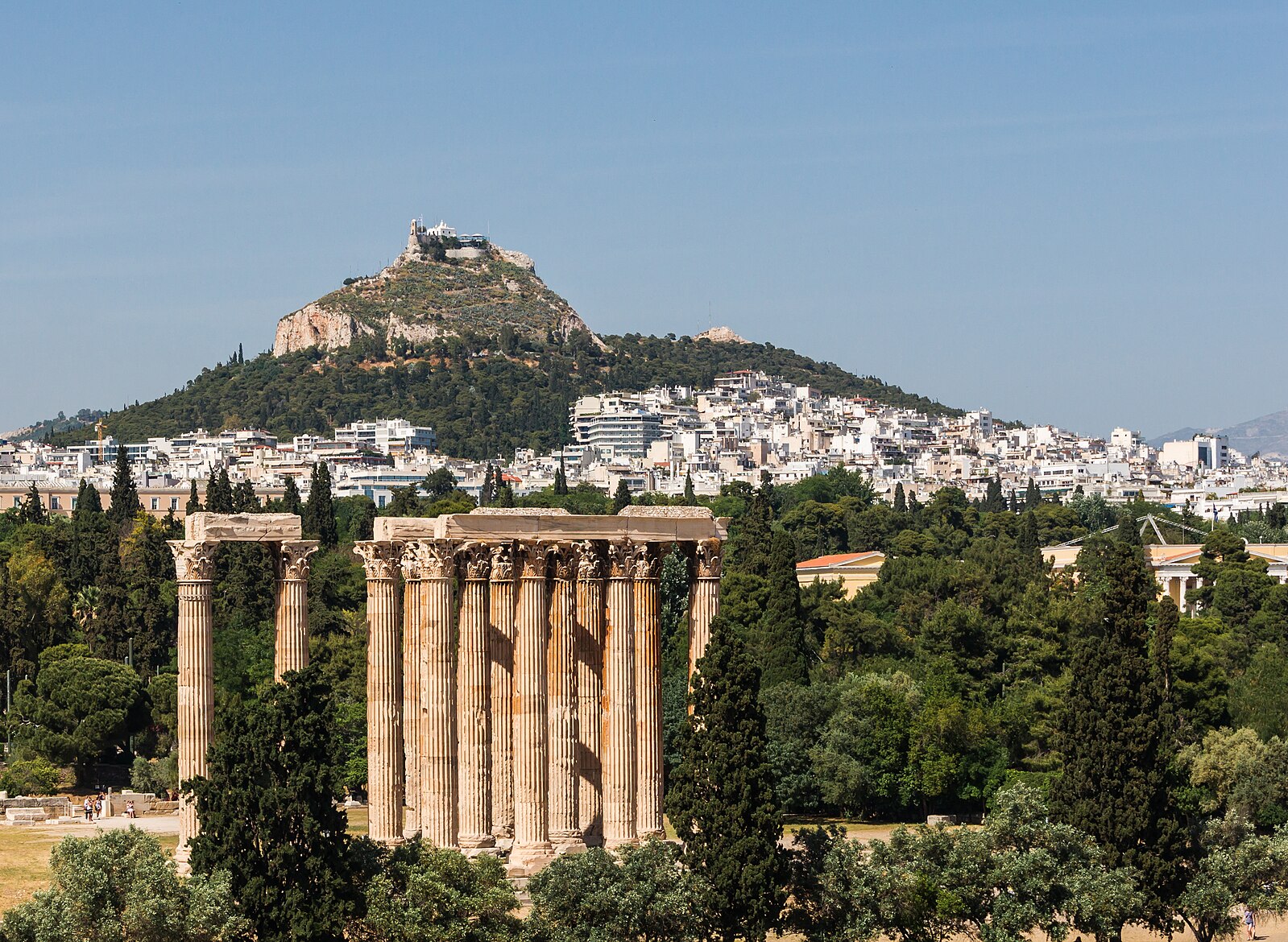 Though they are only ruins today, the Temple of Olympian Zeus is a prime example of the wonders created by ancient Athenian society. (Public Domain)
Pericles’s oration played no small part in this outstanding achievement. The Athenian statesman knew that it’s precisely in dire times that a society’s values need to be articulated clearly. The memory of greatness and the contemplation of higher ideals can make the difference between life and death. They can kindle hope so bright as to make the world withstand fire and rise anew from its ashes.
What arts and culture topics would you like us to cover? Please email ideas or feedback to features@epochtimes.nyc