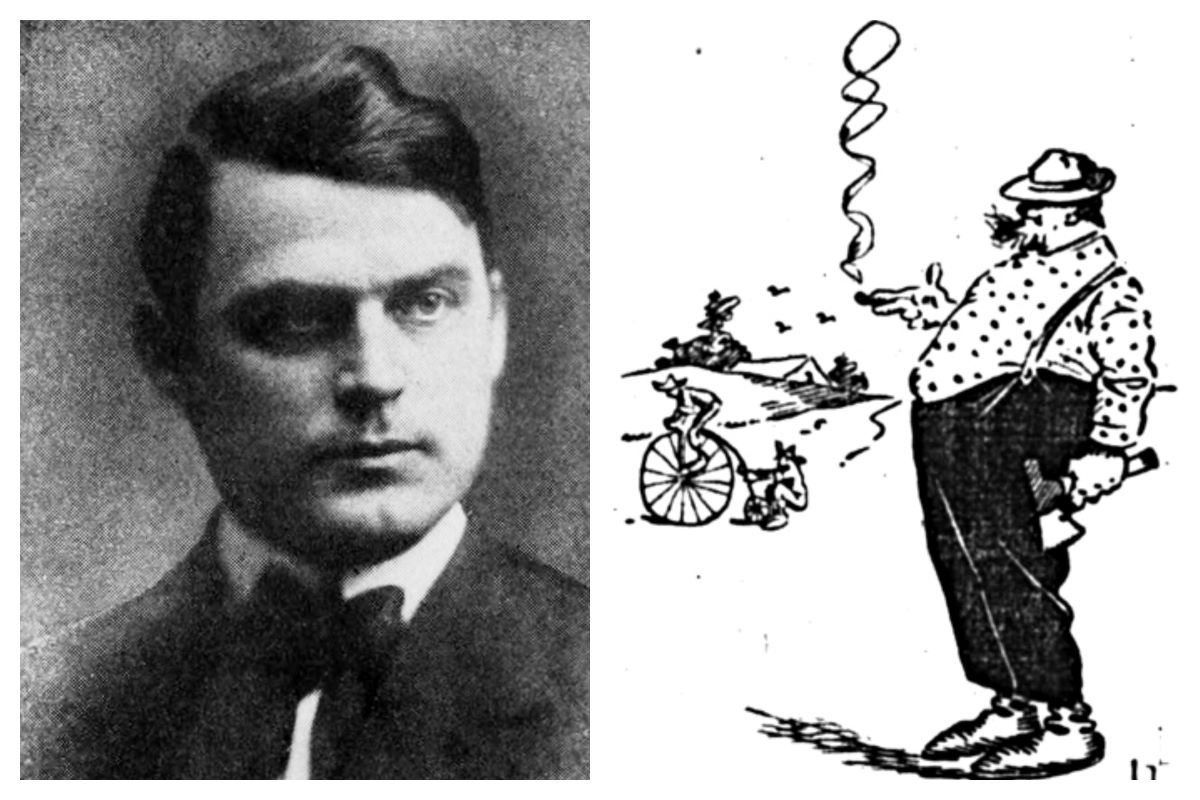
If the Indianapolis News cartoonist and humorist Frank McKinney Hubbard (1868–1930) were alive today, he would probably be a social media influencer or an invited guest on Fox News’s “Gutfeld!”
Hubbard’s pen name was Kin Hubbard, and for those readers unfamiliar with the wisecracking Midwesterner, his primary claim to fame was creating a cartoon of a country bumpkin philosopher named Abe Martin whose homespun opinions were read by millions in more than 300 newspapers. The Indianapolis News was his parent newspaper, and his drawings and observations were so popular that the newspaper published him daily until 1980, 50 years after his death.
Well known humorist Will Rogers was a fan, having once called Hubbard America’s greatest humorist. “Just think—only two lines a day, yet he expressed more original philosophy in ‘em than all the rest of the paper combined,” Rogers once commented.
Hubbard’s “Abe Martin” character usually satirized politicians, but he also opined frequently on social norms and life’s foibles. Hubbard was an adoptive Hoosier who lived in Indianapolis during his two stints with the Indianapolis News. Not unlike fellow Hoosiers, writers George Ade and poet James Whitcomb Riley, ol’ Abe’s musings were uttered in a vernacular ripe with colloquialisms and contractions that appealed to readers.
The Ohio native’s success was even more remarkable considering he had no more than a sixth-grade education and was a self-taught illustrator.
His Start in Art
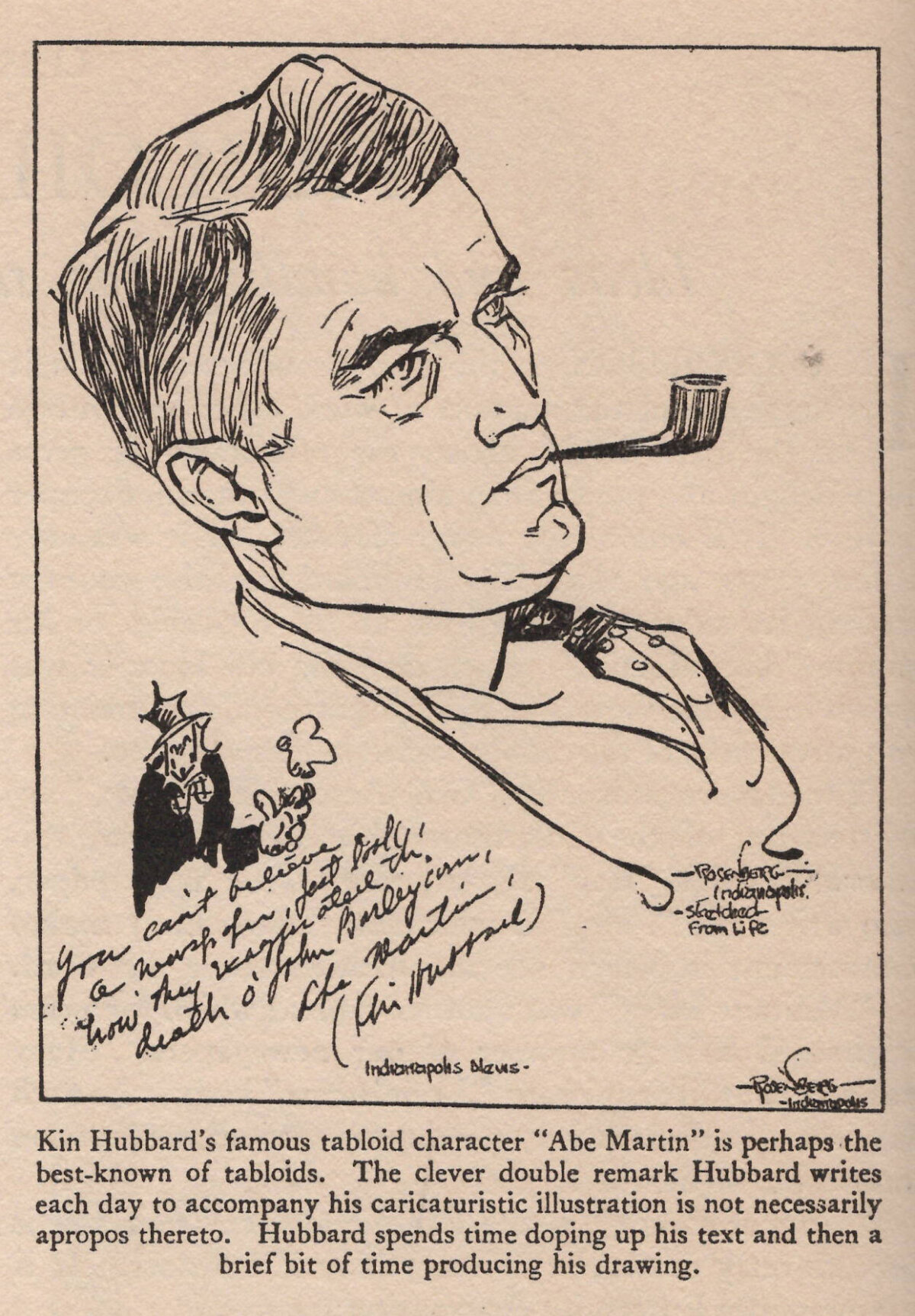
As the youngest of six children raised in Bellefontaine, Ohio, Hubbard displayed artistic talent at an early age. In an autobiographical interview with the Indianapolis News a few years before his death, he said that as a child using scissors, he could cut out from blank paper any kind of animal with unerring accuracy. As gifted as he was artistically, school had little appeal and he quit before finishing seventh grade.
Hubbard’s father, Thomas, was the publisher and editor of the Bellefontaine Examiner. Thomas was a strongly opinionated, dyed-in-the-wool Democrat who once was thrown out of a second-floor window in Dayton, Ohio, for something he wrote during the Civil War.
Politics were front and center in the Hubbard household. Kin’s wife, Josephine, once noted that the family was loyal but opinionated, sharing how family discussions about current events would often grow so heated that the entire family would leave the room, only to gather later in front of the fireplace. Little did any of the family know that the topics of many of those family discussions would one day go viral in the form of a bewhiskered caricature named Abe Martin.
School may not have interested Hubbard, but the theater and circus were passions his entire life. He organized a performance at Bellefontaine’s Grand Opera House and in 1891 shared his theater observations and drawings of it with a friend from Indianapolis. Impressed with the illustrations, his friend shared them with the owner and editor of the Indianapolis News and suggested that Kin apply for a job there. Hubbard was later offered and took the job for $12 a week, though a story appearing in the Indiana Historical Society’s magazine revealed that Hubbard sat in Indianapolis’s University Park for almost a week, working up the courage to apply for a job.
Indy News Parts I and II
As the son of a newspaperman, Hubbard had news ink in his blood, but he also knew his illustration skills were limited. Talented illustrators were in high demand back before the evolution of the modern camera. “I could execute rude, sketchy caricatures that were readily recognized, but I knew nothing of composition, light and shade, and perspective,” Hubbard said in an interview in “Traces of Indiana and Midwestern History.”
His first stint with the Indianapolis newspaper ended in 1894 when he fled in a panic after being asked to draw pictures of detailed restorations of some Indianapolis banks.
Hubbard bounced around Tennessee and Ohio in different jobs the next five years before receiving a job offer in 1899 from the Indianapolis Sun. During his two years there, his confidence grew as he polished his drawing skills. In 1901 he began his second stint with the Indianapolis News, remaining there for the next 29 years until his death at age 62.
His caricatures of state political figures, particularly Indiana legislators, helped Hubbard to establish a following with readers. In 1904, he was part of a press entourage covering campaign trips of Democrat presidential candidate William Jennings Bryan and Republican vice-presidential candidate Charles Fairbanks. After the campaign, Hubbard realized he had extra unpublished material. It was at that point that he invented the rustic and crusty Abe Martin to deliver folksy opinions and satiric one-liners.
“Abe Martin” debuted on Dec. 17, 1904. Abe Martin appeared in 8,000 original cartoons during Hubard’s lifetime, 26 years for the simply dressed, big-footed gentleman. Abe also had a byline every Sunday in a humorous essay series Hubbard wrote and illustrated called “Short Furrows.” Hubbard created nearly 1,000 of those essays through 1930.
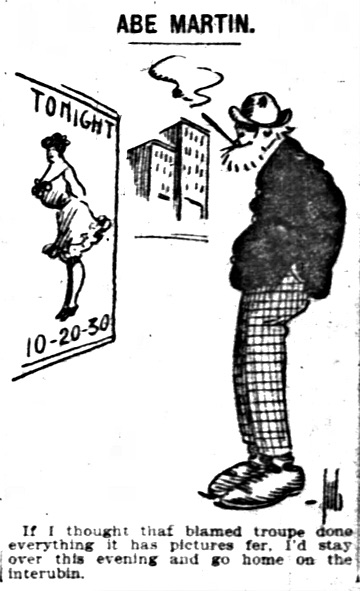
Two months after the cartoon’s initial appearance, Abe announced to readers he was moving to Brown County, an area of Indiana known for its remote location and hilly, heavily wooded terrain. In Hubbard’s time, there was no telegraph or train connections there, so it was a perfect place for Abe and his friends in fictional Bloom Center to express their opinions on current events of the day.
Shortly before Christmas in 1906, Hubbard published the first of what became annual books sharing Abe’s humorous comments, further growing the character’s popularity. More exposure occurred in 1910 when Hoosier humorist George Ade featured Abe Martin in The American Magazine. Syndication offers quickly followed, and, soon, millions of Americans were reading Abe Martin witticisms in their daily newspapers. At one point, there was talk of radio skits featuring Abe Martin, but Hubbard politely declined.
Josephine Hubbard shared during one interview that her husband stayed at the Indianapolis News for so long because the newspaper had been good to him, and he had been good to them. On Dec. 25, 1930, Hubbard shared with his wife and two children that their Christmas together had been the happiest of his life. The next day, he tragically died of a heart attack with his panicked family gathered around him.
Following his death, the Indianapolis News was flooded with tributes. Chicago Tribune cartoonist John McCutcheon published a poignant cartoon of Hubbard’s grieving characters standing reverently outside their creator’s door. Two years after his death, the Indiana Department of Natural Resources renamed the Brown County State Park accommodations as the Abe Martin Lodge. The lodge sits atop Kin Hubbard Ridge and many of the lodge’s guest cabins are named after Brown County characters who appeared in the cartoon.
What arts and culture topics would you like us to cover? Please email ideas or feedback to features@epochtimes.nyc