Lucas Cranach the Elder (1472–1553) was a brilliant and prolific artist of the German Renaissance, adept at painting, printmaking, and creating decorative murals. Steady employment came from successive electors of Saxony, all active patrons of the arts and scholarship: Frederick the Wise, his brother John the Steadfast, and John’s son John Frederick the Magnanimous (John Frederick I). Prince-electors were an exclusive group of German princes allowed to take part in the election of the Holy Roman Empire’s emperor.
As court painter, Cranach made portraits of the electors and their extended families and allies, including leaders of the Protestant Reformation, such as Martin Luther. Additionally, he painted religious and mythological scenes.
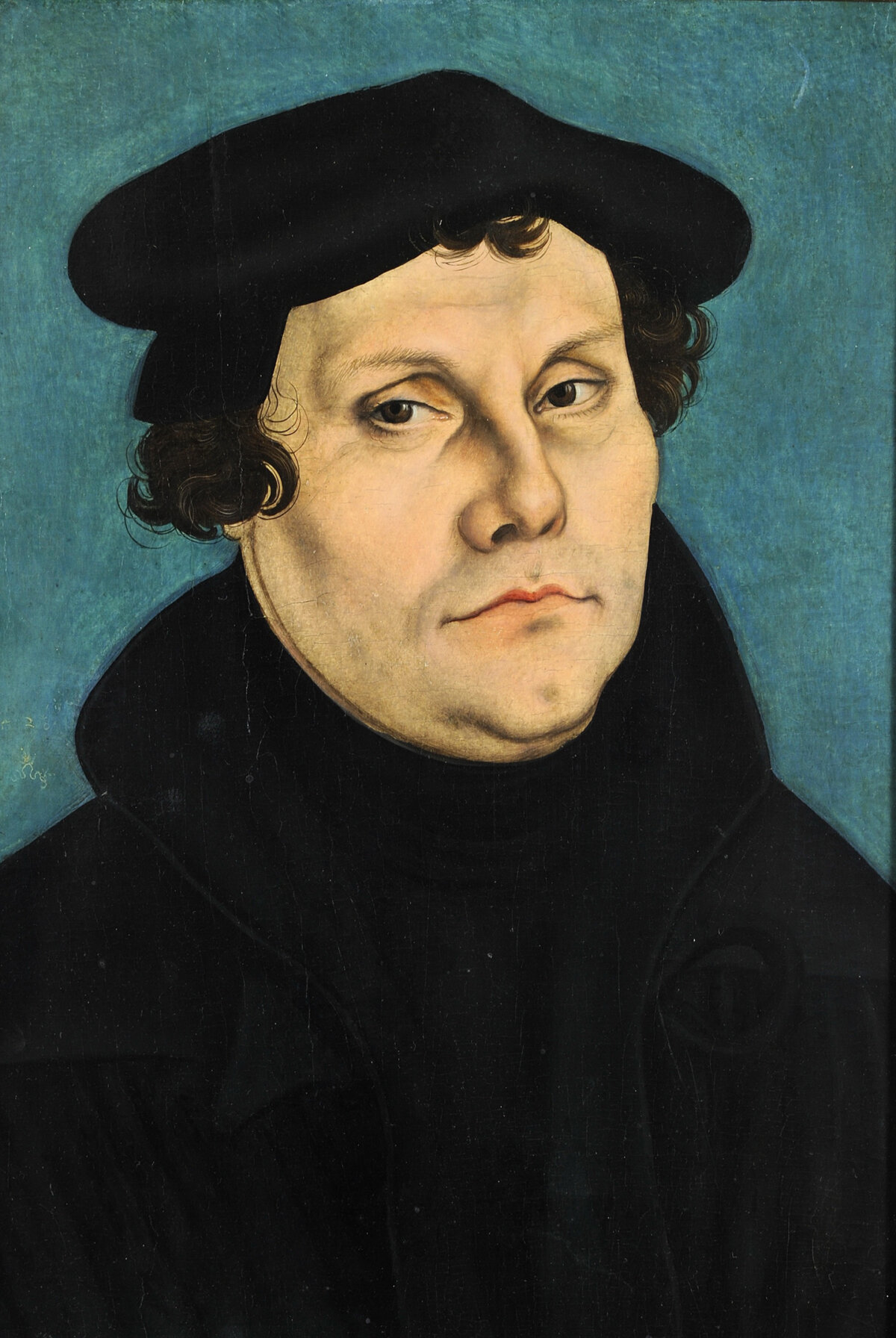
Cranach’s style is striking because of his bold designs, rich color, exacting realism, attention to detail, and skill at incorporating symbolism. These hallmarks are found in his significant works, including portraits of John Frederick and his wife, Princess Sybille of Cleves, along with a court hunting scene.
The Prosperous Painter
The artist was born in the Franconian town of Kronach, from which he took his surname. Art historians assume that his father, a painter, was Cranach’s first teacher. Lucas spent time in Vienna, but by 1505 he was living and working at the Wittenberg court of the electors of Saxony and traveling with them to their various castles.
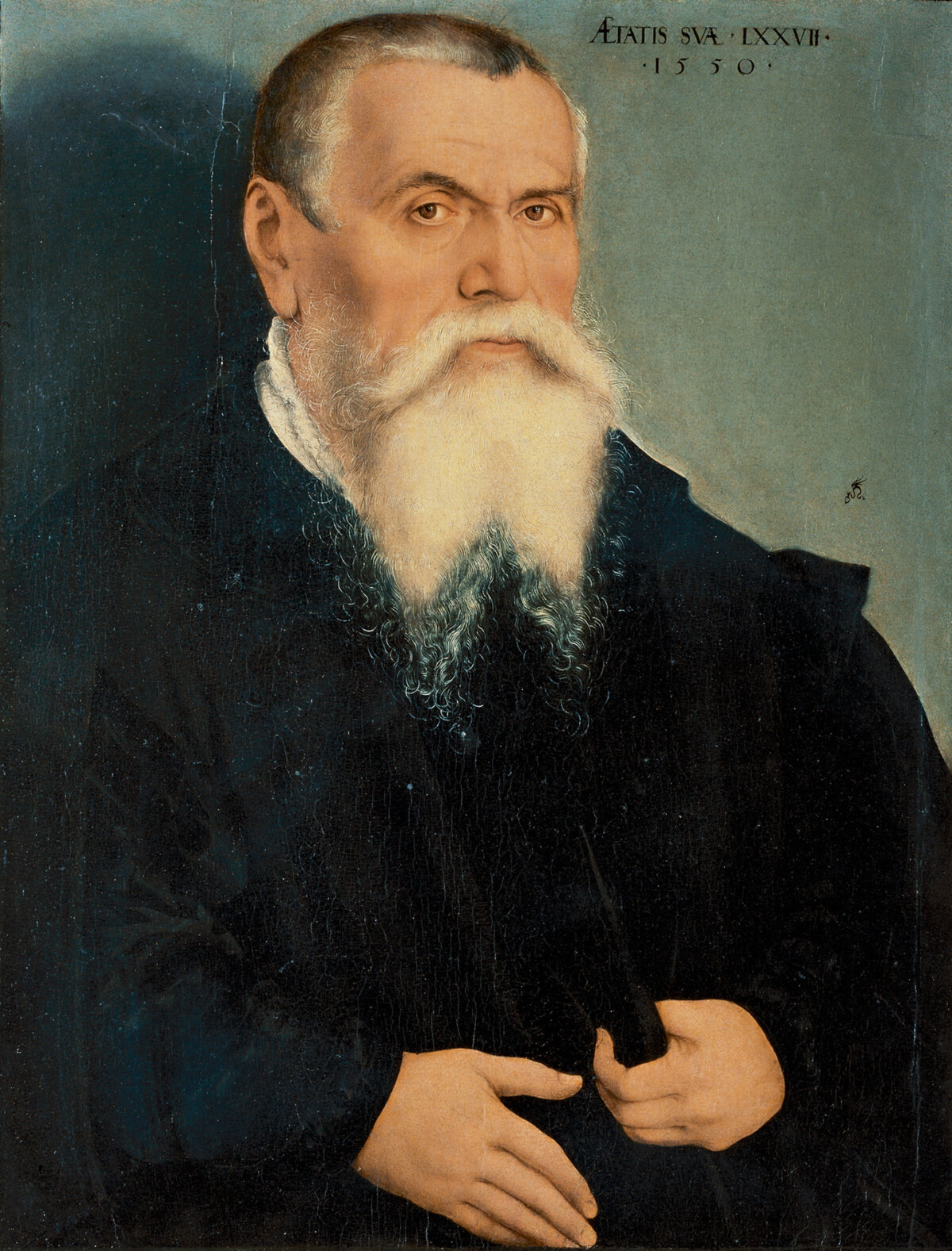
He was successful and prosperous in his professional life, both as an artist and as a leading Wittenberg citizen. He became a member of the town council and burgomaster at different times. Cranach ran a large atelier to keep up with high demand, and over 400 paintings credited to him and his workshop have survived.
The electors John the Steadfast and John Frederick the Magnanimous (John Frederick I) were active supporters of Martin Luther. Cranach became a close friend of the seminal Protestant figure. He designed woodcuts for Luther’s New Testament translation and painted altarpieces for Lutheran churches. The artists and his workshop made many portraits, both painted and printed, of Luther and of Saxony’s ruling family.
Portraits were frequently given as diplomatic gifts, making a large number of the same likeness necessary. For instance, John Frederick once commissioned Cranach to make 60 portrait pairs of the ruler’s two predecessors. The National Gallery in London writes: “It is a notable characteristic of Cranach’s production, however, that subjects were rarely repeated exactly and the quality of different versions was often equally high.”
One of Cranach’s magnificent panel portraits of John Frederick from the 1530s appeared on the auction block at Christie’s in April 2018. It had been missing for nearly 80 years, presumed lost or destroyed. The last known owner was the Dutch banker and prominent art collector Fritz Gutmann. Since Guttmann was of Jewish descent, his collection was looted by the Nazis during World War II, and he was murdered in a concentration camp.
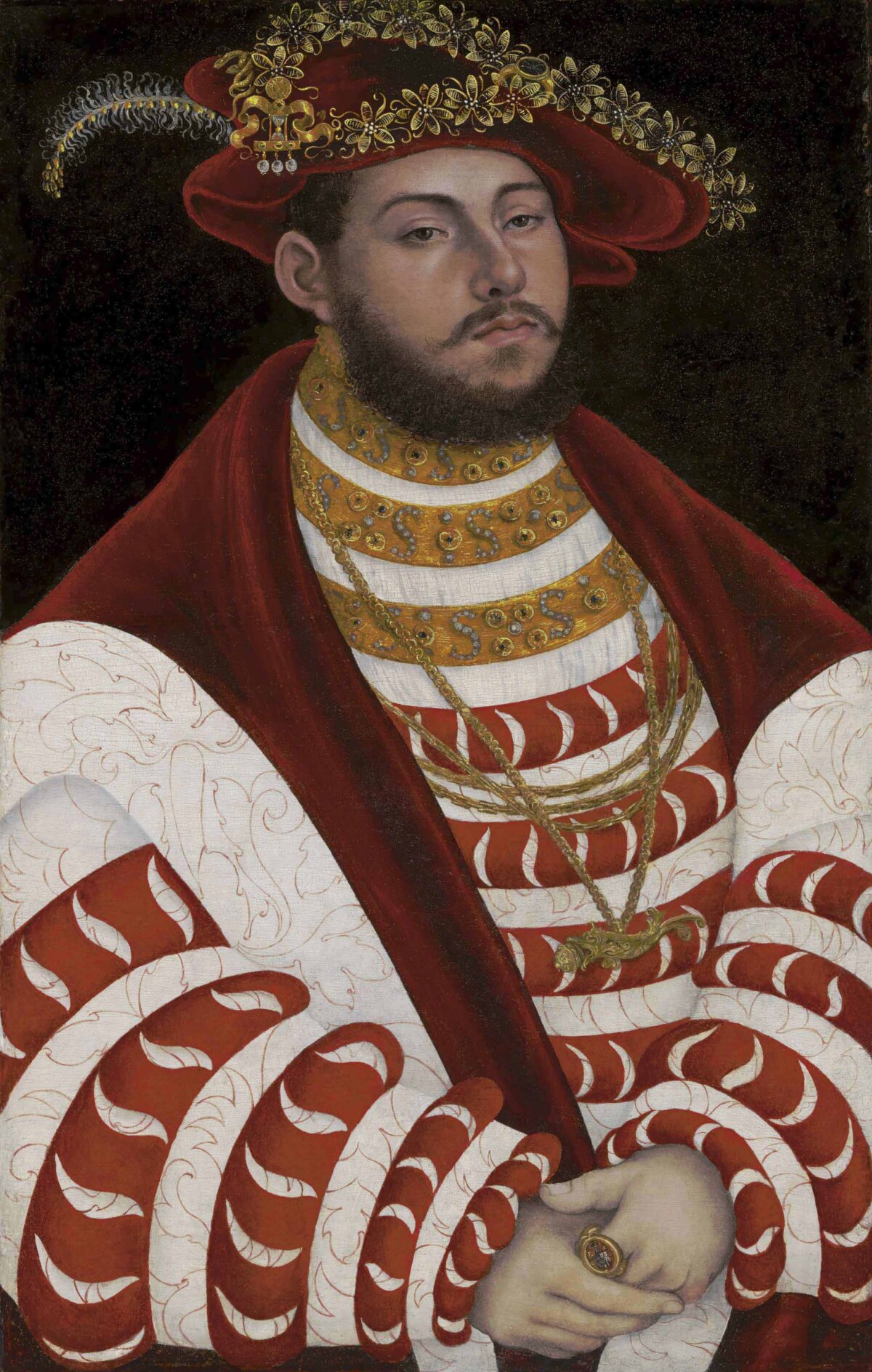
The fate of the half-length portrait of John Frederick, elector of Saxony (1503–1554), and much of the Gutmann collection was unknown after the war. His children and later their heirs worked with restitution agencies and lost-art databases, searching for their family’s property. Its location was discovered only in recent years. The Cranach portrait had ended up in a private American collection. The owners approached Christie’s and acknowledged the painting’s Nazi provenance. This led to the auction house arranging a settlement agreement between the Gutmann heirs and the owners, allowing the painting to be put up for sale. With an estimate of $1 million to $2 million, it sold for $7.7 million.
This portrait is considered one of Cranach’s most refined portrayals of John Frederick, who radiates power and confidence. The work’s outstanding brushwork has led experts to believe that Cranach created the entire painting without studio assistance. The half-length composition, three-quarter profile pose, and cropping at the left and right edges that further the impression of commanding monumentality are all classic Cranach.
The elector’s luxurious clothes and accessories reflect his wealth and social status. Christie’s catalog notes that he wears “a doublet accented with bands of red silk fashionably slashed to allow the embroidered white fabric beneath to peek through.” His jewels include three gold collars at the top of the doublet that are adorned with sapphires and pearls and feature “S” motifs.
John Frederick wears four additional gold chains. The most prominent one has a pendant of a dolphin. Within the sea creature’s jaws is a pomander, or perforated perfume container. The pomander may also have been used as an ear pick, toothpick, or a whistle. Further jewels—enameled flowers, a hat badge, a ring, and entwined serpents—are visible on his burgundy velvet hat. The ring on his right index finger, emphasized by his clasped hands, appears to be ornamented with the Saxon coat of arms.
Sibylle of Cleves
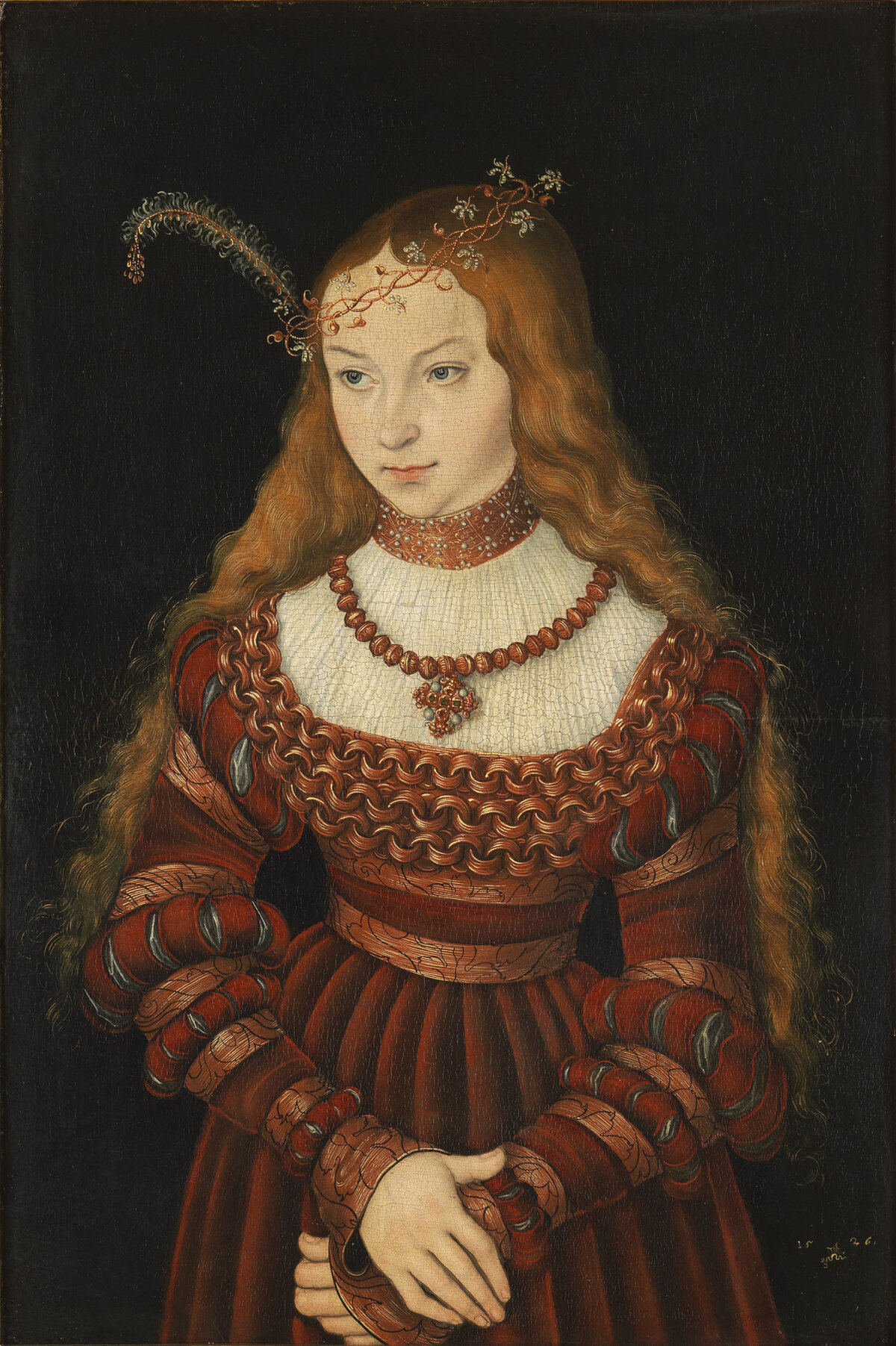
During John Frederick the Magnanimous’s betrothal to and marriage with Sibylle of Cleves (1512–1554), Cranach painted multiple portraits of her. She was the eldest daughter of the duke of Cleves and sister of the infamous Anne of Cleves, fourth wife of King Henry VIII. Ten years before Christie’s sold the restituted Cranach portrait of her husband, it auctioned a beautiful 1526–1527 portrait of the princess for $7.6 million. According to Christie’s, it was painted during her betrothal period, when she was just 14 years old. This is suggested by the jeweled and feathered wreath that she wears. The custom was for brides to present such circlets to grooms at their engagement and wedding ceremonies. Brides, like Sibylle in this portrait, wore their hair loose and uncovered except for the wreath.
Sibylle’s positioning is similar to that of her husband in the Christie’s painting. Set against a dark background, she is also in a three-quarter-length pose, slightly tilted, with clasped hands at her waist. In the catalog note, Christie’s observes: “Every aspect of these portraits, from the fabrics and jewels to her hair and her pose, had some significance to the contemporary viewer. … Not all of the iconography is decipherable today.”
Discernible symbols denote that the House of Saxony included the gold fabric patterned bands around her sleeves and waist, along with the three hefty chains at her chest. The pendant she wears hanging from a necklace has letters that unite her family’s name with that of her husband.
Painting of the Hunt
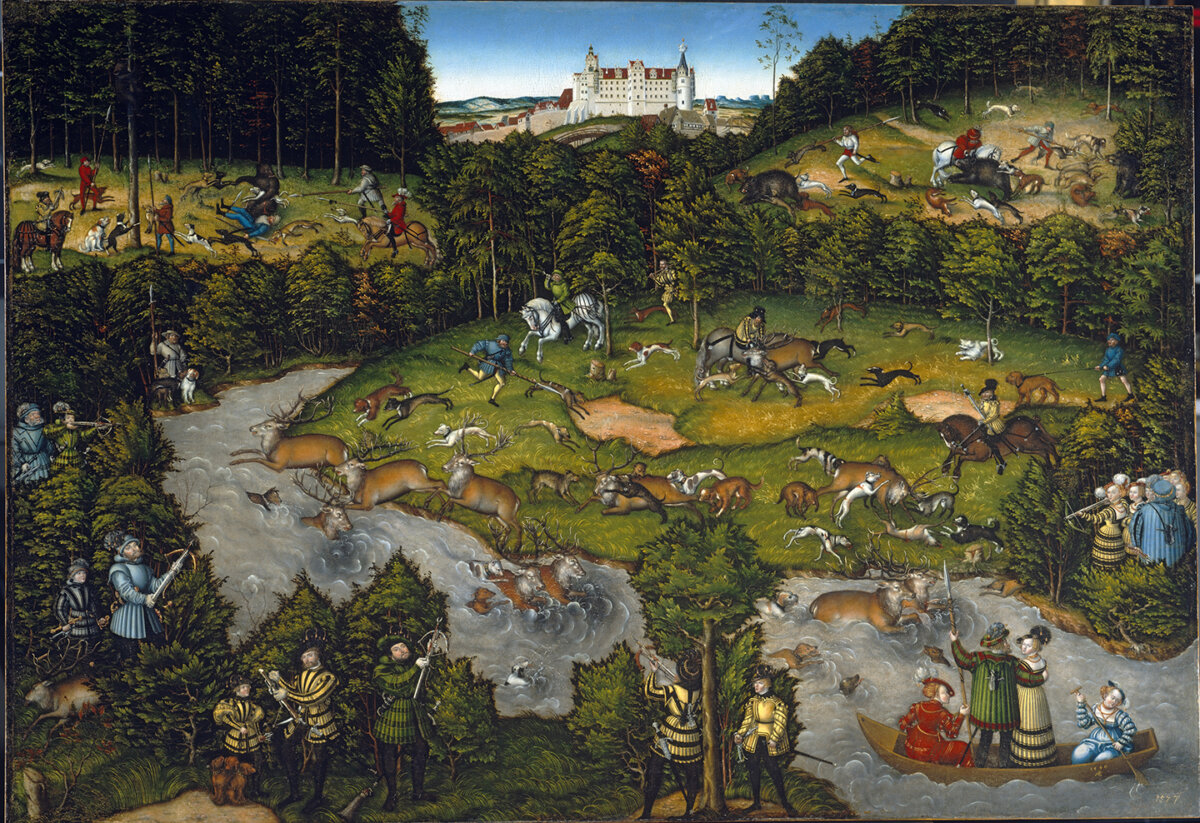
In addition to portraiture, Cranach was renowned for his depictions of animals and hunts. The electors were enthusiastic hunters, and the artist frequently joined these expeditions, bringing with him a drawing book. One of the resplendent works that Cranach made on this theme is the Cleveland Museum of Art’s “Hunting Near Hartenfels Castle” from 1540. The bustling landscape features lush forests, clearings, and a sinuous river. It is the site of three distinct hunting parties that are all overlooked by the luminously portrayed Hartenfels Castle, one of the residences of the electors of Saxony in eastern Germany.
At the top left, Cranach shows a bear hunt. One of the bears can be seen up a tree while the other has a hound under its foreleg. A boar hunt can be seen at the upper right, while the middle of the painting and the foreground feature an elaborate stag hunt with courtiers on horseback and on foot.
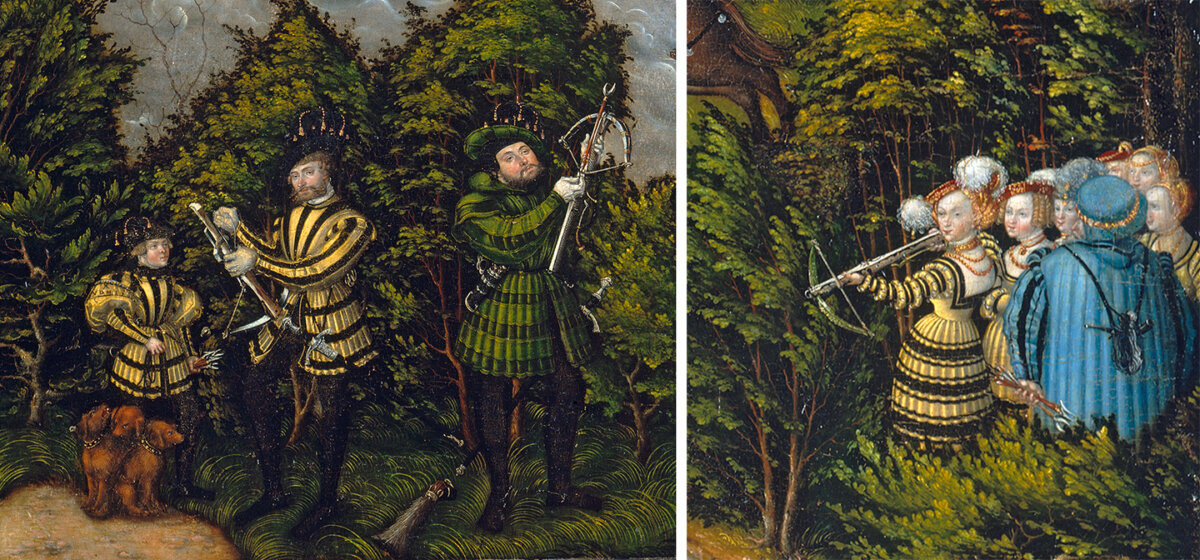
Art historians identify John Frederick as the man at the lower left wearing green as he spans his crossbow. The boy in yellow with three dogs at his feet is one of his sons. Electress Sibylle stands in the brush at the right, about to take the first ceremonial shot. Cranach illustrates a variety of weapons, including ceremonial spears and crossbows, and they are all meticulously realistic.
This painting stayed in the royal collection, first at Hartenfels Castle and then Castle Moritzburg, until the 1950s. It is believed that this work was gifted to John Frederick’s cousin, Duke Maurice of Saxony (1521–1553), a member of a rival branch of the family. John Frederick and Maurice’s relationship was strained.
In 1546, long simmering tensions and clashes between the Catholic Emperor Charles V and John Frederick, leader of the Lutheran alliance known as the Schmalkaldic League, came to a head. Maurice betrayed his Protestant allies and cousin. Supported by Charles V’s armies, he attacked John Frederick’s lands.
John Frederick was taken prisoner in 1547 and condemned to death by the emperor. His sentence was commuted to life imprisonment upon his agreement to cede his territories to Maurice. Cranach joined him in exile. In 1552, after Maurice turned against the emperor, John Frederick was released from prison. He reestablished the Saxon court in the city of Weimar, and Cranach followed him there.
Cranach did not live much longer; he died in 1553. While John Frederick’s sons went on to become dukes of Saxony, Saxe-Weimar and Saxe-Gotha respectively, the title of Elector of Saxony was maintained by Maurice’s branch of the family. A year after Cranach’s death, John Frederick died. How fitting that the end of the immediate family’s holding of the title coincided with Cranach’s own passing, as the artist had captured the heyday of their court.
What arts and culture topics would you like us to cover? Please email ideas or feedback to features@epochtimes.nyc