



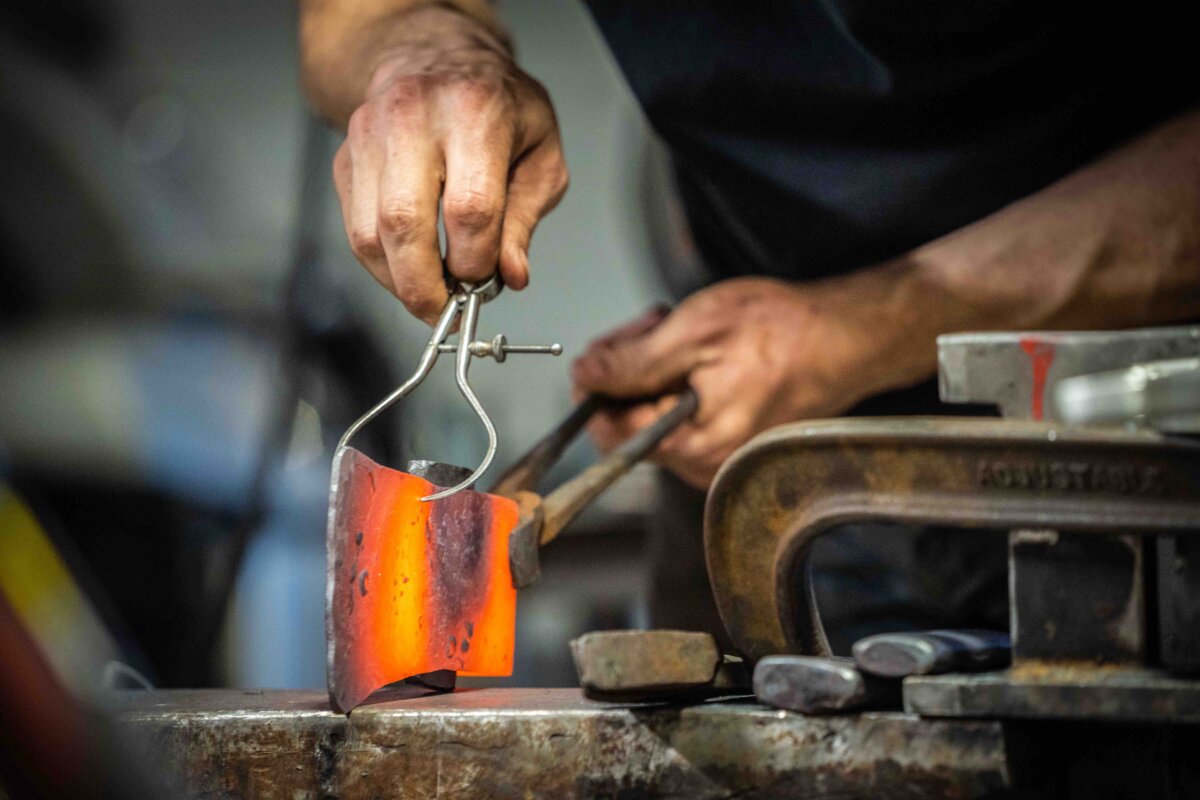
Axe-making company Brant & Cochran was dreamed up by a few good friends over a glass of whiskey. Around 10 years ago, Steve Ferguson’s godson was heading to forestry school. While sitting with his brother Mark Ferguson and their friend Barry Worthing and enjoying a few drams of single malt Scotch, Steve lamented about not being able to find a good American-made axe to give his godson as a high school graduation present. So it was decided: The three men would found their own axe-making firm, right there in Maine.
The state is a vital location for forestry in the United States. Maine employs thousands of professional foresters and arborists. The trio reasoned that their products might also find traction with folks camping, canoeing, and anyone wanting a high-quality axe to use around the wood stove, hearth, or backyard fire pit. Steve and Mark’s grandfather had been a legend in the tool trade, and the brothers dearly wanted to continue his legacy.

Leland Ferguson was a master mechanic in the Detroit automotive industry during World War I. Post-war, he started a business buying and restoring Army surplus machine tools, selling his wares to vehicle makers and their suppliers. That business came to be known as Brant & Cochran.
“The branding for our company is taken from a pack of Brant & Cochran matches found in one of Grandpa’s toolboxes,” said Mark, now the company’s president and co-founder. “Who needs graphic artists when you have Gramps?”
Axe-Making Legacy
Maine was once the axe-making capital of New England. From the late 1800s through World War II, the town of Oakland produced tens of thousands of axes every year. On a mission to match the original product’s unrivaled quality and craftsmanship, Steve, Mark, and Barry set out their nonnegotiables.
First, only American 1045 carbon steel, milled in New York or South Carolina, is used for the axe heads.
“Our biggest challenges were finding U.S. steel distributors to cut and sell us steel in relatively small quantities,” Mark told American Essence. “They were used to selling train carloads of steel. We need loads that can fit into my car every month!”
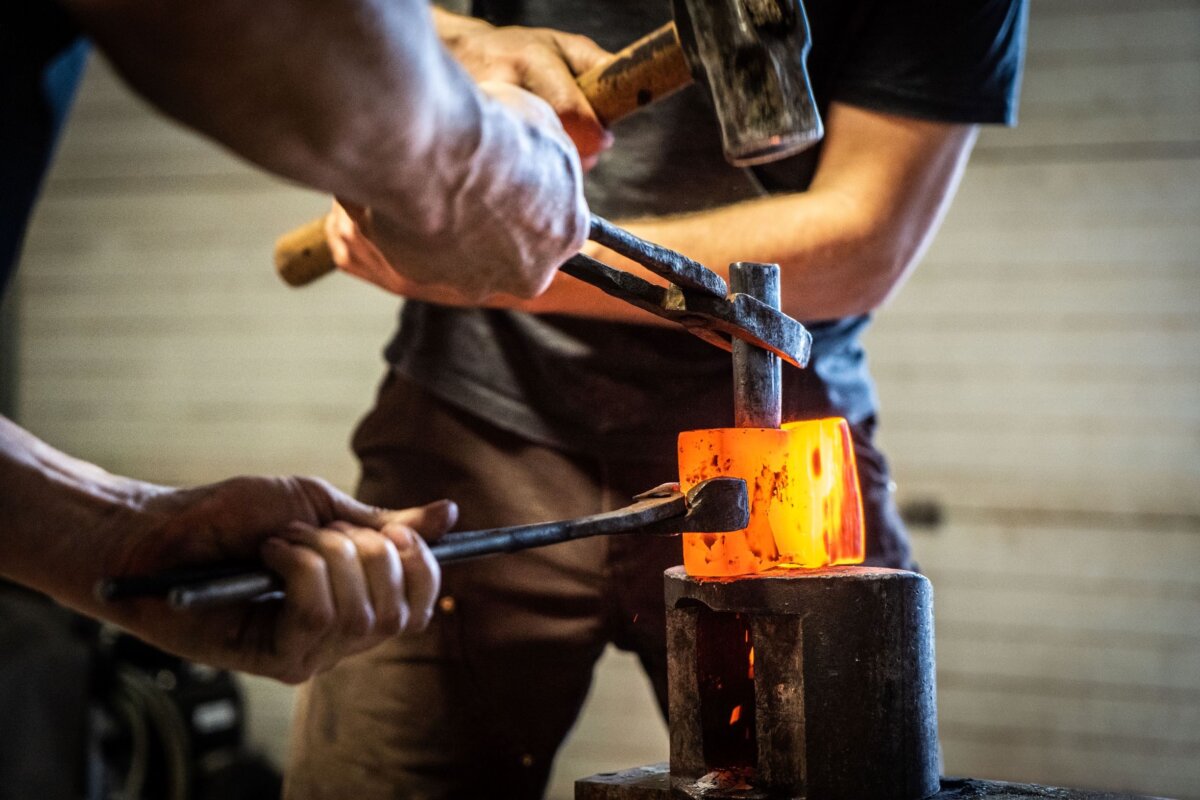
After numerous calls, emails, and meetings, the team finally discovered a steel distributor who wanted to help them bring craft axe making back to America. They also partnered with a small company in Indiana for hydraulic press design.
Secondly, each axe is made on-site at their shop in South Portland, Maine. This meant recruiting “skilled makers who were willing to take a chance on this crazy idea, and flexible enough to try, fail, and try again until we got it right,” Mark said.
With the help of the maker community in Maine, they found skilled blacksmiths and machinists.
Another essential was that the axe handles be made of strong, durable hickory wood. For this purpose, the trio reached out to skilled workers from an Amish community in Ohio who turn the wood to a Brant & Cochran-designed pattern. The custom leather sheaths that protect the blade are made in Maine.
1,500 Axes per Year
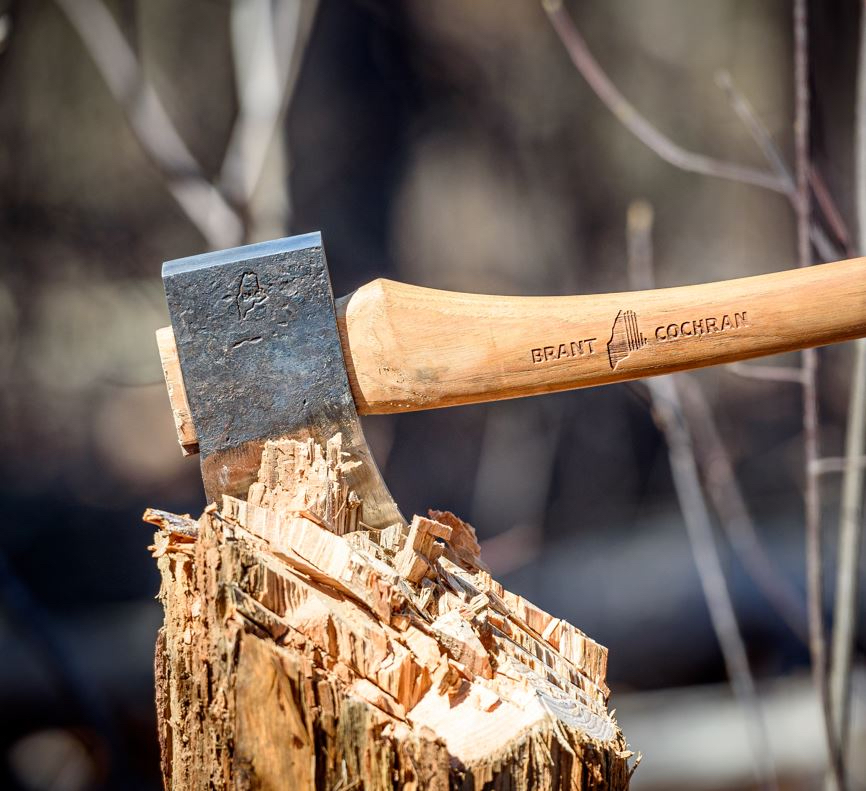
The small company’s axes—each handmade one at a time—couldn’t be more authentic. The head of the Allagash Cruiser, for example, is modeled off a Maine-forged axe from the 1930s that was borrowed from the Patten Lumbermen’s Museum. Brant & Cochran’s take on a traditional Maine wedge pattern camp axe, highly prized for its ability to chop wood, is produced following a rigorous process.
A billet of 1045 carbon steel is heated to a forging temperature of approximately 1,900 degrees Fahrenheit in a gas or induction forge before an eye for the handle is punched with a hydraulic press. Then, a hydraulic press or power hammer is used to fuller out the axe head, and the axe head is ground to its final shape. Then, it’s heat-treated to extreme hardness, sharpened, and hafted onto the handle. Every axe is guaranteed for life.
“Manufacturing is baked into the DNA of America,” Mark said. “While we don’t manufacture as many things here anymore, there is still a hunger to make quality products with your hands.”
This article was originally published in American Essence magazine.
