
In the middle of London, there are four small enclaves, or cities-within-a-city, called the Inns of the Court. They are the places where some of the top members of the English bar and judiciary learn English law and reside; these are small pockets of high society heavily steeped in traditions, rituals, and history.
Sir Gabriel Ward is an Edwardian (1901) barrister who has lived the majority of his life within the confines of one of these Inns of the Court, called the “Inner Temple.” It’s a collection of stately and grand buildings that have become Ward’s home and his sanctuary.
Meticulous, highly intelligent, reclusive, and insightful, Ward is a “tortoise-like” man of unwavering habits and oddities, such as closing his front door three times or ensuring the pencil on his desk always points to the window.
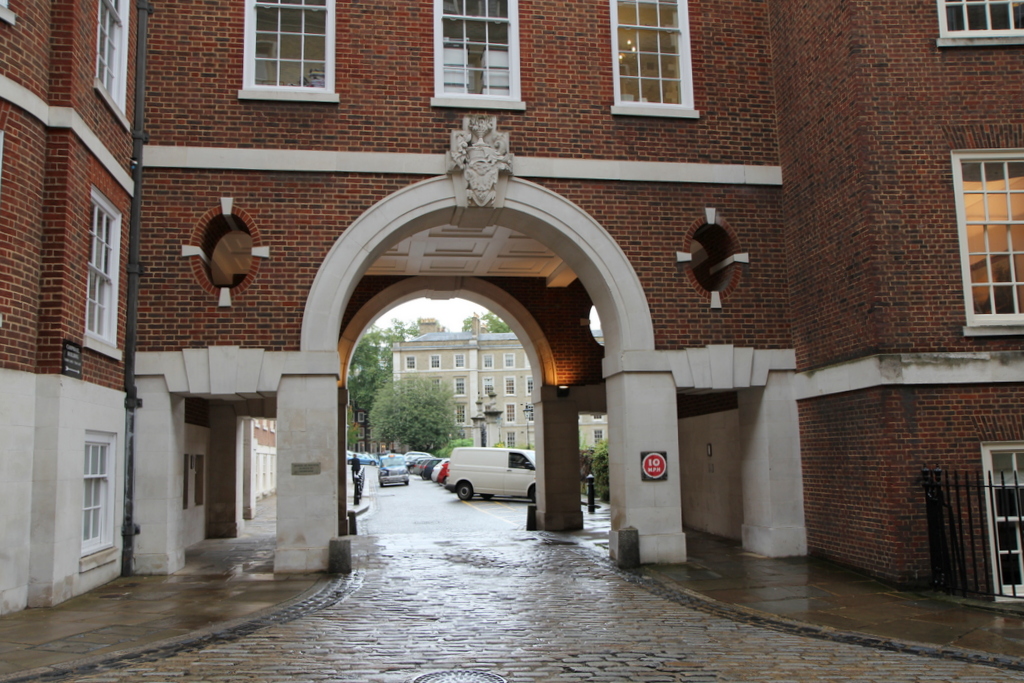
Ward takes great pleasure in keeping his routine precise and his environment unwavering. He hasn’t ventured outside the Inner Temple for many years and has no desire to do so, either. Not so interested in the pursuit of truth or of justice, per se, Ward “had only an immense respect for the rule of law and for the necessity for precision in its application and certainty in its results.”
But there’s nothing like finding a dead body on the steps of your office to sabotage your carefully curated routine.
The Higher They Rise
The body turns out to be none other than Lord Norman Dunning, the lord chief justice of England, whose career and personal life were “uncontroversial [and] unimaginative … the very last sort of man to be murdered.” Nevertheless, one early May morning finds him lying barefoot on the doorstep of Ward’s chambers in Crown Office Row, dressed in evening attire with a carving knife from the Inner Temple kitchens embedded in his chest.
Ward is one of the first people to discover the corpse; in fact, he almost trips over it. After giving his statement and a few insights to a young but bright constable named Wright, he desperately hopes to return to his standard routine. But there is worse to come. The Temple’s governing Master Treasurer, Sir William Waring, soon presses him into discreetly investigating the murder, then passing his findings on to the police.
Why? The Courts of the Inn are actually outside the laws of London, “exempt from all civil and ecclesiastical jurisdictions and governed by its own parliaments,” much like the Vatican in Rome. Rather than having a bunch of grubby policemen poking their noses into their world, or worse, questioning the tradition of judicial independence of the Temple, Waring instructs Ward to solve the case in a week.
Ward tries to refuse, explaining that his current case is quite complex and requires his entire attention, but Waring threatens to revoke the lease on his home if he doesn’t comply.
A Tricky Mouse Problem
The case Ward must put aside is indeed a complicated knot to untangle. Four years previously, a local publisher of law books, Herbert Moore, received a manuscript for a children’s book titled “Millie the Temple Church Mouse” by Harriet Cadamy, but with no contact information attached. Moore’s daughter adored the book, and he ended up publishing it on a lark.
“Millie” becomes a sensation, making Moore a fortune in book and merchandising sales. Early on, he had made a few attempts to locate the mysterious author named Cadamy, but came up empty.
Then, a woman surfaces, named Susan Hatchings, who claims to be the author (writing under a pseudonym) and sues Moore for ownership and damages. If her claim is valid, Moore could be ruined both financially and socially. It was the kind of case Ward relished, but under threat of banishment from the Temple, he reluctantly begins investigating Dunning’s murder instead.
When Moore decides on his own to visit the supposed author in Scotland, she’s not at all what they expected, and it throws the whole case into confusion.
‘Downton Abbey’ Fans Rejoice
Sally Smith’s “A Case of Mice and Murder” is an absolute treasure of crime fiction. The Inner Temple is a setting so removed from the everyday world that the book could almost be called speculative fiction. It’s also a fantastic escape opportunity, a chance to experience a lost world of English high society where the rules of tradition and order are paramount.
The author herself “spent all her working life as a barrister and later King’s Counsel in the Inner Temple.” She’s also written a biography of a famous Edwardian barrister named Sir Edward Marshall Hall, KC (King’s Counsel) and has since retired from the bar to write full-time. That kind of firsthand insight into the environment and the period is invaluable for creating a series like this, and it shows on every page.
Fans of “Downton Abbey” would likely be very keen on Smith’s “A Case of Mice and Murder: The Trials of Gabriel Ward.” Like that famous TV series, Smith’s characters are richly detailed. There is a potent mix of eccentricities, noble leanings, hubris, foolishness, and earnestness that transcend all strata of society.
The mystery itself is also well constructed and had me guessing until the big reveal. Witty, enrapturing, and brilliant.
‘A Case of Mice and Murder: The Trials of Gabriel Ward’
By Sally Smith
Raven Books: June 17, 2025
Hardcover, 336 pages
What arts and culture topics would you like us to cover? Please email ideas or feedback to features@epochtimes.nyc