In my last two articles in this series, I focused on three discrete, less well-known lines from Shakespeare and then three from Milton and sought to explain why the lines were so brilliant. Now, I’ll focus on three lines from less famous poets; each captured something of the genius of poetry to reveal something of beauty, mystery, or grace.
An Insight Into Beauty
John Cleveland (1613–1658) was a Cavalier poet who fought for King Charles I during the English Civil War. His works were extremely popular during the 17th century, with some works having more than 20 editions. By the 18th century, however, he was considered one of the metaphysical poets, identified as abstruse, and his works fell out of favor. But his poem “To Prince Rupert” (also known as “Rupertismus”) deserves to be more widely known.
It contains the following great line:
Beauty, like white Powder, makes no noise
If we take this line as it stands alone, beauty and white powder have, seemingly, no connection. However, at the Stuart court, women commonly used powdered lead (white lead known as ceruse) as a cosmetic. It produced a smooth, pallid look but was also toxic—eating away at the skin beneath. Beauty, then, is deceptive: a false face.
“White powder” might also refer to gunpowder because the English Civil War was ongoing at the time. Gunpowder makes no noise—sits inert in stillness, quiet until it is ignited. No noise, silent, but beauty like the painted face, like gunpowder, can destroy lives.
Here is the rest of the couplet that completes the sense:
And yet the silent Hypocrite destroys.
Notice the marvelous word “hypocrite” and the paradox inherent in its use. A hypocrite says one thing but does the opposite. Beauty says nothing, is silent, but seemingly promises us something that leads to destruction. Beauty is fascinating, irresistible, and also addictive.
To a contemporary reader, the phrase “white powder” inevitably evokes drugs—heroin or cocaine—with their lethal allure. Obviously, Cleveland did not have that connotation in mind, but poetry is never sealed off from later echoes. A modern reader can hear that dangerous association, amplifying the original sense of beauty’s “silent” but deadly power.
This association shows one of poetry’s enduring strengths: Lines can accumulate new resonances over centuries, even while holding onto their historical meanings.
Toward the Unknown
Edward Thomas (1878–1917) is another poet associated with war, but this time, the Great War, or World War I as it finally came to be known. He was killed at Arras, France. He is probably best known for his productive friendship with Robert Frost. Both advocated for natural speech rhythms in metrical verse, and both produced works of astonishing originality.
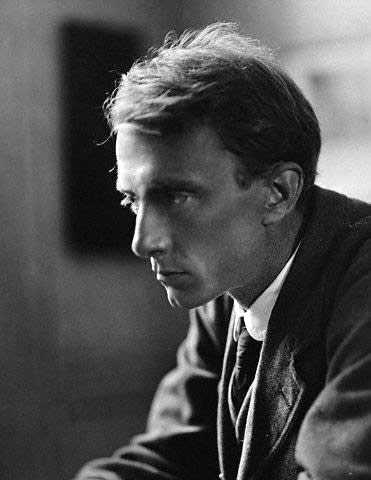
One line that particularly stays with me—haunts me—I first encountered in school when I was only 13 years old. That teacher (a Mr. Thomas by a nice coincidence) in that year turned me on to poetry. In Thomas’s poem, “Old Man,” the final line is:
Only an avenue dark, nameless, without end.
The poem is about an herb called Old Man, also paradoxically named Lad’s Love, and its smell and certain memories from the past. In particular, the poet attempts to remember when he first noted the bitter scent from this specific herb.
The last stanza that includes the line is:
I have mislaid the key. I sniff the spray
And think of nothing; I see and I hear nothing;
Yet seem, too, to be listening, lying in wait
For what I should, yet never can, remember:
No garden appears, no path, no hoar-green bush
Of Lad’s-love, or Old Man, no child beside,
Neither father nor mother, nor any playmate;
Only an avenue, dark, nameless, without end.
But nothing comes of his trying to remember, and the effort assumes a much wider sweep. It’s as if attempting to summon up the one memory constitutes all of our past remembrances past remembrance. But there is no garden (perhaps Eden), no child, no father, no mother, no friend even. All there is, is that mysterious last line.
The line is all the more haunting because it was in one of the last poems he wrote before dying and so seems prophetic: He names the void into which he himself was about to step.
Consider the line’s elliptical closure: how it is spare, almost fragmentary, with its lack of verbs and conjunctions. The effect is of incompletion, echoing the very unknowability it describes. The monosyllables (“dark … end”) give the line a blunt finality. They fall with heavy stress, like tolling bells.
Unlike Cleveland’s intellectual wit, Thomas achieves profundity through stark simplicity. Seemingly, we cannot remember enough, and at the heart of this failure to remember is this frightening and mysterious avenue.
The Yoke of God
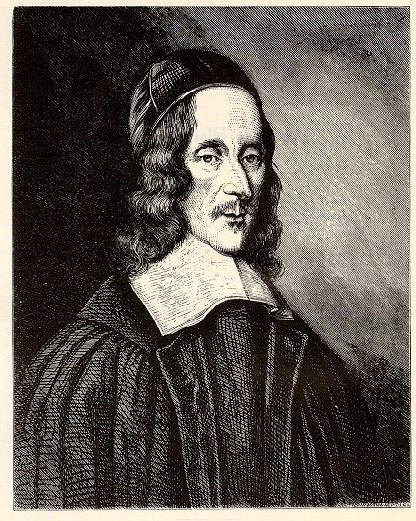
Finally, my third line and third poet, George Herbert (1593–1633), is a particular favorite of mine. Only last month, I visited the church in Bemerton (near Salisbury, England) where he was the rector till his premature death from consumption at 39.
The line comes at the end of possibly my favorite of all his poems: “The Collar.” The final four lines of the poem lead to the virtually anticlimactic last line:
But as I raved and grew more fierce and wild
At every word,
Methoughts I heard one calling, ‘Child!’
And I replied, ‘My Lord.’
The whole poem is one “wild” invective against the yoke of God: Why should the poet not be free to enjoy himself and do whatever he likes? Priests wear a clerical collar—what in England is called their “dog collar”—and God holds the poet by that collar, as it were, in total check and control.
The poet’s raging against God also indicates a second meaning; a homophone to collar is choler. “Choler” in early modern English refers to fury, hot temper, or bile (one of the four humors). The poem is a torrent of anger: The speaker raves, rages, and grows “more fierce and wild.”
Herbert’s title, then, operates as a double pun: The “collar” is the constraint by duty, and it’s also describing the “choler”—the very rebellion itself, his tempest of anger—against the collar.
But the miracle of the poem is that both are overcome in the last two lines. The rage (choler) collapses, and the yoke (collar) is reaccepted—but not as a burden. It becomes instead the bond of love, as the voice of God calls “Child,” and the poet replies “My Lord.”
Notice the sheer simplicity of the resolution: God initiates with his call, but the poet’s innocent, childlike response seals and resolves the whole storm. The language with its quiet, yet emphatic meter, could not be simpler.
The Power of Poetry
Three different lines from three different poets work in different ways to achieve their effects. Cleveland works through barbed wit and paradox. His line on beauty and white powder jolts us with an unexpected comparison, laced with satire (gunpowder, cosmetics, and, for us, drugs). It dazzles intellectually and leaves us wary: Beauty is subtle, silent, dangerous.
Thomas ends not with resolution but with open-ended mystery. “Dark, nameless, without end” offers no closure, only the abyss of memory and mortality. His line haunts precisely because it refuses to resolve, leaving us in silence.
Herbert differs from both: His title itself is a pun (“The Collar,” “The Choler”) that contains the whole drama—rebellion and constraint, anger and submission. Unlike Thomas, Herbert does resolve his issue: the divine voice calls—grace—and the poet replies. Here, wit and rage are transfigured into graceful reconciliation.
What one line from a poet speaks to you with such imaginative power as these three clearly do to me?
What arts and culture topics would you like us to cover? Please email ideas or feedback to features@epochtimes.nyc