




“Romeo and Juliet,” sometimes characterized as an immature tragedy by William Shakespeare, is in fact a wise, complex work about immaturity: immaturity both as the beautiful beginnings of young love and immaturity in the pejorative sense, as a tragic family feud, governed by anger and nurtured by hatred. While it’s a story about true love with much beauty, it’s more than that. It cautions against hatred, which has a special power to warp good things like love and virtue. Understanding this helps audiences leave their own resentments behind.
The Prologue’s Summary
The Bard provides a genuine, balanced understanding of the whole play in the Prologue:
Two households, both alike in dignity
(In fair Verona, where we lay our scene),
From ancient grudge break to new mutiny,
Where civil blood makes civil hands unclean.
From forth the fatal loins of these two foes
A pair of star-crossed lovers take their life;
Whose misadventured piteous overthrows
Doth with their death bury their parents’ strife.
The fearful passage of their death-marked love
And the continuance of their parents’ rage,
Which, but their children’s end, naught could remove,
Is now the two hours’ traffic of our stage;
The which, if you with patient ears attend,
What here shall miss, our toil shall strive to mend.
In plainer language, in the medieval Italian city of Verona, Romeo Montague and Juliet Capulet, born to patriarchs on opposite sides of a bitter feud, meet and fall in love in the play’s first act. They profess their love in the second act. They are secretly married in the third act, under the shadow of Romeo’s killing of one of Juliet’s relatives in a duel.
Romeo is banished, and Juliet’s family attempts to force her to marry someone else. The couple’s go-between, the Franciscan friar Father Lawrence, attempts to arrange for them to reunite, but it ends in both Romeo and Juliet killing themselves in despair.

While the play is full of love-language that reverberates even today, some critics see the play as a wholesale condemnation of Romeo and Juliet’s love as hasty, imprudent, and destructive. This perspective is understandable. After all, Romeo and Juliet refuse to confide in or take counsel from their parents and friends, not to mention that Juliet is barely 13! In this light, their tragedy appears to be due to their rashness.
In addition, Romeo and Juliet both speak of their love for each other as “idolatry.” The prologue to Act II tells the audience that they are “alike bewitched by the charm of looks.” Although they profess to be Christians, it might seem that their attraction is based solely on appearances. It seems they have replaced the God of Christianity with lust.
 “Romeo and Juliet: The Tomb Scene,” 1790, by Joseph Wright of Derby. Derby, England. (Public Domain)
Their suicide seems the strongest proof of their misguided passion. Surely such a passion can’t be love in the truest sense if it ignores the love owed to parents, family, friends, and God. Father Lawrence’s words, “these violent delights have violent ends,” are completely and solely applicable to the couple.
A Fuller Interpretation
This line of thinking, however, ignores the play’s context. In the Prologue, it’s clear that the sin Shakespeare is most concerned with isn’t lust or idolatry. Rather, he addresses harsh, unforgiving anger, the feud between the families, and the “parents’ rage.”
This context brings a new urgency to Father Lawrence’s words about violent ends. Romeo and Juliet’s passionate love is caught up in the older, uglier violence between the two families. The opening scene begins with servants from each family taunting each other and ends with old Lord Montague and old Lord Capulet limping into the fray, thirsty for blood. The fight is only broken up due to the interference of Escalus, the prince of Verona.
Everyone that Romeo and Juliet should be able to rely on for advice and guidance are impetuous and violent. Lord Capulet attempts to arrange a marriage for his daughter in a matter of days. Juliet’s nurse advises her to act against her conscience and violate her marriage vows by marrying the man her father has chosen. Even Father Lawrence, Romeo and Juliet’s one confidante, acts hastily and imprudently from the start. He blesses the young couple’s marriage not because it is a good thing in itself, but as a contrivance for resolving the Montague-Capulet feud.
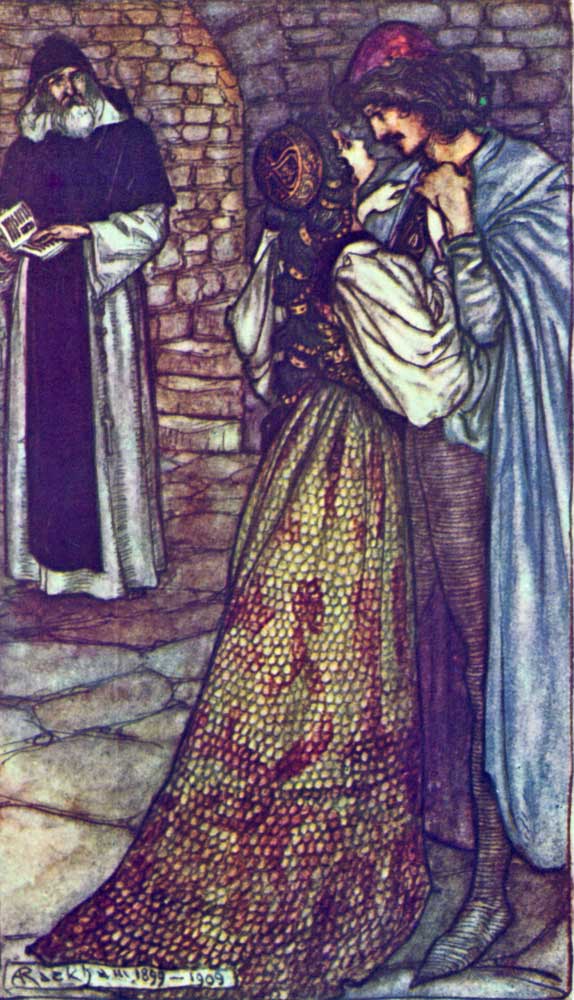 “At the Cell of Friar Lawrence,” an illustration from “Tales from Shakespeare” by Charles & Mary Lamb. Friar Lawrence mistakenly sees Romeo and Juliet’s marriage as a way to reconcile their feuding families. Peace is reached, but only at a great cost. (Public Domain)
Finally, in evaluating the love between Romeo and Juliet, it’s important to consider how love usually begins. Young love is extremely passionate. Romantic love between men and women begins with appearances, and starts as something like idolatry; the beloved becomes one’s whole world. True love begins here, even though it is a dangerous beginning.
According to the Christian tradition in which this play was written, beautiful objects begin the process of drawing men and women to God as the source of all beauty, even though there is a danger that lovers will be distracted and stop at this point of loving lower things. In this tradition, love must be guided in order to become love in a truer sense, a love that is more about self-sacrifice than emotional and bodily pleasure. Romeo and Juliet’s young love, the very kind of love that most requires support from friends and family, can rely on nothing but the lovers themselves.
While Shakespeare surely depicts this young love as fallible, he clearly also believes that it is good. Some of the most beautiful language in the play comes from the couple, such as Romeo’s statement about Juliet when he first meets her: “O, she doth teach the torches to burn bright!”
Meanwhile, for all of her innocent, unguided passion, Juliet is the play’s most moral character. True, she disobeys her father’s request that she marry another, but after all, his command would involve her committing adultery, although he does not know that. And if there be any thought that Juliet is only thinking of her passion for Romeo, avoidance of adultery is the motive she states, to refuse committing a crime against God as well as Romeo: “My husband is on Earth, my faith in heaven.
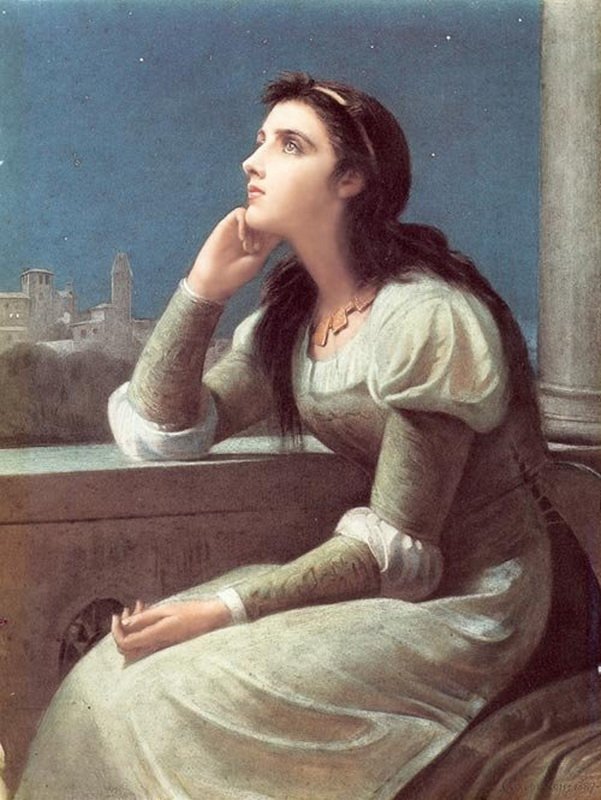 “Juliet,” 1888, by Philip H. Calderon. Many critics consider Juliet Capulet to be the most moral character in “Romeo and Juliet.” (Public Domain)
That Romeo and Juliet are neither clearly praised nor blamed has frustrated critics, and it has led to a third opinion: that the play is immature. It is not up to the standard of Shakespeare’s other tragedies, such as “Macbeth” or “Hamlet.” This was the opinion of many 18th- and 19th-century critics, and of not a few modern scholars. They take issue not only with the seeming moral ambiguity, but also with the character development. Shakespeare’s other tragedies feature protagonists who, while meeting sad ends, also develop a clearer understanding and awareness of themselves and their world. Yet, Romeo and Juliet grow more and more obsessed with each other as they hurtle to their unnecessary deaths.
This interpretation is too narrow. The forces that really move the play’s action are the warring families, not Romeo and Juliet. The Capulets and Montagues have collectively failed to guide the innocent love that took root among them. It is the lack of guidance for this passion, not the passion itself, that is the problem.
The very manner in which Shakespeare portrays this feud is a profound warning about grudges and revenge.
The Destructive Power of a Grudge
By nature, a grudge hides to deceive, and finally, drives the people who hold it to rash decisions. While the feud is the engine driving the play, it is deeply hidden. Few scenes show the families actually confronting each other. On the surface, the feud’s main representatives, Lord Montague and Lord Capulet, spend more time expressing concern about their children than dwelling on their mutual hatred. Yet this hatred lurks beneath the text and motivates all of the play’s sad events: the inability of Romeo and Juliet to confide in their friends and family, Tybalt’s thirst for blood, and the deception and hastiness that reveal themselves again and again.
Grudges are also self-deceptive. People with grudges often think they have them under control. Yet, instead of the reason, which should govern anger and hatred, anger and hatred secretly overrule reason. Lord Capulet and Lord Montague agree to a cold truce at the beginning of Act I, only for Tybalt, a relative of the Capulets, to stoke the feud’s fire when he kills one of Romeo’s friends and is then killed by Romeo. Tybalt’s action is only possible because the Montagues and Capulets indulged their grudge while pretending to let it go. Resentment has first taken over the hearts of these individuals.
Impatience rules the resentful. Lord Capulet, Lady Capulet, and the Nurse are hasty. So are their servants and so are those of the Montagues. What happens within the streets of Verona reveals what happens to those who succumb to resentment instead of governing it. Bearing a grudge spoils even the good aspects of our personalities, just as the unreasonable hatred between the Capulets and Montagues destroyed a young love.
Grudges silently eat out the heart, even while the people who hold them, like the Capulets and Montagues, eat, drink, have good intentions, and make good plans. When it takes over and tyrannizes over the reason, hatred is like Tybalt, a subordinate forcing the hand of his superior.
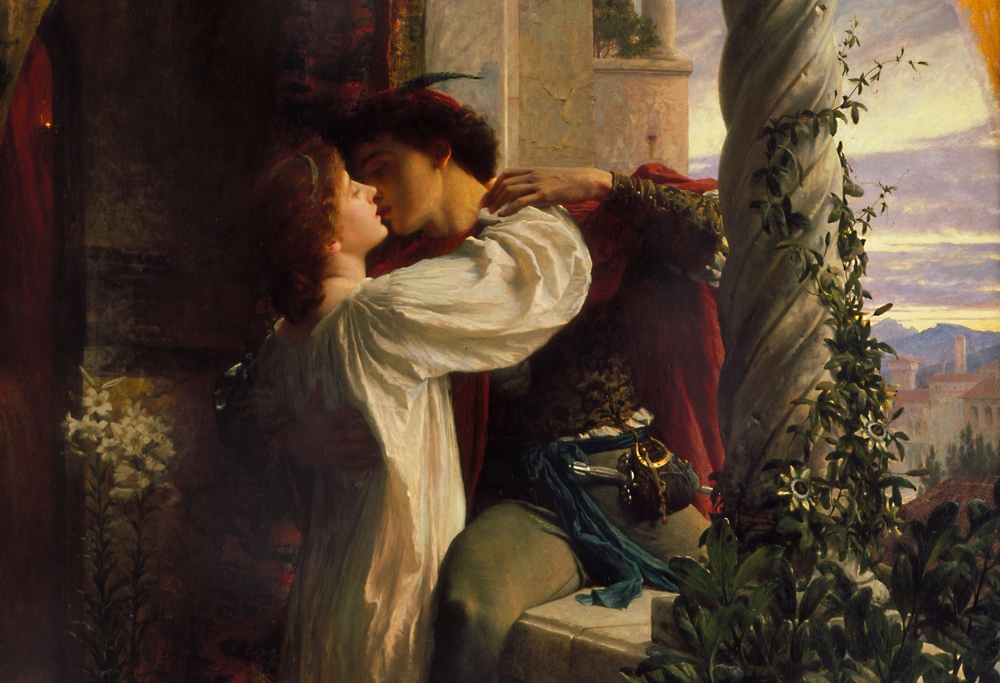 A detail of “Romeo and Juliet,” 1884, depicted in oil on canvas by Frank Bernard Dicksee. Southampton City Art Gallery. (Public Domain)
Finally, grudges devastate by causing those who hold them to unwittingly destroy what they love most. As the Prologue indicates, it takes Romeo and Juliet’s deaths to “bury their parent’s strife.” It’s a lesson for readers, listeners, and viewers of this play, to forgive and bury their own resentment before they harm themselves and those they love.
What arts and culture topics would you like us to cover? Please email ideas or feedback to features@epochtimes.nyc
