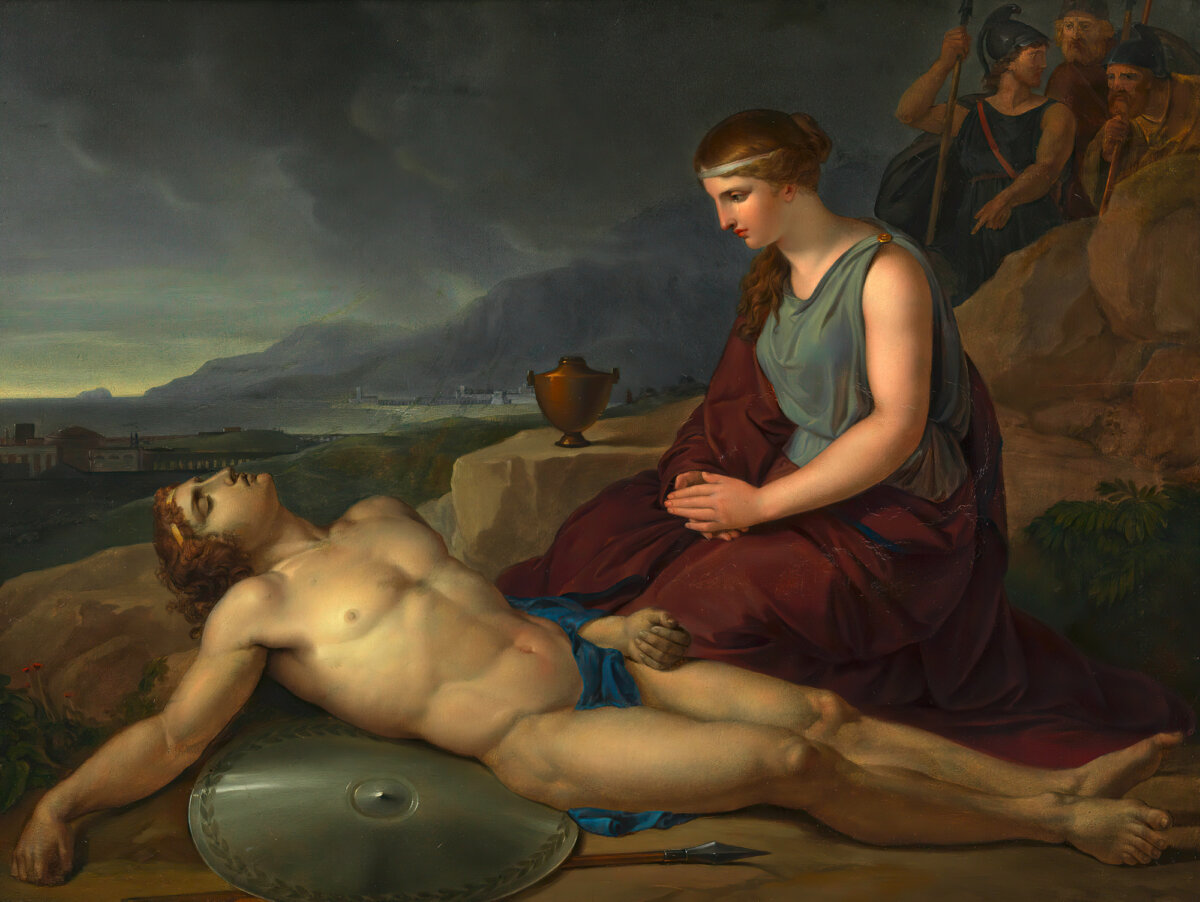
Once upon a time two brothers, Eteocles and Polynices, died fighting against each other to win the throne of Thebes. Creon, their uncle and now the king, ordered Eteocles buried as a hero and the body of Polynices left on the battlefield to rot and be ravaged by wild animals, because the king deemed Polynices a traitor for waging war against the city. This desecration would condemn Polynices to wander the earth forever as an unhappy spirit.
The brothers’ sisters, Antigone and Ismene, were devastated by this repudiation of tradition and the law of the gods, but only the fiery Antigone dared defy Creon’s edict. Slipping out of the city, she performed the funeral rites over her brother’s body and covered him with a thin veil of earth. When she later found the dirt removed, she began conducting a second burial rite when a sentry apprehended her and brought her before Creon. After an acrimonious exchange, the king ordered Antigone sealed into a cave that would become her tomb.
This summary of Sophocles’s “Antigone” sets the stage for the rest of the play, which raises questions regarding the proper balance of loyalty and obedience owed to government, family, and a higher power. Though written nearly 2,500 years ago—and Sophocles himself took his characters and plot from earlier myths wrapped in the mists of time—“Antigone” serves even today as a looking glass, a mirror asking similar questions of us.
Where Do Our Loyalties Lie?
You may be an ambassador to England or France
You may like to gamble, you might like to dance
You may be the heavyweight champion of the world
You might be a socialite with a long string of pearlsBut you’re gonna have to serve somebody, yes indeed
You’re gonna have to serve somebody
Well, it may be the Devil or it may be the Lord
But you’re gonna have to serve somebody
That’s the opening stanza and chorus from Bob Dylan’s “Gotta Serve Somebody.” Dylan makes the point that whatever our station in life, whether we’re billionaires or a clerk at the 7-Eleven, life obliges us to serve and obey another.
“Antigone” examines this same proposition. To whom or to what do we pledge our utmost fealty and love? The family? The state? The gods? Our conscience? Truth? The pressures at play in our choices are just as strong and demanding now as they were in Sophocles’s day, with the recent Covid pandemic perfectly illustrating this tension. Stringent government policies forced many Americans to choose between obedience and rebellion, to decide, for example, whether to follow such commands as the closure of churches and schools without debate or resistance.
These same dilemmas occur in our daily lives. A homeschooling mom with a deep religious faith may have to decide whether to obey the dictates of the government or those of her conscience when planning her child’s curriculum. A journalist may find herself stuck between reporting the truth and adhering to the political biases of her employers. A worker on a construction crew may be employed by a boss whose shoddy practices border on criminality.
Embedded in “Antigone” as well as in Dylan’s song is the idea that we possess the power, however dire the consequences, to choose a different path when obedience seems wrongheaded or even evil. Antigone chooses to follow the laws of the gods rather than those of Creon. As Dylan wrote, “It may be the Devil or it may be the Lord, but you’re gonna have to serve somebody.”
The Battleground of Hierarchies
“Antigone” also calls us to rank our loyalties in order of importance. Creon puts the state first, in part because of his precarious perch on the throne; Antigone obeys her conscience, her loyalty to her family and tradition, and the gods.
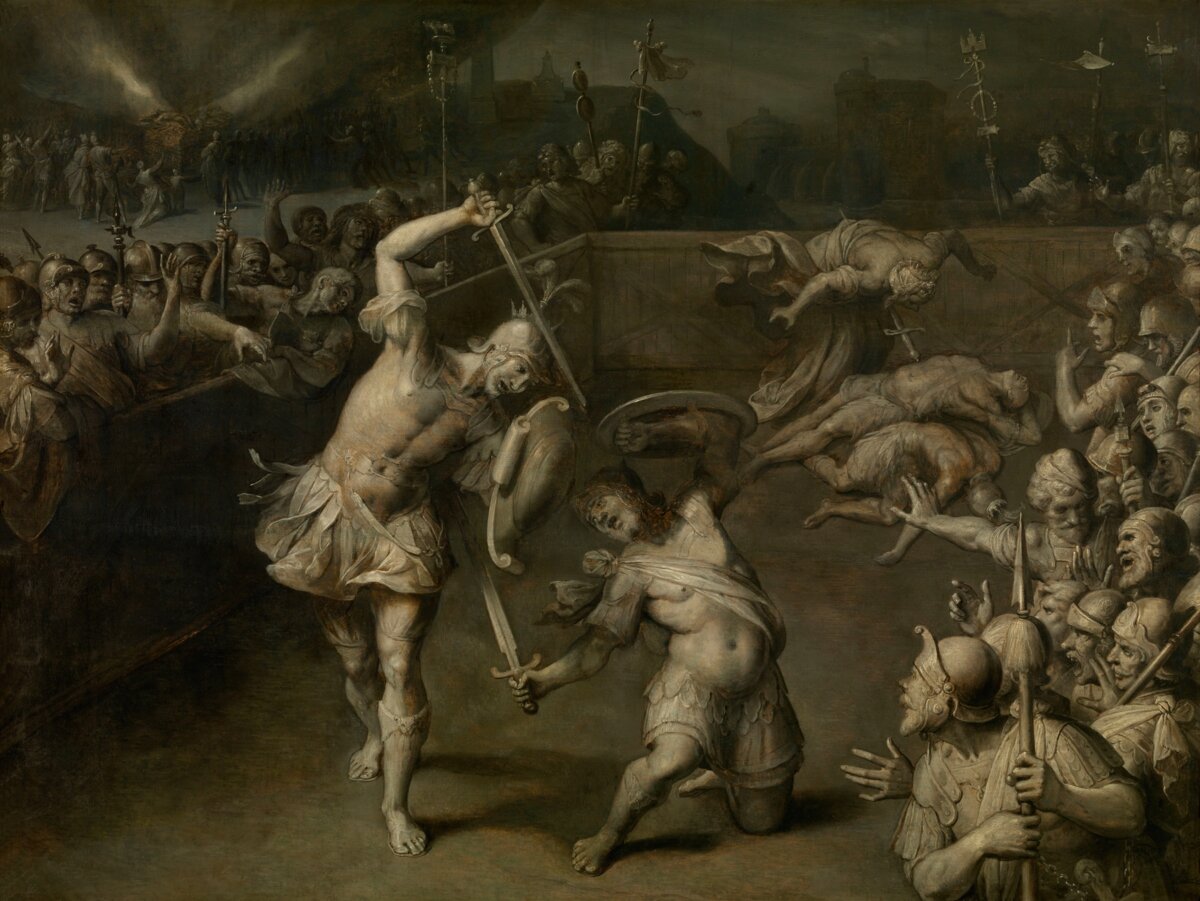
The play shows what happens when these hierarchies collide. Haemon, the king’s son and Antigone’s fiancé, finds himself divided in his loyalties. Caught between the passionate Antigone and the stubborn Creon, he becomes the voice of reason in the tragedy. He urges his father to follow the higher law, the law of the gods, and to remove Antigone’s sentence of death. When he fails in that effort, Haemon flees the court, makes his way to the cave entombing Antigone, and discovers that she has hanged herself. Raging in his grief, he attempts to stab his father, fails, and turns the sword on himself.

Though not always so bloody, a similar collision of values and loyalties brings fireworks to our own culture nearly every day of the year. The ongoing Loudoun County, Virginia, school controversies, for instance, have transformed campuses into cultural war zones, with skirmishes and battles fought by parents, teachers, government agencies, and children who hold differing views of education and policies. A more widespread example can be found in the professors who tout Marxism in classrooms across the country, pushing a political philosophy antithetical to that of their native land.
Intentionally or not, we all erect ladders of commitment. For some, family outranks work in importance; for others, not so much. Some place faith at the top of the ladder, while others rarely pause to consider religion at all. In a marriage, a spouse may pour attention on the children while ignoring a partner.
And sometimes, antagonistic hierarchies lead to tragedy. The terrorist who murders strangers rates his cause as superior to human lives.
Wisdom
By the end of “Antigone,” Eurydice, Creon’s wife, has also embraced the grave in her grief over the loss of her son, and Creon is a broken man—“My life now is death.” The chorus concludes with these words:
Of happiness, far the greatest part
Is wisdom, and reverence toward the gods.
Proud words of the arrogant man, in the end,
Meet punishment, great as his pride was great,
Till at last he is schooled in wisdom.
Here is a key takeaway from “Antigone”: Humility is the birthplace of wisdom.
This message occurs elsewhere in the play. When Haemon warned his father that “it is the gods who give us wisdom” and that “there’s no disgrace, even if one is wise, in learning more, and knowing when to yield,” Creon responded with blistering contempt, “What? Men of our age go to school again and take a lesson from a very boy?”
Whether from the lips of a youth or a graybeard, Sophocles tells us, wisdom is wisdom.
In this matter of humility, Sophocles speaks to our own age. Some among us believe they can control rainfall or breed better humans in laboratories, all without consequence. Some claim that if only they controlled the government, they could construct a utopia. The radicals among them abandon reason altogether and riot in the streets, pushing their agenda by senselessly burning the stores and vehicles of their fellow citizens.
Such arrogance and overweening pride preclude wisdom.
In the movie “Dead Poets Society,” a teacher played by Robin Williams gathers his class around him and says, “We don’t read poetry because it’s cute. We read and write poetry because we are members of the human race.”
We read the ancients for the same reason. We are bound to them by our common humanity, and they have a thing or two to tell us if we are wise enough to listen.