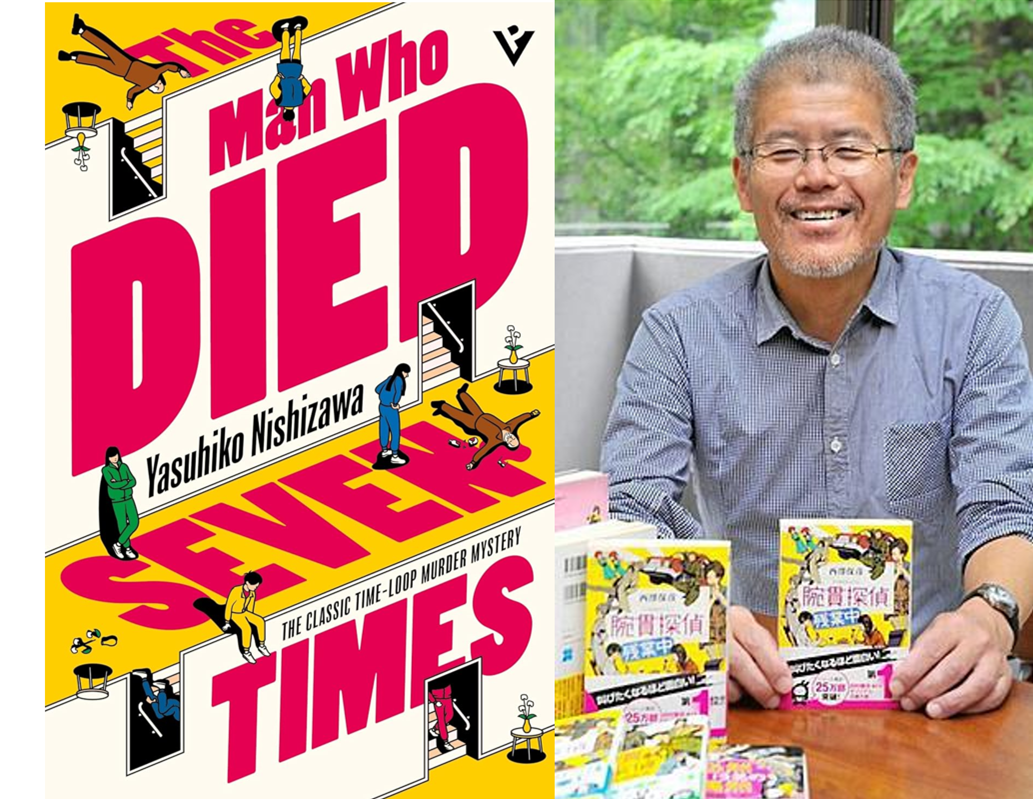
If you hadn’t guessed by the title alone, “The Man Who Died Seven Times,” by Yasuhiko Nishizawa, is a strange book. Whether you enjoy it will depend on a couple of factors.
In 1995, Kyutaro (“Hisataro”) Oba is a 16-year-old Japanese student with a unique condition: He gets stuck in time. As a child, he began to notice that certain days were repeating themselves, including meals, conversations, and events. No one else was conscious of the repetition.
When “the Trap,” as he eventually dubbed it, activates, he relives the same day exactly nine times consecutively, midnight to midnight, and he never knows when it might happen. Only Kyutaro’s actions can change the course of events during these “loops,” and whatever happens in the ninth loop becomes the definitive, permanent version for everyone else.
At first, his odd condition enables him to cheat at exams and impress some girls at school; but he ultimately finds that it complicates his life more than it helps. Additionally, all these extra days he has experienced mean he has mentally lived as long as a 30-year-old man. This makes it very hard for him to relate to others.
Using the Trap to prevent accidents proved to be impractical. Kyutaro eventually decides to intervene only in events directly involving himself or people he knows. Of course, being stuck in high school means not much happens around him. Ultimately, he thinks of it as a disorder rather than an ability.
Heir Today, Gone Tomorrow
Everything changes on one New Year’s Day when Kyutaro, his mother, and his older brothers Fujitaka and Yoshio arrive at Grandfather Reijiro Fuchigami’s mansion. They are there to learn who will be named in Grandfather’s will as the heir to his restaurant empire.
The Oba family is greeted by Reijiro’s assistants and required to change into brightly colored tracksuits with cotton jackets, a peculiar tradition mandated by the grandfather. Kyutaro’s aunts, Kotono and Haruna, are there already, along with his female cousins, Mai and Runa.
Things aren’t going well at home for the Obas or Aunt Haruna’s family. This means Kyutaro’s mother and her sister are desperate for one of their children to become the heir to Reijiro’s fortune. Aunt Kotono is childless, but still a threat to their plans. There’s also an awkward tension between the cousins, as Yoshio and Fujitaka are both infatuated with the gorgeous and arrogant Runa.
Apart from the strange mandate about the tracksuits, Grandfather Reijiro breaks out in deranged laughter at odd moments and says his decision about his will is based entirely on his whims. After the first day of their three-day visit, the families go to bed with no clue who will be chosen as heir. Scheming and embarrassing events fill the second day, and Kyutaro ends up getting blind drunk with his grandfather before passing out.
On the third morning, Kyutaro realizes he’s repeating the events of the second day. Oh no, he’s in the Trap! He doesn’t want to relive that train wreck of a day eight more times, so he resolves to avoid everyone else in seclusion. But things suddenly become very complicated when Grandfather turns up dead.
Because Grandfather was killed on the second day of the Trap, Kyutaro believes he altered something that caused the murder, and one of his family members is likely the killer. Now, he has seven more loops to figure out who the murderer is, how to correct the course of history, and make sure to get it right on the ninth loop so that everyone lives, and his family isn’t destroyed.
Time Travel Traps
Time loop movies and shows are commonplace today, such as “Edge of Tomorrow” and the 1993 hit film “Groundhog Day.” The earliest modern time loop story is “Doubled and Redoubled,” by Malcolm Jameson, published in 1941. Published originally in 1995, “The Man Who Died Seven Times” is one of the smartest and well-crafted versions of this speculative sub-genre ever written.
Kyutaro’s family members are so dysfunctional and conniving that watching him desperately try to keep them from imploding or dying is hilarious. Additionally, by spelling out the rigid rules of time travel here, author Yasuhiko Nishizawa allows careful readers to work on the puzzle alongside his hero.
But let’s emphasize that: Careful readers. The clues, character movements, and motivations are quite complicated on their own—but adding nine different variations? Now that’s a Gordian Knot. But it all seemed to work out without violating its own rules.
Another factor that should be brought to readers’ attention is the presence of a romantic familial relationship. At first, I was very confused by the easy acceptance of a relationship between Kyutaro’s brother and his first cousin, until I learned that 1990s Japanese culture didn’t view such pairings as unseemly. To many Westerners, this can be a turn-off unless they pretend that one of the two was actually adopted.
If you can work through the complex plot and the cringy romantic aspects, “The Man Who Died Seven Times” is a great speculative mystery.
‘The Man Who Died Seven Times’
By Yasuhiko Nishizawa
Pushkin Vertigo: July 29, 2025
Paperback, 288 pages
What arts and culture topics would you like us to cover? Please email ideas or feedback to features@epochtimes.nyc