



Much has been written about Lucille Ball’s comedic talents and her historic rise as the first woman to run a major production company. There are plenty of biographies on her beginnings in Jamestown, New York, early Hollywood days, and many appearances in film and TV until her passing in 1989.
What hasn’t been given as much attention are the many contributions made by her husband, Desi Arnaz. From Cuban royalty, he ended up a penniless Latin musician before becoming the man behind “I Love Lucy,” one of the most beloved sitcoms in history. Here’s the story of Desi Arnaz, the man who revolutionized the television industry for years to come.
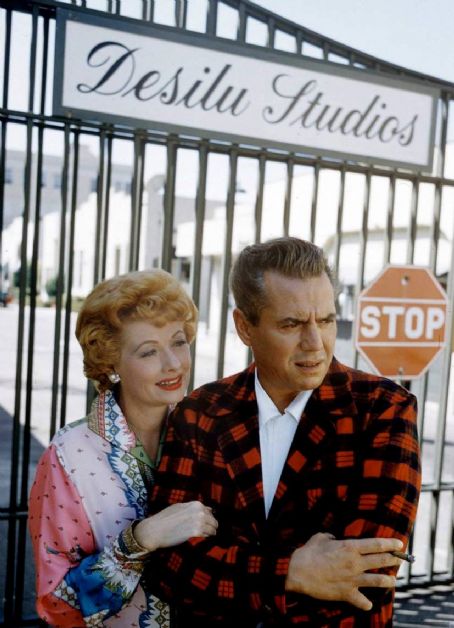
Over the course of their marriage Lucille Ball remained her husband’s biggest cheerleader. She gave him credit for choosing the right people, negotiating the best deals, and being the driving force of the “I Love Lucy” show. It’s said that before streaming, the series played every day, every hour on a TV set somewhere around the world.
Behind the Scenes Magic
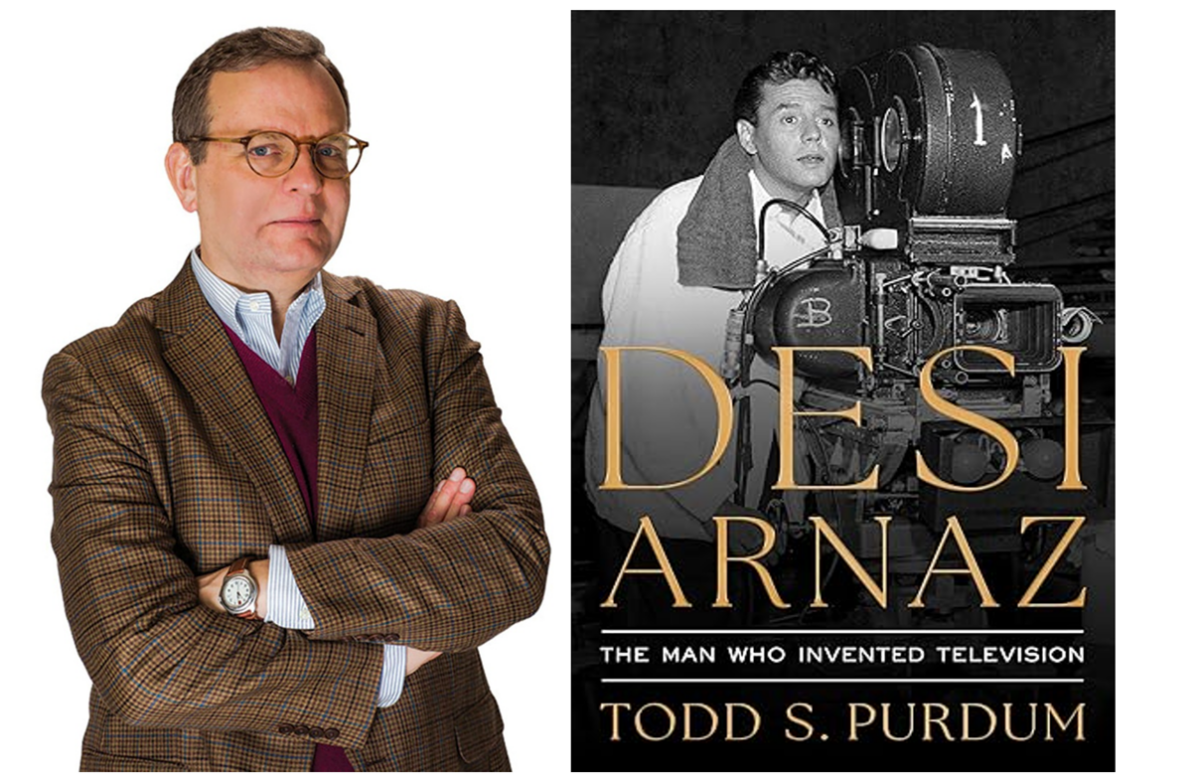
It’s fitting then that the book cover of “Desi Arnaz: The Man Who Invented Television,” by Todd S. Purdum, features a weary Arnaz hovering over a television camera. While Ball made the magic happen on-screen, it was Arnaz who made it happen offscreen.
Fans of the couple and the series may think they’ve heard it all about the tumultuous Ball-Arnaz marriage and the making of the show. However, they should be pleasantly surprised at the number of new details revealed in this intimate biography.
In the acknowledgements, Purdum thanks Arnaz and Ball’s daughter, Lucie Arnaz, for providing access to her “meticulously maintained family archive,” “answering endless questions,” and correcting the wrongs that have been mistaken for facts over the years. Others contributed, from the couple’s son, Desi Arnaz IV; Ball’s long-time secretary; and members of the Arnaz family. Also included are a whole host of researchers.
Born in Cuba, Desi Alberto Arnaz y de Acha III Arnaz fled his homeland for the safety of the United States in the early 1930s after the overthrow of the government. The country was run under a dictatorship until Fidel Castro’s 1959 revolution.
In Miami, Arnaz had to start over, but he never felt comfortable in the United States. He felt more like a refugee than an immigrant, and betrayed by his country.
Arnaz also felt unwelcome in the entertainment industry, was ridiculed for his broken English, and was seen as the “second banana” to his wife. All of this would culminate in bouts of depression; a dependency on alcohol and endless womanizing led to his downfall.
Yet, there was a time in the late 1950s that, due to Arnaz’s magic at deal making and the success of his Desilu production company, a business associate once commented that Arnaz was harder to reach than the president of the United States.
Discovering TV Talent
Arnaz had an eye for talent. He discovered directors like Jay Sandrich who would later work on the “Mary Tyler Moore Show” and “The Cosby Show”; and producers Quinn Martin and Aaron Spelling, who created the massive hits “Barnaby Jones” and “Charlie’s Angels,” respectively.
In the beginning, his good looks attracted women and kept him employed in various Latin bands in Florida and New York. Unfortunately, that quality, combined with watching Cuban men having multiple relationships outside of marriage, would become the talk of Hollywood, and an embarrassment for his wife.
The author provided a thorough examination of Arnaz’s influences from birth in 1917 throughout the turmoil of pre-Castro Cuba, to growing up in a prosperous family. His father was a military hero in the Spanish-American war; he went on to receive a pharmacy degree in New York, and returned to Cuba to build a successful business and become elected Mayor of Santiago, Cuba.
A pivotal time of political unrest in Cuba forced Arnaz and his mother to move to Miami. Growing up with music all around him, he found work as a musician in a local band. He soon learned that playing the bongo would be his ticket to financial security in the entertainment world, and eventually to Hollywood.
A Television Show
Ball and Arnaz clicked from the start, but she soon learned she’d need to keep him and his wandering eye close to home. Though Ball was the more well known, it was the combined power of the couple that prompted CBS to offer them their own show.
Despite her reservations about leaving a film career behind, Arnaz was able to persuade her to “gamble everything on this show.” Arnaz who held out for complete ownership of the show, a condition brand new to the network executives. It was foresight on his part to understand that owning the rights to sell could be a goldmine later. This agreement sets the stage for TV shows to be produced by companies that owned the rights, rather than networks owning them.

The book explains that Arnaz created the three-camera production system and hired an Academy Award-winning cinematographer. He offered William Frawley the job as Fred Mertz (if he controlled his drinking). Catching a performance of Vivian Vance in a local playhouse, Arnaz cast her immediately as Ethel Mertz.
Despite Arnaz’s many flaws, it was his work ethic and innovative ideas that catapulted “I Love Lucy” into TV history. In addition to learning his Ricky Ricardo lines, Arnaz was juggling the responsibilities of running a studio and producing new television shows.
The pace Arnaz was keeping wasn’t sustainable. Soon he experienced health concerns stemming from stress and alcohol abuse. While this isn’t news to readers, author Purdum presents a balanced narrative, recognizing his genius with his faults.
Arnaz’s pride wouldn’t allow him to seek help. Rather, he sank deeper into denial and depression. Ball continued to suggest ideas to save their failing marriage including trips overseas and encouraging him to try counseling, a difficult goal since he “refused to admit he had a problem.” Ball’s attempts to get him to do counseling didn’t last.
He Loved Lucy Until the End
Ball and Arnaz remained in touch after their highly publicized divorce and continued to express their love for each other. Their daughter, Lucie, who was with him at the end of his life, remembers her parents’ last time together. As the two of them watched videotapes of “I Love Lucy,” Lucie left them to be alone, to laugh and remember. Her father died two days later.
Readers looking for more about Lucille Ball may be disappointed as the spotlight consistently remains on Arnaz. Though the book’s title does imply he “invented” television, it’s more accurate to say he was the man who brought innovative ideas to the medium and left it better off than when he entered it.
He’s also credited with paving the way for more Latin performers like George Lopez, John Leguizamo, and Gloria Estefan. To this day, it’s “Desi Arnaz who remains not only the first, but also arguably the more prominent Latino studio executive in Hollywood history,” Purdum wrote.
The book successfully tells Arnaz’s story on many levels: immigration, early television, the power of producers and networks to shape what we watched, the performers who made us laugh, and the man who loved Lucy.
‘Desi Arnaz: The Man Who Invented Television’
By Todd S. Purdum
Simon and Schuster: June 3, 2025
Hardcover, 368 pages
What arts and culture topics would you like us to cover? Please email ideas or feedback to features@epochtimes.nyc
Correction: The article incorrectly states the reason Desi Arnaz fled Cuba, which is because of the dictatorship that overthrew the government. The Epoch Times regrets the error.
