



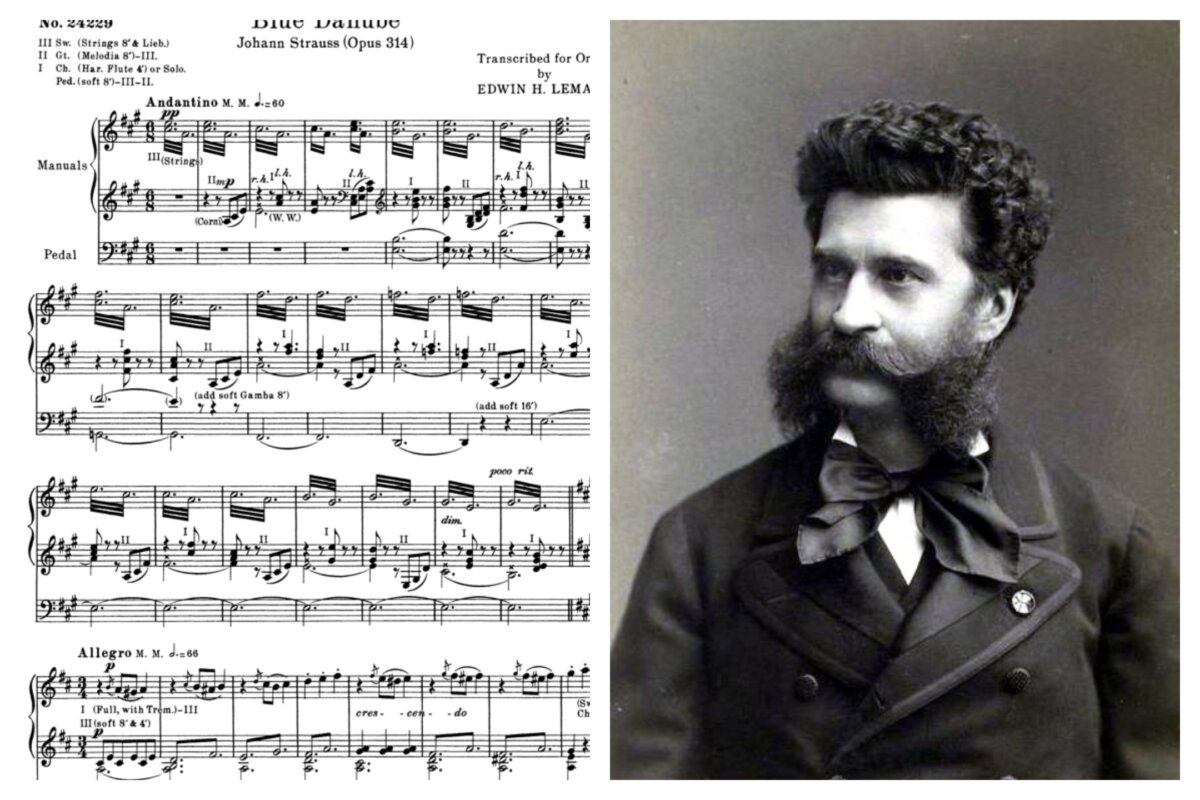
Johann Strauss II—“The Waltz King”—was born on Oct. 25, 1825, in Vienna, Austria. It’s a city he is permanently associated with, now more than ever. In his youth, though, this hadn’t yet come to pass. He grew up in the shadow of a famous father who dominated the waltz genre. Johann Strauss Sr. As successful as he was, he didn’t want his son to be a musician.
The elder Johann Strauss pushed his son toward the “safe” profession of banking, but the younger Strauss quietly studied violin anyway. After his father left his mother for a mistress, Johann, still in his teens, formed his own dance orchestra to support the family.
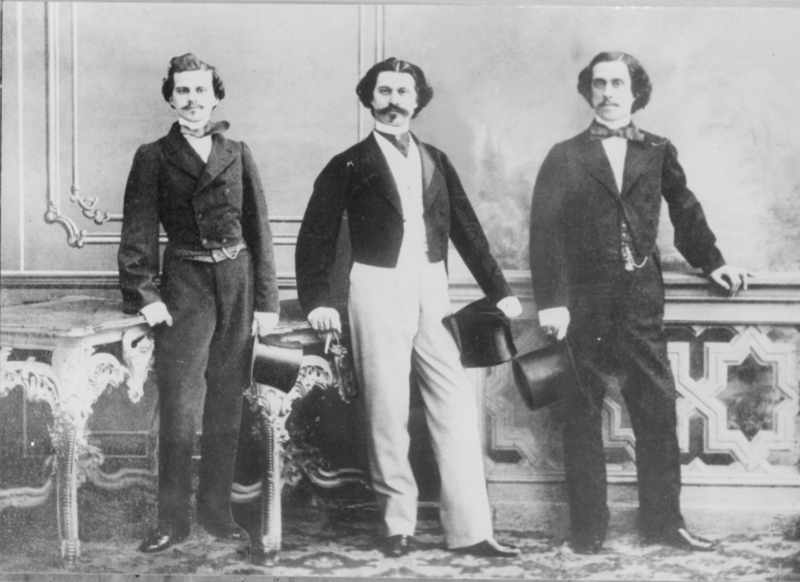 (L–R) A photograph of Eduard, Johann II, and Josef Strauss, taken between 1860 and 1870. (Public Domain)
He formed his first orchestra in 1844, became its bandleader, and made his public debut that same year. In doing so, he became a direct rival to his father’s orchestra. When Strauss Sr. died in 1849, the son took over that orchestra and merged it with his own. Strauss II took prime engagements and began touring widely. By the early 1850s, he’d earned his moniker, ‘Waltz King.’
Strauss II came of age inside the tightly run dance economy of Habsburg Vienna: court balls, public dance halls, military bands, and theater companies needed fresh music every season. A successful bandmaster in this world was part composer, part entrepreneur, and part celebrity. Programs had to be shaped for dancers as well as listeners, and reputations were built as much on reliable leadership as on inspiration.
However, the demands of Strauss’s career took a toll on him. Though his music is light and cheerful, the act of composing his waltzes put him into an irritable and depressive state. His first wife, the mezzo-soprano Henrietta “Jetty” Treffz, helped alleviate his dark moods and relieve the burden of his public duties. Beyond affection, Jetty handled the tedious work of copying, accounts, and schedules.
After she died in 1878, Strauss married the actress Angelika Dittrich. It was an unhappy marriage, and they separated four years later. Balance returned with Strauss’s third marriage in 1887, to Adele Deutsch, and with it a late flowering in operetta and concert pieces.
Strauss had quirky habits that highlight his success in Vienna’s dance marketplace. His public image was of a man in tailcoat with his hair slicked back. He always kept a pencil and paper on him everywhere he went, as he had an obsessive fear of forgetting the melodies that popped into his head.
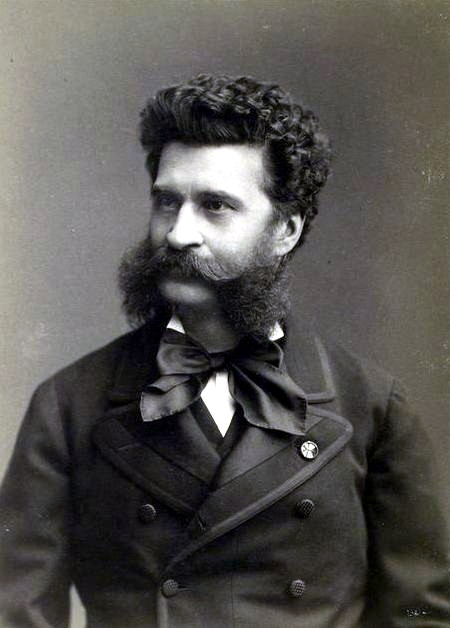 A portrait of a young Johann Strauss II. (Public Domain)
On stage he conducted with his violin, not from a podium, leading his orchestra through the music while playing. This showman’s gesture kept him closer to the players and the floor.
The Blue (Actually Green) Danube
Strauss didn’t invent the waltz, but he did polish it for a cosmopolitan audience. Three fingerprints define his style. First, he opened with a brief introduction, a curtain-raiser that raises expectations. Second, he built a chain of contrasting waltz sections, each with its own “A” and “B” strains and color. The audience heard a suite of short songs linked by tempo and key. Third, he wrote with clarity and lift: light upper strings, buoyant winds, lyrical horns, an occasional harp, and bass lines all combined to contribute to a lively piece. Finally, there is the Viennese lilt, the use of “rubato,” small shifts in tempo that make the music feel sung.
“The Blue Danube,” Strauss’s most famous piece, shows this design at its best. It begins with soft tremolo strings and horn calls, suggesting distant water without doing literal scene-painting. Then come five linked waltz groups. The first theme is modest and unstrained, featuring cellos and horns. Its very simplicity lets Strauss ornament it later without distorting the line. A second group turns dreamier, a third brightens with a touch of parade, a fourth passes the melody between winds and strings like a conversation, and a fifth adds sparkle and rhythmic kick.
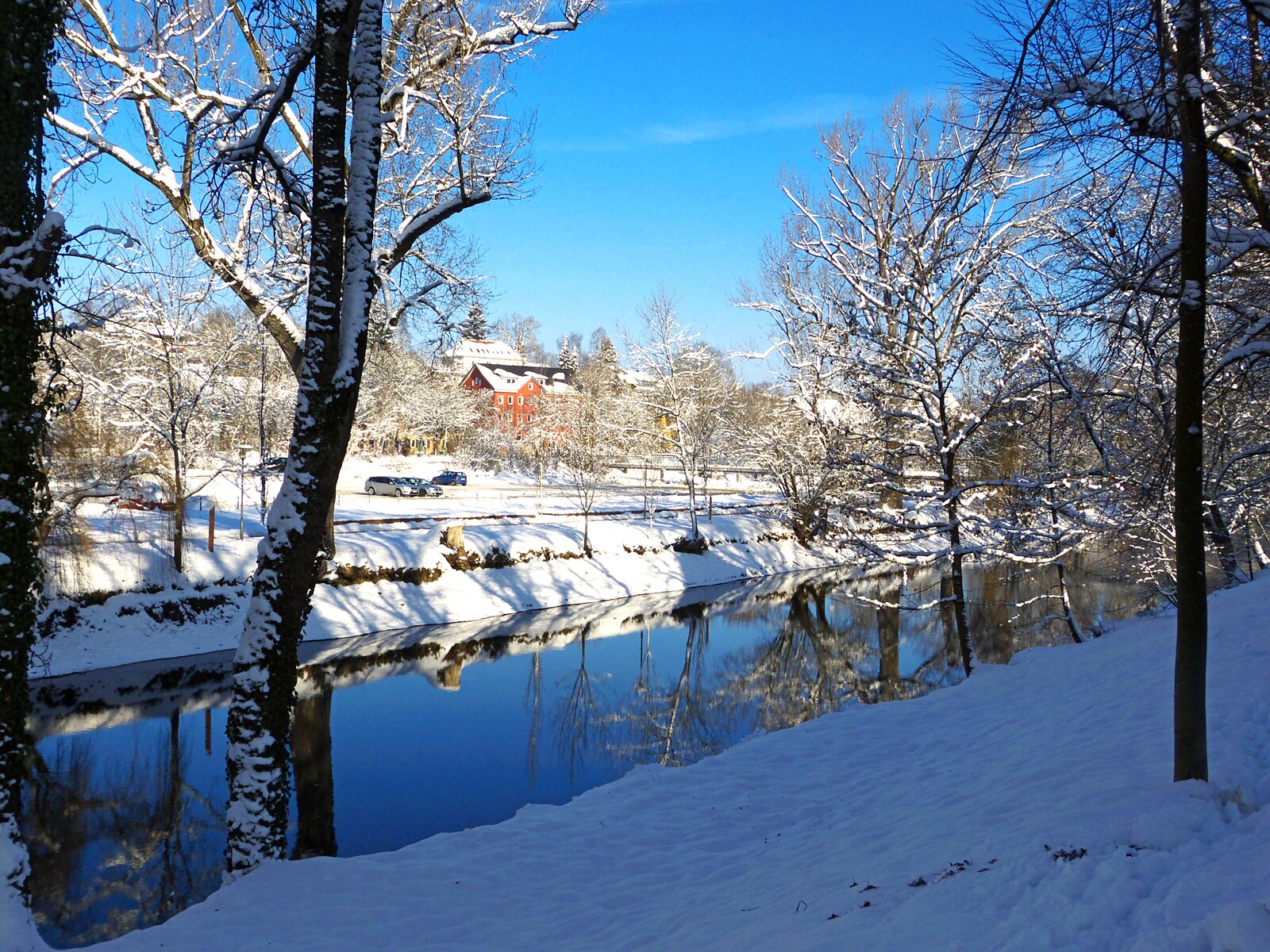 The Danube River appears with a blue cast due to the reflection of the sky above. (Alexander Reuss/CC BY-SA 3.0)
After this arc, he gathers earlier material, scales up the sonority, and closes with a coda of reprises and fanfares. It’s impossible to hear the piece today without thinking of floating down the river named after it.
Strauss took his inspiration for the waltz from a poem by Karl Beck, who was once called “The German Byron”:
And I saw thee, gracious, youthful,
Bearing yet a world of pain,
Where our hearts are ever truthful,
Where our gold has ever lain,
By the Danube, beautiful blue Danube.
Actually, though, the Danube isn’t blue. “It is a pale green, reed-colored river, sometimes it is grey, often silvery but never blue,” wrote Heinrich Jacob. Thanks to the words of Beck and the music of Strauss II, however, blueness is now a quality forever associated with this river.
“The Blue Danube” wasn’t a hit at first. Originally performed as a choral waltz for the Vienna Men’s Choral Association in early 1867, its reception was respectful, but not rapturous. Strauss’s later instrumental arrangement is what conquered the world, especially after the 1867 Paris Exposition introduced a broad public to the Viennese dance style.
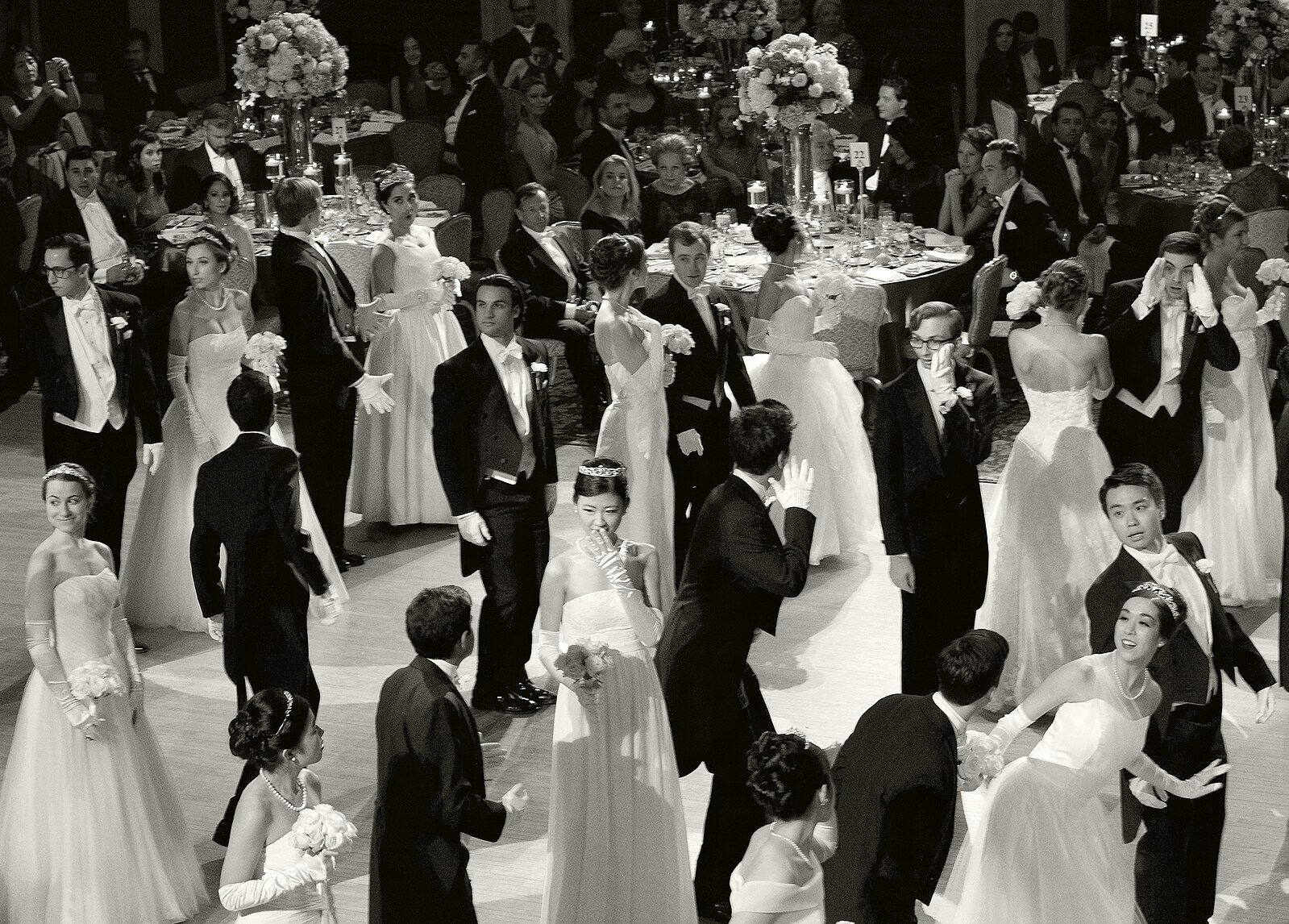 To celebrate the anniversary of “The Blue Danube” waltz, the debutantes strike a pose at the Waldorf-Astoria. (Hope Lourie Killcoyne/CC BY-SA 4.0)
This modification was typical for Strauss, who constantly reworked his own material. Melodies from stage pieces might reappear as independent waltz numbers, and dance hits might be re-cast for the theater. This was practical in a city that consumed new dance music as quickly as it was written. His practice of reworking pieces was less an act of self-plagiarism than an effort to meet the demands of a system that rewarded freshness and punished missed deadlines.
Bicentennial Celebration
By the end of the 19th century Strauss had written more than 500 waltzes, polkas, quadrilles, marches, and stage works; with his brothers, who were also musicians, he effectively branded the sound of Vienna for the world.
His legacy shows up everywhere, most notably in films. The most visible annual reminder, though, is the Vienna Philharmonic’s New Year’s Concert, a broadcast whose core has always been Strauss family music.
Vienna has turned the entire year of 2025 into an all-city Strauss party. Symphonic and chamber concerts, operetta revivals, talks, youth outreach, open-air dances, and park performances are some of the events that have been held so far. The city even set a world record this past spring by having more than 2,025 couples waltz at the same time. This mass waltz surpassed the previous record of 1,966 couples, set in Dresden in 2013.
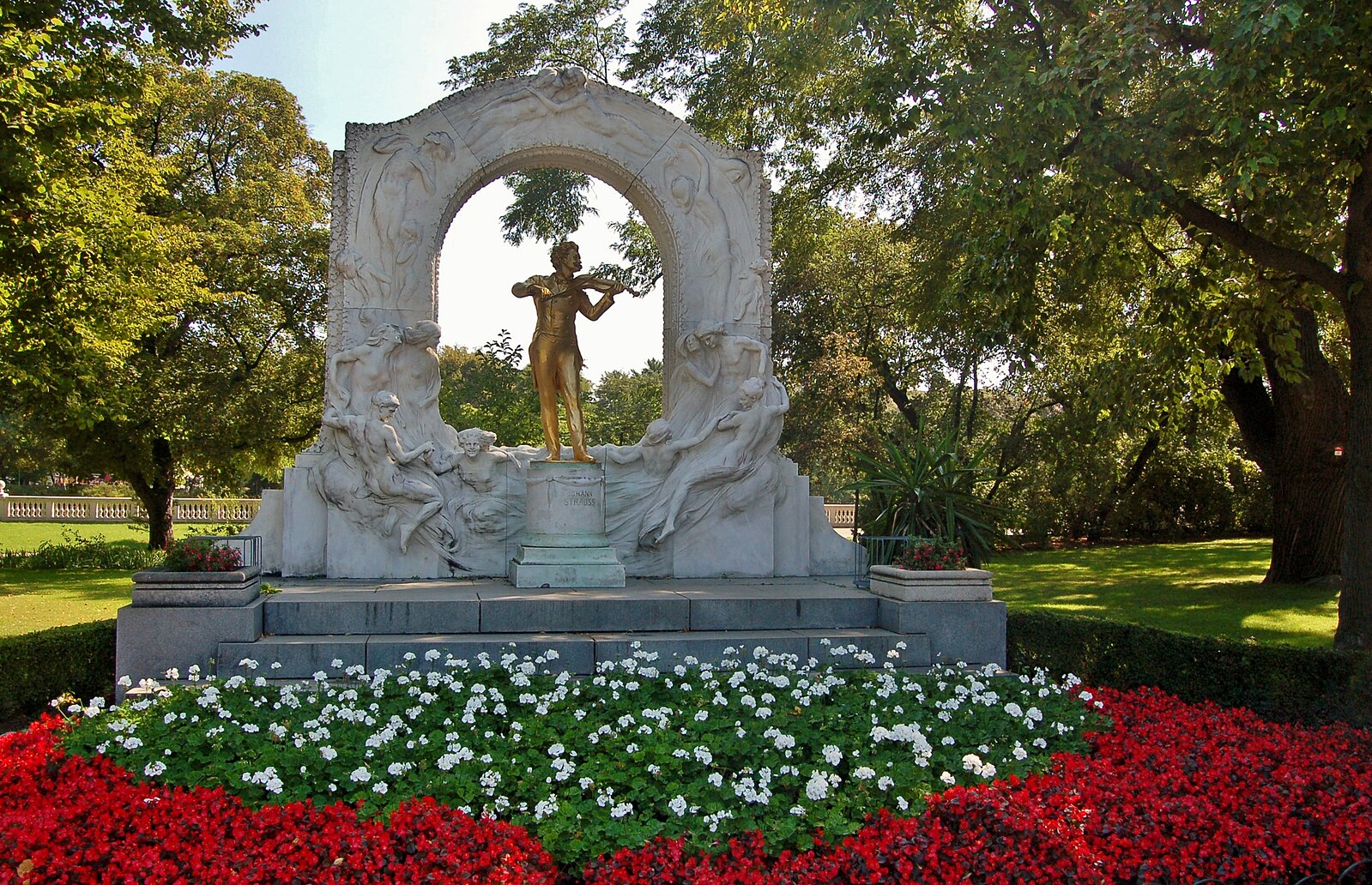 A monument to Johann Strauss II stands in Vienna. (Public Domain)
On May 31 of this year, the European Space Agency beamed “The Blue Danube” into deep space. Given its iconic use in Stanley Kubrick’s film “2001: A Space Odyssey” (1968), this seems appropriate.
What endures after the banners fall? What we might call Strauss’s “civilizing influence”: music that dignifies public gathering and keeps faith with dancers’ feet. At 200, Strauss is no mere statue. He’s a living presence in a city that honors his legacy. The Blue Danube keeps flowing, teaching us to step together.
What arts and culture topics would you like us to cover? Please email ideas or feedback to features@epochtimes.nyc
