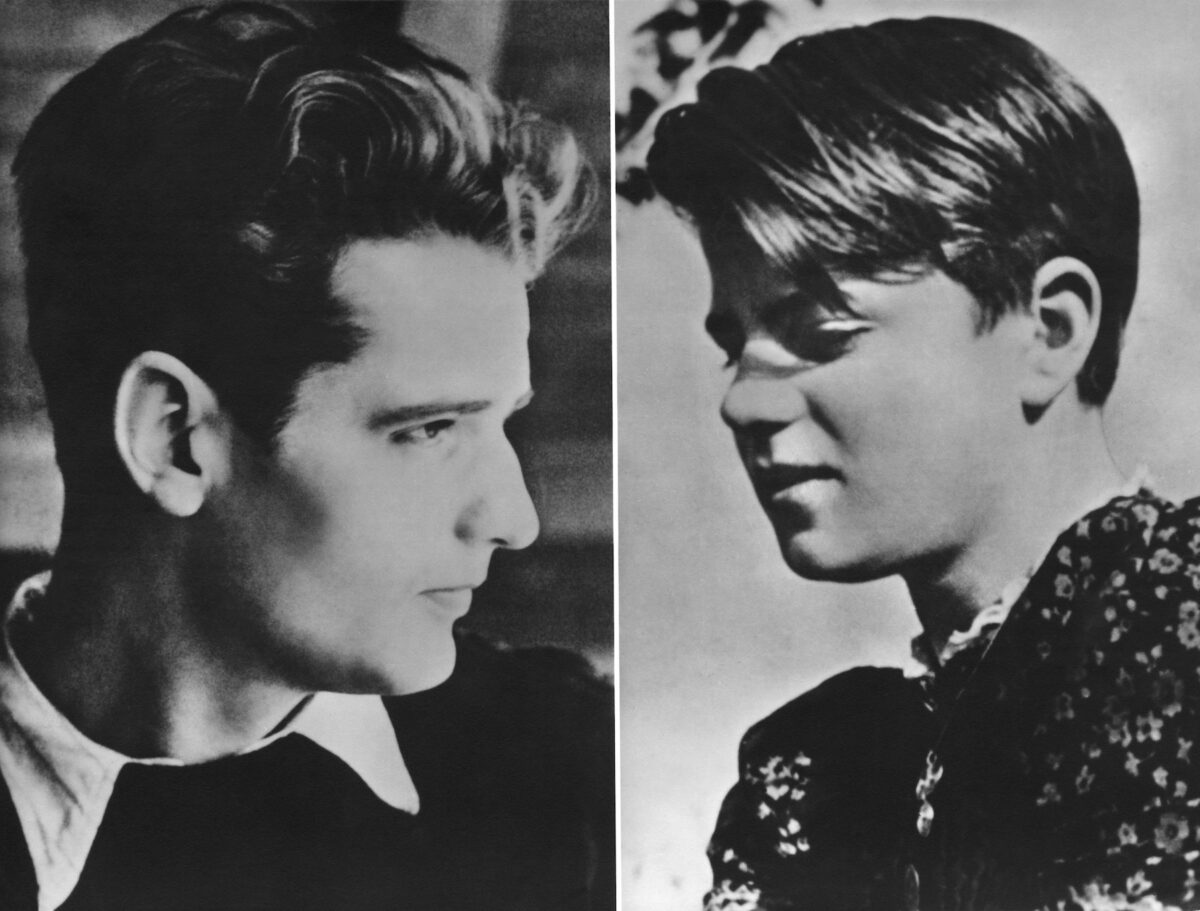
On Feb. 22, 1943, three German university students were sentenced to death and executed by guillotine. Among them was 21-year-old Sophie Scholl (1921–1943), who had been arrested while distributing leaflets that denounced Adolf Hitler’s regime. Her courage became a symbol of freedom, and her defiance a reminder that goodness is always a choice.
Totalitarianism in Germany
When Sophie was born, the German Nazi party had just established the “Sturmabteilung” (“Storm Division”), a nationwide paramilitary group meant to protect its spokespeople and spread Nazi ideology across Germany. The same year, Hitler was appointed leader of the party. Under his direction, the armed coalition began persecuting Jews and silencing political opponents. As its members increased, so did its reach. In just over 10 years, Hitler won the greatest share of the popular vote and the most seats in the German parliament, though not a majority.
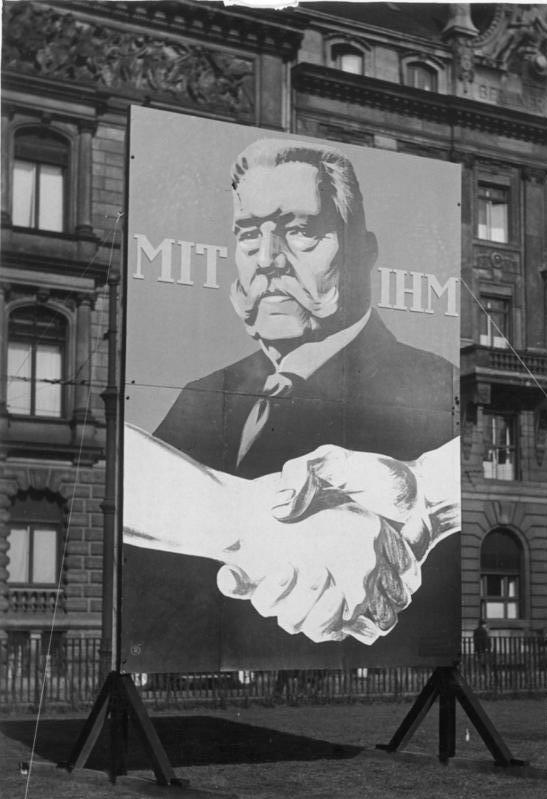
Under political pressures, Germany’s president Paul von Hindenburg eventually appointed Hitler chancellor in 1933. The president was the head of state, while the chancellor was the head of government. As the leader of Germany’s legislative body, Hitler was able to pass the Enabling Act of 1933, which gave him and his cabinet the authority to enact laws without consulting parliament or the president.
Von Hindenburg died of cancer about a year after this momentous legislation. Without opposition, the Nazi party doubled down on its draconian tactics to eliminate opponents and advance Hitler’s vision for German global supremacy. With the invasion of Poland in 1939, Germany unleashed World War II, dragging the world into the deadliest conflict in history.
When Sophie was arrested in 1943, her country was at the apex of its totalitarianism. Those who protested anything the party did faced two options: imprisonment or death. Jürgen Wittenstein, one of Sophie’s close friends, described the situation in a short book about his involvement in resistance groups:
“The government—or rather, the party—controlled everything: the news media, arms, police, the armed forces, the judiciary system, communications, travel, all levels of education from kindergarten to universities, all cultural and religious institutions. Political indoctrination started at a very early age, and continued by means of the Hitler Youth with the ultimate goal of complete mind control. Children were exhorted in school to denounce even their own parents for derogatory remarks about Hitler or Nazi ideology.”
Sophie Scholl
Sophie was one of six children born to a wealthy family in Forchtenberg am Kocher, in Southern Germany. The Scholls grew up as Lutheran Christians. This religious background later informed their political resistance. Sophie’s father, the town’s mayor, vocally criticized Hitler. Of her siblings, the oldest boy, Hans, showed the strongest interest in politics. He and Sophie would collaborate until their deaths.
In 1933, Hans joined the Hitler Youth, a state-sponsored boys’ youth organization. The next year, Sophie joined the girls’ section. At first, they were eager to enlist. As their elder sister, Inge, admitted in her autobiography:
“[It was] the closed ranks of marching youth with banners waving, eyes fixed straight ahead, keeping time to drumbeat and song. Was not this sense of fellowship overpowering? It is not surprising that all of us, Hans and Sophie and the others, joined the Hitler Youth? We entered into it with body and soul.”
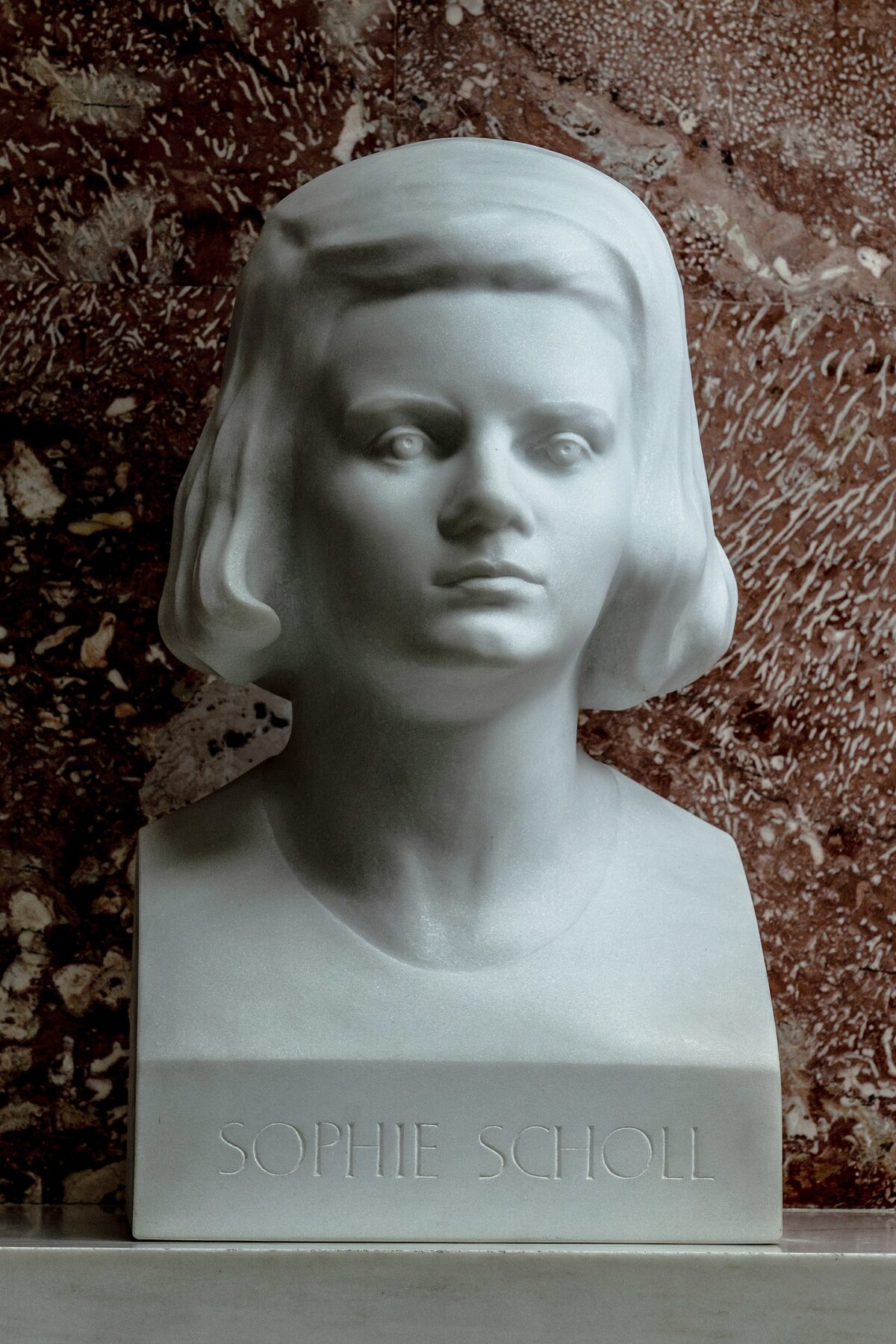
For youth who didn’t know better, these organizations offered purpose, veiling their abhorrent intentions behind a false sense of care for their members. But as they heard their superiors’ hateful rhetoric and witnessed the overt silencing of disagreement, the Scholl siblings realized that the purpose of Hitler Youth was indoctrination. Their enthusiasm turned to disillusionment.
In 1940, Sophie began to train as a kindergarten teacher. A few months later, the government conscripted her to auxiliary war services, a requirement for anyone who wanted to join a university. Common tasks included tending wounded soldiers in infirmeries, supplying troops with food and ammunition, or repairing damaged goods. The more Sophie experienced firsthand the harsh reality of war, the more adamant she became in opposing the despotic government.
After six months of service, Sophie enrolled as a biology and philosophy major at the University of Munich, where Hans was a medical student. Once in Munich, Hans introduced her to his new acquaintances, whose interests in art, poetry, and literature restored Sophie’s lost sense of freedom. The few, close-knit friends took refuge from their grim circumstances by reading beautiful texts and enjoying each other’s company. But the war continued. They knew they couldn’t sit aside as it destroyed everyone and everything they loved.
The White Rose
In 1942, Sophie and Hans met Alexander Schmorell, Christoph Probst, and Willi Graf. Together, they formed the White Rose, an underground coalition that sought to oppose Hitler’s regime. Between 1942 and 1943, they secretly printed and distributed six pamphlets across several cities in Southern Germany. Informed by their diverse religious and intellectual backgrounds, the members tried to awaken the conscience of fellow German citizens. Knowing full well the risks they ran, they called for passive resistance, denounced the war, and exposed Hitler’s extermination of Jews. As their first public statement declared, they sought to oppose the “most horrible of crimes—crimes that infinitely outdistance every human measure.”
The leaflets quoted a wide range of sources, which all underscored the danger of hate-based pride, the harmfulness of war on victims and perpetrators, and the importance of safeguarding freedom of expression from tyrannical forces.
For instance, the second leaflet cited the “Tao Te Ching,” which describes the wise person as one who will “forswear excess … will avoid arrogance and not overreach.” The third mentioned a passage from the Greek philosopher Aristotle, whose foundational book “Politics” argued that tyrants strive “to see to it that nothing is kept hidden of that which any subject says or does, but that everywhere he will be spied upon,” much like what Hitler and his cronies were doing to those under their rule.
Unlike the first few pamphlets, the fourth appealed to readers’ religious sensibilities, reminding them that “man is free, to be sure, but without the true God he is defenseless against the principle of evil.” For Sophie and her friends, the issue was ultimately religious. They invoked God for strength in advancing their resistance and invited their readers, who were mostly Christians, to examine the true teachings of their faith, which preached forgiveness, charity, and love towards fellow human beings. As Sophie’s boyfriend wrote in a letter he mailed her from the frontlines, “We know by whom we are created, and that we stand in a relationship of moral obligation to our creator. Conscience gives us the capacity to distinguish between good and evil.” Their conscience could be neither silenced nor manipulated.
Imprisonment, Trial, and Execution
On that fateful day in February 1943, the Scholls decided to distribute their sixth leaflet in the halls of the University of Munich. As Sophie tossed a few remaining copies into the main atrium, one of the custodians noticed her. He called the police, who came promptly and arrested both siblings.
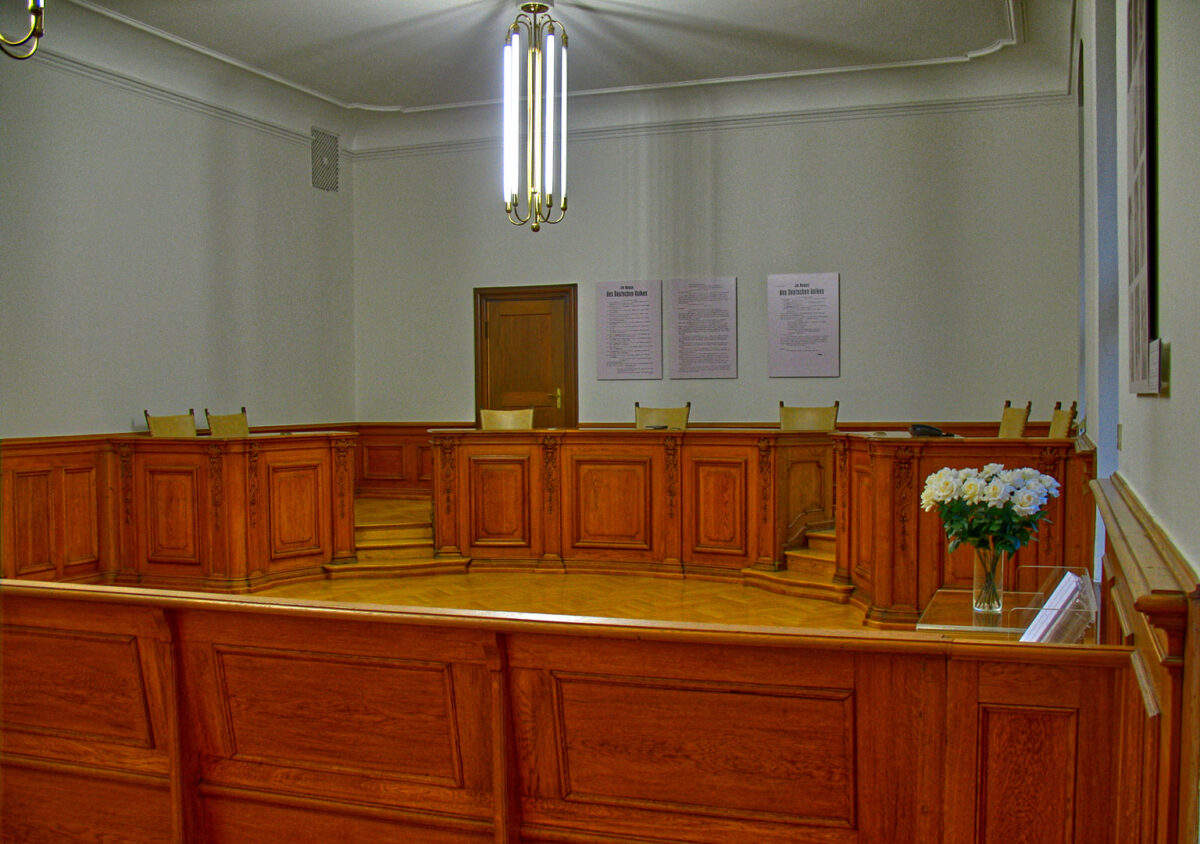
When their trial started a few days later, the prosecutor thought Sophie innocent. After Hans confessed his role as one of the leaders of the White Rose, she pleaded guilty, taking the blame in hopes of protecting their friends. She could have lived, but she chose self-sacrifice instead.
Months after their execution, a copy of the sixth pamphlet reached England’s Prime Minister Winston Churchill, who commissioned millions of additional copies to distribute them by plane all over Germany. The students’ words reached more people than they could have ever imagined. The war didn’t end, but hope was rekindled.
Hope and Freedom
The pamphlet that launched the White Rose’s public resistance closed with an emblematic quotation from Goethe’s “Epimenides Awakens,” an obscure allegorical play about the destructiveness of war and the return of peace to a world that resembles the German poet’s conflict-ridden society. Before peace is reinstated, the personified Hope speaks to a group of soldiers:
Now I find my good men
Are gathered in the night,
To wait in silence, not to sleep.
And the glorious word of liberty
They whisper and murmur,
Till in unaccustomed strangeness,
On the steps of our temple
Once again in delight they cry:
Freedom! Freedom!
Much like Hope in Goethe’s play, the White Rose and its members became heralds of freedom, best embodied in Sophie’s principled bravery. The young woman refused to remain silent, to ignore the blatant brutality around her and let fear dictate her conscience.
Would we ever risk everything for the freedom of others? Sophie did, and her legacy endures.
What arts and culture topics would you like us to cover? Please email ideas or feedback to features@epochtimes.nyc