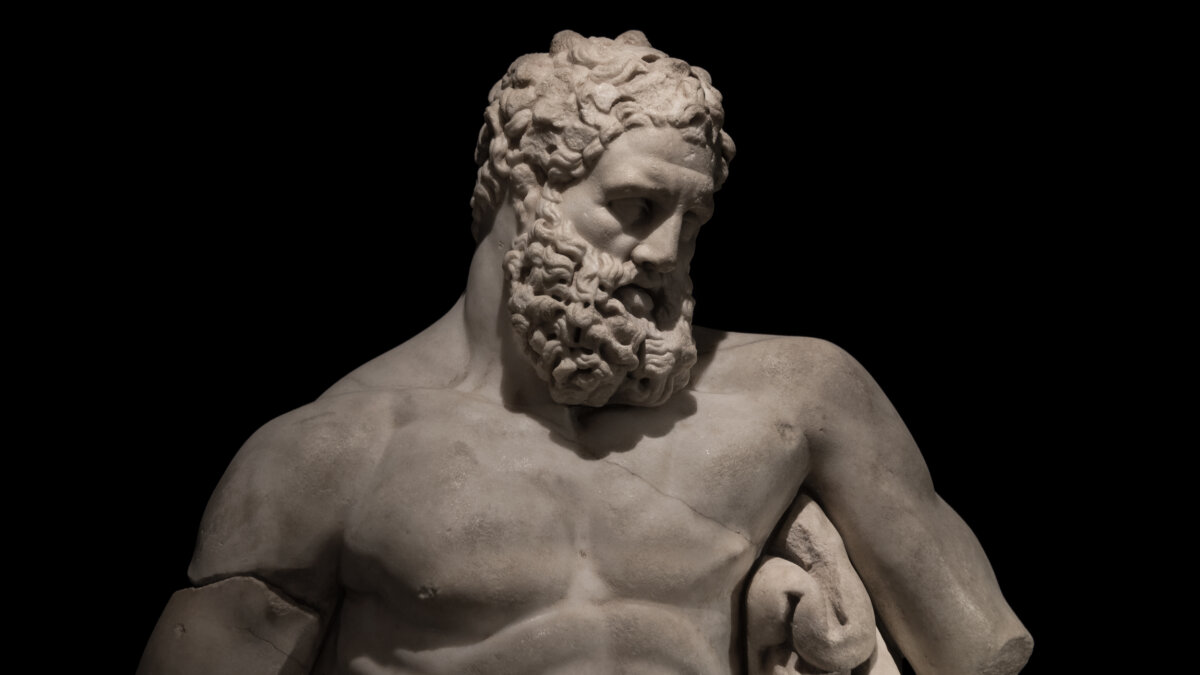
Of all the great Greek heroes, Herakles (or Hercules, as the Romans called him) was considered the greatest.
I touched on Herakles’s greatness in my article about his defeat of the Hydra and explained why this story is so relevant today. In fact, that feat was technically the second of Herakles’s 12 Labors that earned him immortality. (Of course, 12 isn’t an accidental number. For a fuller understanding of its significance across all cultures, I recommend “The Mystery of the Number 12.”)
Herakles’s First Labor
Do Herakles’s other labors speak to us now as brightly as the killing of the Hydra does? Surely, yes; it will come as no surprise that each labor has its own special quality.
The first of Herakles’s 12 Labors set the pattern for every heroic act that follows. It begins not with conquest but with confrontation: the meeting of human courage and primordial fear. Sent by King Eurystheus to slay the monstrous Nemean Lion, Herakles finds himself facing a creature that no weapon can wound.
Born of the monsters Typhon and Echidna, the lion is invulnerable to spear or arrow due to its golden hide. Herakles’s first blows glance off harmlessly. The hero is forced into a realization that will define his destiny. Some terrors cannot be overcome by force, only by presence.
Before outlining what Herakles does, I need to say a little about Typhon and Echidna, father and mother, as it were, of the Nemean Lion: Typhon is one of the most terrifying beings in all Greek myth. He’s the final offspring of Gaia (the Earth herself), and was created as a last challenge to the Olympian gods. He is in fact an anti-Zeus. He represents chaos, storm, and the untamed power of nature—opposing divine order. Zeus eventually defeated him with his thunderbolts, hurling him down and imprisoning him beneath Mount Etna, from which his fiery breath still issued as volcanic eruptions.
Echidna personifies the seductive, generative, and fearful aspects of nature—she is chthonic, belonging to the underworld, a symbol of what is fertile yet dangerous, alluring yet deadly. If Typhon embodies chaos as storm, Echidna embodies it as instinct, sensuality, and the mysterious feminine aspect of the earth. Thus, by slaying the Nemean Lion, Herakles isn’t merely killing an animal; he’s symbolically confronting the primal offspring of chaos itself. In fact, he’s carrying on his father’s (Zeus’s) work to restore order to the cosmos.
Facing Fear
Herakles, finding he cannot kill the Lion with his weapons, abandons them. He pursues the lion into its cave and wrestles it barehanded, body against body, life against death. It’s the most primal of struggles—one that recalls Jacob wrestling with the angel. It represents an inner battle that every human must one day face.
By strangling the beast with his own strength, Herakles demonstrates that courage isn’t the absence of fear but the decision to act within it. He defeats the lion not by avoiding its power but by embracing it, by entering the very space of dread and refusing to retreat. By strangling the beast he is also defeating disorder and thereby establishing the ordering of his own psyche.
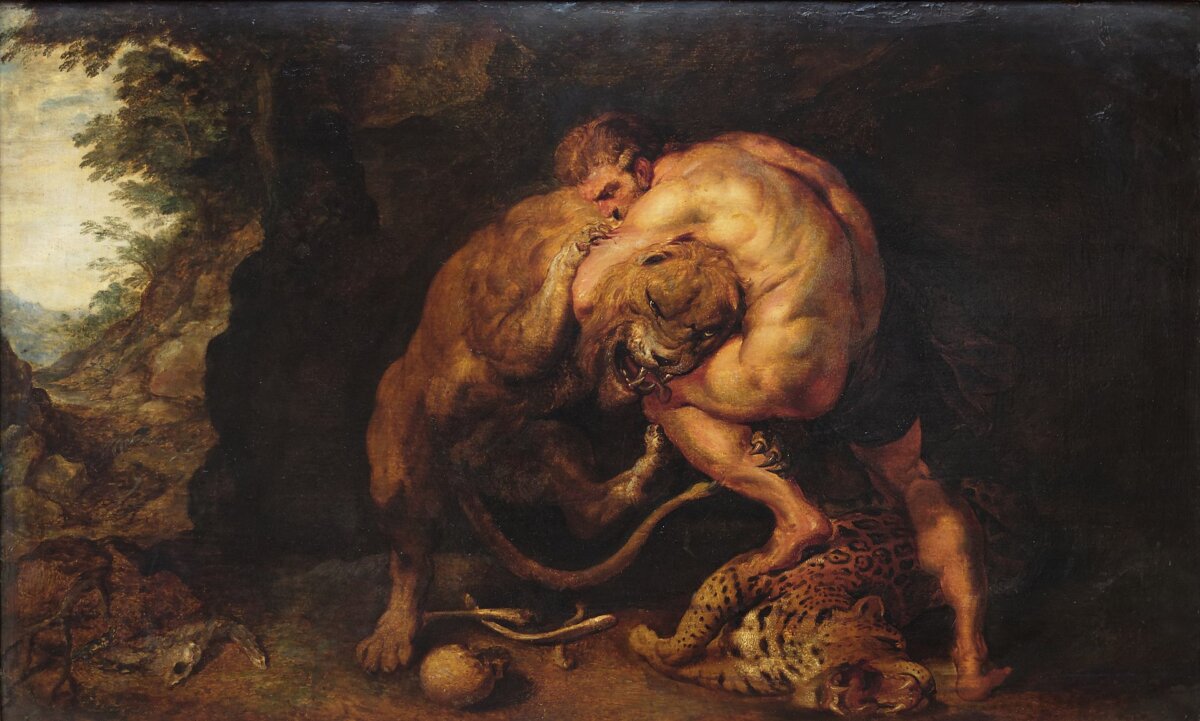
However, when the battle is done, another problem arises: The lion’s hide, impervious to all blades, can’t be skinned, and he needs the pelt to show it to the king. Again, Herakles must think differently, or as we like to say, “out-of-the-box.” No human tool will suffice; instead, a god (or goddess) tells him that the lion’s own claw can pierce its pelt. Using the beast’s own weapon, he strips the hide and thereafter wears it as armor.
Thus, fear—once confronted—becomes his protection. What once threatened to devour him now shields him. The myth captures a universal process: When we face what terrifies us, we are changed. The thing we feared becomes the source of our invulnerability.
In this image lies a profound psychological truth. The Nemean Lion symbolizes what Jung called the shadow—those disowned or repressed aspects of the self we prefer not to acknowledge. These may take the form of anger, vulnerability, shame, or trauma—anything we have buried in the dark corners of our psyche.
The Benefits of Facing Fear
These buried forces never disappear; they stalk us from within. To overcome them, we must do as Herakles does: Go into the cave, confront the monster, and wrestle it until its energy integrates into our being. The hero’s lion-skin cloak is the symbol of this integration. Having faced the darkness, he now wears it; it belongs to him and strengthens him.
This labor is astrologically linked with Leo, as each labor is linked to one of the 12 zodiac signs. The lion-hearted sign is ruled by the sun. It’s an image of illumination, creative fire, and self-mastery. The Leo soul learns that light isn’t gained by denying the shadow, but by shining within it.
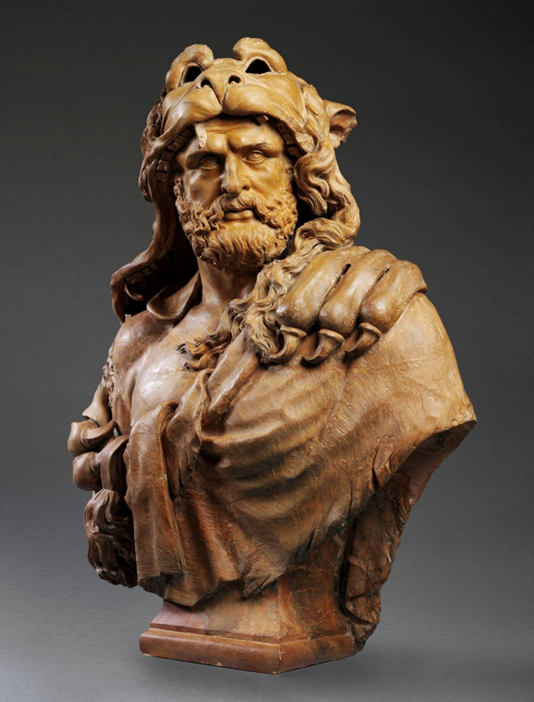
Herakles, as the solar hero, achieves that synthesis. He doesn’t destroy the darkness but absorbs it, becoming radiant through the encounter. The lion’s head atop his own in Greek sculpture shows both beast and man united: the animal spirit sublimated into divine energy.
There is a creative dimension here too. Every artist, thinker, or reformer must wrestle their own Nemean Lion. It’s the paralyzing self-doubt that whispers “You are not enough,” the blank page that mocks one’s ambition. No technique or cleverness can conquer it. Only courage—etymologically from the Latin “cor,” meaning “heart”—can; it comes from the heart, not the head. The willingness to endure the roar allows the work to emerge. Once faced, that fear becomes a kind of Muse. The resistance that once blocked creation becomes the very texture of the art. To create, like to live, one must dare to enter the cave.
This first labor therefore functions as an initiation. Herakles’s victory over the lion isn’t the triumph of strength over weakness, but of consciousness over terror. Having confronted the invulnerable, he becomes invulnerable himself, not in body but in spirit. His pelted cloak signifies that he now carries the essence of fear within him, transmuted into courage. It’s a metamorphosis from prey to protector, from vulnerability to resilience.
The myth continues to resonate in the modern world, which is, if anything, more fearful than ancient Greece ever was. Our lions are internal: anxiety, insecurity, the relentless noise of media and opinion. We fashion weapons—technologies, distractions, evasions—but none can pierce the hide. The only way forward is Heraklean: to abandon the futile tools of avoidance, to step into the cave, and to meet fear where it lives. Only then can we discover, as he did, that fear itself contains the claw capable of freeing and strengthening us.
Herakles’s first labor is therefore the prototype of all true transformation. Before we can purify, enlighten, or create, we must first confront the beast that guards the threshold. The hero isn’t the man without fear, but the one who has entered its heart and come out wearing its skin.
The Nemean Lion is slain, but its roar endures—within us, as a call to courage. To answer that call is to find the strength that no weapon can bestow and no adversity can destroy. In facing our fear, we become, like Herakles, lion-hearted: radiant, resilient, and free. Remember: this is the start of the 12 Labors. At this point, Herakles is relatively raw and inexperienced—but he needs to have defeated the Nemean Lion before he can begin to purge the world of its other monsters, and even more difficult challenges.
In the next article, we’ll jump to Herakles’s fifth amazing triumph and its significance: The Cleansing of the Augean Stables.
What arts and culture topics would you like us to cover? Please email ideas or feedback to features@epochtimes.nyc