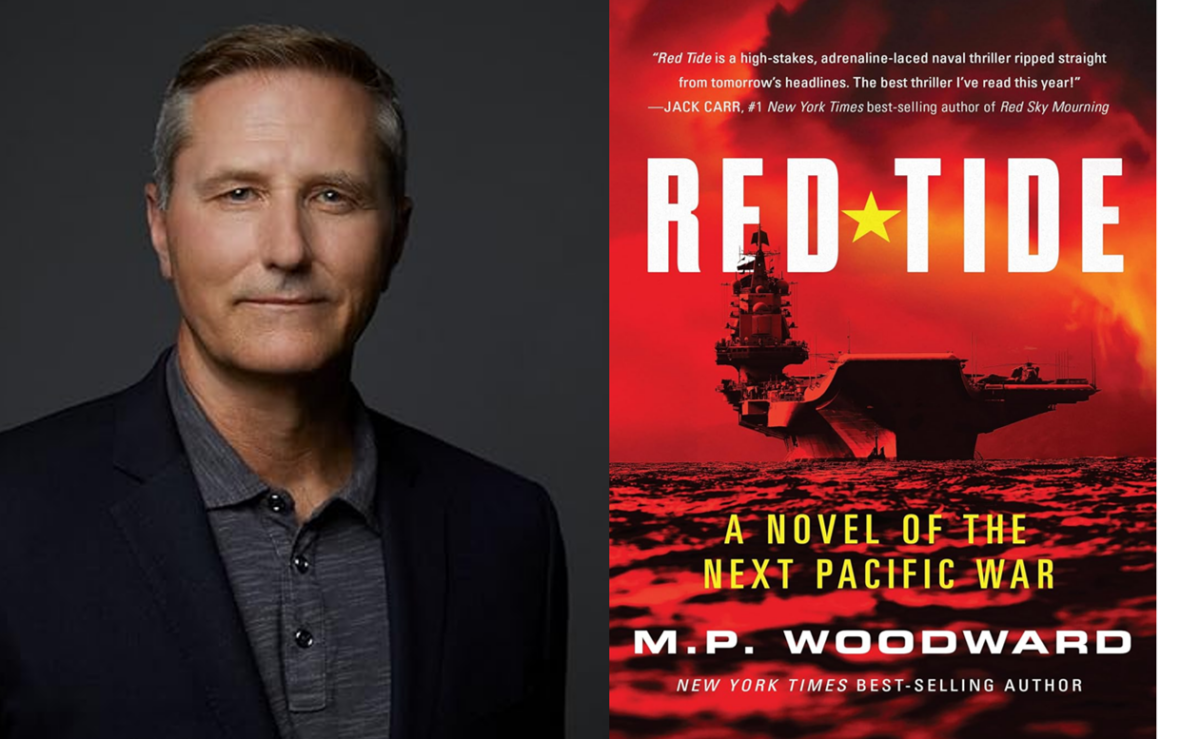
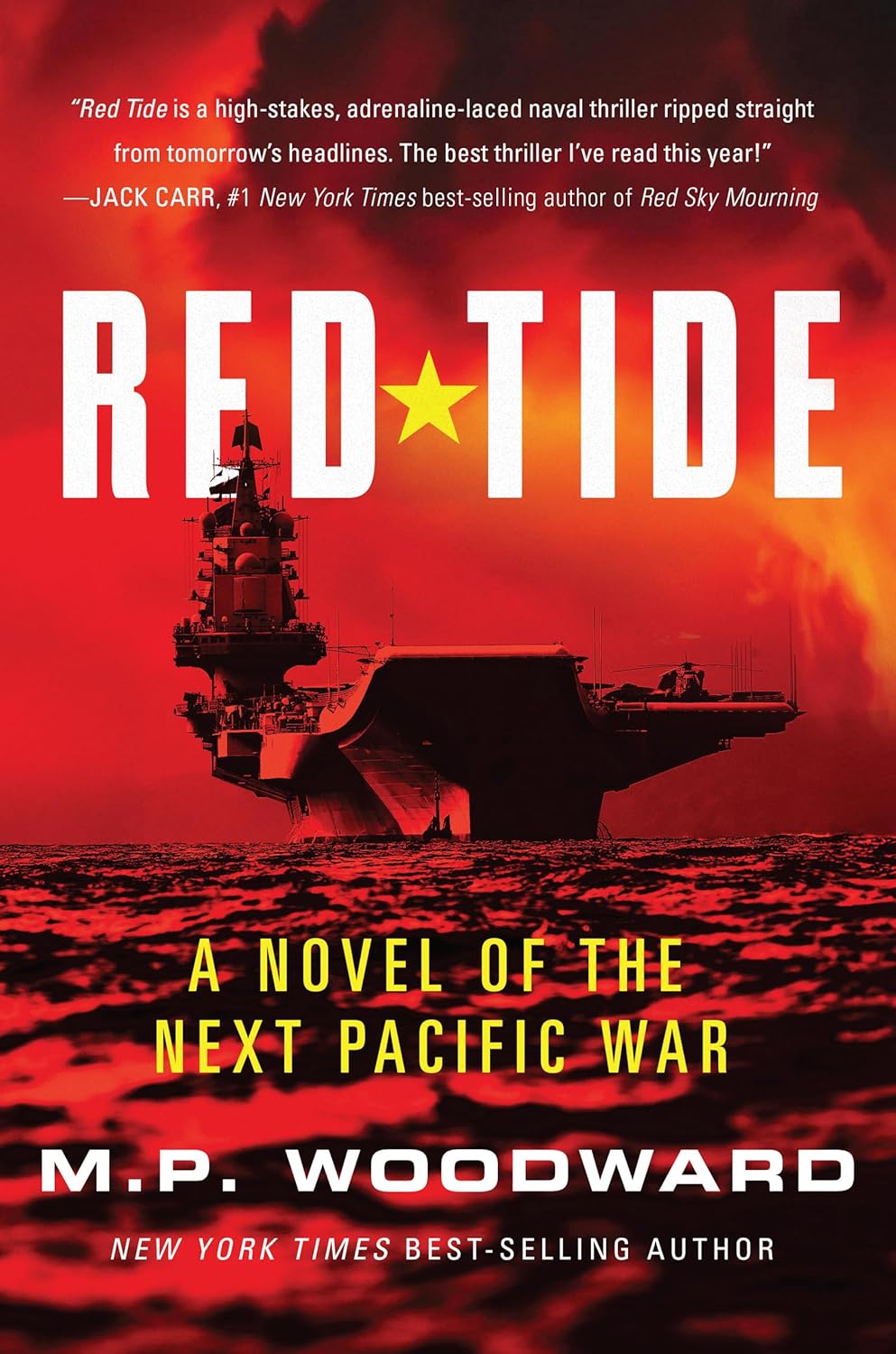
Tensions between Uncle Sam and the Red Dragon are at an all-time high in M.P. Woodward’s newest novel, “Red Tide: A Novel of the Next Pacific War.”
Just as in real life, in the novel China is obsessed with Taiwan and its manufacturing capabilities. When China sends a covert team of special forces to take over a Taiwanese semiconductor company, open hostilities follow, and American forces are suddenly playing catch-up.
If there are fans of military thrillers who are unfamiliar with M.P. Woodward, they probably should change that. Woodward is a former naval intelligence officer who has successfully leveraged his extensive background in covert operations and strategic analysis into a busy writing career.
His work caught the attention of the publishers of the Tom Clancy novels. So far, they have tapped him to write three new Jack Ryan Jr. novels, the most recent of which was “Terminal Velocity.” Technical accuracy and propulsive storytelling are two hallmarks of Woodward’s work, earning him high praise from readers who are keen on realistic spy fiction grounded in genuine operational expertise.
The ‘Fighting Coles’
Unlike Woodward’s previous works, the protagonists of “Red Tide” are an entire family whose roots run deep and throughout the military.
The patriarch, Rear Adm. Will Cole, ironically finds himself metaphorically adrift as he nears his retirement. The military is all he’s ever known. After leaving the service, his only plan is to repair his strained relationship with his wife, Kelly, and make up for the toll his career has taken on the couple.
But fate has other plans. The Pacific Fleet Commander orders him to take charge and speed up the overhaul of the USS Lincoln. The brass are worried that there are too many holes in their Pacific defenses, and they need the Lincoln to fill the gaps.
Cole’s eldest son is Lt. Henry Cole, a decorated naval aviator who followed in his father’s footsteps by attending Annapolis and serving aboard a carrier. The middle child, Jamie Cole, chose a different maritime career, opting for the Australian Merchant Marines. The youngest Cole, Lucy, stayed on dry land to attend college and graduate with a degree in computer science. But she, too, has the strong will and determination that helped them gain the nickname, “The Fighting Coles.”
In the prologue, Jamie is aboard his merchant ship, which now needs an escort from an Australian cruiser, as global tensions have become particularly acute. GPS systems worldwide are down, and the seaways are full of nervous sailors. Moments later, one of China’s newest submarine cruisers attacks his ship.
In Taiwan, Sam Chang is the head of a major semiconductor manufacturing company. He’s under pressure from the U.S. government to comply with their sanctions against China, but the Beijing leaders change the rules, sending a covert attack force to take the plant by force. Unbeknown to Sam, his family is being targeted directly by Chinese spies.
Once hostilities begin, all hell starts to break loose. China declares that several seas around Taiwan are off-limits to foreign ships; this effectively creates a blockade. Soon after, a U.S. submarine in the Philippine Sea comes under attack and is seriously damaged. American forces are suddenly scrambling to deal with the situation before it’s too late, and all the Coles are drawn into the fray.
Real People, Real Scenarios
What’s interesting about “Red Tide” is the depth of detail that Woodward brings to his characters. Thrillers that lean heavily into technical jargon and feature more acronyms than you can shake a stick at tend to forget to include the humanity.
Even beyond the Cole family, it’s great to see how much thought and care Woodward placed into all the characters. The antagonists, the heroes, and even a group of tourists caught in the middle of a sudden war are memorable, likable (the good guys), detestable (the bad guys), and uniformly well-detailed.
That tourist side narrative was a happy discovery. Most of the time, civilians aren’t part of the big picture in a story like this. Or, if they are, their presence seems contrived and marketing-driven. Not so here. The recurring appearance of civilians evolved naturally throughout, and returning to their storyline made for a welcome contrast.
But the real success of “Red Tide” can be attributed to Woodward’s combination of complexity in his world-crafting and efficiency in his writing.
There are a lot of moving pieces here; this isn’t surprising, considering the subject. The Chinese and American economic issues alone are difficult to comprehend. Added to that is a lot of military hardware, modern spy craft, geopolitical considerations, and cultural differences to make this a monumental undertaking. The fact that “Red Tide” isn’t twice as long as it is turned out to be is laudable on its own.
“Red Tide” is a lean, fast-paced thriller. The beginning starts with a bang, and the tension builds continuously before the first shots are fired. Once things get moving, the energy level stays high, and crises come by the dozens.
Not only is “Red Tide” an excellent thriller on its own merits, it may well signal that there is a new contender for the military thriller crown.
‘Red Tide: A Novel of the Next Pacific War’
By M.P. Woodward
Naval Institute Press: Sept. 23, 2025
Hardcover, 416 pages
What arts and culture topics would you like us to cover? Please email ideas or feedback to features@epochtimes.nyc