



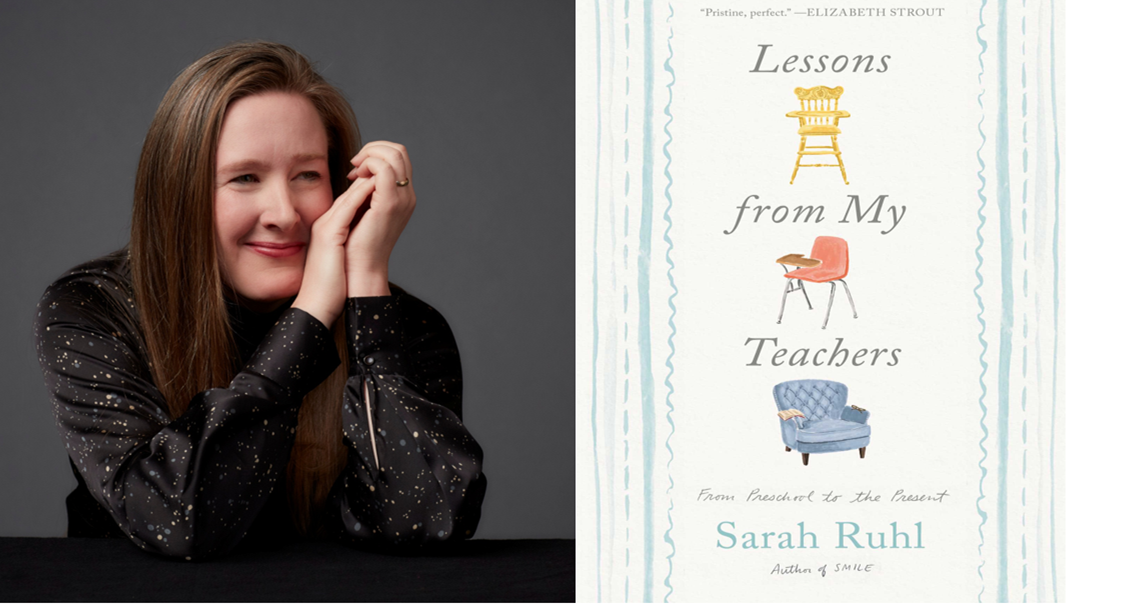
In Sarah Ruhl’s new book, “Lessons From My Teachers,” the author doesn’t rehash obvious tips we’ve heard before, but digs deeper, sharing subtle wisdom from unlikely sources. These are individuals not expected to be included, like a gardener who opened up her eyes to much more than keeping a begonia alive, or how an ill-fated meeting with a disgraced Hollywood mogul gave the author a lesson about power.
It’s the kind of book a reader is meant to savor and allow the wisdom to settle by taking the time to ponder each lesson before moving on to the next. These essays may appear to be simple parables at first, but in fact, each provides an unexpected takeaway from the circumstances the author finds herself in and the people she meets along the way.
That these 60 or so essays are no more than a few pages long doesn’t mean they lack depth. The essays are treasures of clear and concise storytelling. Ruhl exhibits respect for her readers’ ability to grasp the lesson without a lot of padding or unnecessary information. She spells out how these experiences and conversations have been instrumental in her life. She uses the term “transformative,” with the hope they are as beneficial to her audience.
Take, for instance, the story on how to weather the aftermath of a critical review. After a “particularly damning” review about a play she wrote, Ruhl took it hard. She held onto the anger, vowing never to read another review again. However, as she tried to reconcile these feelings, she remembers how horses can walk through fire with blinders on, and the blue whale has a filtration system that takes everything in and filters out what’s not sustenance.
The author wondered if she could take on those same qualities. She set out to change her attitude about what critics wrote about her. Readers who can relate to this example may come away with a new perspective should they be harboring similar feelings.
Lessons From Unlikely Places
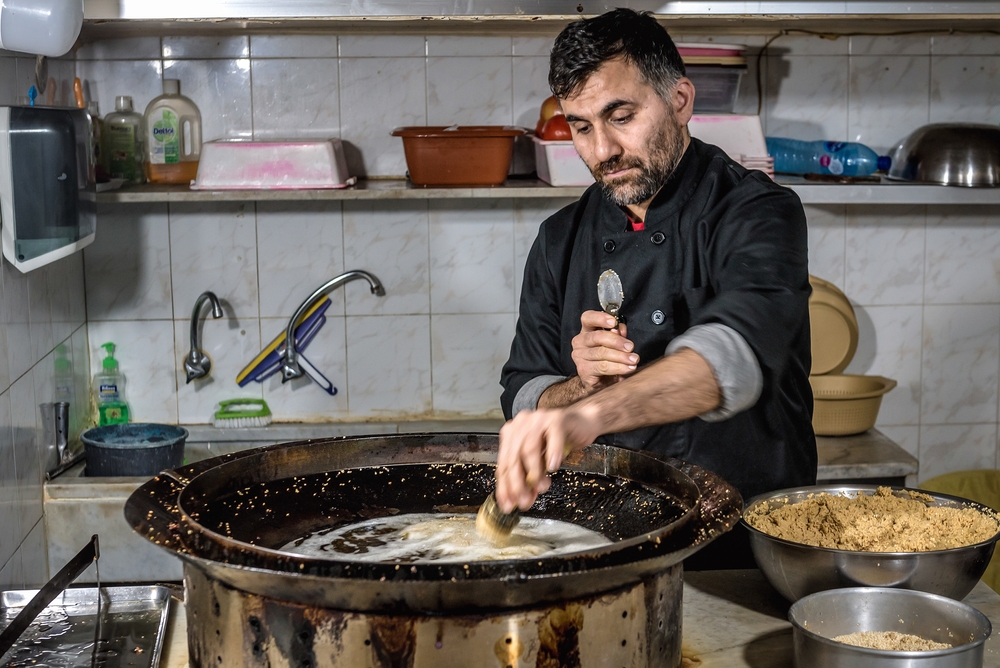
Here is a lesson from Ezra, the falafel maker. Ruhl had been favoring his Manhattan location and was a regular customer, she says, when in the neighborhood. She chatted with him about his work and Ezra’s belief his falafels are the best “on the planet.”
When he heard that Ruhl was a writer working on a play, she shared the plot. “But,” he asked, “Where is the love story? Every good story has to have a love story.”
Ruhl thought he had a point. From that conversation, she now asks those she meets for their love story and makes a point to include one in her writing. She counsels her writing students to do the same and “make geographical decisions based on love rather than career.” She says the writing life can come and go, but having someone to come home to “might be more predictive of duration in the field than anything else.”
There’s the story about a cranky neighbor, the power of a knock on the door, and a peach pie. There is another about how a book she wrote was the catalyst for discovering the unknown disease she’d been battling for a decade. Her daughter, Hope, provides a lesson and so does her small white Havanese named Minerva. The author also has an interesting conversation on a train with a Tibetan monk. One after the other, readers see that simple moments can become philosophical takeaways.
Ruhl’s bio recounts her accomplished playwriting career and the awards she’s received; her “In the Next Room,” was a 2009 Tony Award for Best Play nominee. Other honors include her status as a two-time Pulitzer Prize for Drama finalist, a Pen Award (also known as the Laura Pels Theater award) winner, and the recipient of the Charles MacArthur Award for Outstanding Original New Play or Musical, also known as the Helen Hayes Award for Best New Play.
She’s also a poet and a professor at the Yale School of Drama, where she’s taught for over a decade. The thing about writers, our author concluded, are their keen observations, their skill at paying attention to the people that come in and out of their lives, plus the big and small moments. Especially for successful playwrights, there has to be a desire to understand and value why people do and say the things they do.
True Bravery
The Epilogue explains the “how” and “why” this book came to be. She’d been gathering inspiration from friends and acquaintances on their most important teacher for a class she teaches at Yale. The list included “neighbors, bandleaders, martial arts teachers.”
She also gathered information from friends about their mentors. Ruhl was surprised that some were too afraid to look for one, fearing it showed an uncomfortable vulnerability. “It made me realize,” she wrote, “that finding a teacher is also a process of letting oneself be taught—which is a kind of bravery.”
This collection is also a way for the author to let her lifelong teachers know how much of an impact they’ve had on her. One teacher responded with surprise, telling Ruhl she never really knew whether she affected her students’ lives. “I was shocked,” Ruhl wrote. “It seemed so clear to me, the profound effect she’d had on hundreds of students; I couldn’t believe that wasn’t plain to her.”
With teachers, she wrote, it isn’t always the formal teaching that goes on, but the “attention, presence and listening” that leaves the most lasting impression.
In addition to the wisdom learned from others, Ruhl added her own. She advocates gratitude by encouraging readers to thank a former teacher with a letter or, better yet, with a visit. These are the teachers that didn’t simply share their knowledge, but whose lessons continued long after their students left the classroom.
‘Lessons from My Teachers: From Preschool to the Present’
By Sarah Ruhl
S&S/Marysue Rucci Books: May 6, 2025
Hardcover, 240 pages
What arts and culture topics would you like us to cover? Please email ideas or feedback to features@epochtimes.nyc
