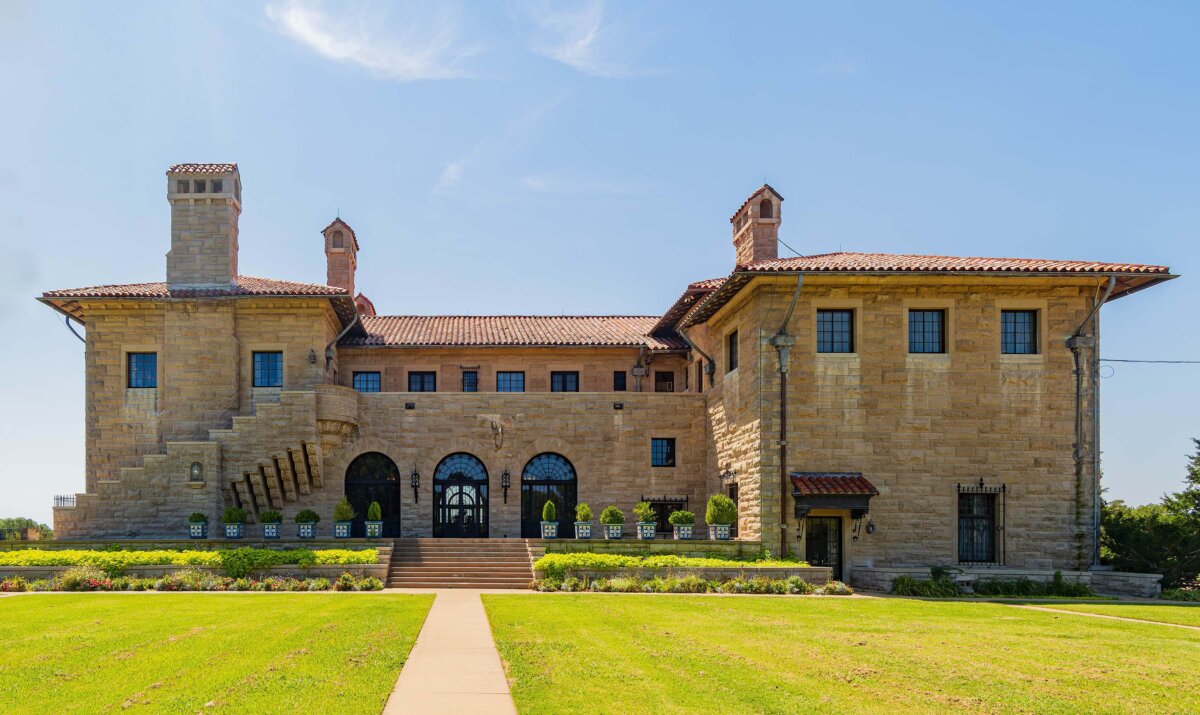
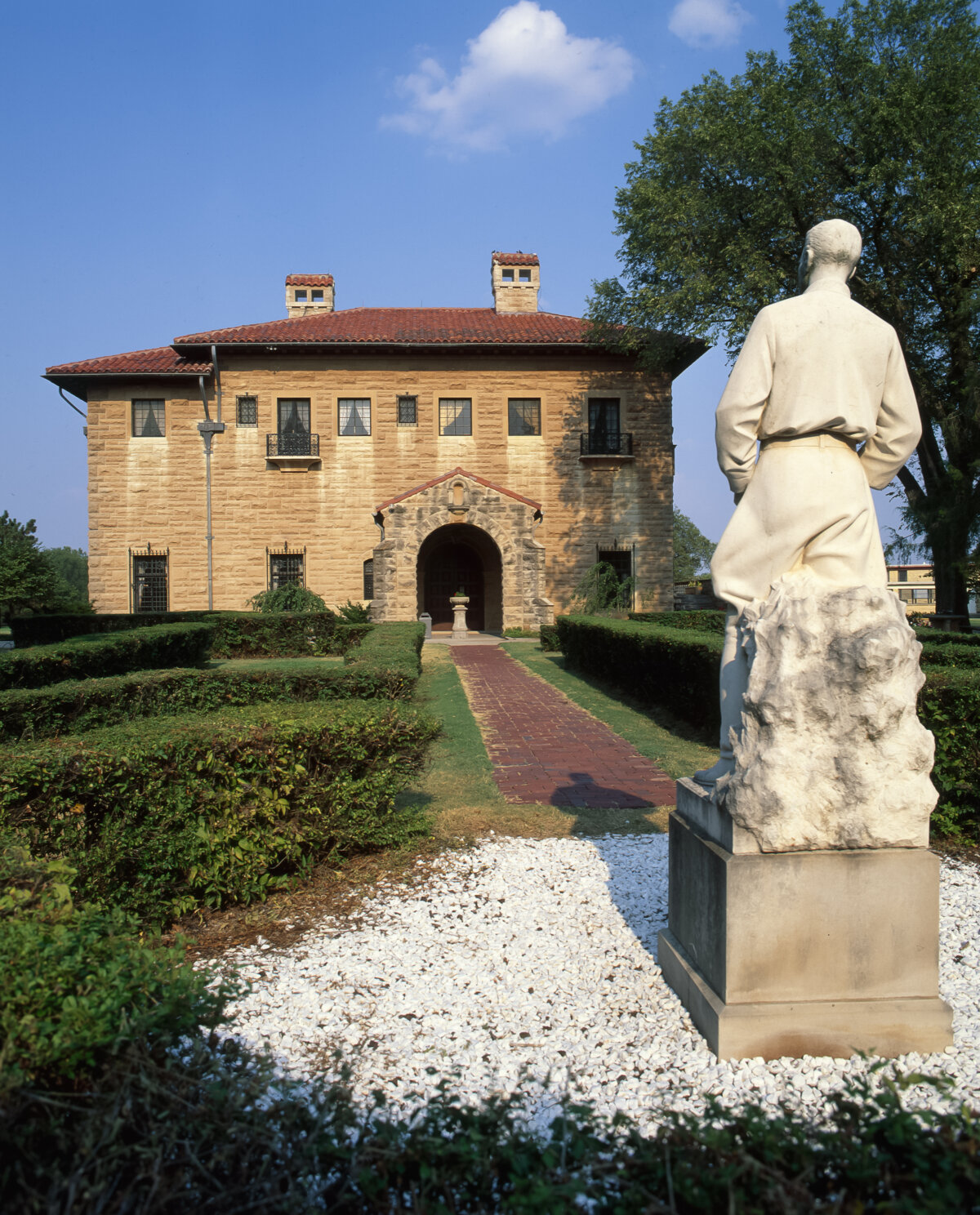
On the prairie near Ponca City, Okla., E.W. Marland created his own castle in the form of a Tuscan villa. Built of rusticated limestone blocks quarried on site, the 55-room "palace on the prairie" is topped with an Italian Renaissance-style terracotta tile roof. Balconies supported by massive corbels punctuate the facade. (Kit Leong/Shutterstock)
Rising above the prairie in Ponca City, Oklahoma, is a fine “castello” constructed in the Tuscan style. Modeled after the Davanzati Palace in Florence, Italy, the E.W. Marland Mansion showcases the work of many artisans and craftsmen from around the world. The Mediterranean Revival-style palace is very true to the distinct architecture of Tuscany, the region of Italy where Florence is located. And its builder might be classified as a Renaissance man.
Ernest Whitworth Marland became a wildcatter in Pennsylvania, where he made (and lost) his first fortune. Undaunted, he explored for oil in Oklahoma and made his second fortune. At the height of America’s oil boom, Marland controlled one-tenth of the world’s oil, and he wanted a home to reflect his wealth and status.
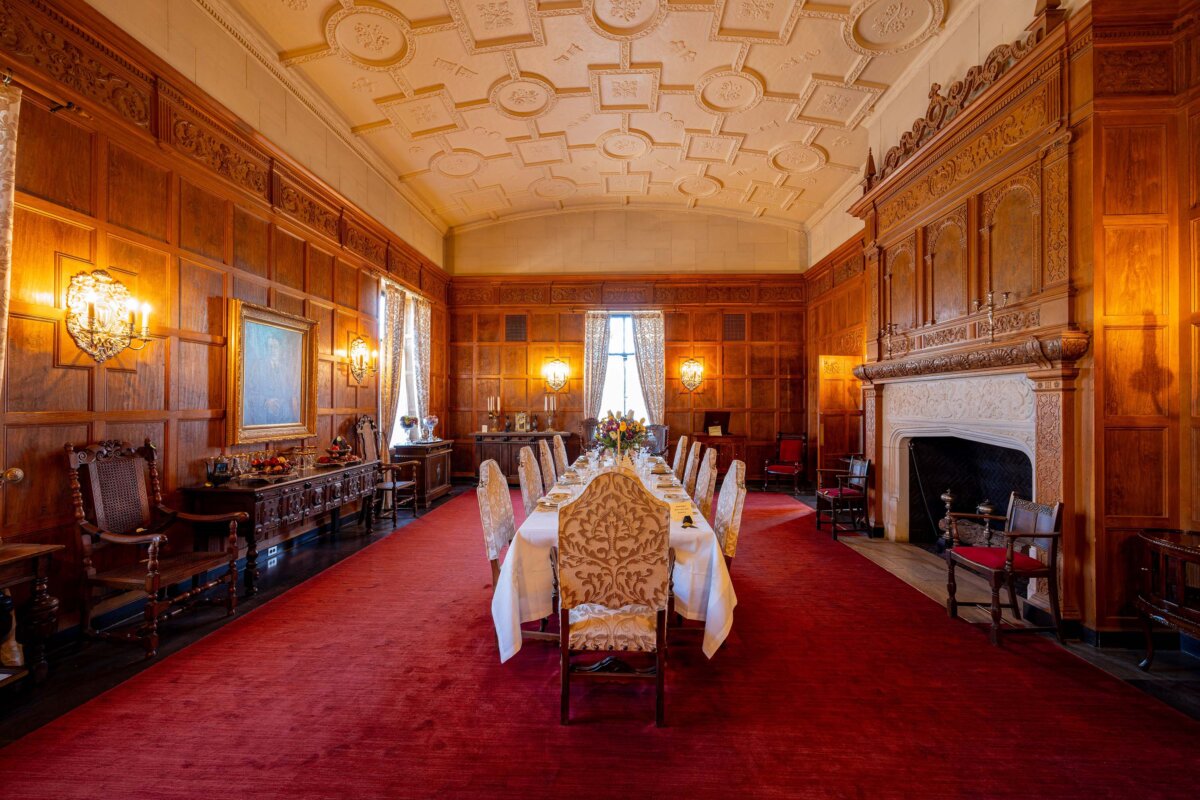
He hired John Duncan Forsyth (circa 1887–1963), a Scottish-born architect educated at Paris’s École des Beaux-Arts who established his practice in Tulsa, Oklahoma. Forsyth skillfully orchestrated an eclectic blending of styles. The house showcases a country-style English breakfast room that Marland loved and a formal Elizabethan-style dining room that is constructed with carved English oak paneling.
The 43,561-square-foot mansion was built on 2,500 acres between 1925 and 1928. Most of the palace’s decorative designs were painted by the artist Vincent Maragliotti, who was born in Sicily, Italy. He spent three years painting murals and decorative motifs for the estate.
The mansion was one of the largest houses in the United States at the time of its construction and features many modern conveniences that were novel in 1928. There is an automatic dishwasher, a refrigerator, central heating and air conditioning, and an elevator. It is one of the first elevators built in a home, and in a nod to the Southwest, it is lined with buffalo leather.
The E.W. Marland Mansion stands today as a testimony to Marland’s intriguing story, as well as the outstanding artistry of the skilled people who constructed it. The estate was designated a National Historic Landmark in 1977 and the house museum is open to the public.
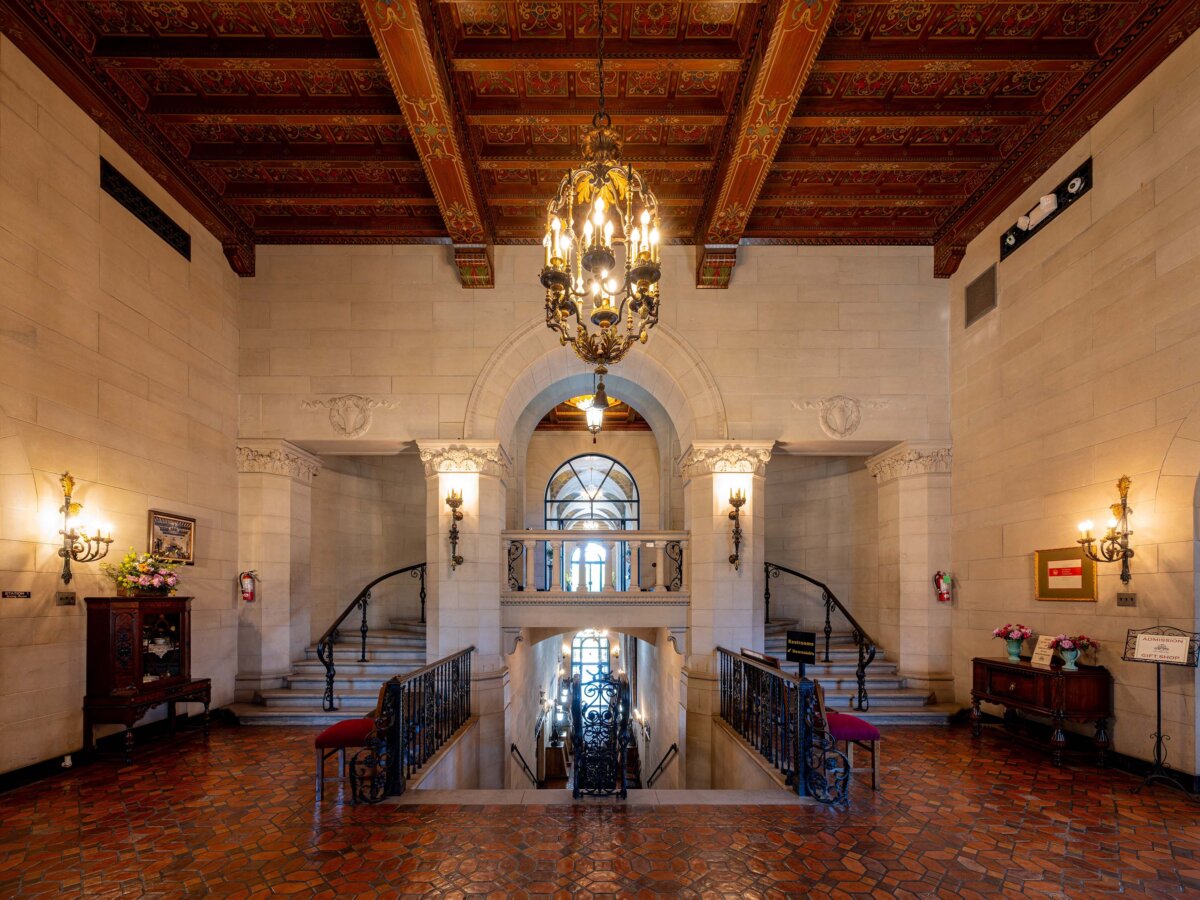
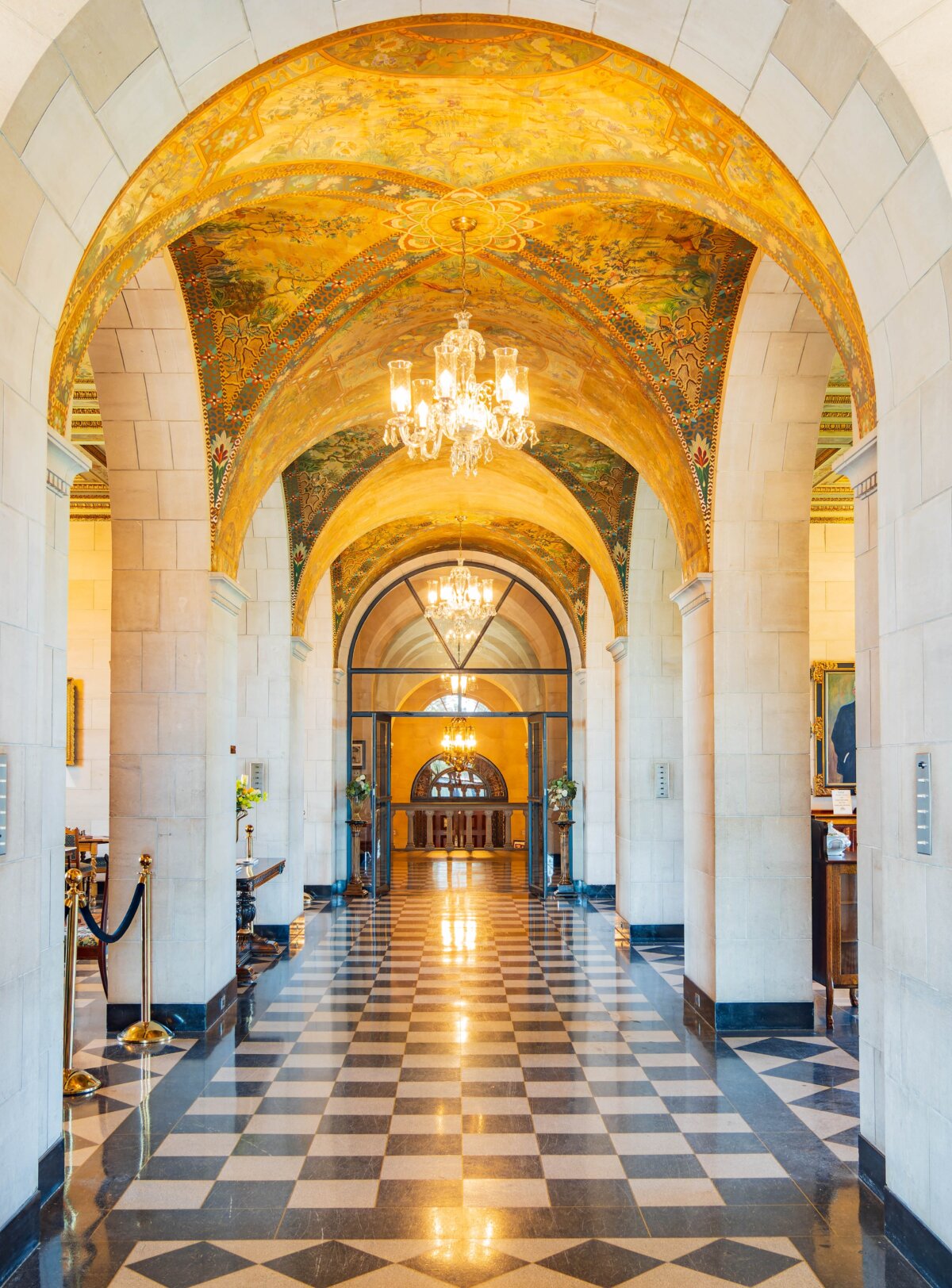
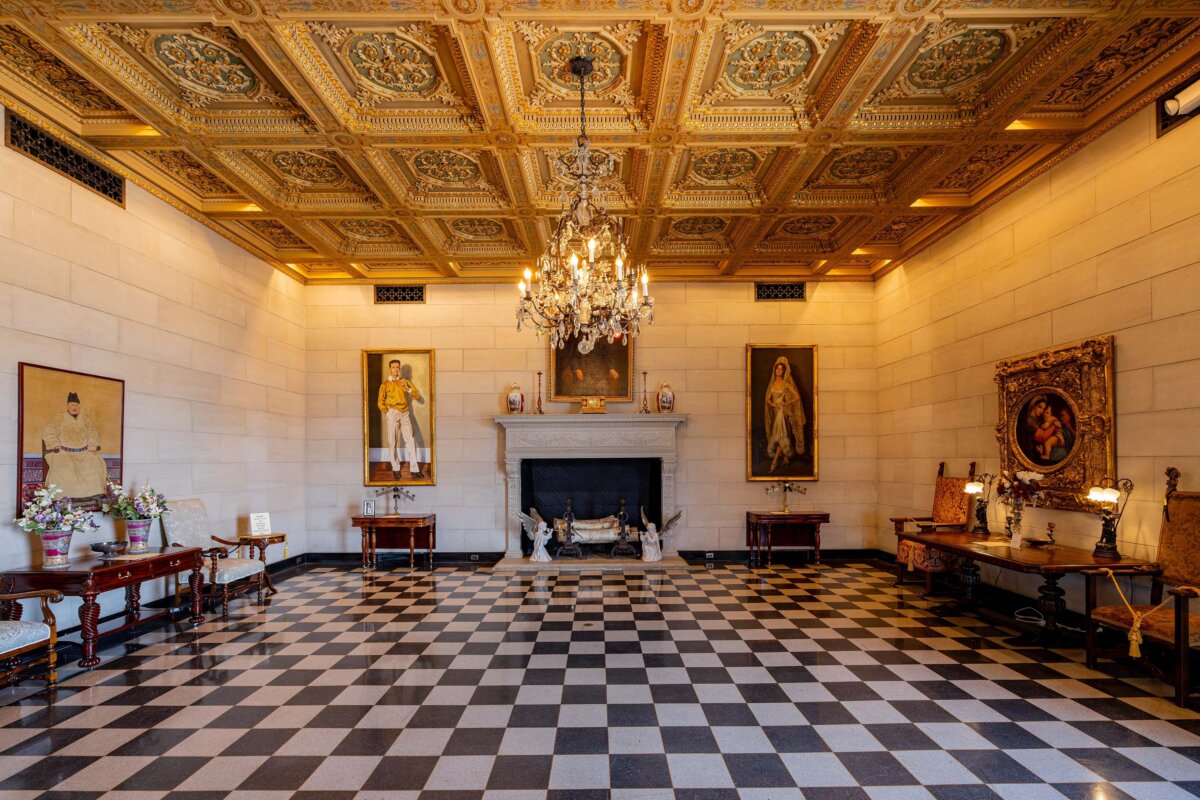
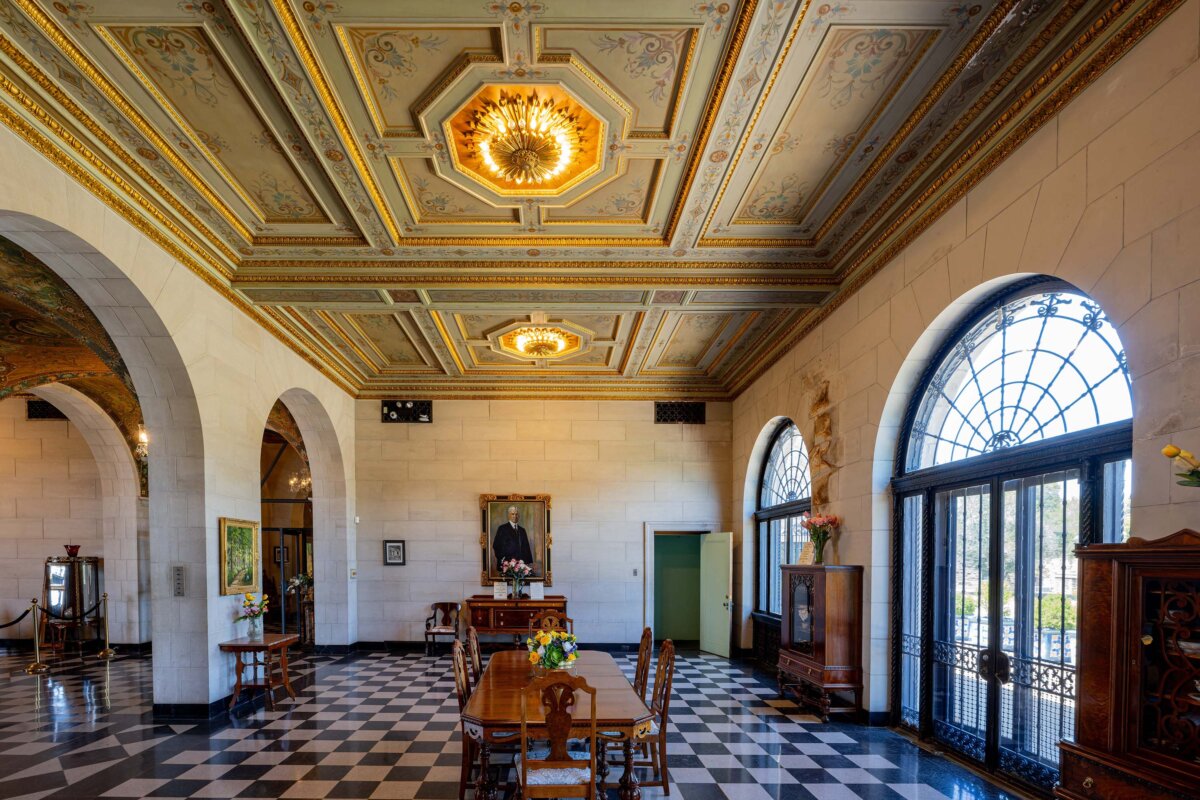
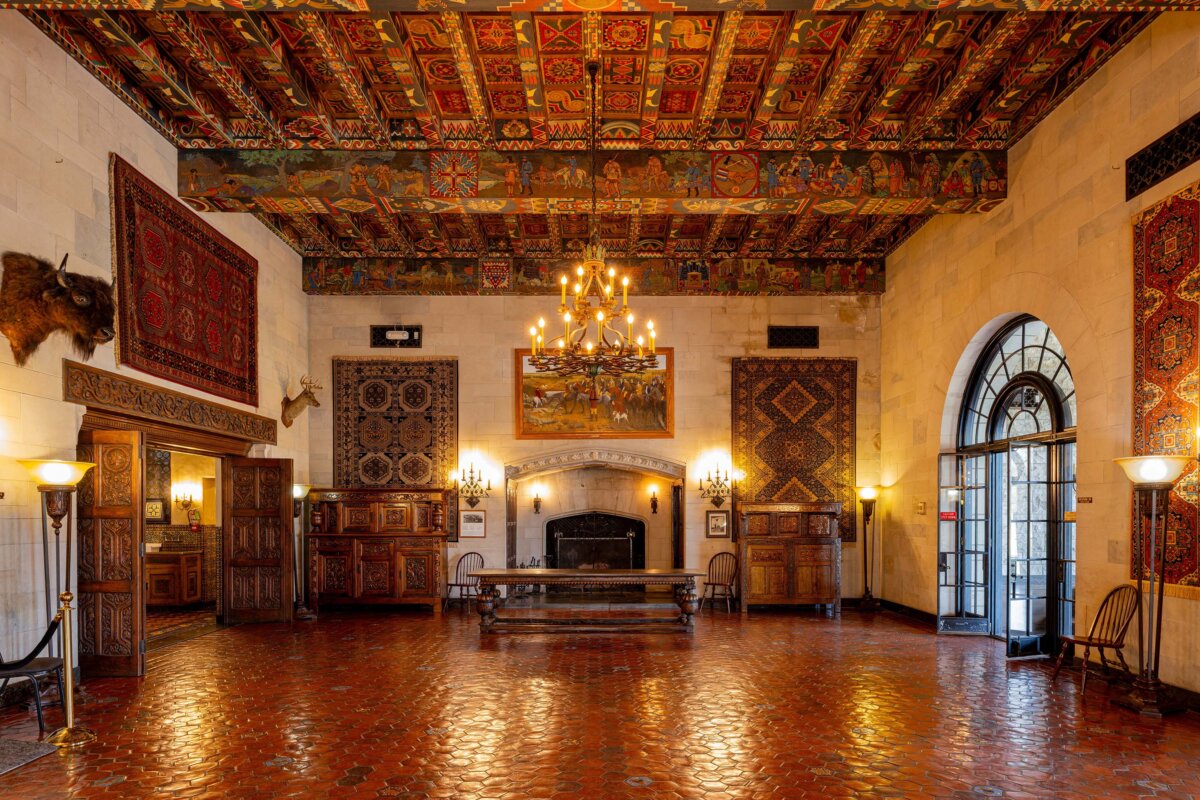
A grand marble, double staircase ascends from the entrance hall to the second-floor loggia and descends to the first-floor gallery. The house had 861 light bulbs illuminating the interior, many in fixtures such as this exquisite bronze chandelier. The walls are constructed of limestone, and a large Palladian arch frames the stairs. The wrought iron seen throughout the interior is a common feature of Tuscan architecture. (Kit Leong/Shutterstock) The loggia features an intricately painted ceiling mural by Vincent Maragliotti. The design is inspired by Chinese Chippendale motifs, which incorporated Gothic and Asian elements. Painted by Maragliotti on flat sheets of canvas, the mural was then applied to the curved plaster vaults. The checkered floor is terrazzo, which is a mixture of crushed marble and concrete poured into brass dividers. (Kit Leong/Shutterstock) E.W. Marland’s second wife, Lydie, loved to dance. The mansion’s grand ballroom, with its gilded ceiling coffers and two enormous Waterford Crystal chandeliers, was where Lydie spent many evenings swaying to the music. Her portrait hangs to the right of the fireplace, where she is depicted wearing a Spanish gown and mantilla. Marland’s portrait hangs over the mantel, and a portrait of his adopted son, George, hangs to the left. (Kit Leong/Shutterstock) Flanking the loggia are the North Salon and South Salon, where E.W. Marland and Lydie Marland welcomed guests for formal events. The North Salon (pictured here) was also called the Sun Room and features Italian stucco walls and a gold-trimmed coffered ceiling that was richly painted by Vincent Maragliotti. (Kit Leong/Shutterstock) To the left of the foyer is the grand Elizabethan dining room. The carved paneling is fashioned from pollarded English oak taken from the royal forests by special permission of the king. Pollarding is a severe pruning method that causes the trees to grow with a unique grain that is desirable for veneers and panels. A barreled ceiling of cast plaster crowns the room. (Kit Leong/Shutterstock) The Inner Lounge, or Winter Room, features a ceiling mural depicting the history of the plains in Kay County, Okla. Painted by Vincent Maragliotti, the mural progresses chronologically across the ceiling, beginning with pre-Columbian Indian settlement on the south beam. The right side of the massive hearth features a secret door to a safe room that could hide the family or high-profile visitors if a dangerous situation were to occur. (Kit Leong/Shutterstock) A replica statue of George Roberts (E.W. Marland’s adopted son) stands in the garden facing the mansion’s western entrance. It is one of three French limestone statues that Marland commissioned from sculptor Jo Davidson for his mansion. The original works by Davidson now stand just inside the entrance to the house. (Richard G Smith/Shutterstock)
What arts and culture topics would you like us to cover? Please email ideas or feedback to features@epochtimes.nyc.
Bob Kirchman is an architectural illustrator who lives in Augusta County, Va., with his wife Pam. He teaches studio art to students in the Augusta Christian Educators Homeschool Co-op.