



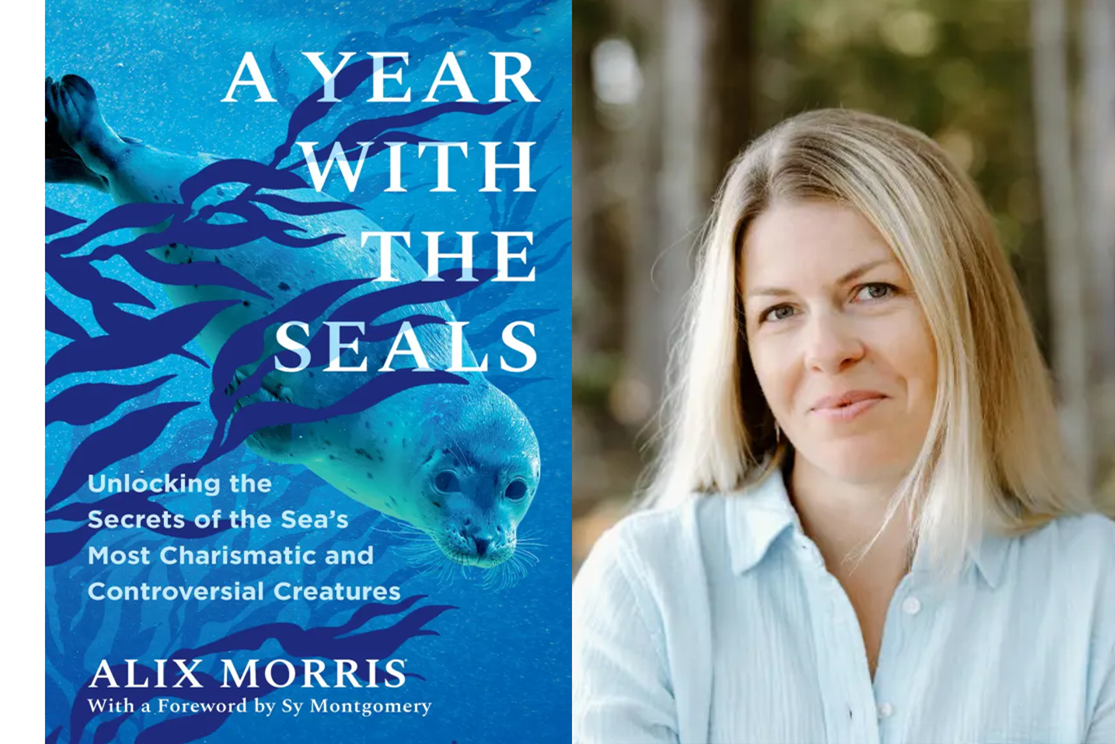
In “A Year With the Seals: Unlocking the Secrets of the Sea’s Most Charismatic and Controversial Creatures,” author Alix Morris confesses she hadn’t thought much about marine mammals. They reminded her of her dog; all she really knew of them was their popularity at zoos and aquariums.
That all changed one summer when living on the Maine coast, and she heard a news report about a shark attack on a New York vacationer. Local officials blamed it on the seals since their increased numbers were attracting more and more sharks to the area.
Already a prolific wildlife writer for science publications, Morris began to think about seals, their life cycles, and their purpose in the ecosystem. Local economies in Maine relied on the dollars from seal walks and seal boat tours; yet the seals’ healthy numbers were an issue with fishermen who complained they were feasting on their catch. What was, she wondered, the appropriate number of seals to satisfy all parties?
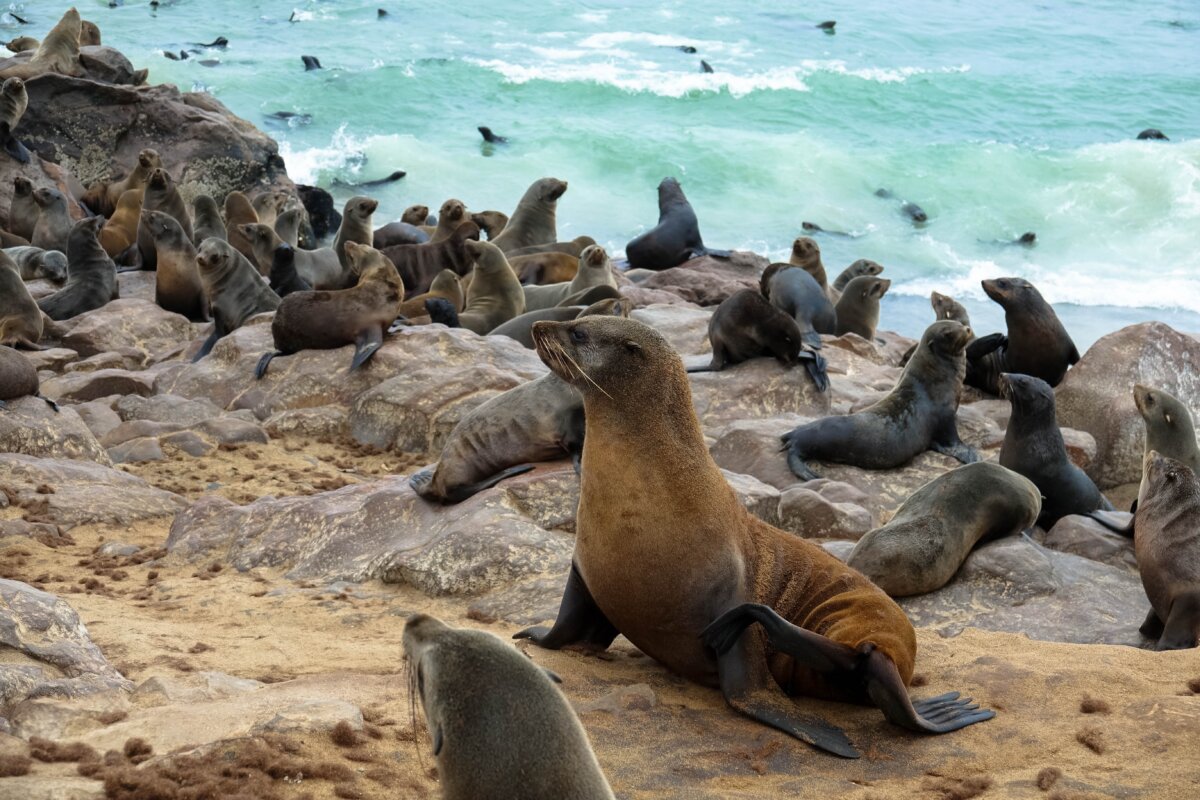
Hoover, the Talking Seal
Before getting into the politics of seals and their impact on coastal and fishing areas, Morris introduces readers to Hoover, the talking seal. Perhaps it was her intent to inspire her audience to become just as enamored as she was about the “clowns” of the marine mammal world.
Hoover was the seal pup saved and raised by Maine resident, George Swallow. He kept the seal comfortable in his bathtub and fed him a mix of fish and warm milk that was gobbled up so fast that he earned the name Hoover, after the vacuum cleaner.
The two formed a bond and, since Swallow regularly conversed with Hoover, the seal began to talk back. Word spread, Morris writes, and the seal soon entertained the local kids. Famous phrases were “Get outta here,” “Come ov-ah hee-yah,” and “Hello dere”—words Hoover spoke with the same New England accent as his owner.
Hoover’s popularity grew, and he became a local celebrity. On Swallow’s tombstone, both he and his buddy are illustrated in stone with the inscription “George and Hoover.” When Hoover died, the Boston Globe published his obituary.
Training Seals
Having shared the sort of intimate bond that can develop between human and seal, Morris talks about her own relationship with seals and her yearlong study of them. She visited marine laboratories and aquariums across the United States; she learned about the seals’ intelligence, their relationships, and how the early peoples depended on them for survival.
Divided into the four seasons, the book follows Morris’s travels as she meets researchers and watches the seals answer commands; this is not to show off for an audience, but for researchers to understand more of how their bodies and senses work.
At the New England Aquarium, for example, she meets Chucky who, when prompted, opens his mouth wide and sticks out his tongue so the trainers can demonstrate how they learn about how seals catch and consume their prey.
Morris learns about the challenges seals face at the hands of helpful humans. Sitting with a group of staffers at a Maine marine rehab center, Morris explains that the biggest danger seals face besides frustrated fishermen are “overly attentive beachgoers.”
A large percentage of seals have their babies along the Maine coast, and the mothers leave their pups to gather food. Passersby misinterpret this as abandonment and cover them up, some returning them to the water. Despite their good intentions, they’re preventing the animal from being able to rest, which is crucial in their early days of life.
A Seal’s Whisker
Studying the animals humans share the world with can sometimes unlock answers to questions we humans face. Take the seal’s whiskers for example, the body part that provides a sixth sense for the seal to detect moving objects. MIT researchers have replicated whiskers to determine whether what they learn can aid ships and underwater vehicles better sense their environment.
Morris hits on many timely issues, especially the state of our ecological system and the conflicts between humans and the natural world. She points out how large-scale fishing disrupts the life cycles of the creatures that inhabit the waters.
Although she’s experienced a whole host of animal life, Morris’s focus on one species, its life cycle and challenges over the course of 12 months, enables readers to easily grasp what can be lost if change is not enacted.
It becomes evident that the experience changed the author. “The more I’d spent watching and thinking about seals,” she writes, “the more I’d consider my own role in nature, my tolerance for inconvenience, the power I had to control, protect, destroy, respect other species. The more I studied seals, the more I learned about what it means to be human.”
To answer her original question about seal populations, Morris comes away with this: “Perhaps the question shouldn’t be whether or how to control nature, but how to control ourselves.”
Still Much to Learn
Humans share a small slice of territory with seals, whether it be a coastline, a rock, or an aquarium tank, and from that, we think we know them. Yet so much of their life goes on underwater.
Here’s a quote from a researcher Morris spends time with, someone who’s been studying seals for decades, “There’s so much more to be discovered and explored. We only have a snapshot of their lives.”
“A Year With the Seals” is an important book for our time. Morris has written a balanced study that combines scientific discovery with human connection. It’s not overly sentimental. It’s well-paced as she moves us from season to season. Her book is as much an entertaining narrative as it is a fact-based expository.
At the end of her year, she comes away with respect and a new understanding of the resilient creatures. She concludes with her hope for the species, that they will endure, “if we let them.”
‘A Year With the Seals: Unlocking the Secrets of the Sea’s Most Charismatic and Controversial Creatures’
By Alix Morris
Algonquin Books: July 2025
Hardcover, 304 Pages
What arts and culture topics would you like us to cover? Please email ideas or feedback to features@epochtimes.nyc
