
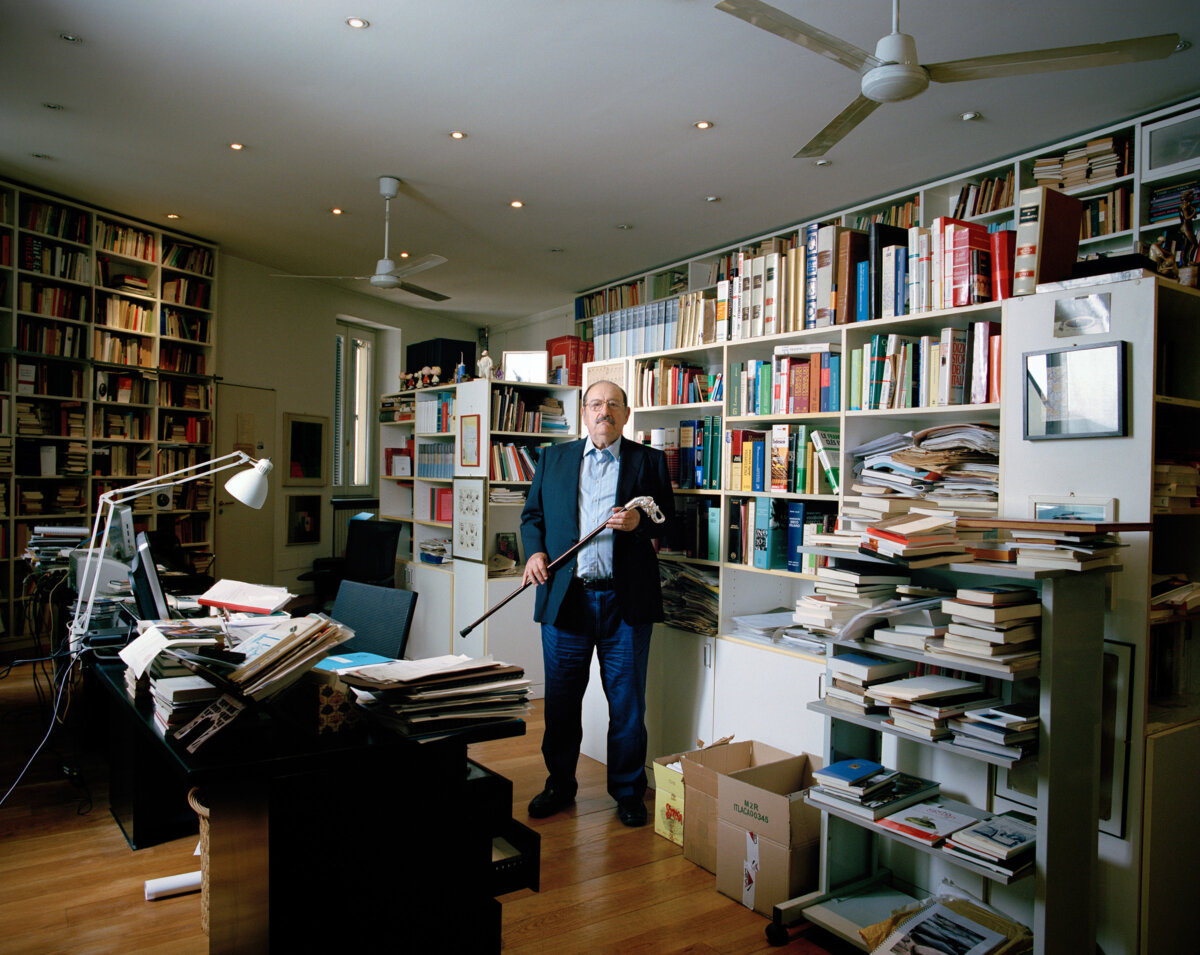
Italian philosopher Umberto Eco (1932–2016) allegedly owned more than 30,000 books. Eco’s library in Milan, where he spent most of his life, was filled to the brim with hardcovers and paperbacks.
Author of more than 40 books, Eco did his fair share of research. But he also liked to admit that he had read only a small number of the books he owned. In a 2007 bestseller, Lebanese American essayist Nassim Nicholas Taleb popularized this biographical fact with the term “anti-library,” which has since become a widespread symbol of intellectual humility.
The Black Swan
Taleb wrote about the anti-library in “The Black Swan,” a book about rare and unpredictable events with vast consequences, such as a halt in the food supply chain or a worldwide financial crash. For Taleb, one problem that leads people into catastrophic scenarios is self-assuredness, or the insistence that one knows more than one actually does. In the financial world, self-assuredness can look like unreasonable trust in tenuous predictions, unusually large one-time investments, or purposeful disregard for information that would undermine one’s investing plans. Blind trust and unwillingness to consider alternatives are standard features of self-assuredness in other areas as well.
According to Taleb, Eco usually observed two reactions in visitors who noticed his gigantic library. Most showered him with flattery, praising his erudition as they quizzed him on how many of the books he had read. A minority marveled at the books in respectful silence.
From this anecdote, Taleb drew the principal lesson of his book: “A private library is not an ego-boosting appendage but a research tool. Read books are far less valuable than unread ones. The library should contain as much of what you do not know as your financial means, mortgage rates, and the currently tight real-estate market allow you to put there. … Indeed, the more you know, the larger the rows of unread books.”
That minority who did not treat the quantity of books as a sign of Eco’s prestige understood something their cajoling counterparts did not: The purpose of knowledge is not self-aggrandizement. Hence the anti-library: a repository of knowledge that reminds its owners of their virtually infinite ignorance.

Unlike Eco, Taleb extended this notion beyond physical libraries in private homes. He used it to describe what psychologists now call “confirmation bias,” or the universal human tendency to look for and interpret information according to existing beliefs. The anti-library can be a remedy to this bias, Taleb suggested. When knowledge is treated “as personal property to be protected and defended,” people go a long way to make sure that their knowledge is never contradicted. This is the source of conceit, or self-assuredness. But when people embrace the anti-library as a living principle, they minimize their intellectual arrogance. The world is better for it.
Taleb coined a corollary term to describe Eco’s second, wiser visitor: An “antischolar” refrains from treating knowledge as a treasure to accumulate and showcase. Antischolars take ignorance seriously, especially their own. As Taleb later explained, this concept was meant to help people better manage high-stakes scenarios in which individual decisions can have far-reaching effects.
Tsundoku
The “anti-library” is rather similar to “tsundoku,” a Japanese word that describes the habit of accumulating books without reading them. It comes from the verbal phrase “tsunde-oku,” meaning “to pile something up and leave it.” Japanese speakers made a pun by dropping the “e.” What remained in the second part of the phrase was “doku” (“to read”), hence “to pile up books and not read them.”
When the term was first popularized in an 1880 publication, it carried comical overtones. People occasionally ridiculed professors whose houses had barely any livable space because they were filled with books, symbols of concepts and abstractions. “Tsundoku” eventually became a neutral expression to describe anyone who purchases more books than they are realistically able to read.
Intentional Ignorance
“Tsundoku” and the “anti-library” are not the same as book hoarding. Hoarding stems from an uncontrolled urge to accumulate things for the sake of accumulating them, be they books, figurines, or whatever. It is an impulsive act performed without any potential benefit in mind. A book hoarder is not necessarily someone who reads. He or she just wants books, like a person might want anything else.
On the contrary, both “tsundoku” and “anti-library” imply habitual reading and both concern something more intentional than mere collection. Compiling books for an ever-growing anti-library is a conscious, deliberate effort. Or at least it should be, according to Taleb and Eco. The goals are specific: to safeguard against intellectual arrogance, stop overestimating the value of what one knows, and stop underestimating the value of what one does not know.
Ignorance and Humility
In an autobiographical essay from 1925, American journalist Lincoln Steffens wrote, “It is our knowledge—the things we are sure of—that makes the world go wrong and keeps us from seeing and learning.” Steffens was writing about fatherhood, but the principle seems to apply universally. Popular wisdom has it that the more one knows, the better one is.
That may be true, but so is Steffens’s maxim. How many fights began because the parties involved were sure of being in the right, when in truth they were not? How many mistakes could be avoided by admitting ignorance and asking for help instead of insisting on a misguided course of action? Maybe not all, but, Taleb might claim, probably the vast majority.
For him and Eco, unread books were not signs of failure of prestige, but visible, ubiquitous reminders of everything there is yet to know. If the anti-library was a personal matter for the Italian philosopher, Taleb turned it into a guiding principle for people and nations alike, that they might surrender their blinding self-assuredness in the name of the unknown.