On the cusp of widespread upheaval and religious warfare, Dutch priest and theologian Desiderius Erasmus (circa 1466–1536) decided to lampoon monks, theologians, and ordinary people in a book that made him one of the most read authors of his time.
But Erasmus’s goal wasn’t to ridicule. It was to champion modesty, the lack of which he blamed for the disastrous conflicts that troubled his world. With timely words still relevant today, “In Praise of Folly” called on readers to give up dogma and embrace humility as a guide for developing wisdom.
Simple Beginnings
Born out of wedlock in the Dutch town of Rotterdam, Erasmus had a simple childhood. His family prioritized learning and made sure he obtained the best education available to people of their social class.
But both his parents died during an outbreak of the bubonic plague in 1483. By then, Erasmus had begun studying Latin and Greek, which defined his intellectual life and contributions. In 1487, spurred by poverty and illness, he entered the novitiate to become a priest. He was ordained five years later.
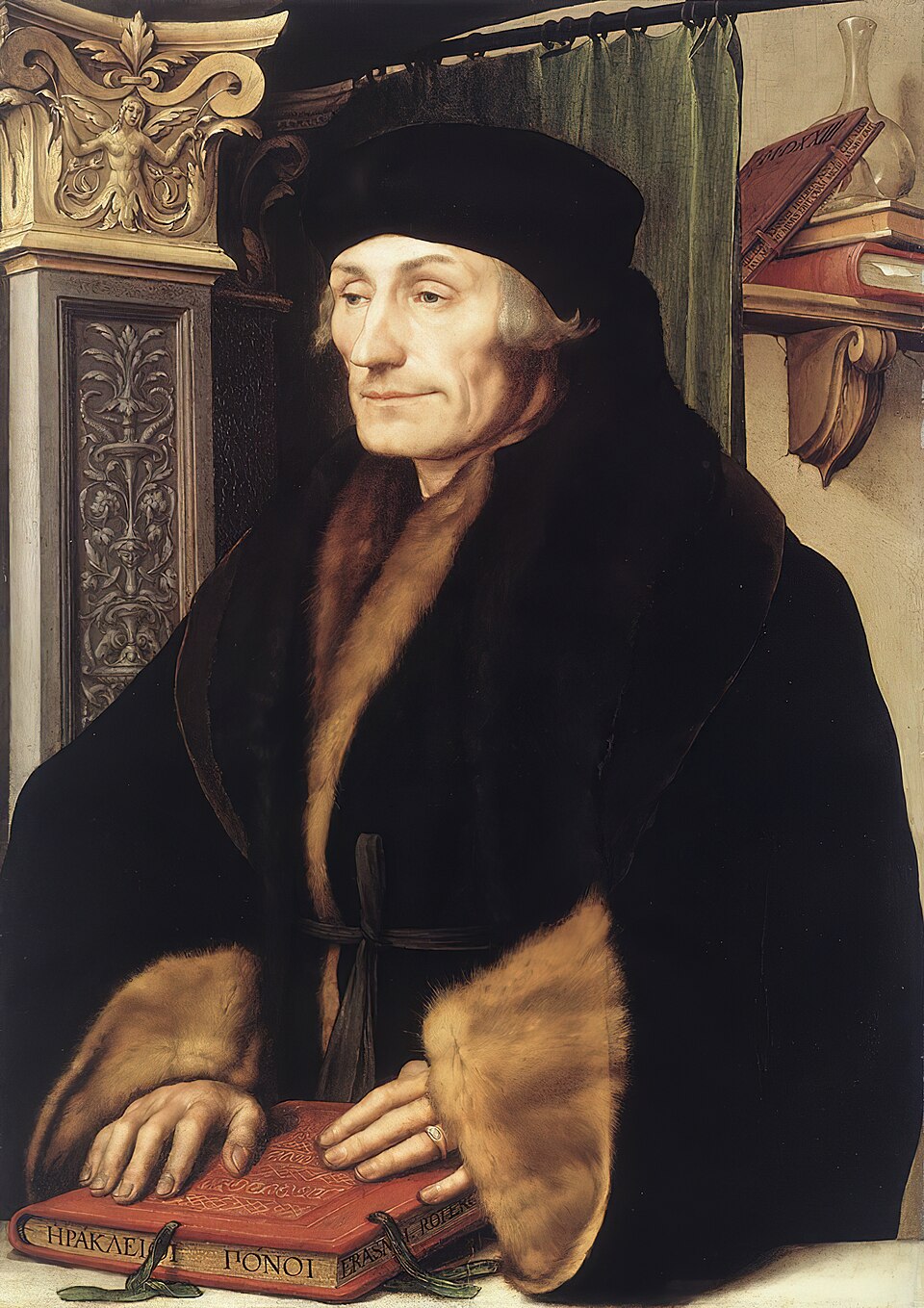 A portrait of Desiderius Erasmus of Rotterdam, 1523, by Hans Holbein the Younger. Oil and tempera on panel. London. (Public Domain)
The Intellectual Life
Erasmus spent most of his adult life studying the Bible and ancient Greek and Roman texts. His scholarly genius shone brightest in his pioneering translations of the Greek New Testament. The “Erasmian” pronunciations of Latin and Greek are still used in virtually every classics department in the West.
When he printed “In Praise of Folly” in 1511, the papacy was entangled in politics, polarized universities were entrenched in zealous scholastic disputations, and the first murmurs of what soon became the Protestant Reformation were spreading throughout Europe.
Erasmus received harsh criticism from fellow Catholics because of his unwillingness to participate in the intellectual disputes that busied the theologians of his day. The problem of free will was particularly contentious. Some, like religious reformer Martin Luther (1483–1546), argued that everything was preordained, while others stressed that human freedom was more than an empty idea.
Toward the end of his life, Erasmus concluded that this perennial problem was beyond human comprehension. The sensible and faithful person, he suggested, refrains from fomenting disputes over issues that defy definitive understanding. His humble self-awareness singled him out as one of the few tolerant minds of his time.
After he died in 1536, Western Europe fell into a series of bloody religious wars that jeopardized its cultural eminence and inflicted innumerable losses. The times didn’t follow his lead. But he left behind a book, often touted as his finest, which staunchly opposed the dogmatism that endangered the world.
In Praise of Folly
Written in Latin, “In Praise of Folly” reads like a religious sermon, except that the orator is a personification of Folly. After a boastful introduction, Folly introduces “the lives of men,” about which she says that “it will easily appear not only how much they owe to me, but how much they esteem me even from the highest to the lowest.” So begins her exhaustive critique of virtually every stratum of society, from the lowest to the highest, none of which seems immune from Folly’s influence.
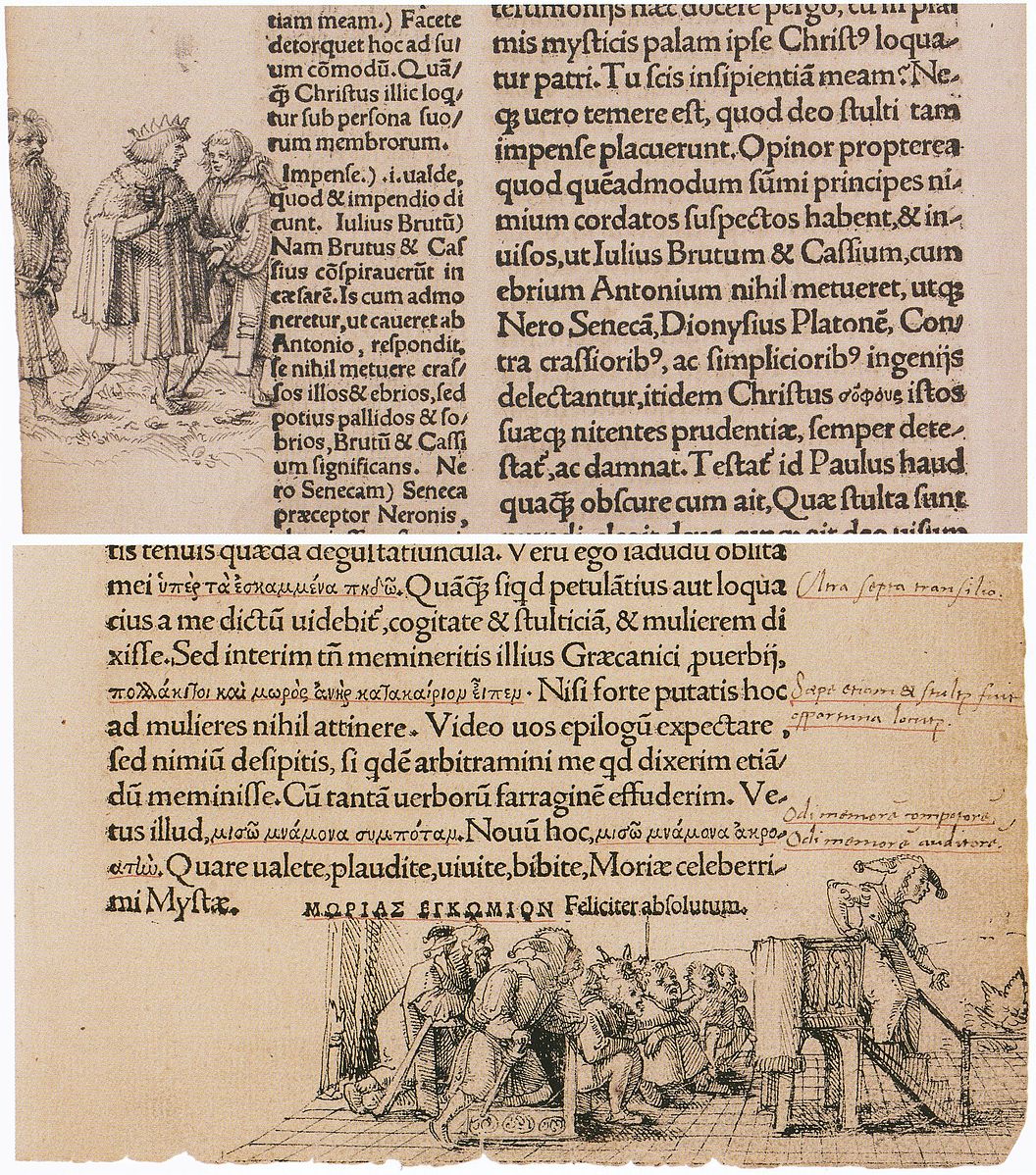 Marginal drawings for “In Praise of Folly,” by Erasmus. Drawings by Hans Holbein the Younger, 1515. (Public Domain)
The Folly of Ordinary People
Folly’s first targets are “common people,” who “abound everywhere with so many several sorts of folly, and are every day so busy in inventing new [ones].” Her list includes people who marry because of money, squander modest salaries on food and drink, prefer idleness to work, mind other people’s business before their own, bet recklessly, choose war and violence over peace and tranquility, and cheat, all for “gold rings on their fingers.”
Folly claims these behaviors as her own because they undermine well-being in the name of money, pleasure, or power. These lead people astray from reason. People, she says, would rather abandon the good things they have than give up their impulsive, mindless, and often disastrous pursuits of fleeting desires.
The Folly of Clergymen
Next in Folly’s catalog are people with whom Erasmus spent most of his clerical life: “those that commonly call themselves the religious and monks, most false in both titles, when both a great part of them are farthest from religion.”
She first pokes fun at the obsessive attention that clergymen put on seemingly insignificant matters, “as how many knots their shoes must be tied with, of what color everything is, what distinction of habits, of what stuff made, how many straws broad their girdles and of what fashion.”
On a more serious note, Folly tells readers that, despite their declarations of universal love in God’s name, clergymen “despise one another, and for the different wearing of a habit, or that ’tis of darker color, they put all things in combustion.” These rigid, antagonistic tendencies qualify them as hypocrites who profess to live by their Christian faith, when in fact they’re as foolishly concerned with their egos as the next person.
The Folly of Intellectuals
The influence of Erasmus’s background is most evident in what Folly says about intellectuals, especially theologians. In Erasmus’s view, academics spent too much time writing dense commentaries of obscure texts, debating trivial issues, and fixating on being right over being sensible. He saw these tendencies as a root cause of the vain dogma that eventually fomented bloody conflicts like the Knights’ Revolt, the French Wars of Religion, and the Eighty Years’ War.
Erasmus was particularly displeased with Luther, whose writings took aggressive stances against his perceived enemies, including Erasmus. But Luther wasn’t the only self-assured public intellectual who bothered the author of Folly’s oration. Erasmus also protested against fellow Catholics who sought to quash their opponents with harsh retorts. He believed their behavior contradicted the Christian exhortation to compassionate forgiveness, which he esteemed dearly.
Scientists, philosophers, and theologians, says Folly, “look upon themselves as the only wise men and all others as shadows.” Scientists imagine “innumerable worlds,” confidently proclaim to have found the causes of “inexplicable matters,” and measure things immeasurable, “without the least doubting.” Philosophers search for glory in trivial matters. If they “pick out of some worm-eaten manuscript a word not commonly known—as suppose it bubsequa for a cowherd, bovinator for a wrangler, manticulator for a cutpurse … what triumphs! what commendations! as if they had conquered Africa or taken in Babylon.”
Theologians were possibly the worst among these experts of trivialities, since they dealt with sacred topics Erasmus deemed more significant than any other. In addition to priding themselves on their exact knowledge of mysteries like hell, God’s will, and the afterlife, theologians also entertained intellectual games that hinged on the blasphemous. One famous game was “whether it was possible that Christ could have taken upon Him the likeness of a woman, or of the devil, or of an ass, or of a stone, or of a gourd.” Folly portrays them as erudite but unable to stave off conceit, as rational but enamored with frivolities.
Erasmus, who by now had one of the largest readerships in Europe, recognized that he was often guilty of the same intellectual arrogance. He was often among the people busy laboring pointlessly in damp libraries. For this reason, Folly lampoons him as well, who “deserves if not the first place yet certainly the second.”
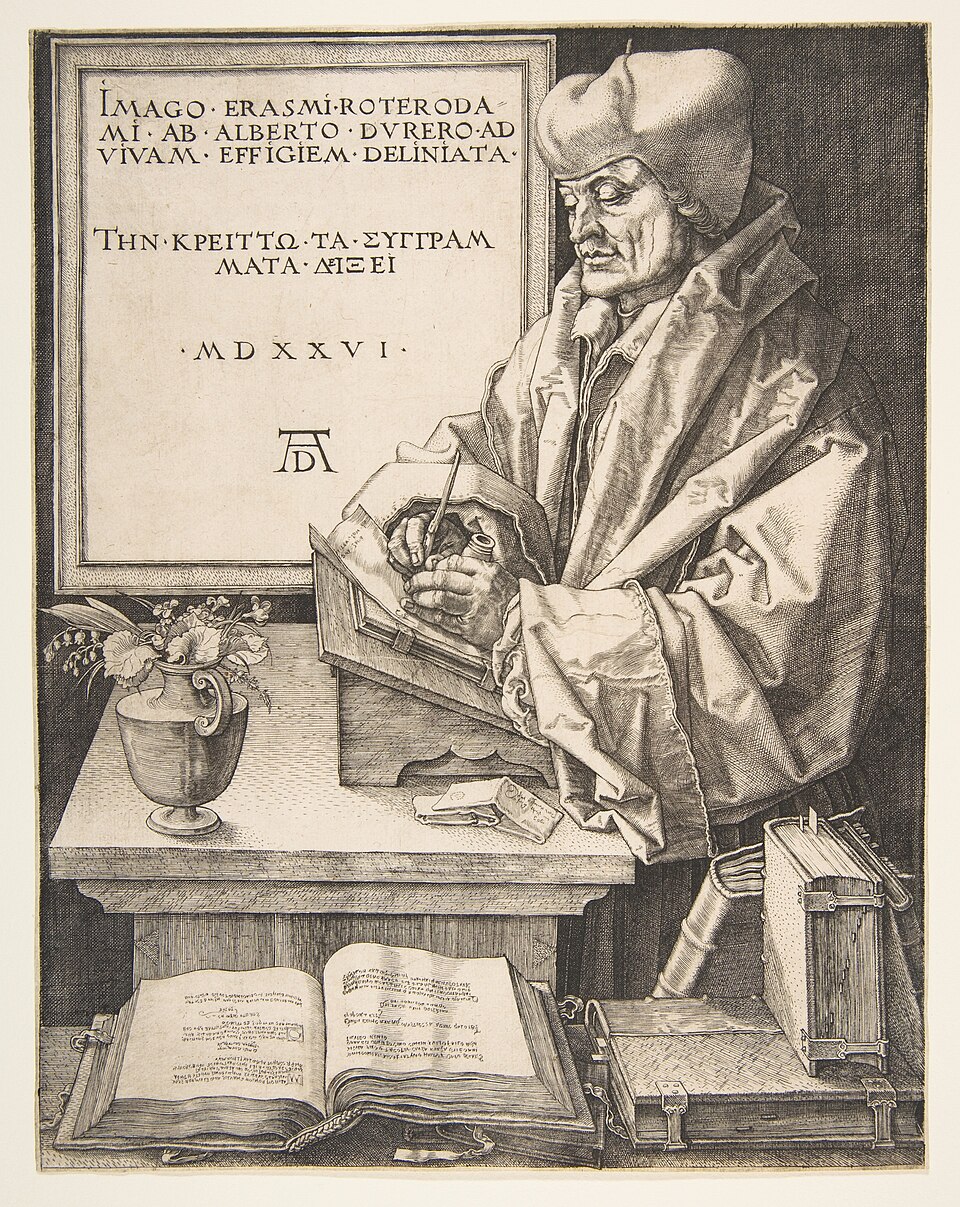 “Erasmus of Rotterdam,” 1526, by Albrecht Dürer. Metropolitan Museum of Art, New York City. (Public Domain)
A Humble Call to Action
The rhetorical efficacy of Erasmus’s text lies in the impartiality with which Folly chastises her targets. As Nobel Prize winner John Maxwell Coetzee noted, Erasmus placed Folly’s critiques in “a position not simply impartial between the rivals but also, by self-definition, off the stage of rivalry altogether.” Theologians reading the work would have scoffed at her depictions of base crowds and self-absorbed monks. Both groups would have all jeered at snobbish intellectuals, and so on.
If no one is immune to Folly, Erasmus seemed to imply, no one has the moral upper ground to launch unforgiving attacks against people they deem at fault. That doesn’t mean that no one should point out wrongdoings. A world without moral teachers would be the same barbaric world Erasmus sought to avoid. But any lesson should come with the humility to recognize that everyone falls short sometimes.
Despite his biting style, Erasmus never suggested giving up the things he criticized. Through Folly, he ridiculed intellectualist pretensions. By holding a clear mirror before his educated audience, he sought to show them that genuine learning lay elsewhere. He mocked misapplications of intelligence and misconceptions of religiosity. But he never undermined faith. In fact, the text abounds with biblical verses, as if to remind readers of how they should actually behave.
Folly’s main contention is that everyone is guilty of misuse and excess, not that everyone should stop trying to correct their wrongs. Dogmatism thrives when people forget their own faults and limitations. Anger, violence, and even war may ensue. On the contrary, wisdom begins with the honesty to acknowledge imperfections in oneself, and the good sense to humbly recognize another’s.
What arts and culture topics would you like us to cover? Please email ideas or feedback to features@epochtimes.nyc