The Federalist-majority Congress passed four pieces of legislation, known collectively as the Alien and Sedition Acts, which were swiftly signed into law during the summer of 1798 by President John Adams, a Federalist himself. The acts, which ultimately curbed freedom of speech by criminalizing the writing, printing, speaking or publishing anything “false, scandalous, and malicious” about the government, quickly came under intense scrutiny. Among those critics were Thomas Jefferson and James Madison.
Jefferson and Madison were alarmed at the federal overreach. Jefferson, the Father of the Declaration of Independence, and Madison, the Father of the Constitution, agreed to put their criticisms on paper and thus penned the Kentucky Resolves and the Virginia Resolves, respectively. It appears that in October, Madison had visited Jefferson at his Monticello home, where Jefferson presented his draft of resolutions. As much as Madison was alarmed by the actions of the federal government, he was apparently also somewhat alarmed by Jefferson’s wording.
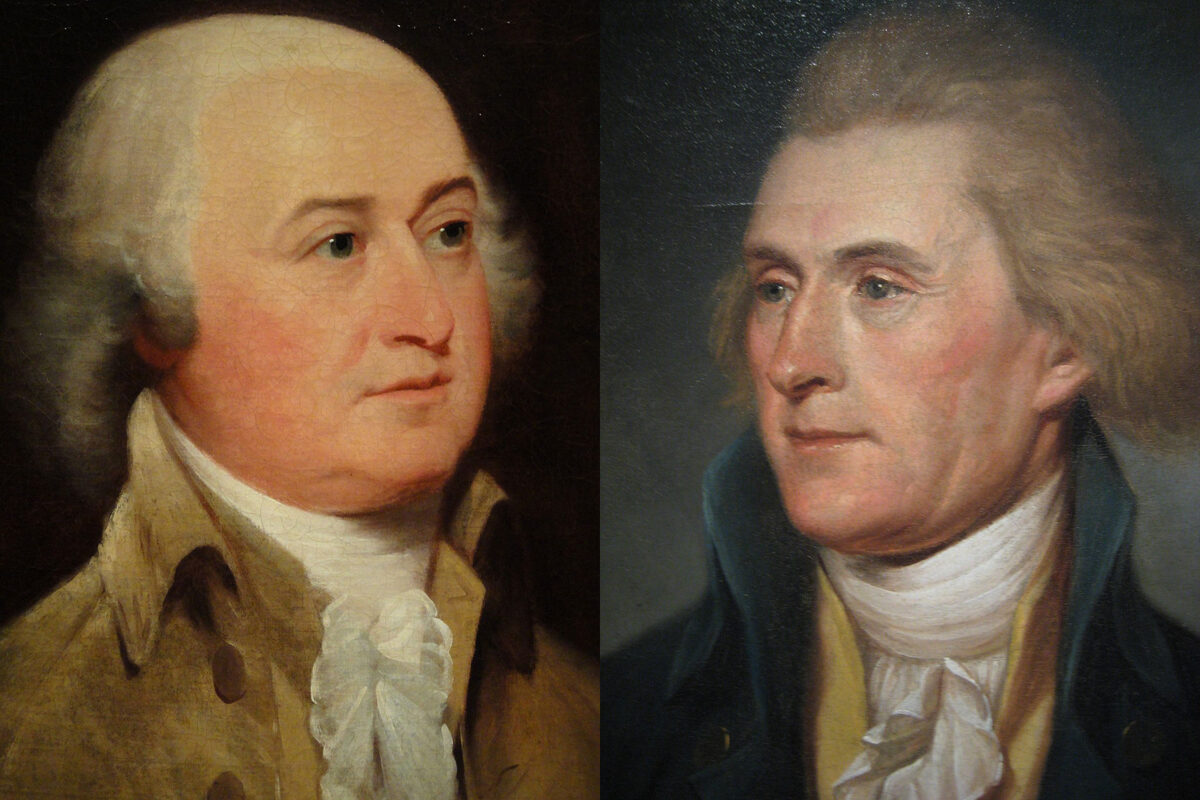
In the first of his nine resolutions, Jefferson, no stranger to inflammatory authorship, wrote “that whensoever the General government assumes undelegated powers, its acts are unauthoritative, void, & of no force.”
He added in a proceeding resolution: “These & successive acts of the same character, unless arrested at the threshold, necessarily drive these states into revolution & blood, & will furnish new calumnies against republican government, & new pretexts for those who wish it to be believed that man cannot be governed but by a rod of iron.”
Madison proved more reserved, but his resolutions still maintained the limits of the federal government:
“No farther valid than they are authorised by the grants enumerated in [the Constitution], and that in case of a deliberate, palpable and dangerous exercise of other powers not granted by the said compact, the states who are parties there—to have the right, and are in duty bound, to interpose for arresting the pro(gress) of the evil, and for maintaining within their respective limits, the authorities, rights and liberties appertaining to them.”
Though not going so far as to predict “revolution & blood,” he did suggest an overreaching federal government would “consolidate the states by degrees into one sovereignty … [and] transform the present republican system of the United States, into an absolute, or at best a mixed monarchy.”
There was no doubt that Jefferson and Madison were concerned about the machinations of the Adams administration and the Federalists. The houses of delegates in Kentucky and Virginia proved equally concerned. Their concern, however, was not echoed by the other states. In fact, of the 14 others, 10 states issued rebukes of the Kentucky and Virginia resolves, most referencing the Constitution’s Supremacy Clause in Article VI. The issue seemed to subside after Jefferson defeated Adams in the election of 1800. Nonetheless, Jefferson and Madison had swung wide the door to the theory of nullification. It was a theory that would be put into practice 30 years later.
Quincy Adams, Jackson, and Van Buren
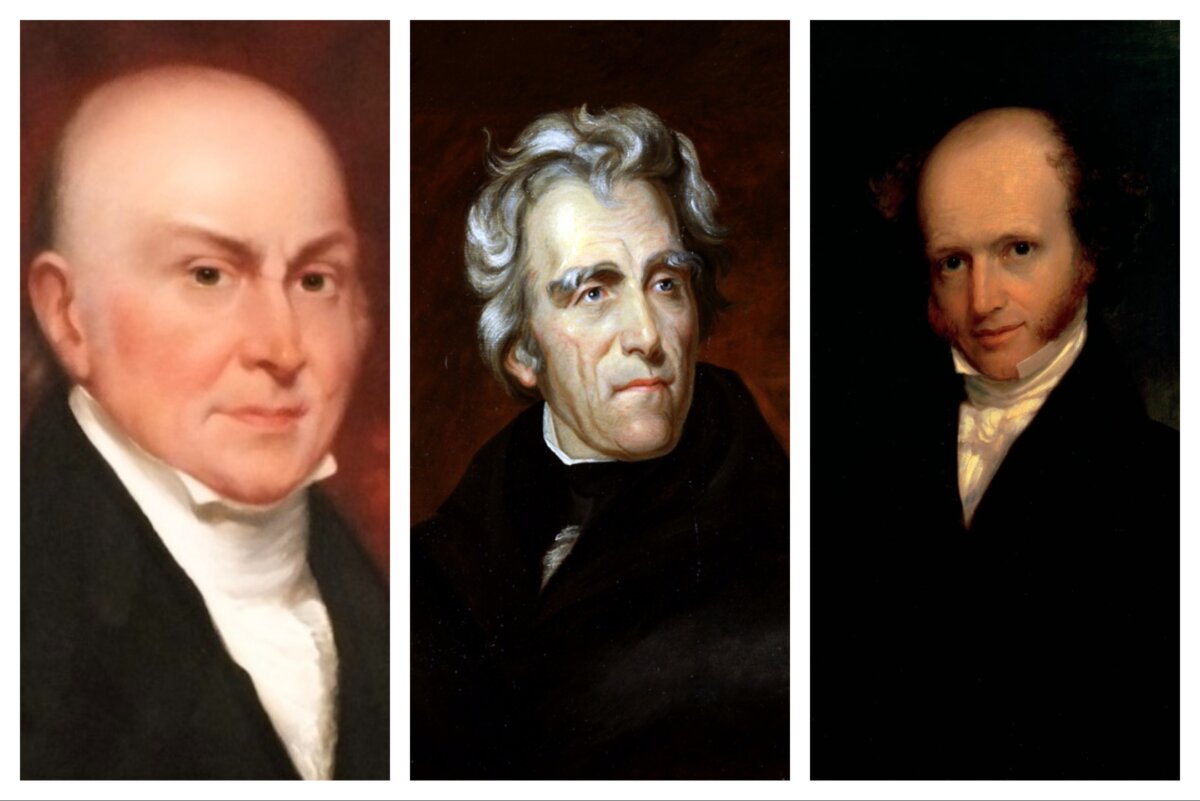
The son of Adams, John Quincy Adams, had defeated his political opponent, Andrew Jackson, in a roundabout way during the election of 1824. Adams had grown up a Federalist like his father, but he soon became a member of Jefferson’s Democratic-Republicans. He oversaw the final years of what was known as the Era of Good Feelings, in which American politics were under the banner of a single party.
The Democratic-Republicans, generally, and Adams, specifically, had fallen out of favor with Southerners. In fact, in 1824, he was successful almost exclusively in the northeastern states. Jackson, who like Adams and the other two 1824 candidates ran as a Democratic-Republican, had practically dominated the South in 1824, thus those states were practically guaranteed for him in 1828.
The looming question for Jackson was how to gain the support of the North and the West. For that, several members of Congress would prove indispensable.
Martin Van Buren had been the dominant force in New York’s politics. Before the start of the 1820s, he had formed New York’s first statewide political machine: the Albany Regency. According to historian Robert V. Remini, by 1822 all the members of the State Assembly and Senate, most of the state officials, and the governor, were “Van Buren Republicans.” In 1821, in light of his leadership, the state legislature elected him to the U.S. Senate.
During the 1824 election, however, New York had chosen Adams—giving him 26 of the state’s 36 electoral votes. Jackson received only one. For Van Buren, this outcome did not suffice. He immediately began organizing a team of polished politicians to join Jackson, including John C. Calhoun, the current vice president under Adams. By 1826, Van Buren had spurned Adams, accusing his administration of federalism, and fully embraced the rising Jacksonian political movement. But it was 1828 that witnessed Van Buren’s coup de grâce.
A Politically Helpful Tariff
Understanding that Adams was viewed as the champion of northern manufacturers, much to the disdain of the southerners, Van Buren needed a bill that would secure the support of those manufacturing states for Jackson; it would also further secure his power grip on New York. He therefore sponsored a new tariff that would protect the manufacturers, specifically wool and iron, in the northern and western states. During the early congressional session of 1828, the Jacksonians in the House of Representatives began formulating the bill. Van Buren was never too far away.
One journalist for the Massachusetts Journal noted that Van Buren often “call[ed] out the Jackson members of the committee daily, and many times a day, to hold talks with them; and it is presumed that nothing important was done or has been reported, without his knowledge and consent.”
Indeed, Van Buren had one of his most loyal Albany Regency members on the House committee, Silas Wright. Wright ensured the bill was guided along Van Buren’s designs. The plan practically worked to perfection. On April 22, 1828, the bill, organized by Jacksonians, passed the House. When Adams signed the bill on May 19, he all but sealed his fate. The Jacksonians had proven their worth to the northern and western states, while Adams’s signature further separated him from the southerners. With the Tariff of 1828 signed, all Jackson and Van Buren had to do now was wait for the upcoming election.
Jackson, with his new Democrat Party, won the 1828 election in a landslide, taking 20 of New York’s 36 electoral votes, and sweeping all of the southern and western states. The Jacksonians had won the battle, but their Tariff of 1828 would soon create a war.
The Return of Nullification
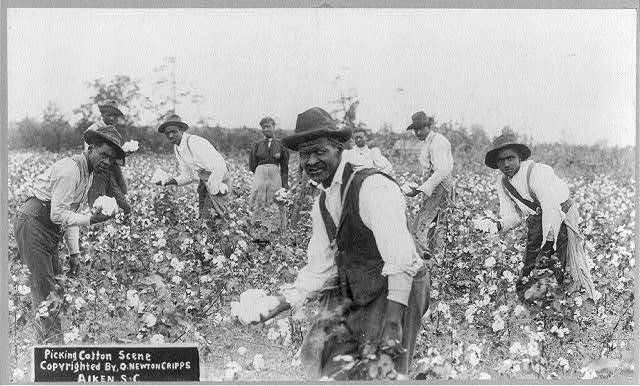
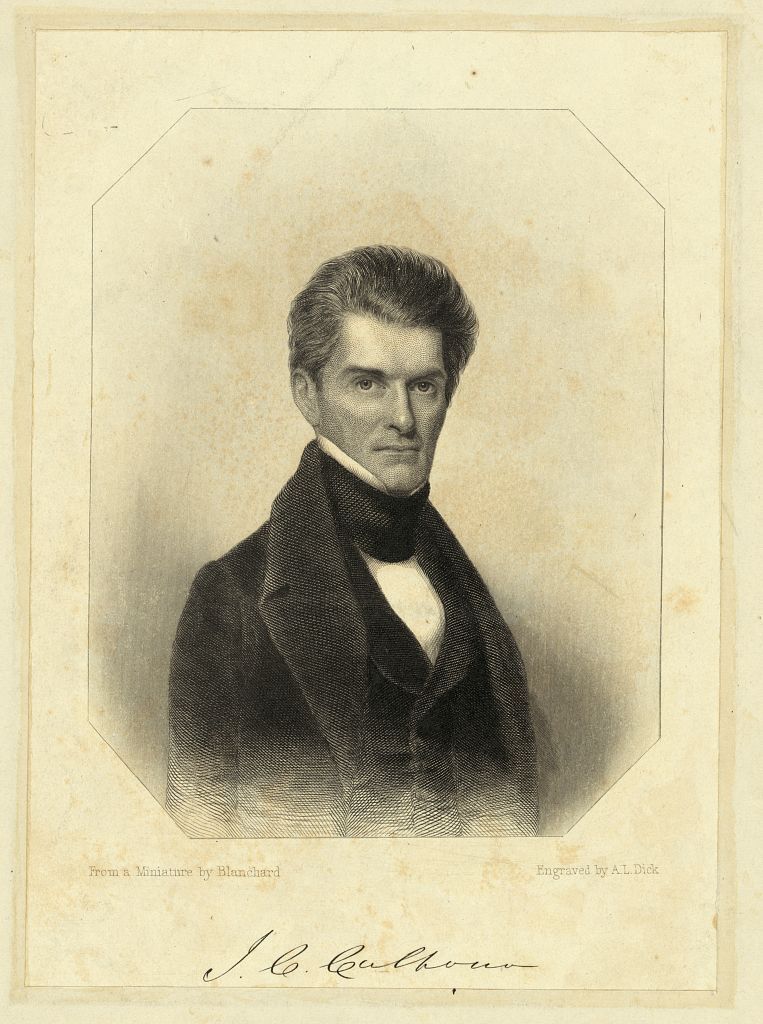
It was during this week in history, on Dec. 19, shortly after the 1828 election, that Vice President Calhoun anonymously published his “South Carolina Exposition and Protest,” in which he voiced the South Carolinians’ and the other southerners’ hatred of the bill. The Tariff of 1828 had increased duties by 30 to 50 percent in order to protect the northern manufacturers from foreign competition. This resulted in foreign countries halting the purchase of cotton, substantially hurting the southern economy. The Tariff of 1828 became known as the Tariff of Abominations, especially after Jackson proved unwilling to lower the rates on duties, something southerners had anticipated after his election.
Calhoun’s 35,000 word protest lifted the 1798 banner of Jefferson and Madison. He stated that tariffs, when done to raise revenue, were acceptable, but when done to protect one portion of the country’s economy at the expense of another, were unconstitutional and therefore null and void. Calhoun indicated that states, when they were subjected to such legislation, had the right to nullify the federal law. Although South Carolina did not nullify the tariff, it did fully embrace the power to do so. Soon Virginia, Georgia, and Mississippi fell into agreement with the idea of nullification.
The divide between Jackson and his vice president became indicative of the divide forming between northern and southern sentiments. On April 13, 1830, Jackson and Calhoun famously made their division rather public at a celebration of Jefferson’s birthday. Jackson gave a toast, stating, “The Union—it must be preserved!” To which Calhoun responded, “The Union, next to our liberty, most dear.”
From Theory to Constitutional Right
During the summer of 1831, Calhoun penned his thoughts on the idea of nullification, and on July 26, he made his thoughts public during a speech at his South Carolina mansion. His “Fort Hill Address” quickly referred to the foundation upon which he placed the states’ rights to nullify federal laws which a state may deem unconstitutional.

“The Constitution of the United States is, in fact, a compact, to which each State is a party, in the character already described,” Calhoun proclaimed, “and that the several States, or parties, have a right to judge of its infractions; and in case of a deliberate, palpable, and dangerous exercise of power not delegated, they have the right, in the last resort, to use the language of the Virginia Resolutions, ‘to interpose for arresting the progress of the evil, and for maintaining, within their respective limits, the authorities, rights, and liberties appertaining to them.’”
Vice President Calhoun had made it clear he believed nullification was no longer just a political theory, but a constitutional right.
Jackson pressed on despite his differences with Calhoun. Indeed, his political relationship with Van Buren only increased, which certainly added to the division between Jackson and Calhoun. It had become very clear that Calhoun, who had presidential aspirations, was not to be Jackson’s heir apparent, but rather Van Buren.
Considering the political and economic issues the Tariff of 1828 had caused, Congress passed the Tariff of 1832, which lowered the tariff rates, yet still protected the northern manufacturers. The South, though somewhat alleviated, was still not satisfied.
From Nullification to Secession
Despite southern sentiment, Jackson won the 1832 election by an even greater margin than 1828, taking 219 electoral votes compared to the previous 178, including all of New York, New Jersey, New Hampshire, and Maine. He also won all of the South, except Kentucky, which went to Henry Clay; and South Carolina, which perhaps was more indicative of the Jackson-Calhoun rift than the North-South. Expressing that rift, on Dec. 28, 1832, Calhoun resigned as vice president and returned to the Senate. This resignation was hardly a concern, as Van Buren had been elected the new vice president. Jackson, however, faced a great concern.
On Nov. 24, the South Carolina legislature had passed its Ordinance of Nullification, claiming Congress’s tariffs of 1828 and 1832 had “violate[d] the true meaning and intent [of the Constitution] and are null, void, and no law, nor binding upon this State.” The state legislature took the Jefferson-Madison-Calhoun idea of nullification one giant step further, stating in conclusion that if the federal government attempted “to reduce this State to obedience” that it would “forthwith proceed to organize a separate government.”
Jackson quickly addressed the Ordinance of Nullification on Dec. 10 with his nearly 9,000-word Proclamation Regarding Nullification, stating,
“I consider … the power to annul a law of the United States, assumed by one State, incompatible with the existence of the Union, contradicted expressly by the letter of the Constitution, unauthorized by its spirit, inconsistent with every principle on which It was founded, and destructive of the great object for which it was formed. … Secession, like any other revolutionary act, may be morally justified by the extremity of oppression; but to call it a constitutional right, is confounding the meaning of terms, and can only be done through gross error, or to deceive those who are willing to assert a right, but would pause before they made a revolution, or incur the penalties consequent upon a failure.”
A week later, Jackson wrote to Secretary of War Lewis Cass, stating:
“If I can judge from the signs of the times Nullification, and secession, or in the language of truth, disunion, is gaining strength, we must be prepared to act with promptness, and crush the monster in its cradle before it matures to manhood.”
Appeasement, Then War
In March 1833, Jackson and Congress appeared ready to “crush the monster” of nullification and secession by passing the Force Bill, which expanded the president’s power to enforce tariffs by use of the military. The Senate, led by Calhoun, Clay, and Daniel Webster, established the Compromise Tariff of 1833, which promised to lower the tariff rates over the course of 10 years to its 1816 level. The bill tempered both sides, and led South Carolina to repeal its Ordinance of Nullification.
In a May 1833 letter to his cousin, Andrew Crawford, Jackson wrote,
“I have had a laborious task here—but nullification is dead, and its actors & exciters will only be remembered by the people to be execrated for their wicked designs to sever & destroy the only good government on the Globe, and that prosperity and happiness we enjoy over every other portion of the world.”
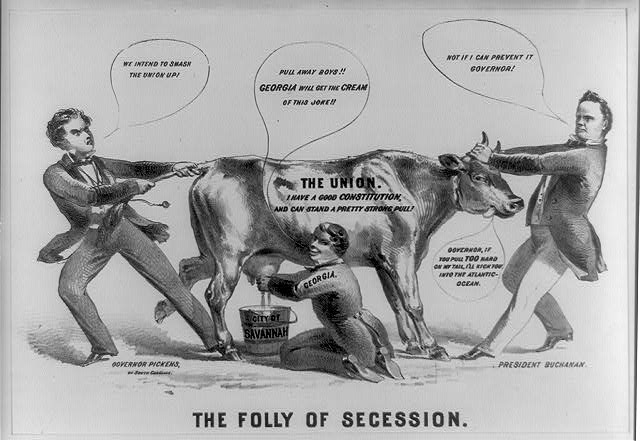
Jackson had won the war on nullification, but his assessment that nullification was dead would prove in error. Less than three decades later, the theory of nullification and secession was revived with destructive results, culminating in the American Civil War.
Never miss a This Week in History story! Sign up for the American History newsletter here.
What arts and culture topics would you like us to cover? Please email ideas or feedback to features@epochtimes.nyc