



CHICAGO—Charles Dickens’s “A Christmas Carol” opens with the famous line “Marley was dead: to begin with. … Old Marley was as dead as a door-nail.” By creating an air of finality in the first sentences, Dickens set up the fear that Scrooge will experience when Marley returns. The ghost warns Scrooge that all his past misdeeds will terrorize him long after his death—a key factor in what eventually causes Scrooge to change his ways at the end of the novel.
We know what happens to Scrooge, but what happens to poor Jacob Marley? That was the question that playwright Tom Mula explored when he wrote “Jacob Marley’s Christmas Carol” in 1995. It’s now an exquisite production at Chicago’s Timeline Theatre.
A Unique Revisioning
The tale is told from Marley’s point of view as Mula’s inventive vision makes the character the creator of the events that unfold in “A Christmas Carol.” From the very beginning, we see Marley as the man behind the scenes, who is responsible for events that end up spinning out of his control.
Once again, we hear Marley’s famous words: “I wear the chain I forged in life. I made it link by link, and yard by yard; I girded it on my own free will and of my own free will I wore it.” And, we once more see him appear to Scrooge on Christmas Eve to warn him that he’ll suffer the same fate unless he changes his ways. Marley foretells the visits from three spirits from the past, present, and future.
But is Marley doomed to clank around in his chains for eternity or does he get as much a chance for redemption as Scrooge?
The story takes off when Marley meets an otherworldly bureaucrat, Record Keeper, who forces Marley to face his worldly actions in the afterlife. Marley realizes he cannot bully, buy or beg a reprieve from the Record Keeper, who lets Marley know in no uncertain terms that “forgiveness is not [his] department.” This shapes the main trajectory of the unfolding plot.
At this point, the chains drop on Marley, and he realizes what his afterlife holds in store for him. But there is a loophole: If Marley can redeem one human being the chains will be lifted. It’s an offer Marley can’t refuse: face eternal damnation or convince Scrooge to have a full, complete, and voluntary change of heart in 24 hours.
With this as his only option, Marley grapples with his own demons. Though he starts off seeking an escape from hell, his journey proves that if terrible old Scrooge can be forgiven and therefore save his own soul, there’s hope not just for Scrooge and Marley but for everyone.
An Excellent Performance
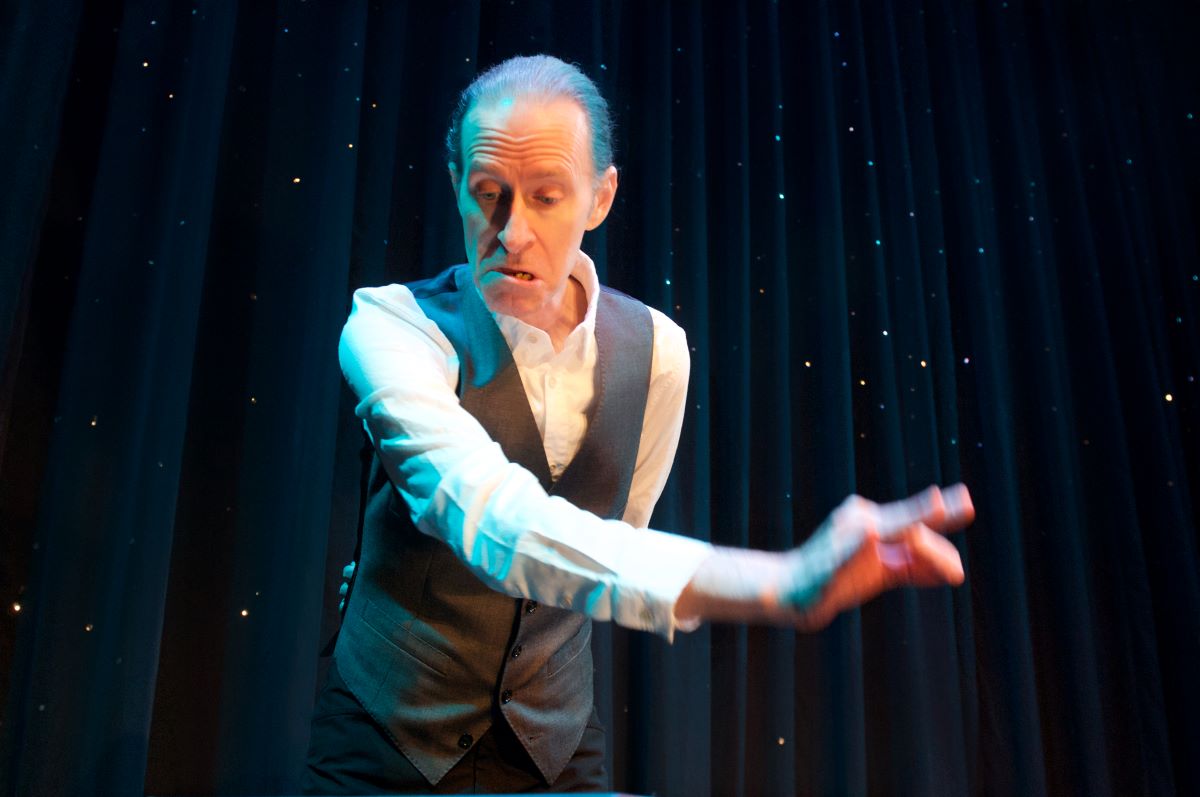
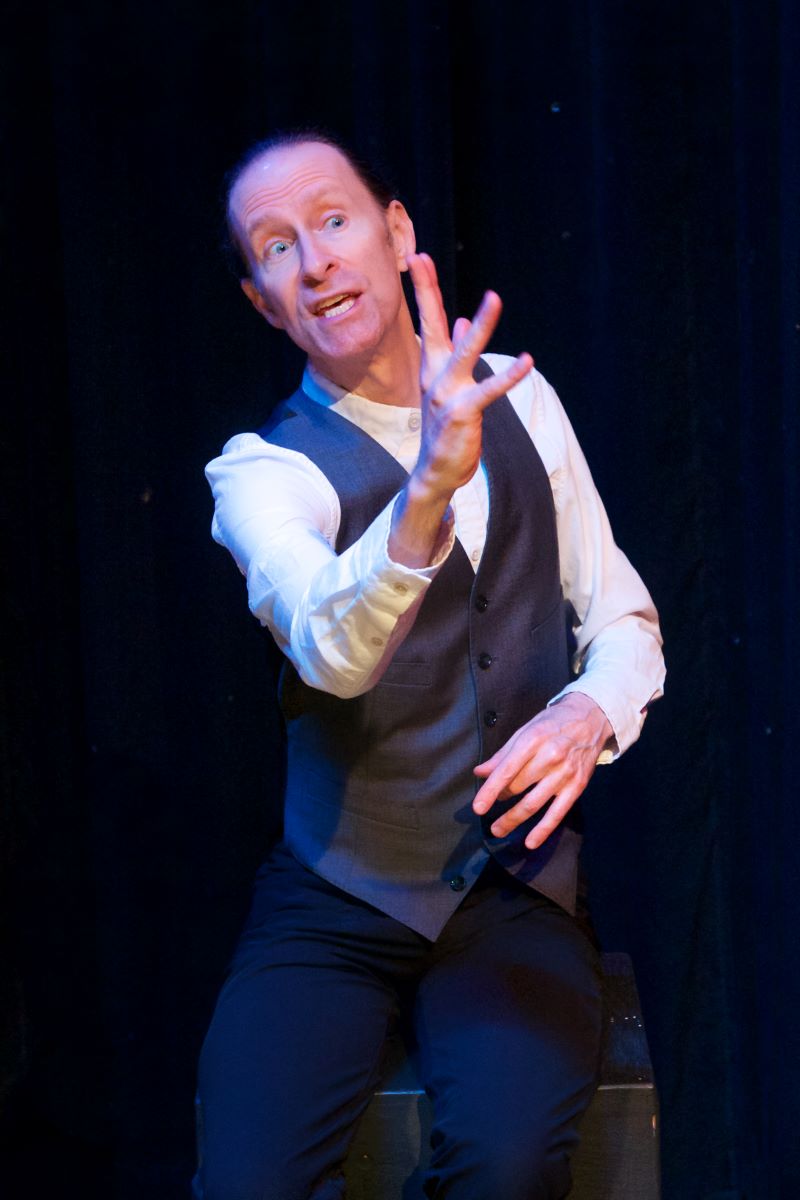
The show rises and falls on the performance of Phil Timberlake. He not only portrays Marley but multiple characters as well. It’s a challenging undertaking that takes an exceptionally talented actor to pull off. Timberlake is more than up to the task. With a fascinating vocal range and breathtaking acting ability, Timberlake switches between vocal expressions, physical transformations, and changes in facial expressions that make each of his many characters distinct and compelling.
The set is simple by design. It features a small table with a glass and candle and a dazzling curtain sprinkled with stars that towers to a ceiling sky. The powerful lighting effects by designer Diane Fairchild provide for mood swings and shifts between this world and the next. The design also serves to focus attention on Timberlake’s Marley.
This is Lifeline Theatre’s second back-to-back year of staging “Jacob Marley’s Christmas Carol.” It calls upon all of us to search for the best in ourselves, for the saving grace of goodness. It’s as powerful and poignant a work of redemption as Dickens’s “A Christmas Carol. Lifeline has done wonders with Marley for two years running and should make the extraordinary play a yearly tradition.
‘Jacob Marley’s Christmas Carol’
Lifeline Theatre
6912 N. Glenwood Ave., Chicago
Tickets: 773-761-4477or LifelineTheatre.com
Runs: 2 hours (one intermission)
Closes: Dec. 21, 2025
What arts and culture topics would you like us to cover? Please email ideas or feedback to features@epochtimes.nyc
