



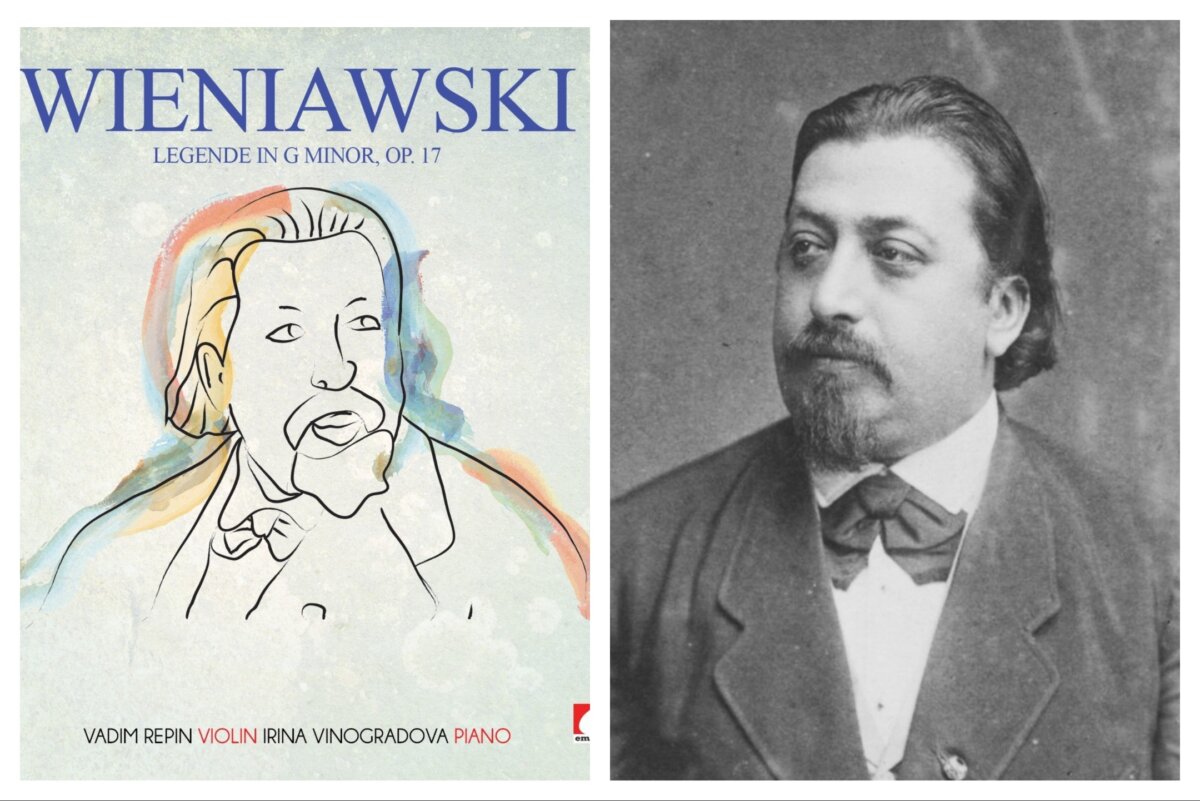
The Polish violinist Henryk Wieniawski was facing a crisis.
After an immensely successful concert tour of London, Wieniawski was introduced by his friend Anton Rubinstein to a young woman named Isabella Hampton. The two fell deeply in love, with the young violinist writing in a letter dated November 1859, “I wish to marry a young English woman whom I love more deeply than the finest Stradivarius or Guarneri [violin].”
However, in a tale as old as time, there was a major obstacle to the affair: Mr. Hampton, her father, did not approve.
It was ultimately with a Guarneri in hand that Wieniawski made his marriage a reality. According to popular legend, Wieniawski, in a desperate bid to win the hand of Isabella, composed his Op. 17 titled “Légende.” He then invited the Hamptons to a private concert. There, his skillful and emotional performance impressed the parents so much that they agreed to the match. The couple wed at the Church of Saint Andrew, an event attended by musical aristocracy such as Gioacchino Rossini and Henri Vieuxtemps.
Wieniawski’s ‘Légende’
This recording of Wieniawski’s Op. 17 “Légende” for violin and orchestra is by David Oistrakh, with Vladimir Yampolsky on a piano reduction (an orchestral work arranged for a single instrument). (Listen)
The atmosphere is foreboding. Running low notes played by the piano accompaniment trace a chromatic line, giving a sense of wandering. Suddenly, we hear a moment of brightness; a major chord appears before returning to the opening mood. This juxtaposition of light and darkness is a major characteristic of this piece, and we’ll hear how this glimmer of light grows into a ray of hope.
The violin enters, singing an elegiac melody. Listen to how the notes reach up higher and higher with every phrase until 0:53, where the repetition of the five-note motif creates a sense of struggle. After the melody resolves, the piano returns with the opening figure. The violin returns, seemingly with the same melody, before deviating off course in an impassioned burst, now imitating the somber opening figure of the piano.
Now, at 3:18, that foreshadowing glimmer of the major chord in the beginning returns, leading into a jubilant and elated section. The transition into the new soundscape is like a happy memory, surfacing in a time of turmoil and uncertainty. The violin dances, free and uninhibited.
At 4:41, a minor chord casts a brief shadow into the happy paradise. As the tension and energy build, they culminate into a sudden fall, an abrupt descent. The violin tumbles all the way down, returning to the opening.
This sudden jolt is like an awakening, and as frigid reality sets in, the violin is left all alone at 6:55. The foray into hope now makes the elegiac melody sound hollow as the violin trails off into emptiness.
What arts and culture topics would you like us to cover? Please email ideas or feedback to features@epochtimes.nyc
