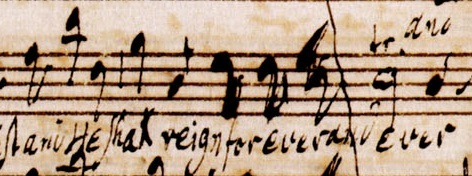
In July 1741, librettist Charles Jennens sent a new oratorio text to England’s best-known composer of the age, George Frideric Handel. Handel had previously set to music Jennens’s oratorio libretto, “Saul,” based on the Old Testament story. (An oratorio is a musical work for voices and instruments with narrative text. Unlike opera, it isn’t staged.)
The new text was more ambitious. Jennens wrote in a letter to a friend:
“I hope [Handel] will lay out his whole Genius & Skill upon it, that the Composition may excel all his former Compositions, as the Subject excels every other subject. The Subject is Messiah.”
“Messiah” is a Hebrew word meaning “The Anointed One,” a term applied by Christians to Jesus Christ, the savior of mankind. The idea of relating the life of Jesus in a single musical composition had never before been attempted, since many considered the subject too vast. But Jennens was undaunted.
Facing the Challenge
Jennens assembled pertinent portions of scripture into three parts. First came the Old Testament prophecy of Messiah’s coming and the birth of Jesus as told in the book of Luke. Second was Jesus’s passion, death, resurrection and ascension. Finally, came the Day of Judgement and Christ’s final victory over death.
Handel took to Jennens’s text immediately and with great zeal. Records show that he began work on the score on Aug. 22 that year. He completed it by Sept. 14. In only 24 days, the composer produced 259 pages of score. In performance, it lasts a little over two hours.
The usual interpretation of this speed was that Handel was in ecstatic bliss, devoting all his waking hours to the work’s completion. Incredibly, Jennens took the speed for haste and later accused his friend of sloppy work. The two were estranged for the remainder of their lives.
Handel’s ecstatic state was evidenced by a servant, who brought food for the composer only to find him in tears. Handel declined the food, explaining that he was too deeply engaged with the chorus ending Part II. Handel exclaimed to the servant that, as he was composing the chorus, he thought he “did see all Heaven before me, and the great God Himself seated on His throne, with His company of Angels.”
The piece that filled Handel with beatific vision would become the best-known choral work in the English language: The “Hallelujah” chorus.
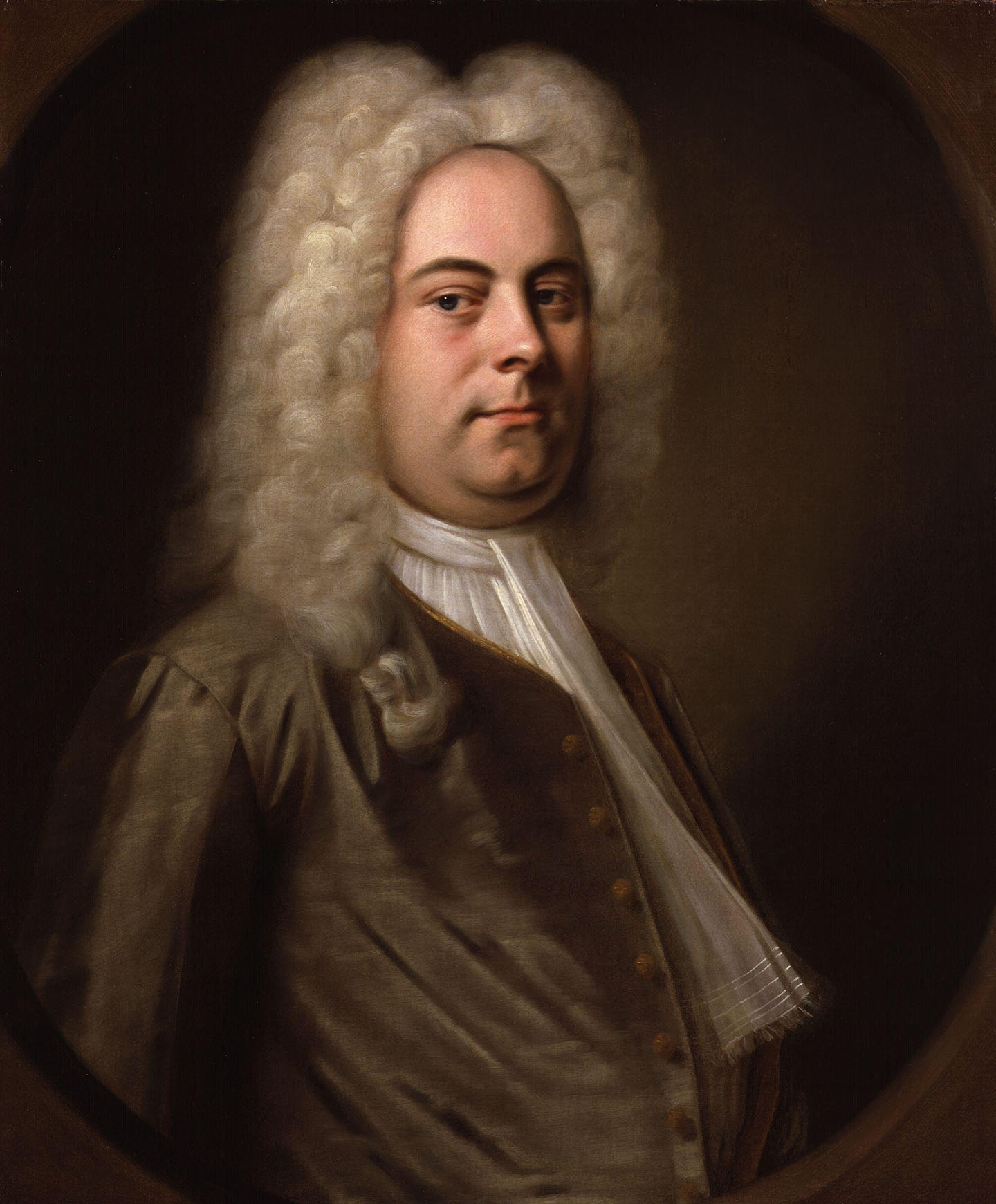 Portrait of George Frideric Handel, circa 1726–1728, attributed to Balthasar Denner. (Public Domain)
Readers paying close attention will notice that the conclusion of Part II, where the “Hallelujah” chorus is placed, follows Jesus’s death and resurrection. It has nothing to do with Christmas. Indeed, “Messiah” was intended as an Easter work, and was premiered in April 1742 as part of Eastertide celebration.
The performance of the “Hallelujah Chorus” here by the Royal Choral Society was given on Good Friday, 2012, a date appropriate to Handel’s intention. (Listen)
After all, the key textual passage of the “Hallelujah” chorus refers not Jesus’s birth, but to his mission fulfilled, taken from Revelation 11:15: “The kingdom of this world/Is become the kingdom of our Lord/And of His Christ, and of His Christ.”
The salvation of the world has been achieved; Jesus’s death and resurrection are that fulfillment. This is the movement’s only quiet section, sung at about 2:53 into the video.
How did “Messiah” and the “Hallelujah” chorus in particular come to be associated with Christmas? It seems to be largely an American evolution of the score, dating back to the Handel and Haydn Society of Boston’s 1818 performance in December that year.
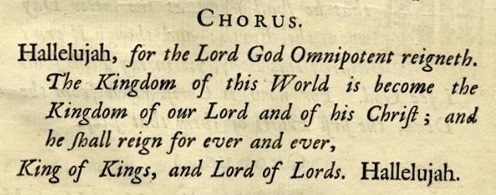 The oratorio of Handel’s “Messiah” was written by Charles Jennens. (Public Domain)
Whatever time of year it is sung, the “Hallelujah” chorus causes us to stand up in jubilation. Handel’s use of the trumpet is especially effective. Near the middle the chorus climbs ever higher, heavenward as it were, in successive exclamations of the words “King of Kings, and Lord of Lords.”
“Messiah” is 283 years old this year. That’s good reason to shout “Hallelujah!”
What arts and culture topics would you like us to cover? Please email ideas or feedback to features@epochtimes.nyc