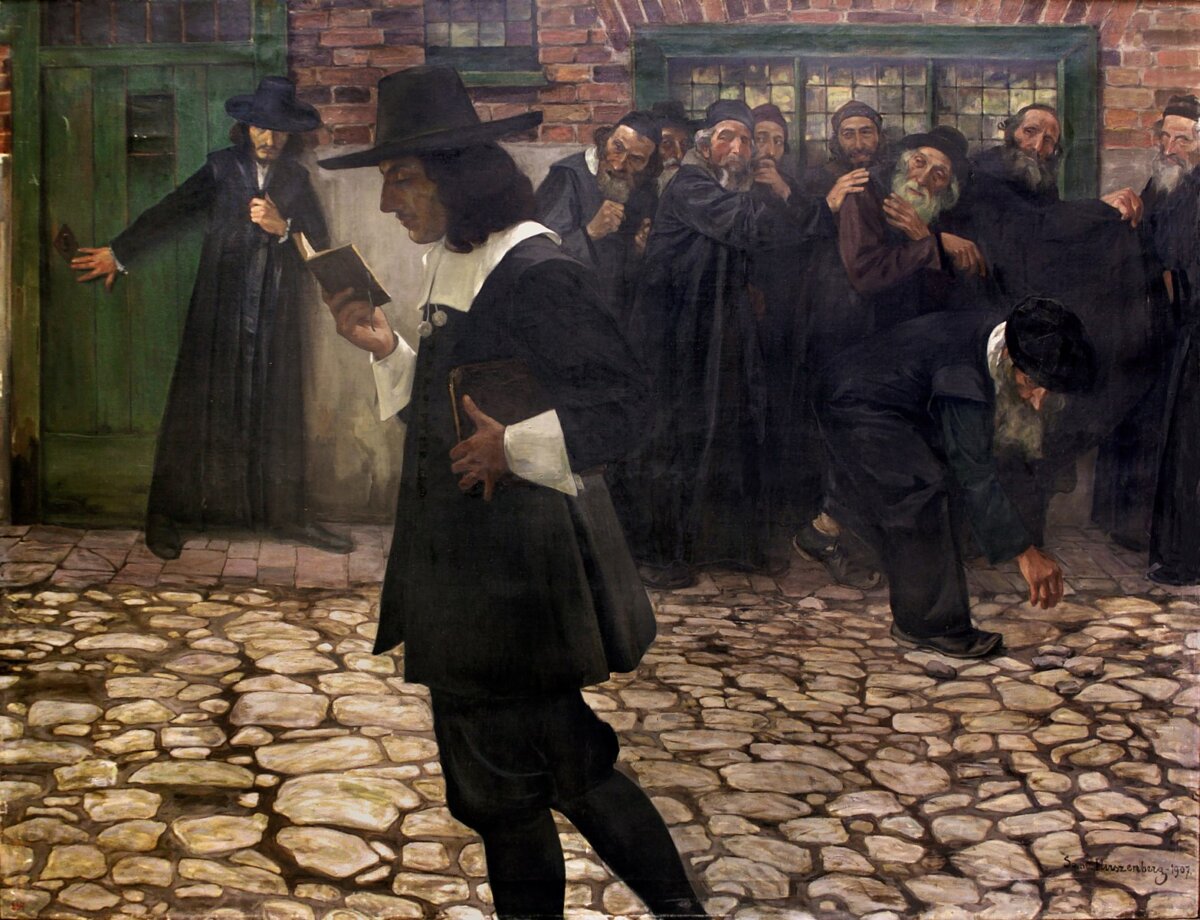
In the 17th century, the inventive Dutch philosopher Baruch Spinoza (1632–1677) found himself at a crossroads.
His world was increasingly troubled by public tensions between faith and science. Born a Jew, Spinoza eventually distanced himself from his parents’ natal creed in search of broader knowledge. Though he never sought to give up belief in God, he didn’t want to give in to institutions he deemed corrupt.
This ambivalent relationship to religious faith led Spinoza to fashion a third path. His intellectual contributions were full of provocative claims. Full knowledge of God, he thought, was available to anyone, anywhere. It only required understanding what knowing really meant.
Spinoza: Businessman, Lens Grinder, and Philosopher
Born in Amsterdam to an affluent family of Sephardic Jewish merchants who fled the Portuguese Inquisition, Spinoza received a traditional education centered around the Torah, which he studied and translated under his teachers’ guidance.
When his older brother died young, Spinoza’s father recruited him to help run the family business. He probably left school at 14, though he continued studying independently. Once old enough to frequent intellectual circles beyond his Jewish congregation, Spinoza abandoned his childhood’s curriculum in favor of more liberal studies. He learned Latin and explored new philosophical traditions, including atheism. He also loved geometry, mathematics, and optics.
When Spinoza bypassed his local synagogue’s authority to avoid repaying his deceased father’s debts, he was publicly censored. In addition to alleged legal transgressions, the 1656 decree also mentioned “abominable heresies.” It ordered that “no one should communicate with [Spinoza] orally or in writing, or show him any favor, or … read anything composed or written by him.” Spinoza had yet to publish any of his major works.
Banishment scarred the 24-year-old. He retreated into a modest, solitary life, supporting himself as a lens grinder while quietly developing ambitious intellectual projects. The quality of his lenses attracted prominent European scientists. He studied philosophy sporadically at several Dutch universities. Despite frequent invitations to become a philosophy professor, Spinoza refused to enter the academic world. Though often lonely, his independence allowed him to work exactly as he wanted.
Financial and emotional difficulties aside, backlash didn’t sidetrack Spinoza’s intellectual drive. One of the two works he printed while alive promised to free readers from superstitions and ecclesiastical authorities. Such bold statements only increased his unpopularity among religious traditionalists.
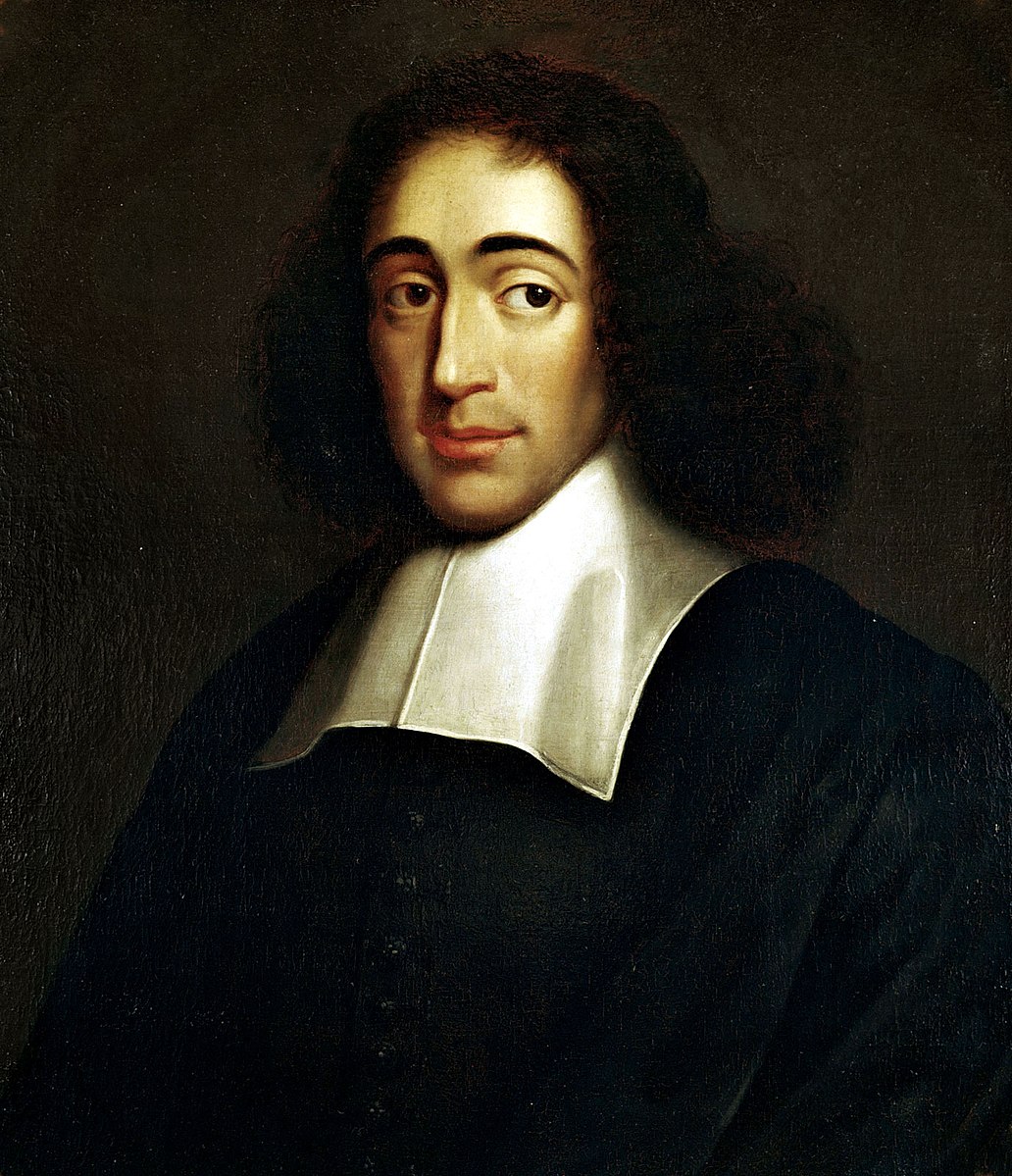 Anonymous portrait of Benedictus de Spinoza, 1665. Herzog August Library, Germany. (Public Domain)
But contrary to his Jewish contemporaries’ suspicions, Spinoza never embraced atheism. As he wrote in the same text, he was concerned with the “misconceptions which … still disfigure our notion of religion.” His belief in God didn’t waver. In fact, he often wrote for theologians. Even his non-theological works relied on biblical commentaries. He just opted to take matters of faith in his own hands, hoping to bypass what he saw as rigid and misleading dogmas.
Spinoza’s most important text was published in 1677, shortly after he died in middle age. Titled “Ethics,” the five-part volume applied geometric principles to moral, psychological, and theological questions. God, Spinoza argued, was a single infinite substance. The philosopher further suggested that every material object was one of countless expressions of this divine substance.
At first glance, a tree may look like an independent entity. Its branches and roots define its limits and distinguish it from the soil and other things around it. But for the philosopher, that was a false impression. The tree’s real essence was, to him, the same divine essence of its creator.
Spinoza’s God designed and directed everything. In his deterministic framework, human agency didn’t exist. All a person could do was understand and embrace necessity.
The rogue truth-seeker died at 44, likely from tuberculosis exacerbated by regular exposure to noxious dust from grinded glass. Today, he’s hailed as one of the most daring and original philosophers in recent history, not least because he believed that true knowledge of God was available to anyone, anywhere, so long as one proceeded in sequence through three levels of knowledge.
Imaginative Knowledge
Spinoza’s first level of knowledge is the imagination. This is the lowest and least adequate form of knowledge. To him, “imagination” meant opinion formed through experience, or, as he defined it in a treatise on the topic, “Perception arising from mere experience.” Imagination consisted of images and assumptions derived from sensory perceptions.
Spinoza used the example of the earth’s shape. When we look into the far distance, the ground seems level and the horizon abrupt, while the sky looks like a dome. From these visual inputs, we could assume or “imagine” that the earth is flat. We wouldn’t think it could be a different shape because sight alone doesn’t give us enough data to form that conclusion.
 Watching the sunset is a great way to visualize the horizon, in this sunset at Lake Paijanna in Sysma, Finland. (Joonas Lyytinen/CC BY 2.0)
Spinoza also thought that imaginative knowledge included “hearsay,” a term that described inherited and unexamined opinions. He believed imaginative knowledge was the most natural perspective on reality. To him, its defining feature was the lack of doubt. As he wrote in the same treatise, “By hearsay I know the day of my birth, my parentage, and other matters about which I have never felt any doubt.” So long as “we have no contradictory fact” about an opinion, he suggested, imaginative knowledge remains the most credible option. That’s why he viewed it as mankind’s standard perspective on the world. We aren’t born with a fully developed intellect. In its absence, the senses are all we have.
Being born with a predominantly imaginative perspective on the world didn’t mean to him we should never transcend it. If we stopped at the imagination, Spinoza proposed, we’d only be able to understand the world as a random compilation of appearances. This rudimentary understanding would preclude the liberating bliss that he thought true knowledge could offer. He viewed the world as a perfectly ordered whole with a divine nature, whose true essence only the intellect could begin to understand.
Intellectual Knowledge
In light of the senses’ partial knowledge, Spinoza wanted to find a better, more reliable alternative. Like most philosophers, he was after the most accurate knowledge of the world possible.
His first step was to shift attention to the rational powers of the intellect. Reason told him that experience yielded faulty claims about the world. Looking down into a pond distorts a person’s face, though reason suggests that the face didn’t change at all. Gazing at the starry sky shows a blanket of minuscule lights, when in truth those celestial bodies are immense and more remote than we could ever conceive. The issue is more complicated, but Spinoza’s basic point was that the mind can understand more and better than the imagination.
Indeed, the more the mind acquires new ideas through reason, “the better it understand[s] its own strength and the order of nature.” With a better understanding of the world, Spinoza proposed we could also gain a better understanding of its perfectly ordered nature.
However, he didn’t think that reason sufficed. It, too, relied on images. The intellect, he thought, only activated to disprove opinions and assumptions from experience. He couldn’t leave knowledge entirely to the imagination, but neither could he leave it to reason. A third, final step was needed.
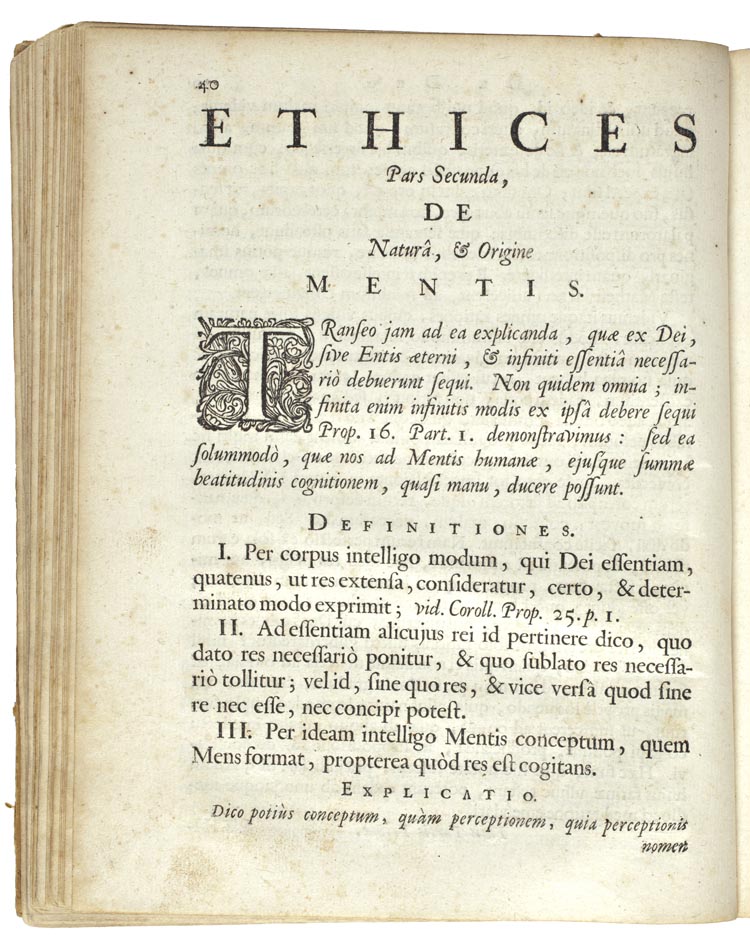 Spinoza’s “Ethics: Part Two,” was published posthumously in 1677. (Public Domain)
Intuitive Knowledge
The last tier in Spinoza’s ladder of knowledge is intuition, which he defined as “the perception arising when a thing is perceived solely through its essence.” Spinoza argued that because created things were inseparable parts of the creator, they were also, in essence, the creator. Once he began glimpsing this truth through the intellect, he could work his way to contemplating it without the mediation of ideas.
Intuition unfolded not in words, images, or concepts, but in direct and total awareness, like God’s knowledge of himself and his creation.
In other words, Spinoza saw no difference between intuiting the essence of an object—say, a tree or person—and intuiting the essence of God. As he put it, “Insofar as our mind knows itself and the body under a species of eternity, it necessarily has knowledge of God, and knows that it is in God and is conceived through God.”
By tapping into the power of intuition, Spinoza thought humans could participate consciously in the divine’s eternal nature. The body decomposes, as do all the objects that stimulate the imagination. While we live, however, he believed our minds could know God’s perfection entirely. Shifting our perspective from images to ideas and finally to essences might allow us to see ourselves as one with God.
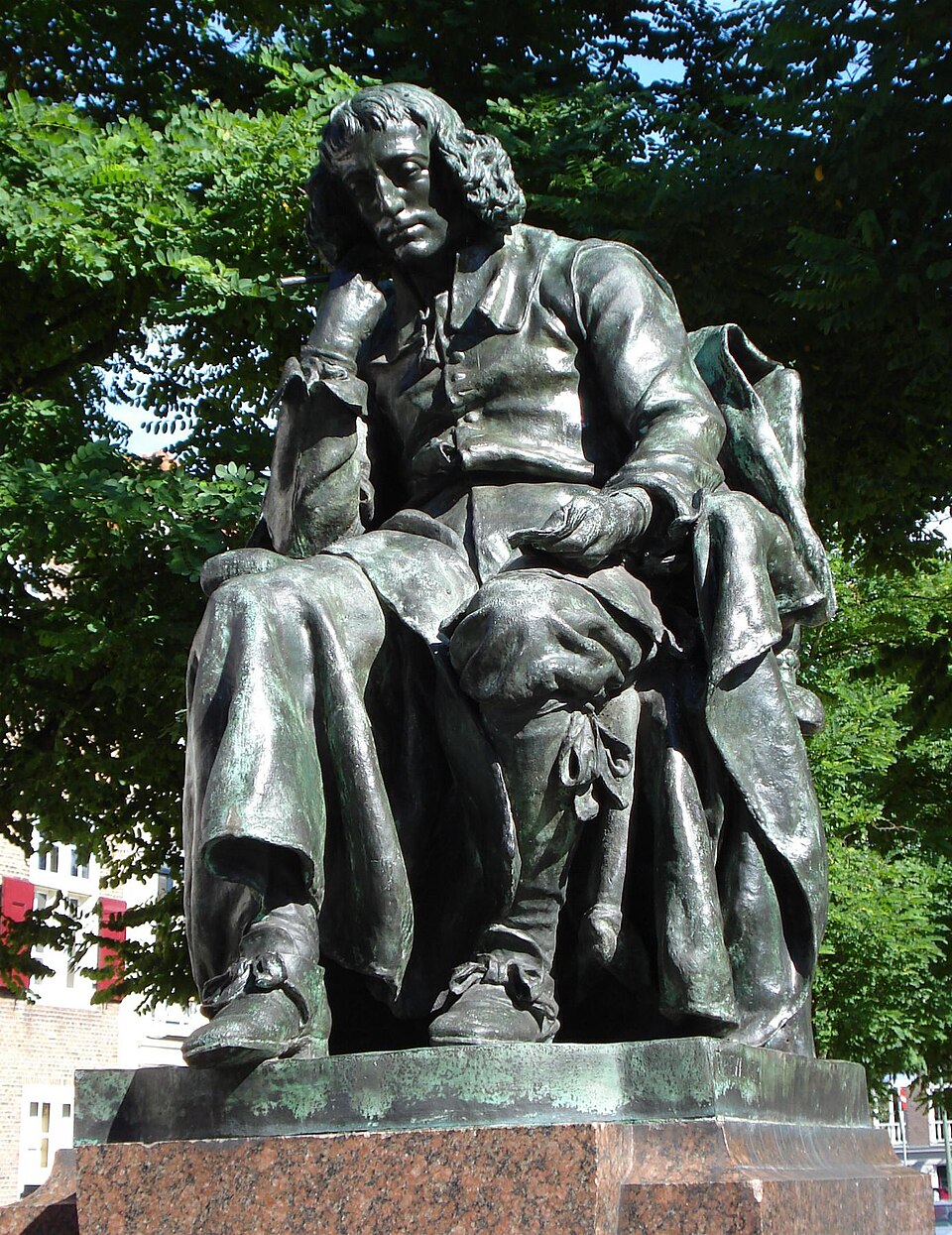 Thanks to his contributions to philosophy and ethics, Spinoza is memorialized in statue form. Frederic Hexamer designed this seated Spinoza, deep in thought, in 1880. The Hague, Netherlands. (Public Domain)
Knowing any part of creation was to Spinoza the same as knowing God, for his God was ever present in everything. It’s in this intuitive knowledge that the philosopher hoped to experience beatitude, even if for a moment.
In a 1910 introduction to one of Spinoza’s shorter works, philosophy professor Abraham Wolf described intuitive knowledge as the “intellectual love of God.” This love was reserved to the individual who experienced it, hence its intellectual quality. But Spinoza was clear about the universality of intuition. Though intellectual, this love was available to anyone.
Although Spinoza was accused of heresy and atheism, he never lost sight of what mattered most to him: the chance to know the world in all its divine majesty.
What arts and culture topics would you like us to cover? Please email ideas or feedback to features@epochtimes.nyc