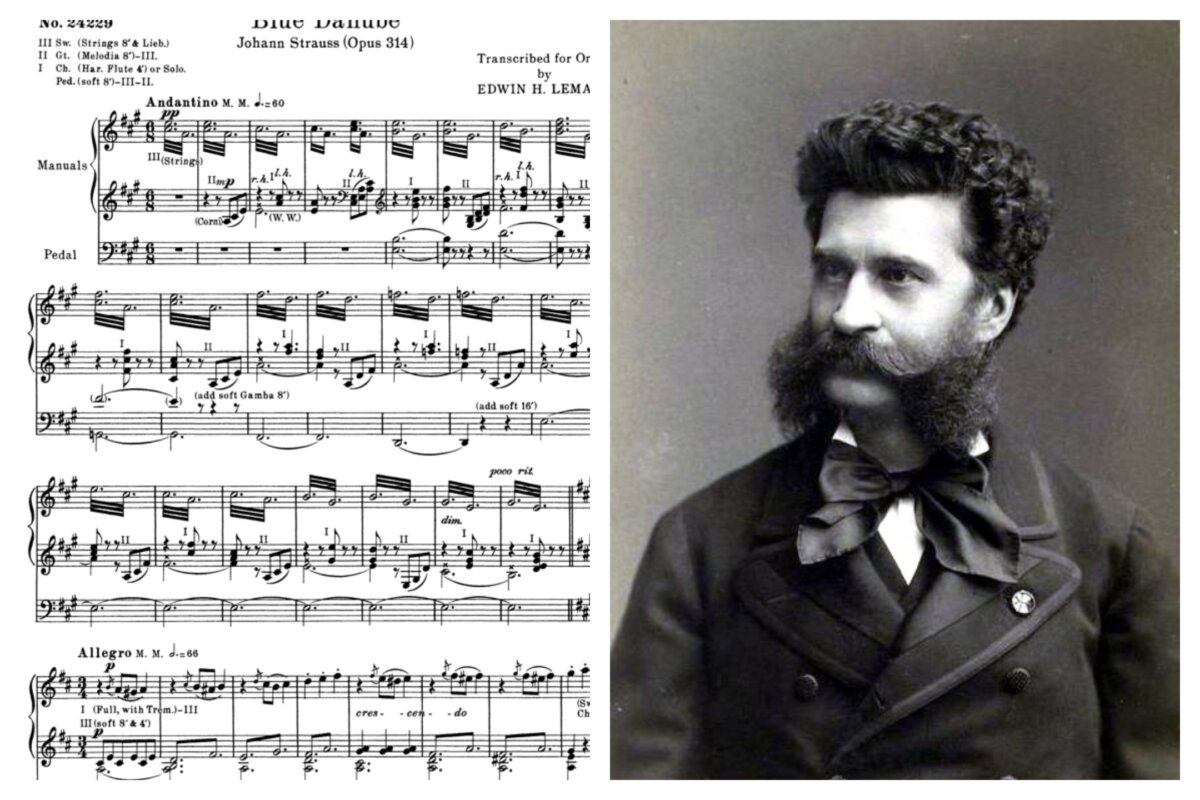
This New Year’s Eve, as on all New Year’s Eves within recent memory, the major orchestras of the world will perform pops concerts consisting of breezy old pieces from the 19th century, most of them with dance pedigrees: polkas, marches, quadrilles, and, of course, waltzes.
Among the myriad waltzes likely to be on the New Year’s programs of everyone from the Vienna Philharmonic to your local symphony orchestra is one work that is absolutely required. Leaving it out would be like citing the works of Homer and not mentioning the Odyssey: “An der schönen blauen Donau,” known in English as “The Blue Danube,” composed by Johann Strauss II (1825–1899) in 1866.
The “II” in his name is significant, as it indicates there was a Johann Strauss I. Indeed, Strauss I (1804–1849) was an enormously successful orchestra leader and composer of the light-hearted fare that Vienna craved in the mid-19th century. Many of his works still show up on 21st-century programs; his “Radetzky March” is nearly as ubiquitous as “The Blue Danube.”
In his early 20s, the son launched his own orchestra in competition with the old man, but soon found out that Vienna was loyal to the father. Johann II’s luck changed when Johann I died prematurely in 1849. Though the elder Strauss’s other sons, Josef and Eduard, also composed, Johann II’s gift for crafting sweeping melodies in 3/4 time—the three-beat signature of the waltz—made him their father’s natural replacement. Vienna approved the succession.
The First Dance

Strauss junior composed more than 150 waltzes (and almost as many polkas), of which “The Blue Danube” was approximately the 100th. While many Strauss waltzes enjoy permanent places in the repertoire—especially “The Emperor’s Waltz,” “Voices of Spring,” and “Viennese Blood”—nothing he wrote comes near the popularity of “Blue Danube.” Strauss wrote it originally as a concert work for chorus and orchestra. Josef Weyl wrote the original lyrics before the first performance in 1867, but an alternative set of lyrics, written by Franz von Gernerth in 1889, has proven more popular. The words begin (translated from the German):
“Danube so blue,
so bright and blue,
through vale and field
you flow so calm,
our Vienna greets you,
your silver stream
through all the lands
you merry the heart
with your beautiful shores.”
Its original success was moderate, but when the composer arranged it for orchestra alone, designed for the ballroom rather than the concert hall, “Blue Danube” shot to the top of the charts—or would have, if they’d had hit-tune charts in the 1860s.
Song Breakdown
A waltz is actually several strains of waltz tunes strung together, unified by meter, tempo, and key. Assembled, the various strains of “Blue Danube” amount to about 10 minutes in length, standard for a waltz.
The Vienna Johann Strauss Orchestra played “Blue Danube” for the New Year’s Concert 2024. (Listen)
The music starts at about 0:20. Strauss’s score teases us for a minute with the first few, oh-so-readily-recognized notes of the famous melody announced on the horns and then by the orchestra as a whole. Just as we’re expecting the melody to burst forth in all its well-known glory, another idea intercedes at 1:28—but not for long. At 1:52 the tune can be restrained no longer.
Like so many famous melodies, it is the essence of simplicity: the notes of a rising major triad repeated and expanded. And yet it is unforgettable. No sooner do we hear it completed than the next link in the chain of tiny waltz melodies is heard at 2:31. Then, the next at 3:00, and one after that at 3:29, and so on. The essence of the form is the seemingly endless blossoming of one short melody after another. In this case, strains 2, 3, and 4 recycle in altered form until at last the score lands on a repeat of the opening melody, which we hear starting at 8:50.
The waltz form remains with us today, the ancient dance that it is, and not just at New Year’s celebrations. Composers of all nationalities continued to write waltzes well in the 20th century, supplying music lovers’ need for light ballroom and concert works. The latest one to enter the repertoire is “Waltz No. 2” by Dmitri Shostakovich, which we will look at in the next “Tune in Today.”
What arts and culture topics would you like us to cover? Please email ideas or feedback to features@epochtimes.nyc