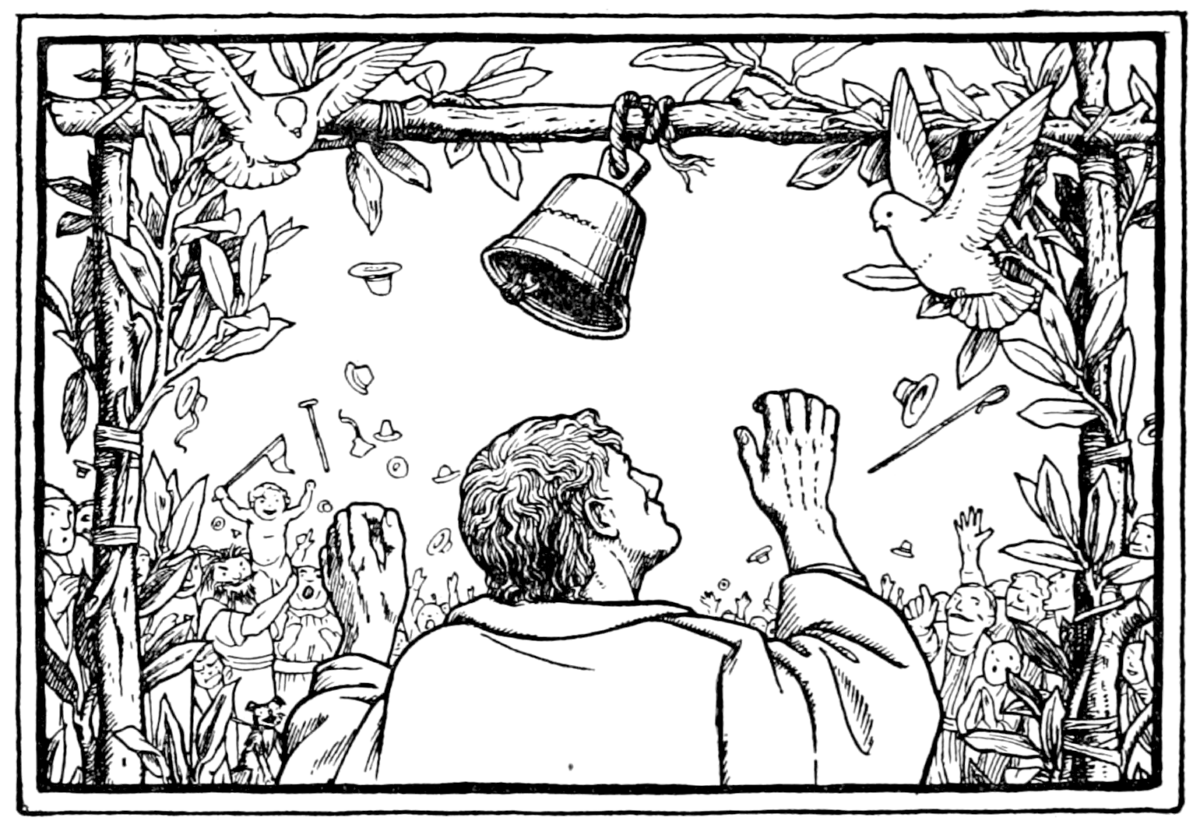
In their fairy tale “The Three Languages,” the Brothers Grimm demonstrate how to handle one’s individual, special gifts. It’s the story of a count’s son whose father thinks his son’s gifts are useless. The son must learn that his gifts are unique and that they will play a special role in determining his destiny.
Learning Odd Skills
A rich count in Switzerland has just one son, who is rather dull. One day, the count sends his son to another town for a year with a tutor in hopes that his boy will learn something useful.
Much to the count’s chagrin, when his son returns from his studies he tells his father that he has learned how to understand dogs’ barking. The count is rather shocked. Unsatisfied, he sends his son to a different town with a new teacher.
The son is away for a whole year. When he returns, the count asks him what he has learned. This time, the boy says that he has learned a new language; he has learned to understand what the birds say.
The count grows furious. He wants his son to learn something useful, as he believes that understanding the language of animals is useless. So, the count sends his son away a third time, saying: “I will send you to a third master, but if you learn nothing this time also, I will no longer be your father.”
The son obeys and stays away for another year. When he returns on the long-awaited day, the anxious count asks his son if he has learned anything useful this time. The son responds, “Dear father, I have this year learnt what the frogs croak.”
Hearing this, the count flies into a rage and disowns his son. Since the youth hasn’t learned anything useful, the count orders his servants to drive him into the woods and kill him. They haven’t the heart to kill the innocent boy, so they send him out into the world unharmed.
An Exciting Future
Now alone in the world, the count’s son wanders until he finds a fortress. There, he asks the lord if he can have lodging for the night. The lord consents, saying:
“If you will pass the night down there in the old tower, go thither; but I warn you, … it is full of wild dogs.” The young man isn’t afraid of ravenous dogs and goes into the fortress anyway.
In the morning, the count’s son appears unscathed and announces to the people: “The dogs have revealed to me … [that] they are bewitched, and are obliged to watch over a great treasure which is below in the tower.” Hearing this, the lord of the fortress tells the count’s son that, if he removes the treasure and frees the dogs, he will adopt him as his son.
The count’s son subsequently frees the dogs, obtains the treasure, and finds a new home. Although this is a wonderful result of his talents, an even greater destiny awaits the count’s son, which he will obtain using his other gifts.
Through this story, children can learn that their gifts and talents (whether they are born with them or accrue them over time) are unique. Because of that very uniqueness, their gifts can help them change the world around them, as well as achieve their destiny.
A child’s gifts doesn’t become less valuable because others don’t see a use for them; rather, they simply await the right moment. When that moment comes, children can see their talents multiply, causing their lives to blossom in wonderful ways.
What arts and culture topics would you like us to cover? Please email ideas or feedback to features@epochtimes.nyc