Herakles is remembered as a figure of overwhelming strength—a slayer of monsters, a conqueror of chaos. Yet among his 12 labors is one that demands the opposite of force: the capture, without harm, of the Ceryneian hind.
We might think of Herakles’s 12 labors as exploits or adventures. But “labors” is the correct word. Even after his death, when Herakles was deified and joined the immortal gods on Olympus, his shade—his shadow-like existence after death—remained in the realm of the dead, called Hades.
In Homer’s “The Odyssey,” Herakles complains to Odysseus, whom he meets during Odysseus’s descent among the dead, “I was a son of Zeus, but infinite was my suffering; for I was a slave to a far inferior man, and heavy were the labours he laid on me.”
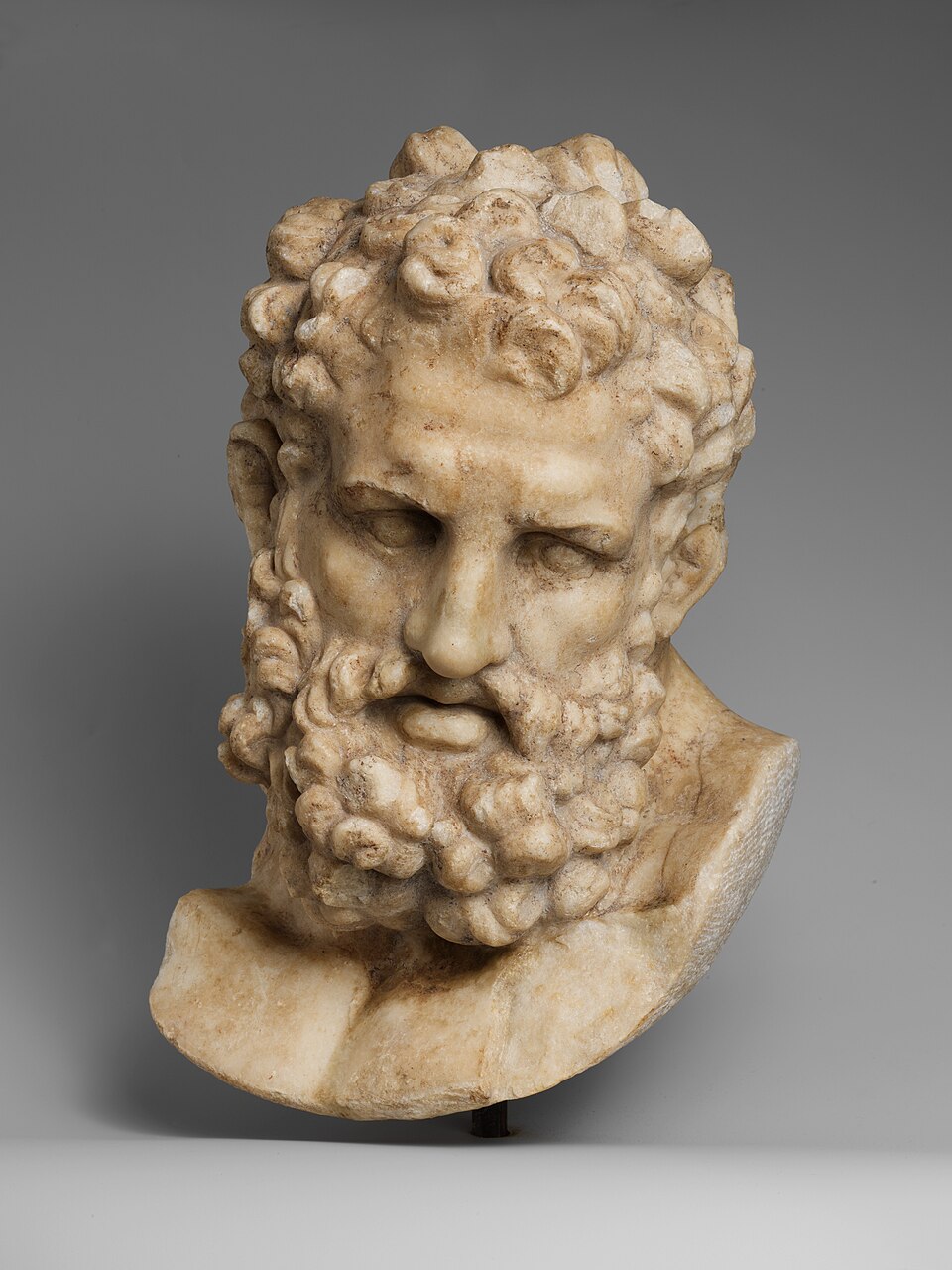 Marble head of Herakles, first century A.D. Marble. Metropolitan Museum of Art, New York City. (Public Domain)
The labors of Herakles represent not merely a sequence of heroic exploits but a systematic education of the soul. Each task unfolds like a chapter in a moral curriculum. More specifically, these labors are traditionally linked to specific astrological signs of the zodiac, and, correspondingly, to one of the four elements: fire, air, water, and earth.
In the Hydra labor, associated symbolically with water, Herakles confronts the dark multiplicity of inner life—the fears and compulsions that, when attacked crudely, regenerate stronger than before.
In the Nemean lion labor, associated with fire, he faces primal terror directly, discovering that true courage doesn’t destroy fear but transforms it into strength. Thereafter, he wears the lion’s pelt as protection; the lion’s skin was known to be indestructible.
The labor of the Augean stables, associated with air, shifts the register again. Here, brute effort is useless, and Herakles learns the art of creative reframing when faced with an insoluble, even impossible task. The redirection of the water flow was a stroke of genius. With the labor of the Stymphalian birds, also associated with air, he enters the realm of the mind’s atmosphere, where clamor and distraction give way to a higher, wiser sound—a labor of clarity amid chaos.
Sequentially, his third labor is the capture of the Ceryneian hind, which corresponds to the sign of Virgo and marks the first appearance of the earth element in this cycle.
Here a surprising distinction emerges. Although Herakles is commonly imagined as a figure of brute strength and violence, the labors themselves fall into two types: labors of force, in which chaos must be opposed, monsters confronted, and destruction resisted, and labors of restraint, in which the challenge is to refrain, to respect limits, and to act creatively or reverently.
Here is a lesson for all of us, then: Are we too often yang, trying to win and overwhelm the opposition at all costs, or are we too yin, too laid-back, too laissez-faire, allowing opportunity to slip away? To be a hero, we have to know when to apply force and when to withhold it.
After the excessive violence of confronting first the Nemean lion and the Hydra, Herakles is ordered to capture the Ceryneian hind. Sacred to Artemis, the hind is gold-horned, swift, and untouchable. Although Herakles is a master archer and could easily kill it, he’s commanded to take the animal alive. The task demands patience, humility, and precision rather than strength.
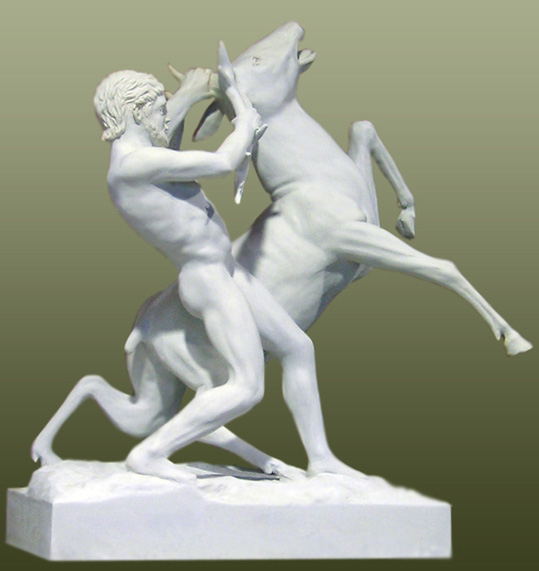 “Hercules Captures the Ceryneian Hind,” 2009, by J. M. Félix Magdalena. (Jomafemag/CC BY-SA 3.0)
The danger lay not in the hind itself, but in its sacred status. Artemis is a ruthless punisher of those who trespass in her domain. British writer and comedian Stephen Fry, in his book “Heroes,” rather amusingly puts these words into her mouth: “If it was our father [Zeus], the Storm Bringer himself, I would shoot him for daring to take my hind.” That is the level of threat to Herakles.
The hind is not a monster to be slain nor a threat to be destroyed. It’s a creature of purity and grace, elusive and ethereal, and untouched by human hands (so virginal). The requirement that it be captured alive transforms Herakles’s labor into something subtler, almost contemplative. This is a trial of precision rather than force, spiritual discipline masquerading as a hunt.
The myth tells us that Herakles pursues the hind for a full year. This passing of seasons matters. Unlike the dramatic single combats of his other labors, this one unfolds in silence and duration—through forests, across mountains, over frozen rivers and sunburned plains. The chasing is not frantic but patient. It’s a slow apprenticeship in attentiveness. The hind is never truly cornered; it’s perpetually just out of reach, drawing Herakles toward a lesson he does not yet understand.
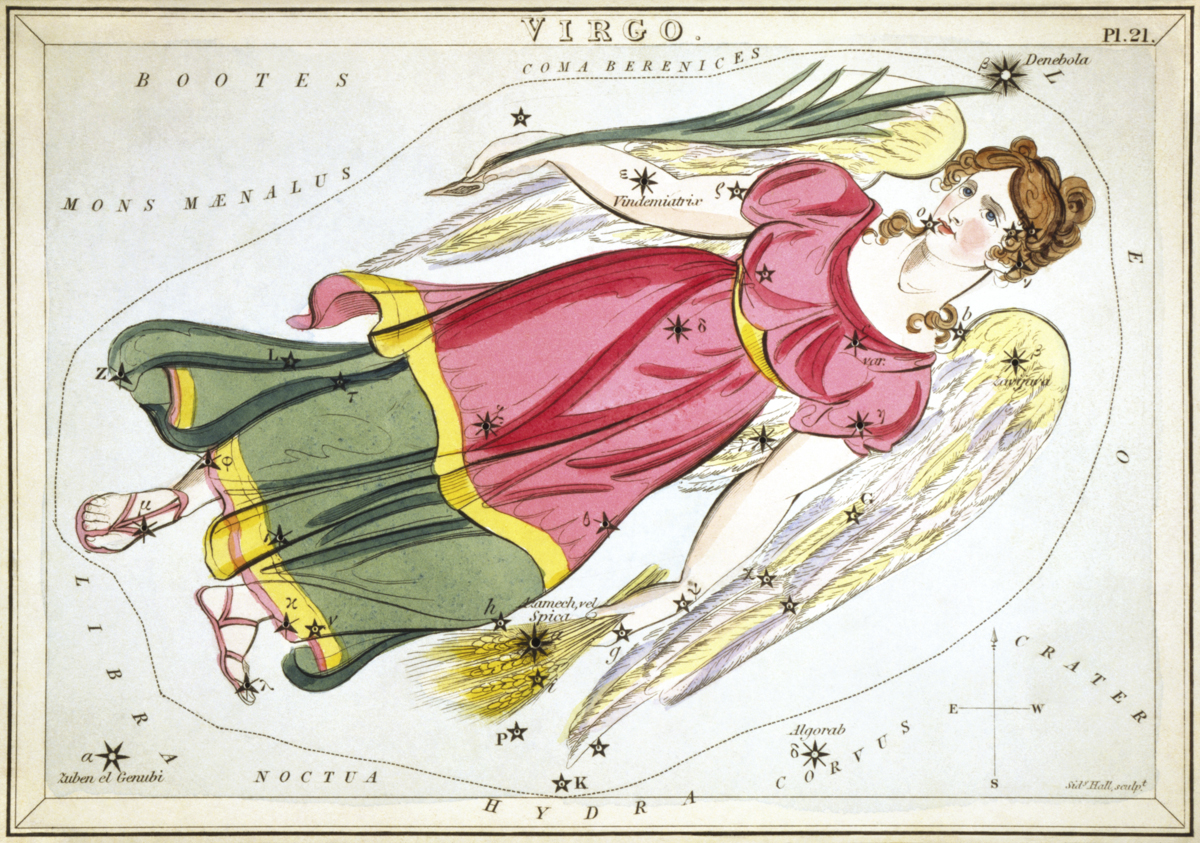 The Virgo constellation as depicted by engraver Sidney Hall, circa 1825, in “Urania’s Mirror,” a set of constellation cards published in London. Library of Congress’s Prints and Photographs division. (Public Domain)
The year-long pursuit symbolizes typically Virgoan (and so grounded earth) themes of perseverance, service, and duty. Where the lion and Hydra forced Herakles inward—toward courage and inner darkness—the hind draws him outward, toward reverence for what is holy and inviolate. Virgo, the virgin (Artemis is a virgin), governs purity and the service of higher principles.
Herakles must learn to act without harming, to hold power without possession. The strongest mortal must learn to become gentle. He must master the art of withholding power, of controlling impulse, of acting without violation. The hind stands as a living boundary—a reminder that not everything that can be subdued should be subdued, and that true strength is sometimes revealed not in decisive action, but in the refusal to act crudely.
As the sacred animal of Artemis—goddess of the wild, of chastity, of the untouched spaces of nature and the soul—the hind embodies virginity in its original, pre-moral sense: not sexual abstinence, but integrity of being, unbreached, whole, inviolate. It represents the parts of life that must be approached with reverence: the purity of conscience, the dignity of the natural world, and the fragile moral bonds that hold civilization together.
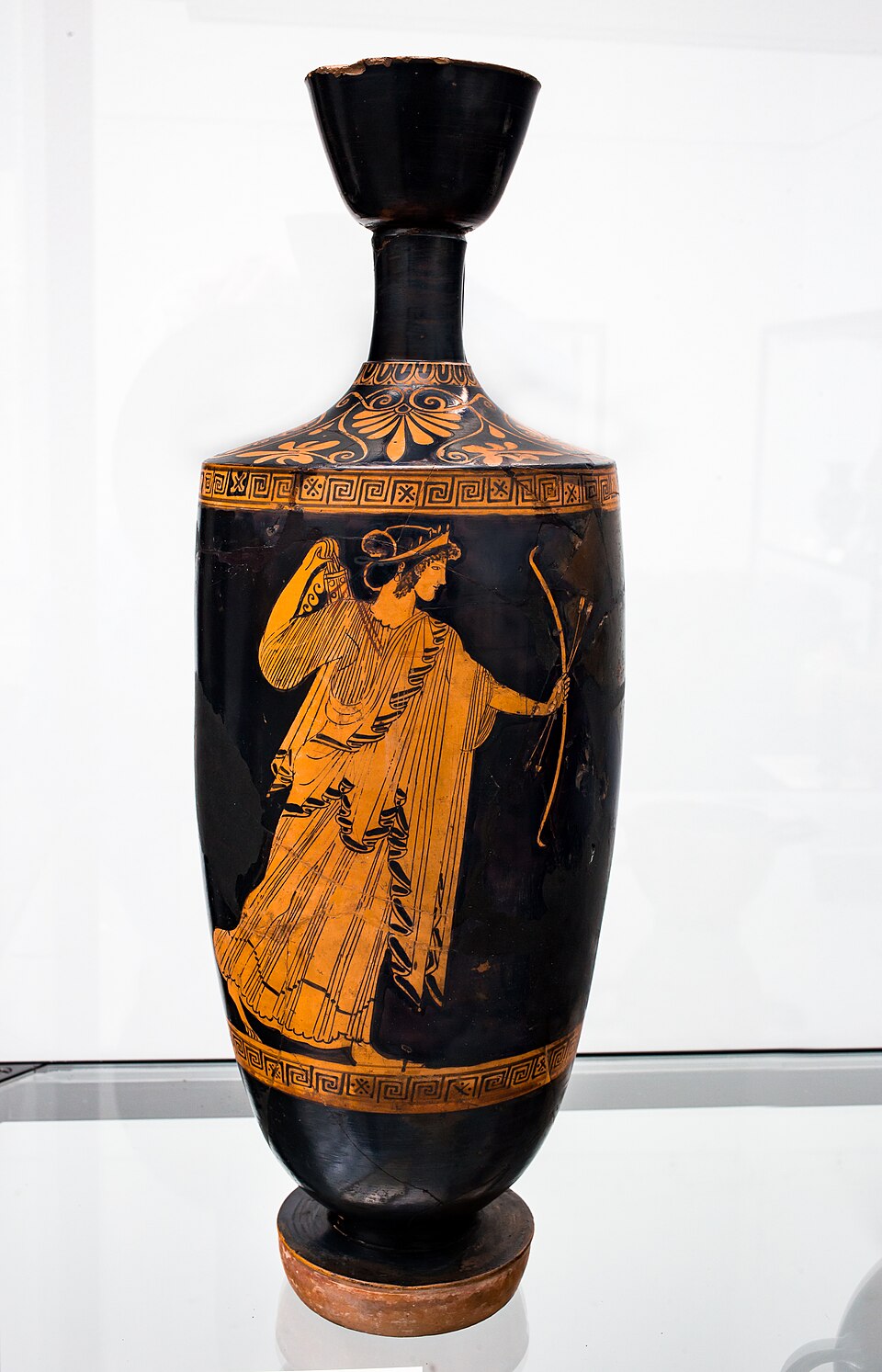 “Artemis,” circa 480 B.C.–470 B.C. This Athenian lekythos depicts a dynamic Artemis taking two arrows out of her quiver and preparing to fire another. Staatliche Antikensammlungen, Munich. (ArchaiOptix/CC BY-SA 4.0)
To harm such a creature would be easy for Herakles, yet catastrophic for his soul. The labor thus becomes a meditation on the ethics of power. Strength without reverence becomes brutality; will without restraint becomes desecration. The hind forces Herakles to confront what it means to act with justice. That’s required when the object of action isn’t an enemy, but a symbol of the sacred order itself.
When he finally seizes the hind and Artemis confronts him, Herakles must justify his actions honestly and respectfully. This mirrors the Virgo virtue of truthfulness and conscientiousness. It is doing the difficult but necessary thing while remaining morally accountable. The goddess is angered. Her creature has been seized, her sacred animal brought under mortal control.
The meaning of the labor crystallizes in this encounter. Herakles must justify what he has done—not with bravado, not with excuses, but with truth, humility, and moral clarity. He explains that he did not act from arrogance or sacrilege, but from necessity. A command was laid upon him (ultimately deriving from Hera, the queen of the gods), and he has treated the hind with honor.
What matters here is not merely the explanation, but its tone. Herakles doesn’t roar or posture. He doesn’t claim divine sanction as entitlement. He submits his action to judgment. In doing so, he enacts something profoundly Virgoan: accountability, honesty before a higher order, a willingness to answer morally for his deeds.
Artemis relents. She allows Herakles to take the hind. He takes it not as plunder, not as trophy, but as a kind of sacred loan, a temporary yielding of the divine to human vocation. Her permission is an acknowledgment that Herakles has passed the true test of ethical maturity.
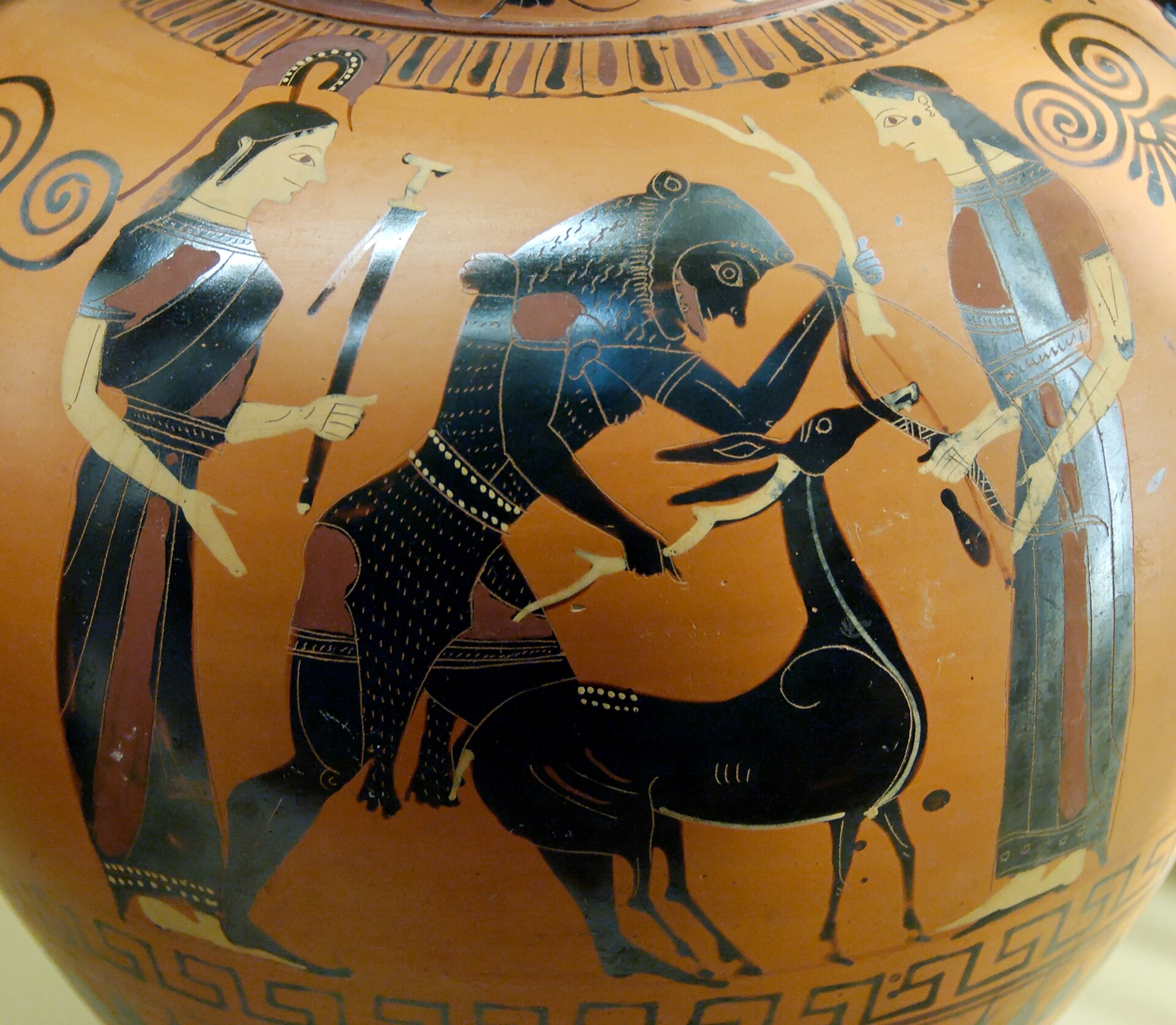 An amphora dating from circa 540 B.C. to 530 B.C., possibly from Vulci, depicting Herakles capturing the hind while Artemis and Athena look on. (Public Domain)
The labor marks an initiation into a different kind of heroism. Up to this point, Herakles has been a conqueror of dangers, a slayer of beasts, a master of physical trial. But here he learns that the path to greatness also runs through the discipline of conscience, through the recognition that some things must be handled with care or not at all. The hind reveals a world in which victory is measured not by conquest, but by how gently one carries what one is strong enough to break.
And there is a further nuance. The year-long pursuit can also be read as the slow taming of Herakles’s own restlessness, his instinct toward immediacy and force. By following the hind without overtaking it, he is apprenticed to time, to patience, to the rhythm of the seasons. The labor becomes a parable about the part of the soul that must be educated before it can be trusted with power.
In a culture that prizes speed, impact, and decisive outcomes, this labor speaks with quiet but urgent relevance. It reminds us that there are forms of work, of leadership, of moral responsibility that cannot be rushed; that competence without conscience is dangerous; and that brilliance without humility can become destructive.
What arts and culture topics would you like us to cover? Please email ideas or feedback to features@epochtimes.nyc.