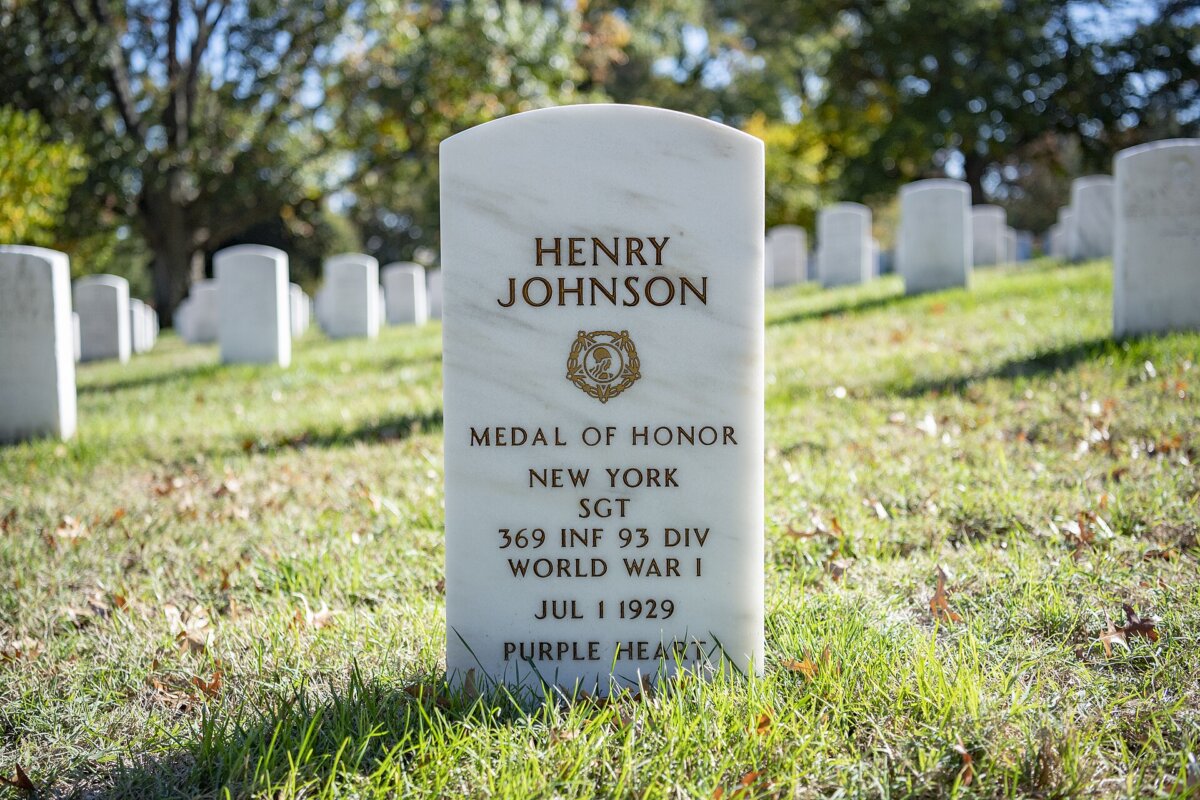
When the United States entered World War I on April 6, 1917, the nation mobilized rapidly for a conflict already reshaping Europe. Among the Americans who volunteered for service was Henry Johnson, a young laborer from New York whose brief life would include one of the most remarkable acts of battlefield courage of the war—an act that went largely unrecognized at home for decades.
Johnson was born around July 15, 1892, in Winston-Salem, North Carolina. His early years were marked by the whims of available work, and like many Americans of his generation, he moved north in search of opportunity. By his early 20s, he had settled in Albany, New York, where he supported himself through a succession of physically demanding jobs, including employment as a chauffeur, a coal yard laborer, and eventually a redcap porter at Union Station. It was there, amid the constant movement of people and trains, that Johnson encountered a nation preparing for war.
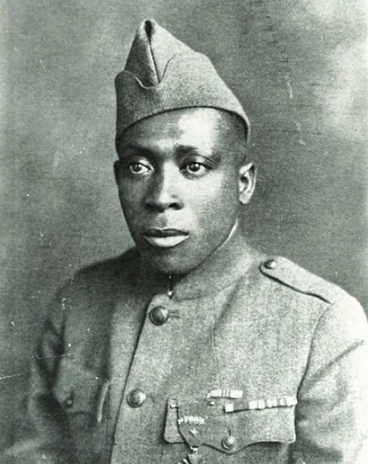 Henry Johnson in uniform, circa 1917. (Public Domain)
Before the introduction of conscription under the Selective Service Act, military opportunities were limited. Johnson enlisted through the 15th New York National Guard Regiment, an African-American unit. When the unit was federalized, it became the 369th Infantry Regiment, sometimes referred to as the Harlem Hellfighters. After training at Camp Wadsworth in South Carolina, the regiment was deployed to France, likely due to intolerance from white American soldiers, where it was attached to the French Army and assigned to front-line duty.
By the spring of 1918, Johnson was serving as a private first class. In the early hours of May 15, he and fellow soldier Needham Roberts (1901–1949) were posted on sentry duty near the Aisne River in northeastern France. The position was isolated and removed from immediate reinforcement. Under cover of darkness, an estimated 20 or more German soldiers launched a sudden raid, advancing in coordinated groups.
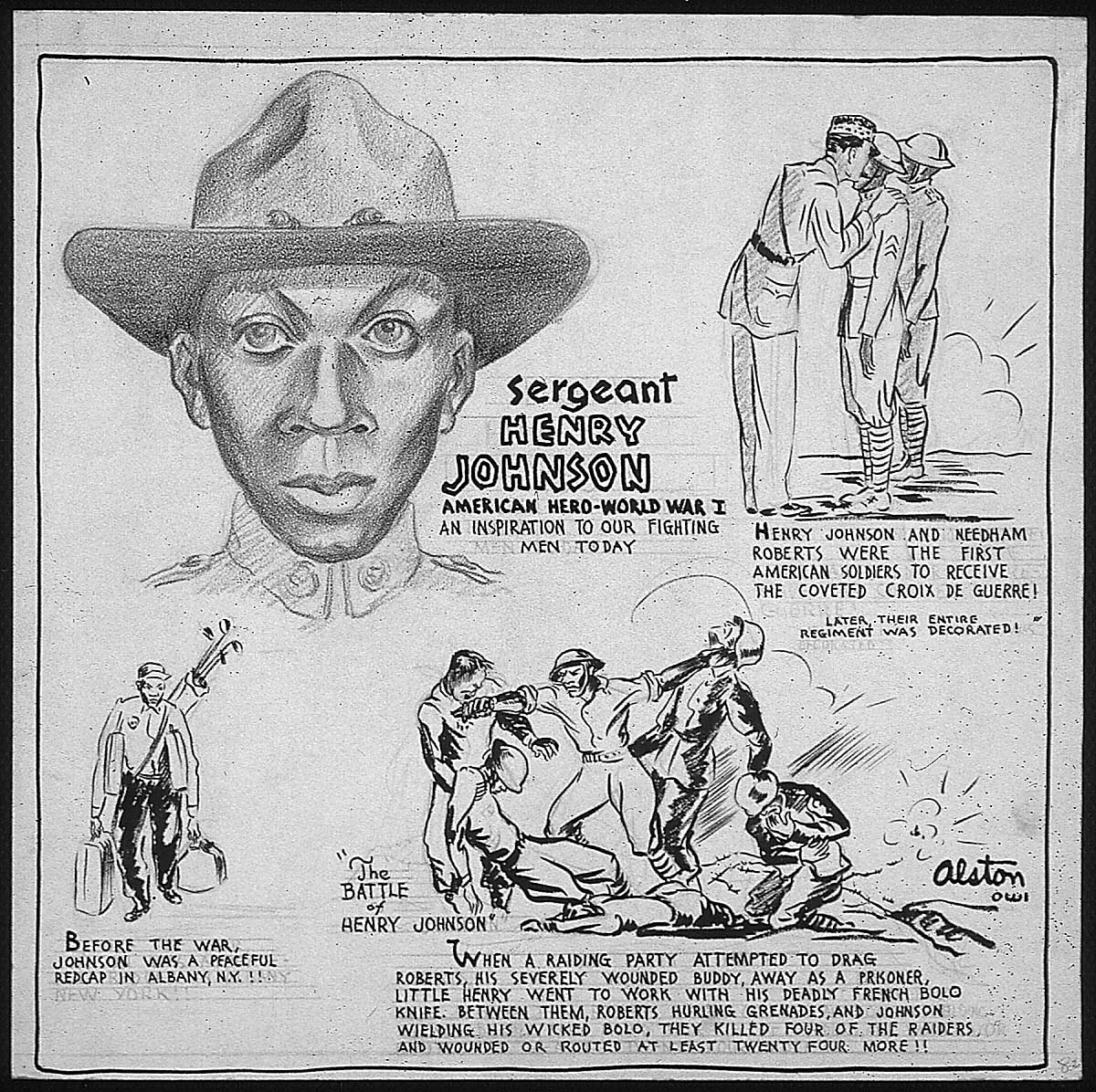 A 1943 patriotic cartoon depicting Pvt. Henry Johnson, by Charles Alston. (Public Domain)
The encounter quickly escalated into close-quarters combat. Both men were wounded early, and their ammunition was soon exhausted. When Roberts was seized during the attack, Johnson chose to press forward rather than withdraw. Armed only with a knife and the broken butt of his rifle, he fought through the raiding party and succeeded in freeing his comrade. During the struggle, Johnson was shot and repeatedly wounded by bayonet and grenade fragments.
As the sound of approaching forces grew nearer, the attackers withdrew. At daylight, the extent of the violence became clear. Johnson had suffered approximately 21 wounds to his back, face, arms, and feet. Contemporary accounts credited him with killing at least four enemy soldiers and wounding others. Exhausted and severely injured, he collapsed and was taken to a French field hospital.
A Humble Soldier
Johnson later resisted heroic characterization of the event, explaining that instinct had governed his actions. He described the encounter as a fight for survival rather than a calculated act of valor. Nonetheless, the French Army regarded the engagement as extraordinary. Johnson and Roberts were awarded the Croix de Guerre, France’s highest military decoration for bravery, and the clash became widely known as “The Battle of Henry Johnson.”
The 369th Infantry Regiment compiled an exceptional combat record during the war. Serving for roughly 191 days on the front lines, the regiment earned repeated commendations for its conduct under fire. It sustained heavy casualties—approximately 1,500 were killed or wounded—and a significant number of its officers and enlisted men received individual decorations. The regiment as a whole was awarded the Croix de Guerre for collective gallantry.
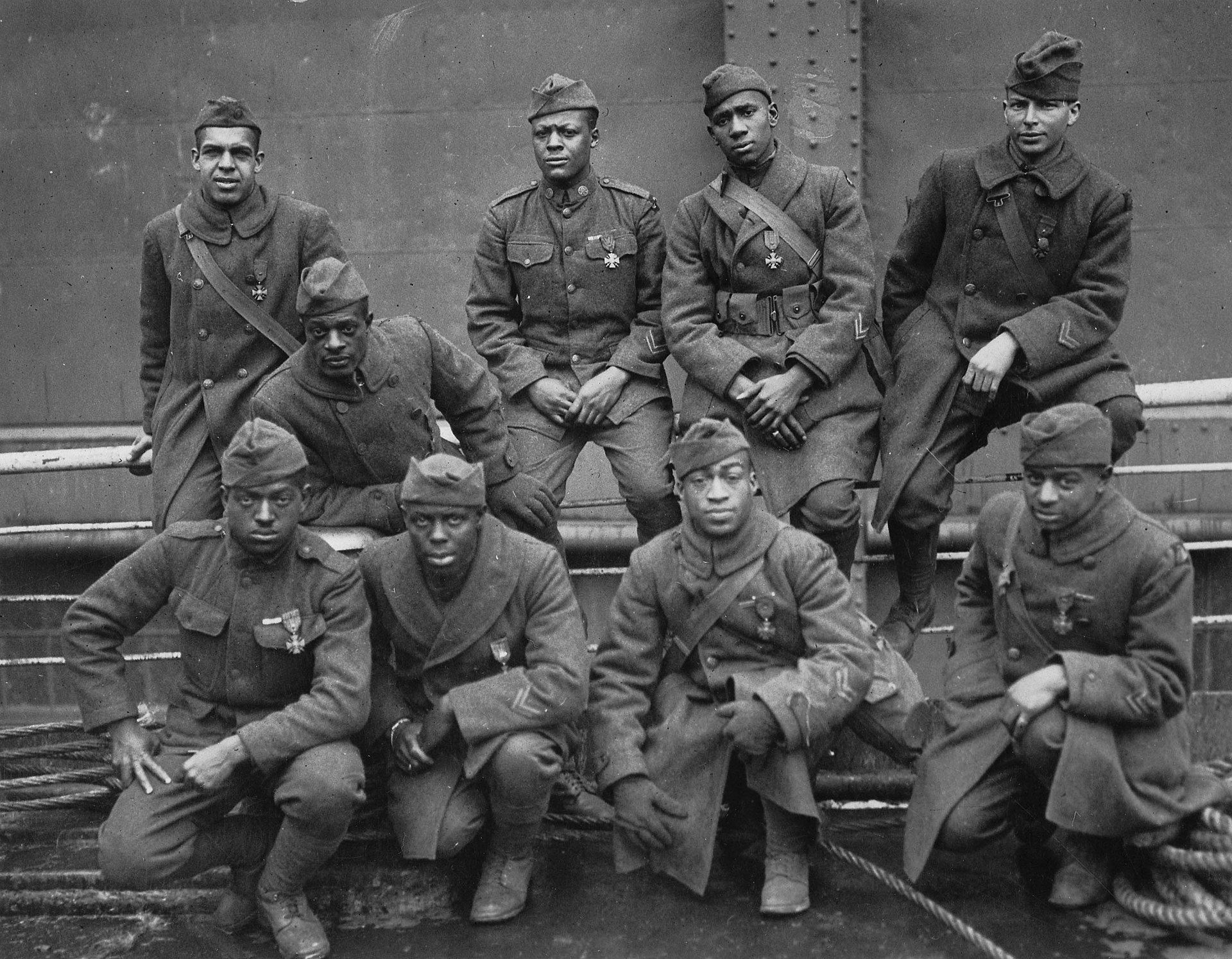 Many members of the 369th Regiment were awarded the Croix de Guerre medal from France, 1919. (Public Domain)
When the war ended, the regiment returned to the United States to widespread acclaim. In February 1919, it was honored with a parade up Fifth Avenue in New York City. At the front of the procession rode Henry Johnson, newly promoted to sergeant, standing in an open car and waving to cheering crowds. The moment marked the peak of his public recognition.
In the years that followed, the attention faded. Although former President Theodore Roosevelt (1858-1919) later described Johnson as one of the bravest American soldiers of the war, and although Johnson’s image appeared in wartime promotional materials, official recognition from the U.S. military didn’t follow.
His discharge papers didn’t document his extensive wounds. He didn’t receive a Purple Heart during his lifetime, nor was he granted disability compensation despite being unable to work regularly because of his injuries.
Johnson returned to Albany and attempted to resume civilian life. But his physical injuries limited his employment prospects, and his circumstances steadily declined. Financial hardship, failing health, and alcoholism followed. His family eventually left him, and in July 1929, at the age of 36, Henry Johnson died in poverty. For many years, even his relatives believed he had been buried in an unmarked grave.
Righting Past Wrongs
Decades later, renewed historical interest brought Johnson’s story back into view. In 1996, he was posthumously awarded the Purple Heart. Subsequent research by military historians revealed that he had, in fact, been buried with full military honors at Arlington National Cemetery in 1929, a fact unknown to his family for more than 70 years.
Further investigation continued to clarify the record. In 2002, the U.S. Army posthumously awarded Johnson the Distinguished Service Cross. Additional firsthand accounts of the May 1918 battle surfaced, including a contemporaneous report from General John J. Pershing (1860—1948), the senior American commander during the war. His report described Johnson’s actions in detail. These findings contributed to a final reassessment.
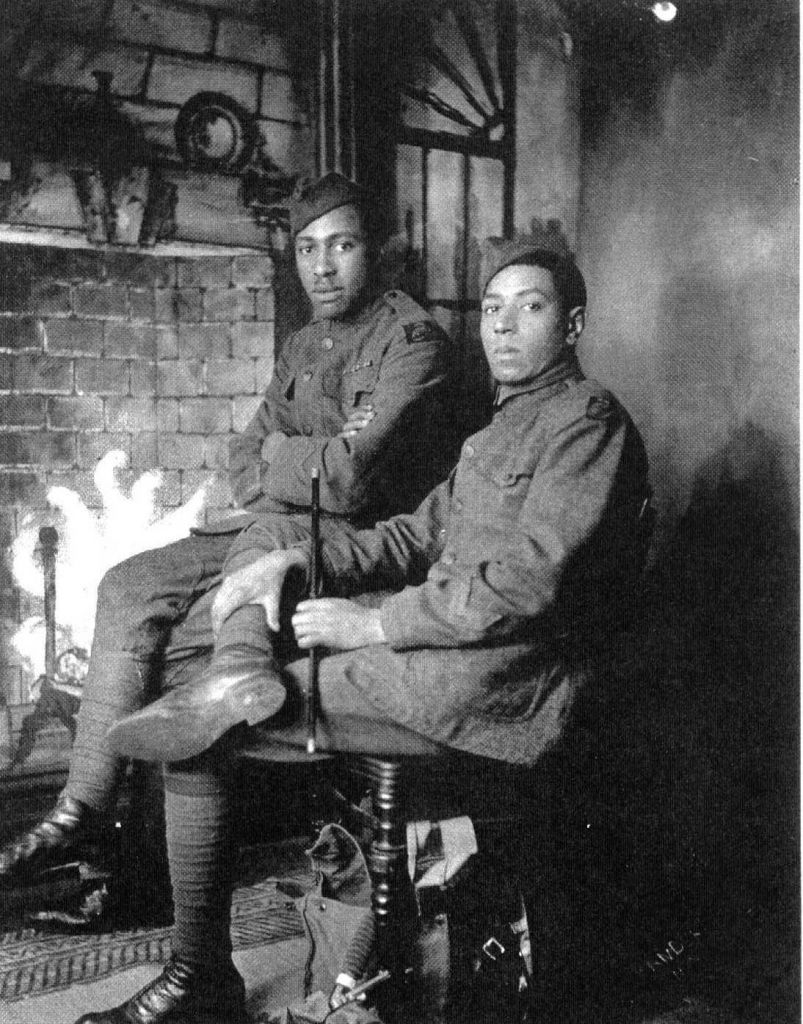 The heroism of Henry Johnson and Needham Roberts (L) has been preserved to inspire future generations. (Public Domain)
On June 2, 2015—nearly a century after the events near the Aisne River—Henry Johnson was awarded the Medal of Honor. The ceremony acknowledged both his extraordinary conduct in combat and the long delay in recognizing it. The medal was accepted on his behalf by a senior representative of the New York National Guard.
Henry Johnson’s life traced a difficult passage from obscurity to battlefield distinction, from postwar neglect to belated recognition, leaving a record that endures as a sober testament to courage and to the necessity of setting the historical record right.
What arts and culture topics would you like us to cover? Please email ideas or feedback to features@epochtimes.nyc