Throughout history, especially since the Industrial Revolution, humanity has struggled to live in harmony with nature while still supplying for its needs. How do we use nature without destroying it? Is human presence always antithetical to the health of the natural environment?
New answers to these age-old questions have emerged from an unexpected source: a recently published study on the biodiversity of the region around Lake Constance in southwestern Germany during the medieval era. The study, published in the Proceedings of the National Academy of Sciences, found that the building and farming practices used by the Monastery of St. Gall near Lake Constance led to an increase in the biodiversity of the local ecosystem.
In other words, agricultural and commercial activities of the lakeside medieval communities helped the natural world flourish, not wither.
The study made use of pollen data from lake sediment cores and archaeobotanical evidence (ancient plant remains) to reconstruct 4,000 years of ecological history in the area of Lake Constance. Analysis of this data revealed a 45 percent increase in plant richness between A.D. 500 and A.D. 1000. Shannon’s Diversity Index, which measures ecological diversity, also increased by 23 percent during the same time period. The estimated number of plant taxa increased from 27 to 40.
Of these new taxa that emerged during the 500-year period, a large number were associated in some way with farming. The study’s authors wrote:
“Among upland herb and grass taxa, the majority with known subgroups belong to four subgroups directly or indirectly associated with human agriculture: crops, crop weeds, fallow/grassland plants, and ruderals. Crops and crop weeds grow in tended fields. Fallow/grassland plants grow in untended fields, pastures, or meadows. Ruderals grow on disturbed land.”
This means that the ecological flourishing didn’t happen by chance. It was tied to human activity. Researchers compared the plant data with archeological findings and St. Gall’s extensive archives. They made a strong case that this increase in ecological health and diversity was caused by the agricultural and economic activities of the communities around the monastery. Beneficial activities included forest clearing, draining of swamps, installing of dikes, cultivation of land, and trade with distant regions.
“This transformation [of the ecosystem], the study argues, was not simply a function of climate,” reported Medievalists.net. “Instead, it emerged from new agricultural practices, population growth, and the development of an extensive network of trade and land management linked to the Monastery of St. Gall.”
The same article summarized the significance of these findings, explaining that they “demonstrate that human activity does not inevitably lead to biodiversity loss and that medieval agricultural systems offer lessons for sustainable land management today.” The farming practices of the time produced abundant food and improved the existing ecosystem instead of spoiling it.
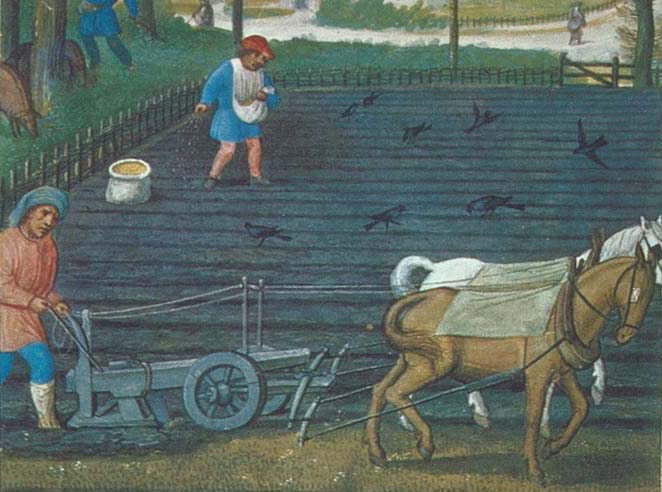
One of the most important of these practices was the three-field system: a method of crop rotation in which a third of a field was planted with a winter crop, a third with a spring crop, and a third left fallow for the season. Other farming practices included farming marginal soils and the use of iron ploughshares. Plant diversity was also increased by the introduction of new species via St. Gall’s expanding trade network, which reached all the way to Tuscany.
The inhabitants around Lake Constance managed to reach a beautiful balance. The landscape was an “intermediate-disturbance system. That’s an area that is neither virgin wilderness nor intensively farmed monoculture (single crop fields), but instead a patchwork of fields, forests, meadows, gardens, and semi-wild areas. This type of landscape promotes biodiversity because it creates many different ecological zones.
Plant diversity in the region peaked around 1350, then dropped off when the human population collapsed due to the Black Death. In this unusual situation, the health of the local ecosystem depended on the health of the human population. As farming and settling decreased, so did biodiversity. Although that biodiversity did recover in later years, it never reached pre-Black Death levels, partly because in the early modern period, flax monocropping for the production of linen was introduced in the region.
The history of the Lake Constance area tells a tale of the powerful integration of human society with culture, trade, and the natural world. Though the story is now over 1,000 years old, it still has relevance today. The basic farming principles used by the medieval farmers could be applied in our time, too. As the study’s authors note:
“Landscape mosaicking through agriculture has, in the Lake Constance region and elsewhere, exhibited the potential to increase plant diversity while maintaining society-sustaining food production. If undertaken at the appropriate scale and in a manner respectful of critical ecological thresholds, similar landscape management techniques may be useful in modern biodiversity conservation.”
The study provides modern farmers and conservationists with a fascinating new model for study and imitation.