
In her short story “Why the Peterkins Had a Late Dinner,” Lucretia P. Hale demonstrated that life is far better with humility, patience, and laughter. These gifts illuminate the reality of one’s limitations, help bear one’s frailties and ignorance, and, subsequently, rise from faults with a laugh and lightheartedness.
Dinner Time
The Peterkins sit down to dinner. The table is set, everyone is present, and the only thing missing is the food. Amanda, the Peterkins’s cook, has finished making dinner downstairs and puts it in the dumbwaiter. However, when she gets upstairs and pulls on the cord, the dumbwaiter gets stuck halfway between the top floor and the kitchen. Each of the Peterkins goes to the dumbwaiter and pulls on the rope, but it refuses to budge.
Mr. Peterkin announces to the family: “I am not proud. I am willing to dine in the kitchen.” So they all reconvene downstairs to have their dinner. Amanda sets the table for them in the kitchen and then heads to the dumbwaiter.
Much to her dismay, she can’t pull the dumbwaiter back down and the food remains stuck halfway between the kitchen and the dining room. Mr. Peterkin in anguish asks what is for dinner. Mrs. Peterkin says, “Roast turkey … squash, tomato, potato, and sweet potato.” This wonderful list leads to moans and groans over the loss of such an excellent meal.
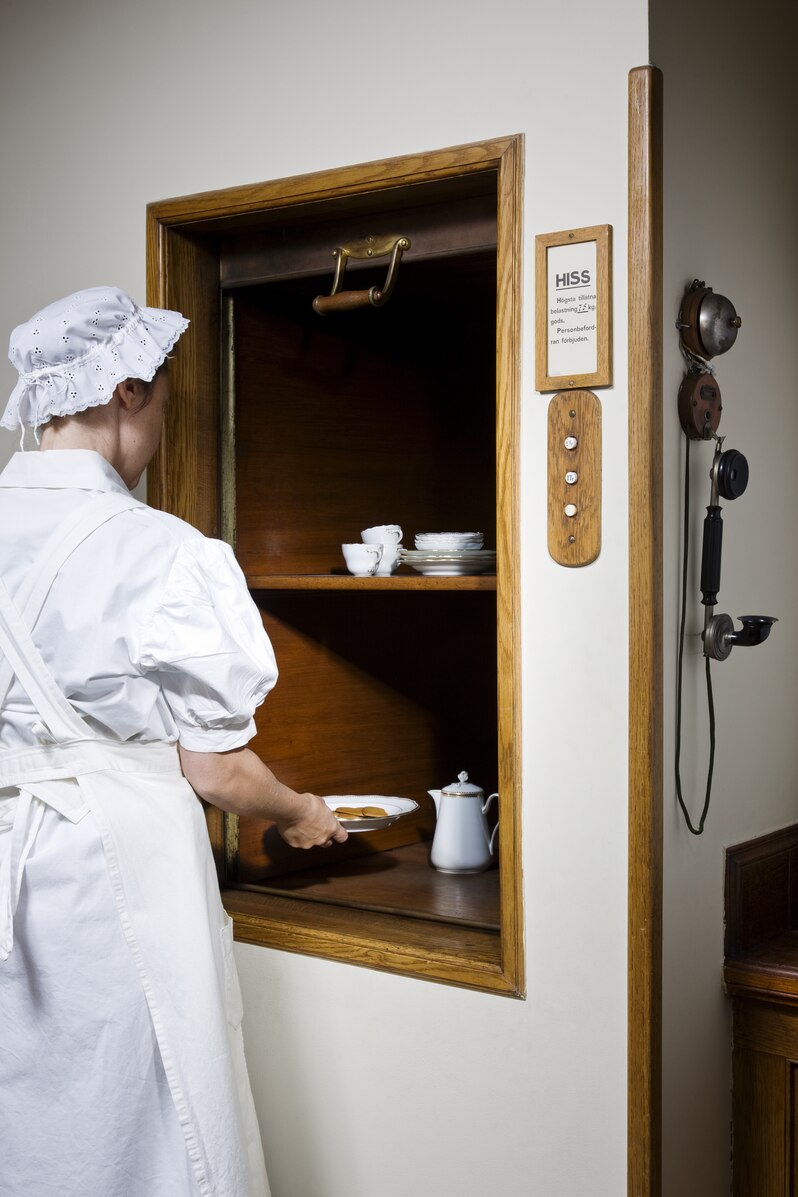 Dumbwaiters are far less common in the 21st than in the 19th and even 20th centuries. (Jens Mohr/CC BY-SA 3.0)
Learning With Laughter
But Mr. Peterkin quickly suggests that they sit down and think of a solution. Agamemnon states: “The turkey … must be just above the kitchen door. If I had a ladder and an axe, I could cut away the plastering and reach it.”
The family supports this idea, but Elizabeth Eliza wonders if a carpenter wouldn’t be the better option. Everyone jumps at this idea, and Mr. Peterkin, Solomon John, and the youngest boys head out to finda carpenter. Meanwhile, Agamemnon decides that he will do research on Herculaneum: “This affair of the turkey … reminds me of those buried cities that have been dug out,—Herculaneum, for instance. … They found there pots and kettles. Now, I should like to know how they did it.”
The family splits up to their individual tasks. Unfortunately, the carpenter is out of town and won’t return until nine o’clock that night. So, while Agamemnon reads and the family waits for the carpenter, they all enjoy some tea.
Finally, when the Peterkins hear the church bell ring the ninth hour, Agamemnon hurries out with the two youngest and Solomon John to get the carpenter. They inform the carpenter that they will need an axe, a ladder, and a pickaxe. The carpenter brings all of these tools, as well as some buckets (just in case there is a fire). But, when the carpenter sees that they are having difficulty with the dumbwaiter, he provides the Peterkins with a much simpler solution.
Through this story, Hale shows that when solving problems in life, humility, patience, and the ability to laugh at one’s self should always be practiced. Often the answer to one’s problems is quite simple, but, if unable to recognize a solution, laughter and humility are the best cure.
J.M. Barrie puts it very aptly in “The Little Minister”: “Life is a long lesson in humility.” Yet laughter should always be coupled with that lesson in humility, for it lifts the spirit and makes humility a sweeter, more efficacious pill to swallow. Life may be long and full of humbling lessons, but laughter fills those lessons with bright smiles and lightheartedness.
What arts and culture topics would you like us to cover? Please email ideas or feedback to features@epochtimes.nyc