



Among the many interesting facts about Abraham Lincoln—that he was the only president to hold a patent (for a device for lifting boats over shoals), that he was an accomplished wrestler and was honored in the Wrestling Hall of Fame, that he held several jobs (such as surveyor, storekeeper, and postmaster) before being elected to the local government in Illinois at the age of 25—there is the little-known fact that Lincoln also wrote poetry. Not only did he write poems himself, but he was very well-read and had a great love for poetry in general.
This is all the more surprising given that his parents could neither read nor write, and he was largely self-educated aside from about a year’s worth of formal schooling. Yet he went on to become a lawyer and politician. His Gettysburg Address is the most well-known speech by an English-speaking politician.
Lincoln said his early life was best encapsulated by the final line of the eighth stanza from Thomas Gray’s “Elegy in a Country Churchyard”:
Let not Ambition mock their useful toil,
Their homely joys, and destiny obscure;
Nor Grandeur hear with a disdainful smile
The short and simple annals of the poor.
 Abraham Lincoln’s childhood cabin, on display at the 1904 Worlds Fair. (Public Domain)
The lines speak to a childhood marked by poverty, hard work on the family farm in Indiana, and suffering as Lincoln lost his mother when he was nine and his sister 10 years later. The family moved from Indiana to Illinois in 1830, and Lincoln didn’t return until 1844, when he went back to give campaign speeches on behalf of Henry Clay.
Despite the hardship he’d endured there, Lincoln retained an attachment to the land and wrote a poem on the occasion. As he wrote in a letter to his friend Andrew Johnston in 1846,
“That part of the country is, within itself, as unpoetical as any spot of the earth; but still, seeing it and its objects and inhabitants aroused feelings in me which were certainly poetry; though whether my expression of those feelings is poetry is quite another question.”
He enclosed in the letter the first of four cantos of a poem called “My Childhood Home I See Again,” which Johnston later published anonymously under the title “The Return”:
My childhood’s home I see again,
And sadden with the view;
And still, as memory crowds my brain,
There’s pleasure in it too.
O Memory! thou midway world
’Twixt earth and paradise,
Where things decayed and loved ones lost
In dreamy shadows rise,
And, freed from all that’s earthly vile,
Seem hallowed, pure, and bright,
Like scenes in some enchanted isle
All bathed in liquid light.
As dusky mountains please the eye
When twilight chases day;
As bugle-notes that, passing by,
In distance die away;
As leaving some grand waterfall,
We, lingering, list its roar—
So memory will hallow all
We’ve known, but know no more.
Near twenty years have passed away
Since here I bid farewell
To woods and fields, and scenes of play,
And playmates loved so well.
Where many were, but few remain
Of old familiar things;
But seeing them, to mind again
The lost and absent brings.
The friends I left that parting day,
How changed, as time has sped!
Young childhood grown, strong manhood gray,
And half of all are dead.
I hear the loved survivors tell
How nought from death could save,
Till every sound appears a knell,
And every spot a grave.
I range the fields with pensive tread,
And pace the hollow rooms,
And feel (companion of the dead)
I’m living in the tombs.
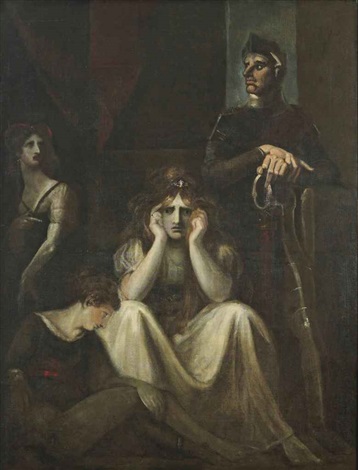 “Lady Constance, Arthur and the Earl of Salisbury,” 18th century, by Henry Fuseli. (Public Domain)
Poetry continued to be a solace for Lincoln as a means of expressing his grappling with grief for “the lost and absent.” Lincoln’s favorite poets were William Shakespeare and Robert Burns; he loved “Hamlet,” “Macbeth,” and the Histories, and could quote them extensively from memory. In 1862, months after the death of his 11-year-old son Willie, Lincoln recited a passage from “The Life and Death of King John” to Officer Le Grand B. Cannon. The lines are spoken by Constance, the widow of King John’s older brother Geoffrey, who has also lost a child: “Grief fills the room up of my absent child/ Lies in his bed, walks up and down with me.”
Solace in Political Turmoil
Beyond grief, Lincoln also struggled with the pressures he faced as a leader and even with disdain from the general public. He found that Shakespeare’s characters had also wrestled with the tension between ambition and the weight of the offices attained by that ambition.
Perhaps for this reason, Lincoln preferred King Claudius’s soliloquy “O my offense is rank” to the famous “To be or not to be” soliloquy in “Hamlet.” The latter is a philosophical reflection on life and death and on whether it is right for Hamlet to avenge his father while the former dwells on ambition, confession without contrition, and the punishment for sin.
As revealed in his second inaugural address, Lincoln contemplated sin and contrition a great deal in light of the suffering brought by the Civil War. He quoted the Gospel of Matthew and spoke of the war as the punishment both sides must suffer due to an offense against the divine law:
“Both read the same Bible and pray to the same God, and each invokes His aid against the other. It may seem strange that any men should dare to ask a just God’s assistance in wringing their bread from the sweat of other men’s faces, but let us judge not, that we be not judged. The prayers of both could not be answered. That of neither has been answered fully. The Almighty has His own purposes. ‘Woe unto the world because of offenses; for it must needs be that offenses come, but woe to that man by whom the offense cometh.’”
It’s not unlikely that “Hamlet” informed his reflections, particularly given that King Claudius’s speech consists of a prayer lacking repentance. It also lacks the necessary penance of relinquishing the throne he had taken after murdering his brother. The prayers of those asking for God’s assistance in maintaining slavery follow a similar vein, echoing Claudius’s prayer: “May one be pardoned and retain the offence?”
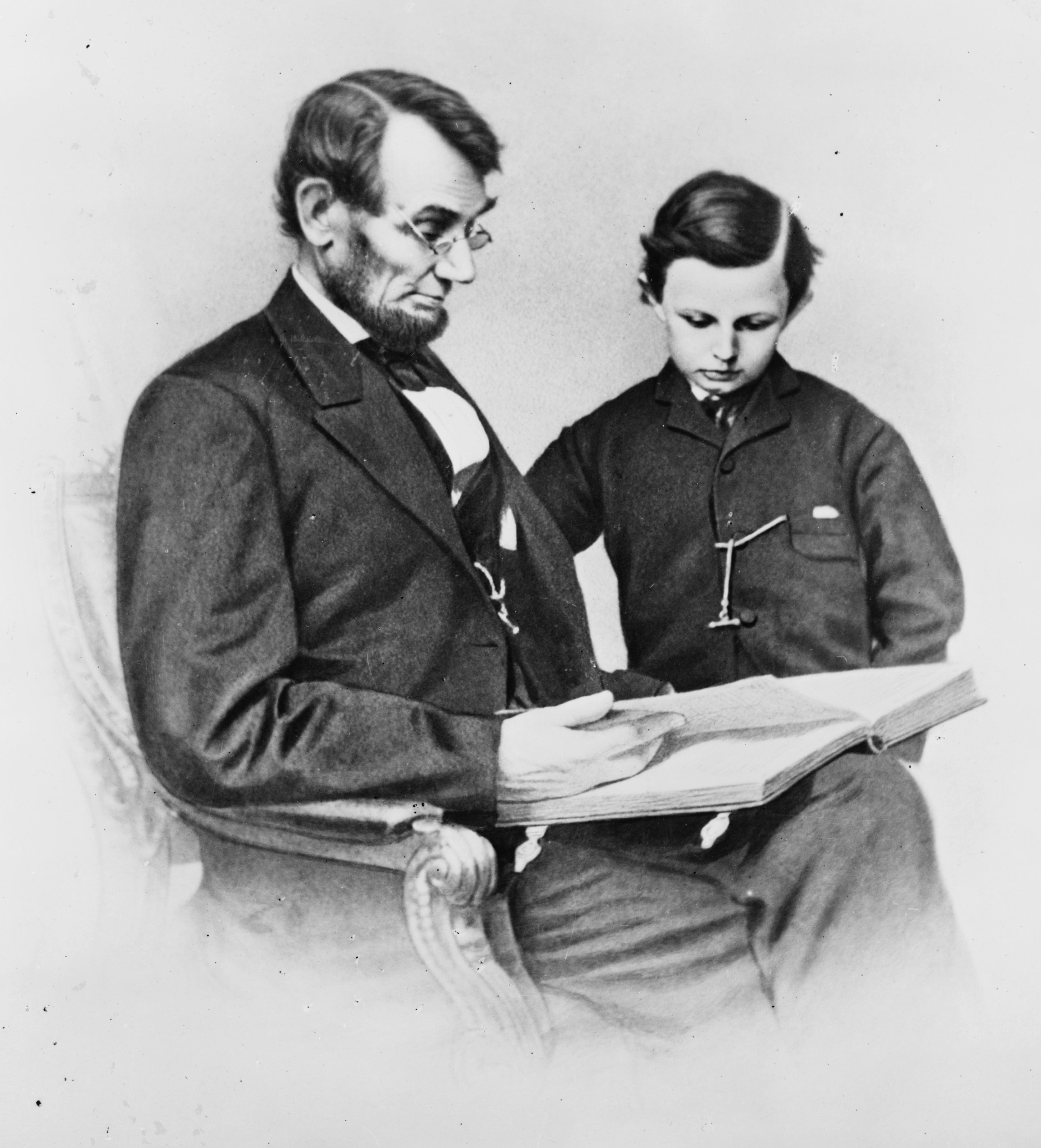 Abraham Lincoln with his son Tad. (Public Domain)
However, Lincoln’s favorite poem, which further indicates his attitude of humility towards the office he held, was William Knox’s “Mortality.” Lincoln wrote to Johnston:
“I would give all I am worth, and go in debt, to be able to write so fine a piece as I think that is.” The poem illustrates how death is the great equalizer, affecting even “the hand of the king that the sceptre hath borne.”
It not only expresses how death makes all men equal regardless of rank or circumstance, but it also creates an equality between past and present generations:
The thoughts we are thinking, our fathers would think;
From the death we are shrinking, our fathers would shrink;
To the life we are clinging, they also would cling; —
But it speeds from us all like a bird on the wing.
It’s likely that Lincoln would have been delighted by the poetic tributes paid to him after his death. William Cullen Bryant’s “The Death of Lincoln,” like Knox’s “Mortality,” shows that even one who bore “The sword of power, a nation’s trust!” goes the way of all flesh. There is hope in that he now stands “Among the noble host of those/ Who perished in the cause of Right!”
Beyond sharing the human condition with Lincoln, successive generations can aspire to share his zeal for justice and excellence. They would be glad to follow the way of one who let no grief or suffering hinder him from pursuing such a cause, nor allowed circumstance or hardship to deter him from the pursuit of wisdom and learning.
What arts and culture topics would you like us to cover? Please email ideas or feedback to features@epochtimes.nyc
