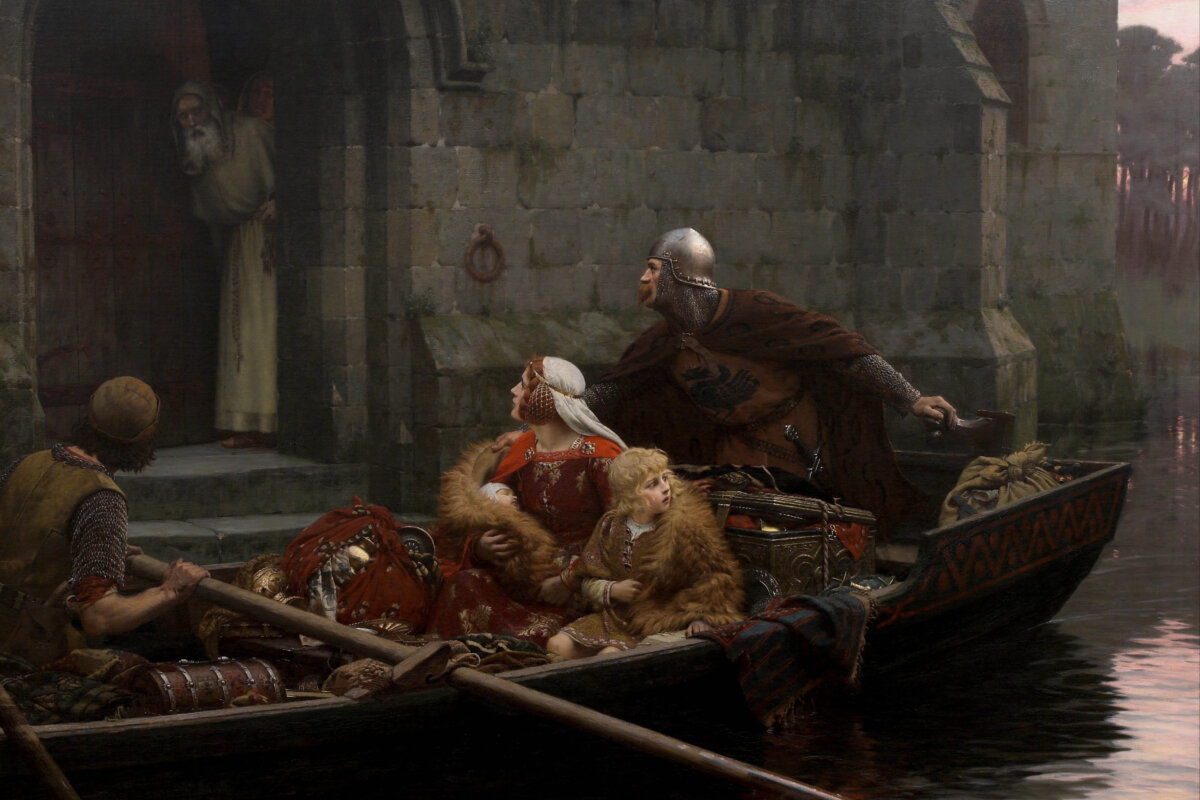
By the time Edmund Blair Leighton exhibited “In Time of Peril” at the Royal Academy in 1897, Victorian England was awash in nostalgia. The nation was marking the 60th anniversary of Queen Victoria’s reign with the Diamond Jubilee, a celebration that brought both national pride and an underlying anxiety about what would come next. Into this charged atmosphere, Leighton delivered a painting that looked backward to the 14th century while speaking directly to the present: a mother, two young children, and the desperate urgency of sanctuary.
The painting now belongs to the Mackelvie Trust Collection at Auckland Art Gallery Toi o Tamaki in New Zealand, where it has been a favorite since its acquisition. Its popularity is easy to understand. The image is immediate, emotionally direct, and technically accomplished—everything Victorian academic painting aspired to be.
At the Water Gate

Leighton himself described the setting as “laid at the water gate of a monastery in the fourteenth century, the outcome of reading of the shelter afforded by such places to the women, children and treasure, of those who were hard driven, and in danger.” The painting delivers exactly that. A small boat carries a glamorous noblewoman and her two children, one an infant, toward the stone entrance of a monastery. A young child turns to look back at whatever threat pursues them, a gesture that crystallizes the tension of the entire scene. Safety is within reach, but danger remains close behind.
Leighton’s technique amplifies the emotional stakes. The dark, cold water of the foreground gives way to the warm, guarded light of the monastery entrance, creating a visual grammar of risk and refuge. His meticulous rendering of textures—the softness of fabric, the roughness of ancient stone, the shimmer of water—draws the viewer into a world that feels tactile and real despite its medieval remove.
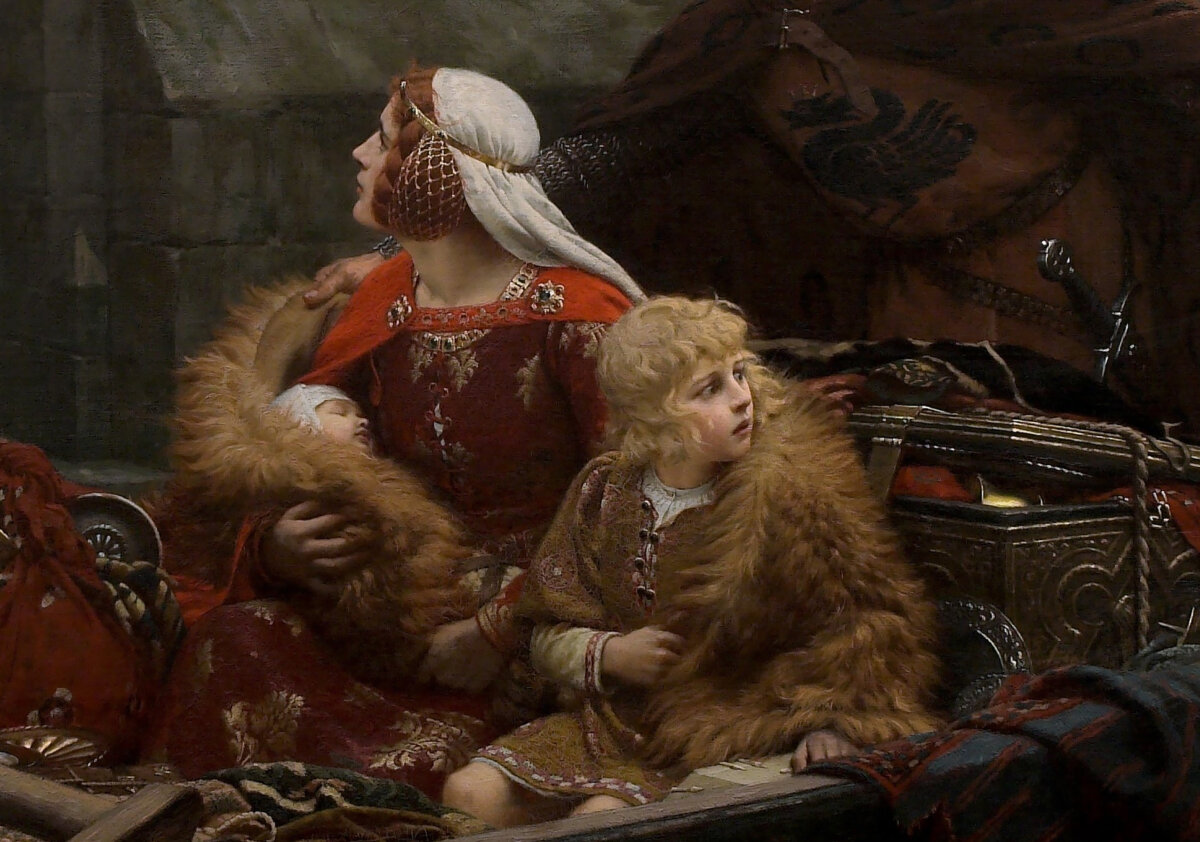
This naturalism distinguished Leighton from the more stylized Pre-Raphaelites with whom he is often associated. He shared their interest in historical subjects, brilliant color, and moral seriousness, but his figures breathe with a directness that the movement’s founders—among them John Everett Millais and William Holman Hunt—did not always pursue.
Knights, Nostalgia, and the Medieval Dream
The painting did not emerge in isolation. Throughout his career, Leighton returned persistently to themes of chivalry, protection, and feminine vulnerability. The year before, he exhibited “In Nomine Christi,” which depicts nuns offering a place of refuge to a persecuted Jewish man. The pairing reveals something consistent in Leighton’s moral imagination: the sacred obligation to protect those who are threatened, set against medieval backdrops.
Leighton’s works reflected the broader currents of Victorian culture. Britain in the mid to late 19th century had cultivated a deep romance with the Middle Ages, drawn to Arthurian legend and the chivalric code as a kind of antidote to the industrialized, rapidly modernizing world around it. The Pre-Raphaelite Brotherhood had helped establish the visual language of this sensibility, and painters like Leighton brought it to a wider audience, giving Royal Academy crowds the beauty and moral weight they were looking for.
But Victorian society had its contradictions. Immigrants—first the Irish and then Eastern European Jews—faced widespread hostility and prejudice, even as the country liked to think of itself as a refuge for the displaced, welcoming European exiles who lived and worked in London with relatively little interference.
These tensions, between nostalgia and modernity, insularity and openness, ran just beneath the surface of much of the art of the period, and “In Time of Peril” is no exception. Exhibited in the Diamond Jubilee year of 1897, with its themes of dynastic vulnerability and the protection of children, the painting would have carried a particular charge for audiences conscious of an aging monarch and an uncertain succession. Leighton was a canny observer of popular taste, and he chose his subject well.
Legacy and Appeal
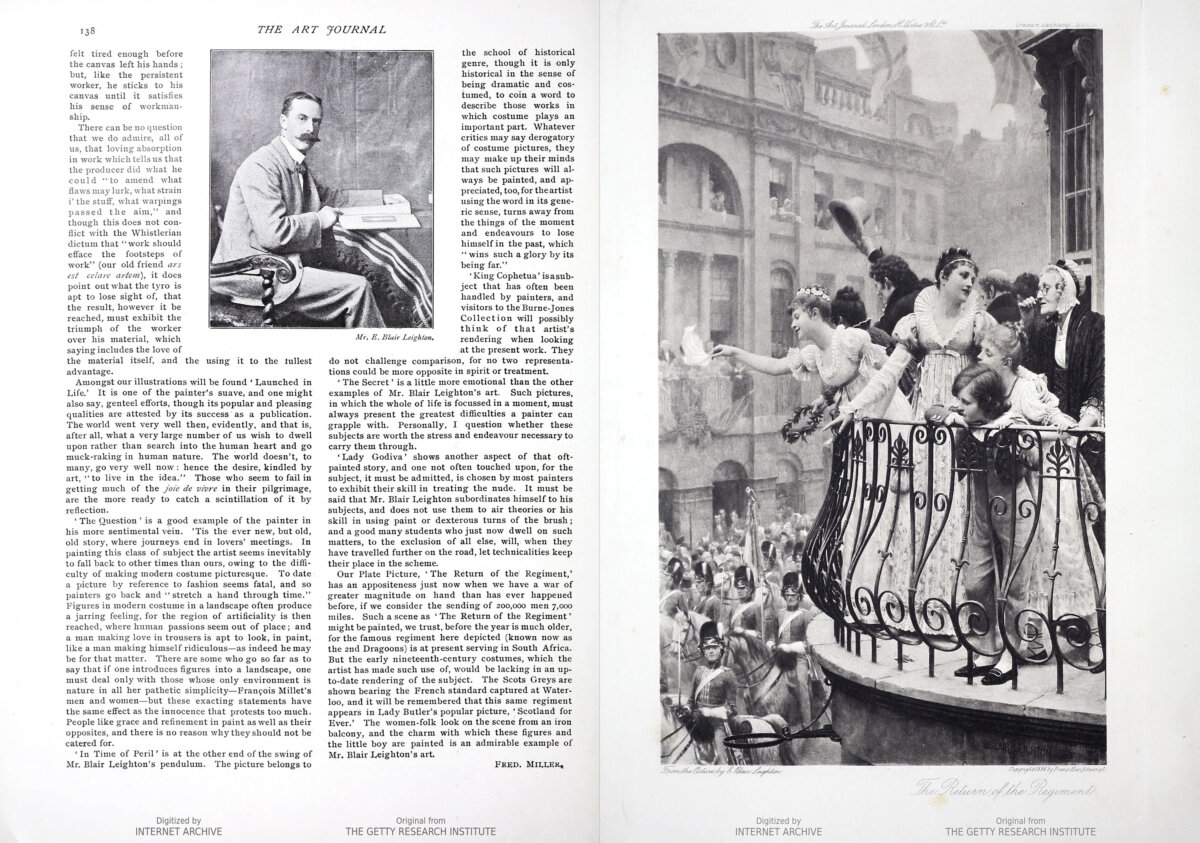
Born Sept. 21, 1852, in London, Leighton trained at the Heatherley School of Fine Art and, later, the Royal Academy Schools, where he entered the institution at 21 after an early detour working for a tea merchant. He exhibited at the Royal Academy annually until 1920, a span of more than four decades, though he was never elected an academician or associate. “In Time of Peril,” produced when he was 45, represents the mature expression of everything his career had been building toward: historical authority, emotional accessibility, and technical command in the service of a story that needed no caption.
Following its acquisition by the Mackelvie Trust, the painting became a staple of art education in Auckland, revered by generations of art lovers. That legacy speaks to what Leighton achieved: not a painting that demands interpretation, but one that earns repeated attention. In the fearful backward glance of a child on dark water, he rendered something every generation has understood: the desperate hope of making it to safety.
What arts and culture topics would you like us to cover? Please email ideas or feedback to features@epochtimes.nyc.