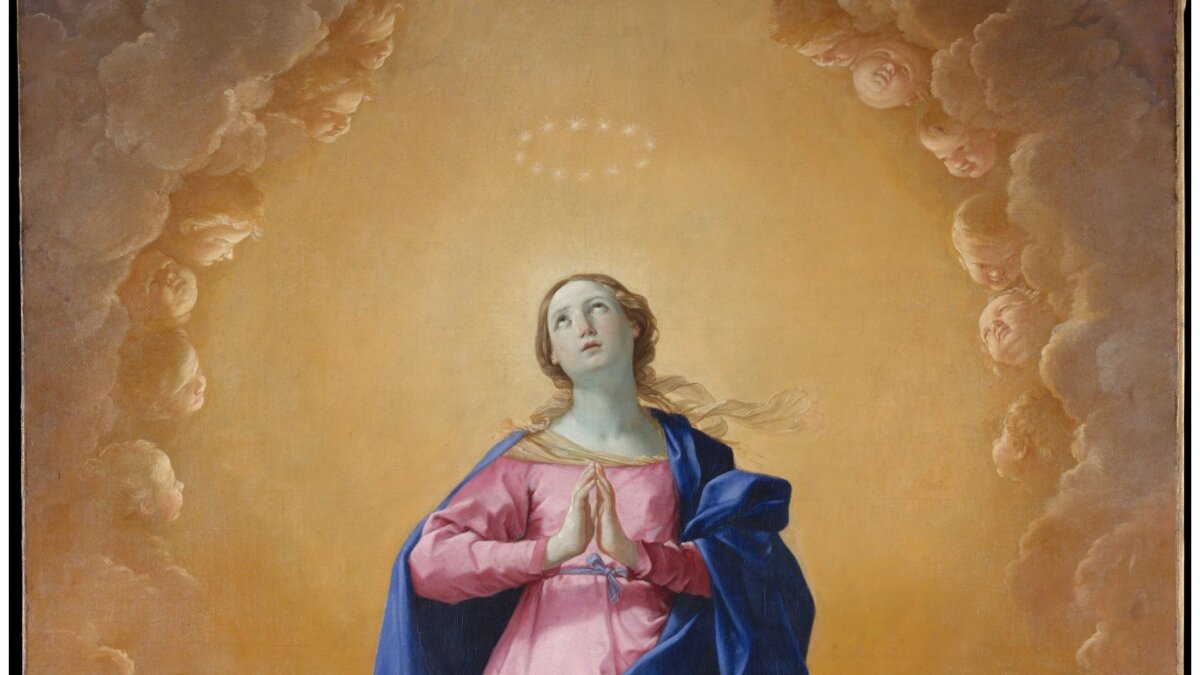
Divine beauty, purity, and light emanate from 17th-century Italian painter Guido Reni’s work “The Immaculate Conception,” wherein the Virgin’s every gesture reveals her pious heart. She tilts her head and gazes adoringly up to God, while gently clasping her hands together in prayer. You can almost hear the chorus of angels singing among the clouds in adulation.
A sublime golden light, symbolizing sunlight, dominates the scene as the Virgin stands on a crescent moon, and above her head hovers a 12-star halo. Each star symbolizes one of the 12 apostles. Reni depicted the sun, moon, and halo motifs as signposts directing Catholics to Revelation 12:1 in the Bible.
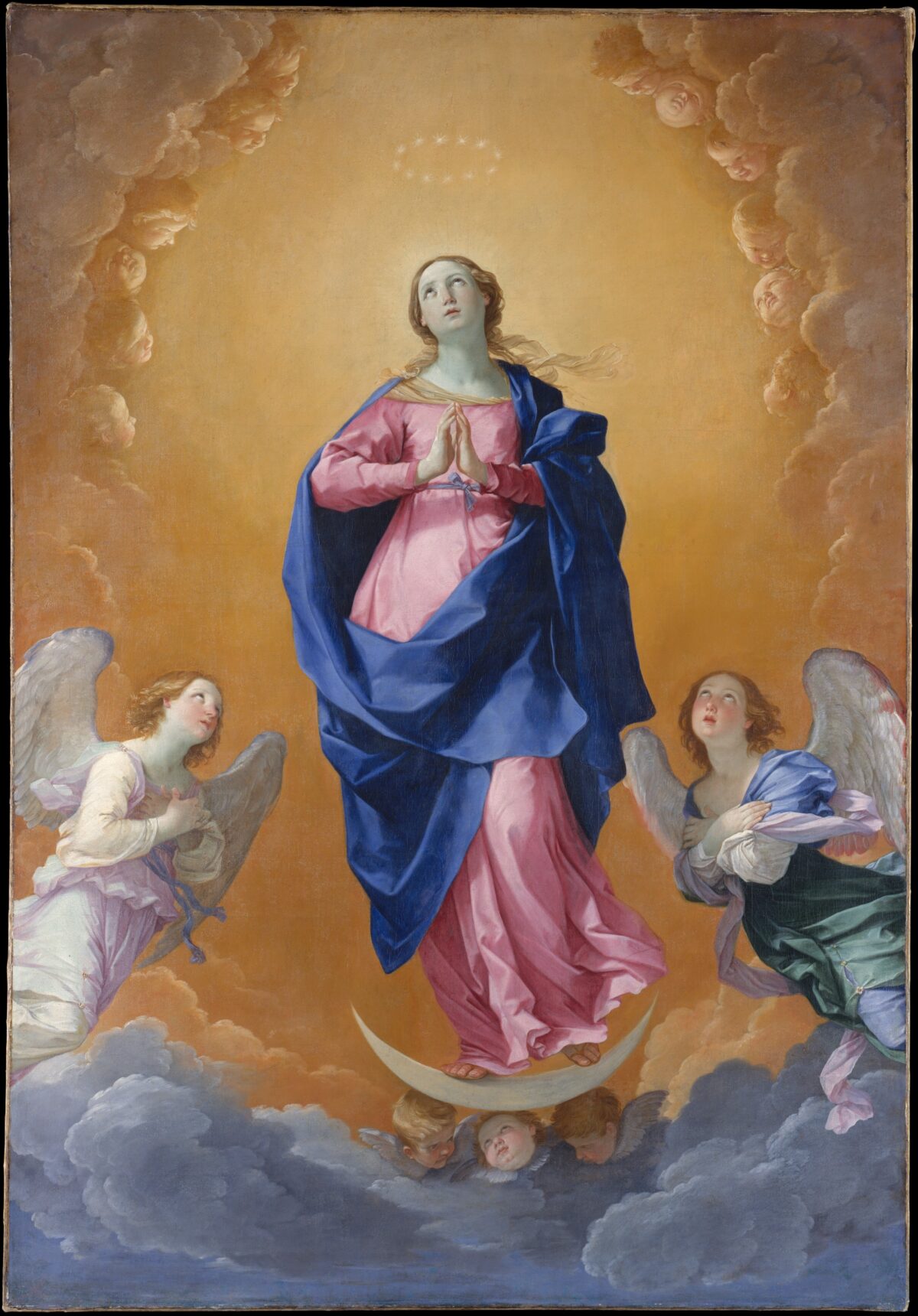
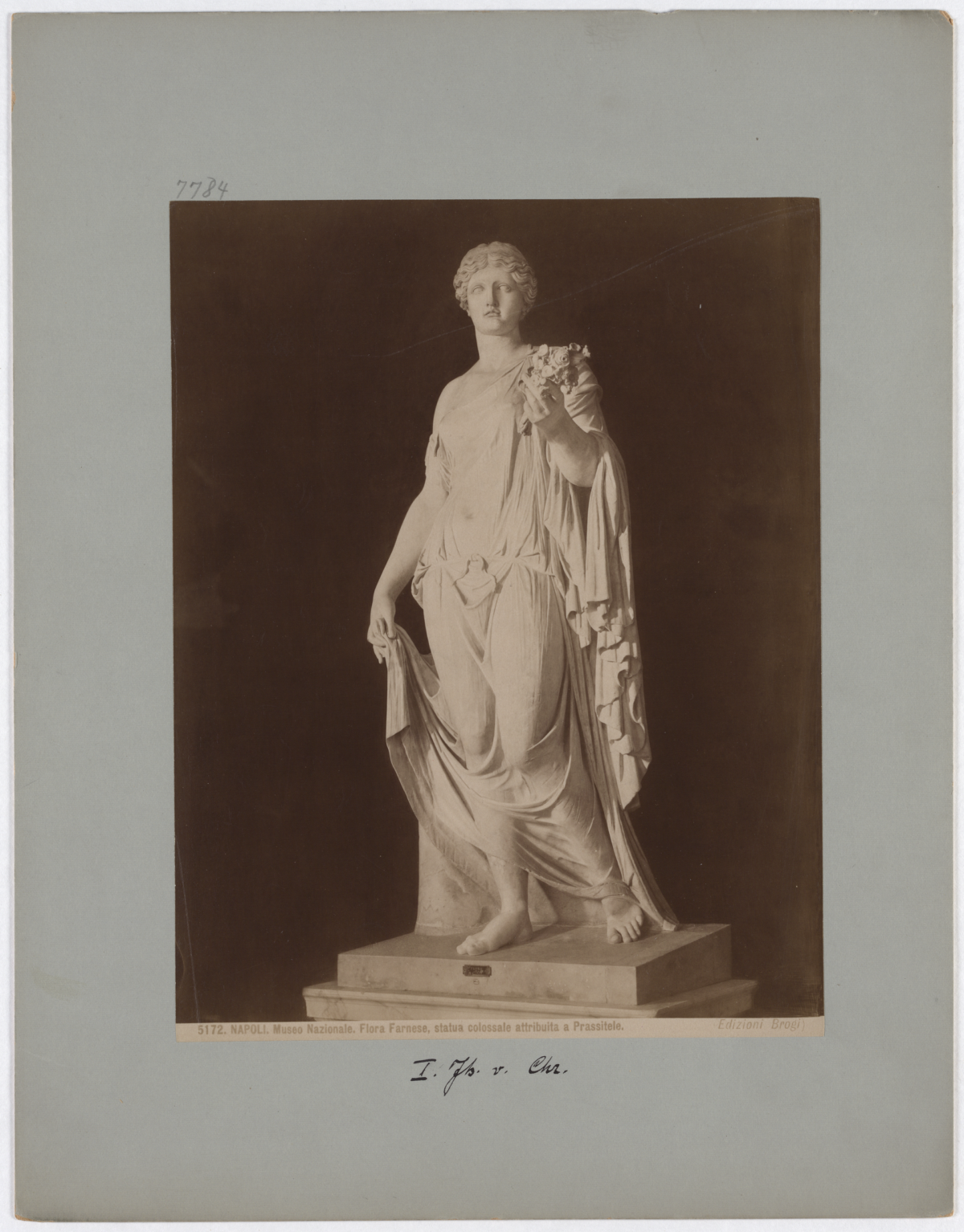
Reni’s painting shows that he not only stayed true to the Bible but also to established artistic traditions. For instance, the Virgin stands in a “contrapposto” pose (holding most of her weight on one foot), a pose first seen in ancient Greece. Reni’s use of pink and blue on the gold background illuminates the Virgin, making the blue (a color long symbolizing purity and virginity) of her robes stand out. And the whole scene of idealized, graceful figures wouldn’t look out of place as a painting in Raphael’s workshop, some 100 years before Reni.
Reni influenced his peers across Europe. His works inspired French artists, such as the founder of the French Academy, Eustache Le Sueur, and Louis XIV’s court painter, Charles Le Brun. He also inspired Spanish painters Jusepe de Ribera and Bartolomé Esteban Murillo.
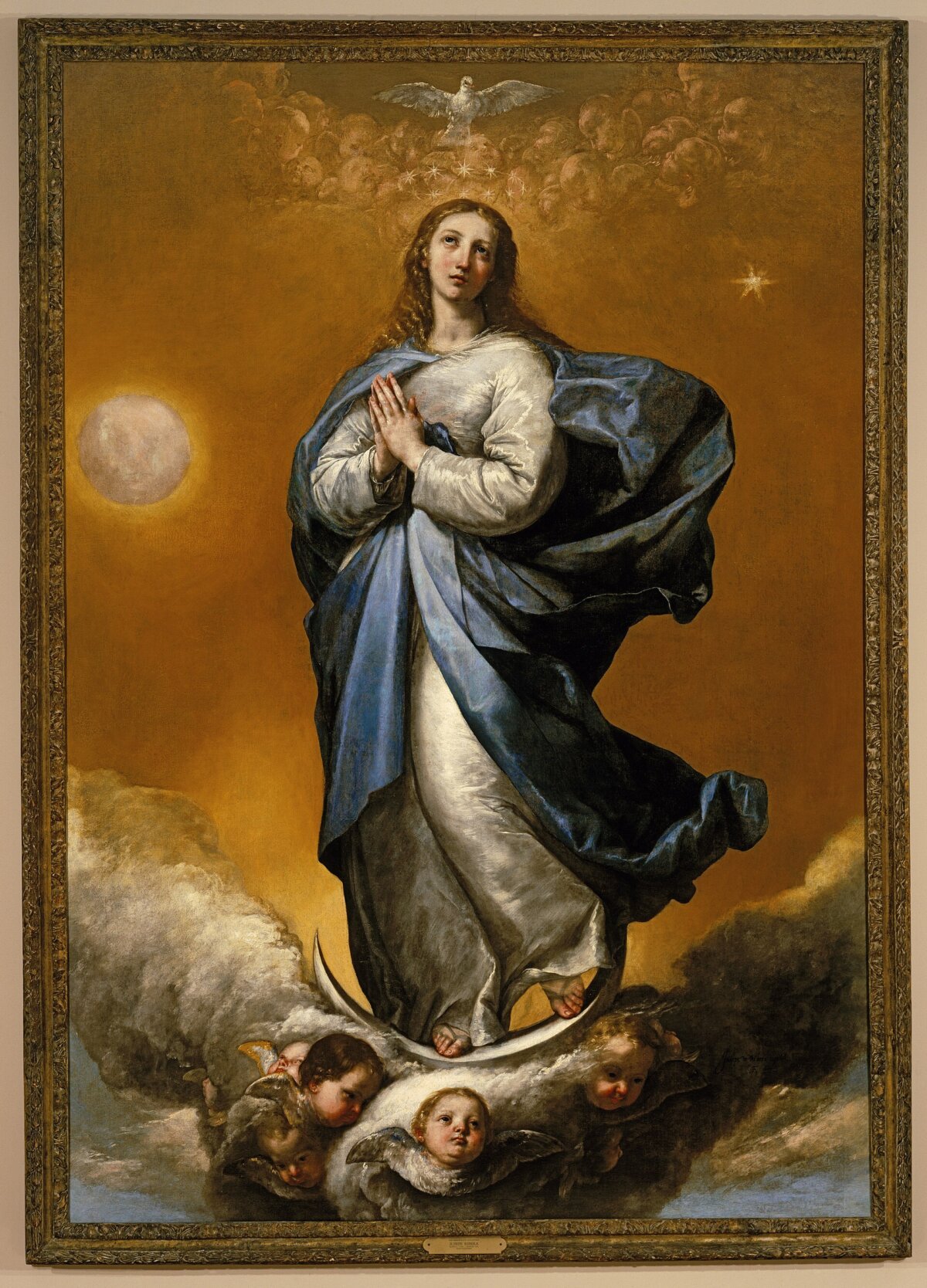
Ribera’s “The Immaculate Conception” (1637) and Murillo’s “The Immaculate Conception” (painted between 1675 and 1680), in the Oratory of St. Philip Neri in Cádiz, appear similar to Reni’s painting. Both painters rendered additional religious motifs. Ribera added the dove of the Holy Spirit hovering over the Virgin’s 12-star halo. Murillo painted cherubs holding roses, a white lily, and a palm leaf, all symbolic of the Virgin.
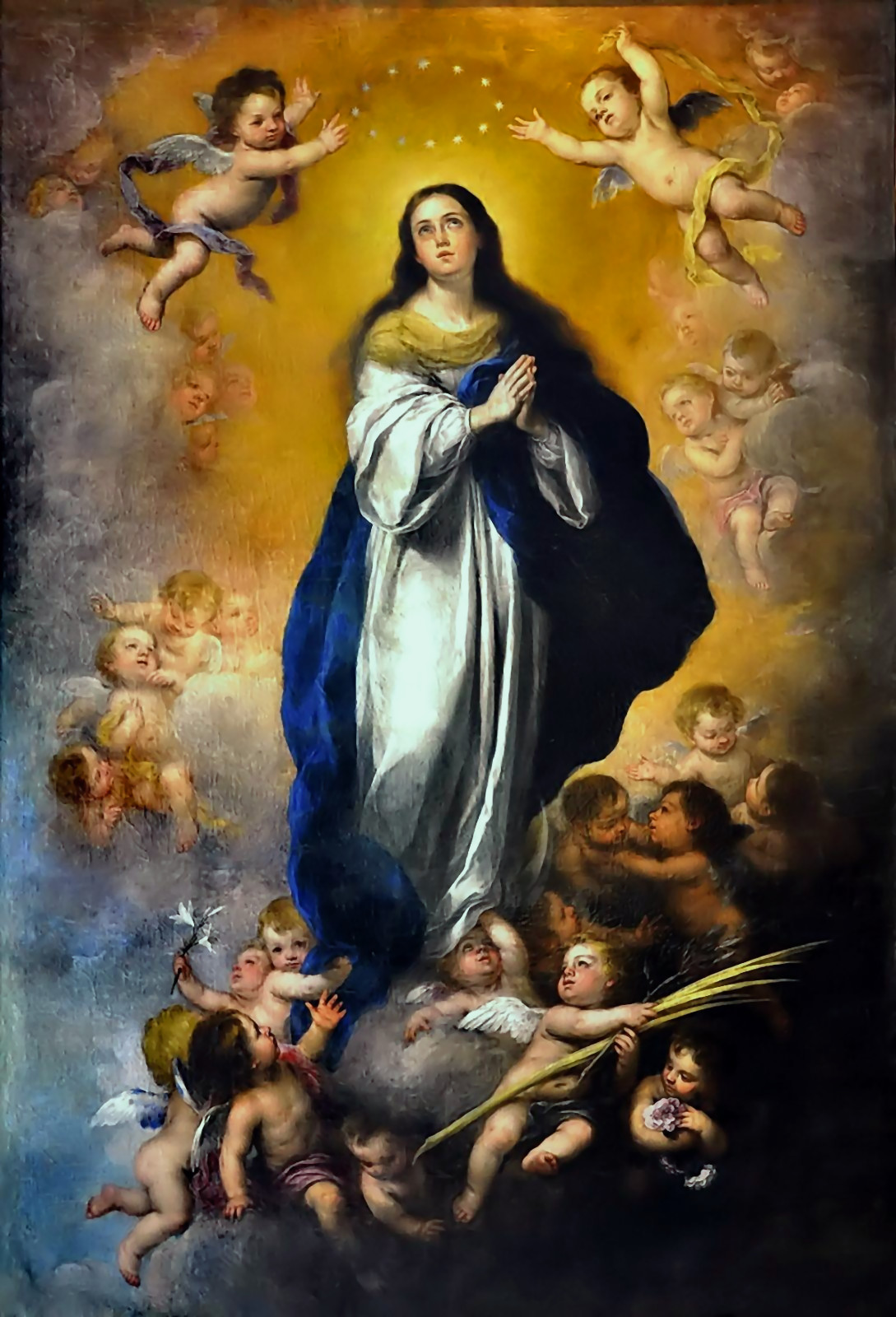
Some 18th- and early 19th-century art critics lauded Reni as second only to Raphael. The 18th-century German art historian and archaeologist Johann Joachim Winckelmann even compared Reni to the eminent ancient Greek sculptor Praxiteles. Reni’s “The Immaculate Conception” stands as testimony to these great artists, traditional art, and the Christian faith.
What arts and culture topics would you like us to cover? Please email ideas or feedback to features@epochtimes.nyc