The Venetian painter Titian was a giant of Renaissance art who shaped the course of art history. A brilliant colorist and manipulator of paint, he worked in different genres but turned most frequently to portraiture throughout his long career. He executed grand works for the who’s who of 16th-century European elite, including Holy Roman Emperor Charles V, Pope Paul III, King Philip II of Spain, successive doges, and cultural figures of the day.
However, one of his earliest celebrated portraits features an unknown male sitter. The circa 1510 canvas at London’s National Gallery is currently referred to as “Portrait of Gerolamo (?) Barbarigo.” The man has remained captivating to viewers for so long due to Titian’s use of a dynamic turning pose on a parapet, expressive conveyance of the figure’s inner life, and a superlative quilted satin sleeve.
Pioneering the ‘Turning Portrait’
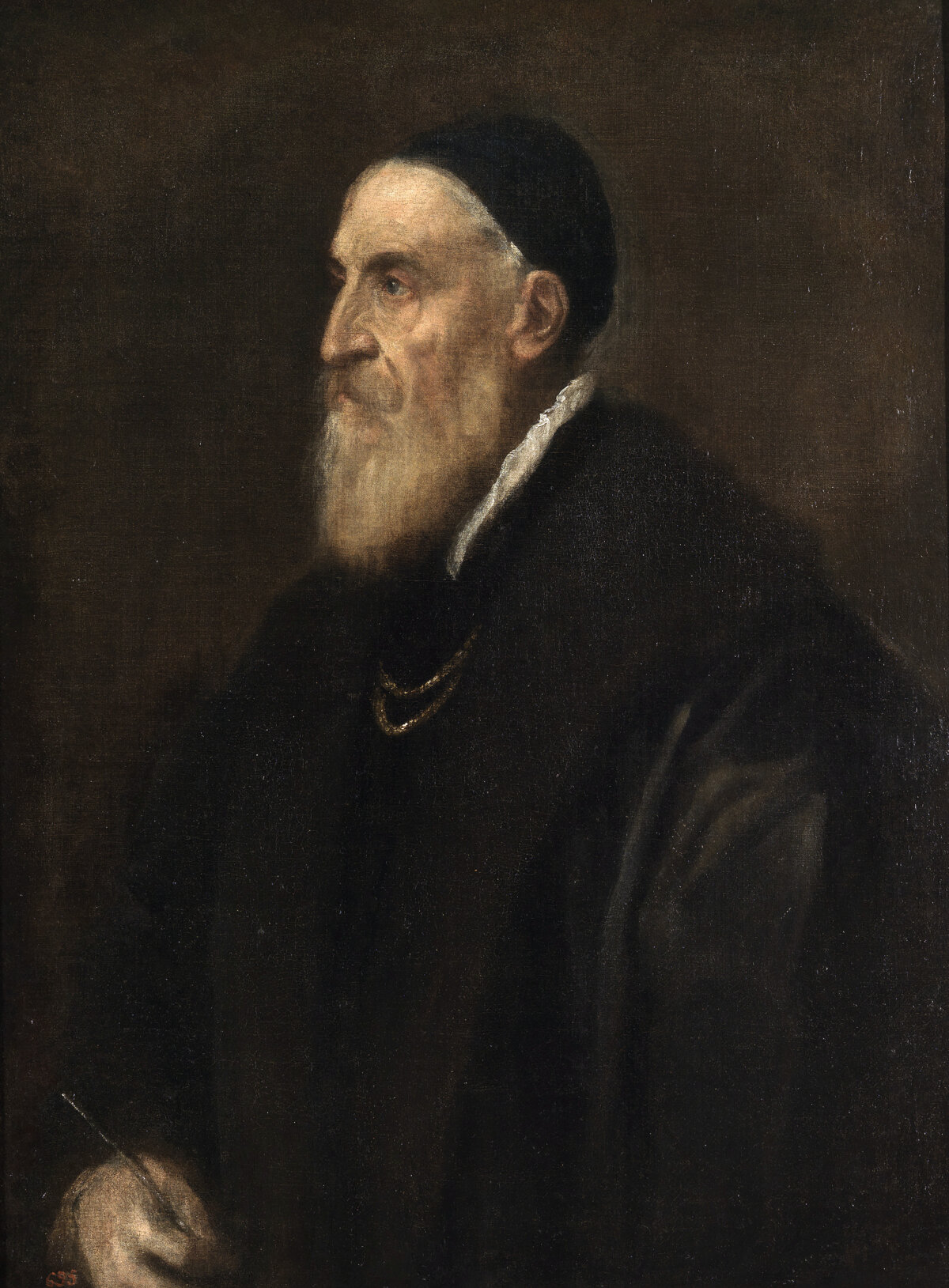
Titian (circa 1485/90–1576) was born at an unknown date in a small northern Italian town. By the beginning of the 16th century, he had moved to Venice, the cosmopolitan city that would become synonymous with his artistic output. Once there, it is believed that Titian studied with giants of the previous generation, Giovanni and Gentile Bellini. Additionally, young Titian collaborated with the short-lived, brilliant Giorgione (1477/8–1510).
Giorgione’s portraits were influential in the development of Titian’s early style. The artist was a pioneer of the “turning portrait,” in which sitters in three-quarter profile look over their shoulder at the viewer. This positioning, which had been popular in Venice since around 1500, can be seen in Giorgione’s works such as “Portrait of a Young Man” in Berlin’s Gemäldegalerie. This half-length picture of a man with a sense of inner mystery shows the sitter clothed in a pale violet quilted garment against a dark background. Titian would go on to amplify this compositional innovation.
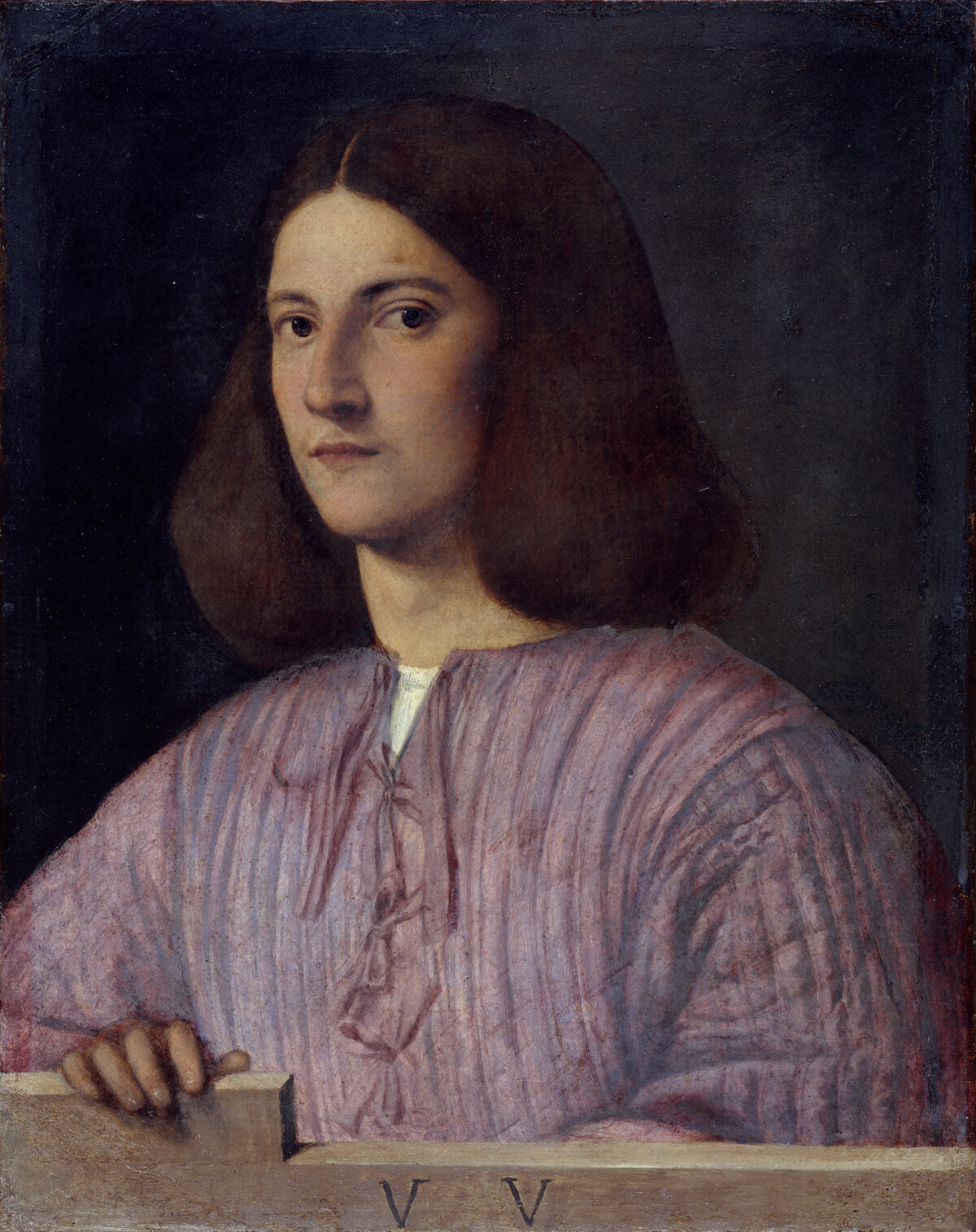
In Giorgione’s painting, there is a stone parapet between the viewer and the figure. Early Renaissance Italian portraits often feature the pictorial device of a parapet, but Giorgione’s positioning of the man’s hand resting on it was not a Venetian tradition. Its origin may trace to Netherlandish artists or to Leonardo da Vinci.
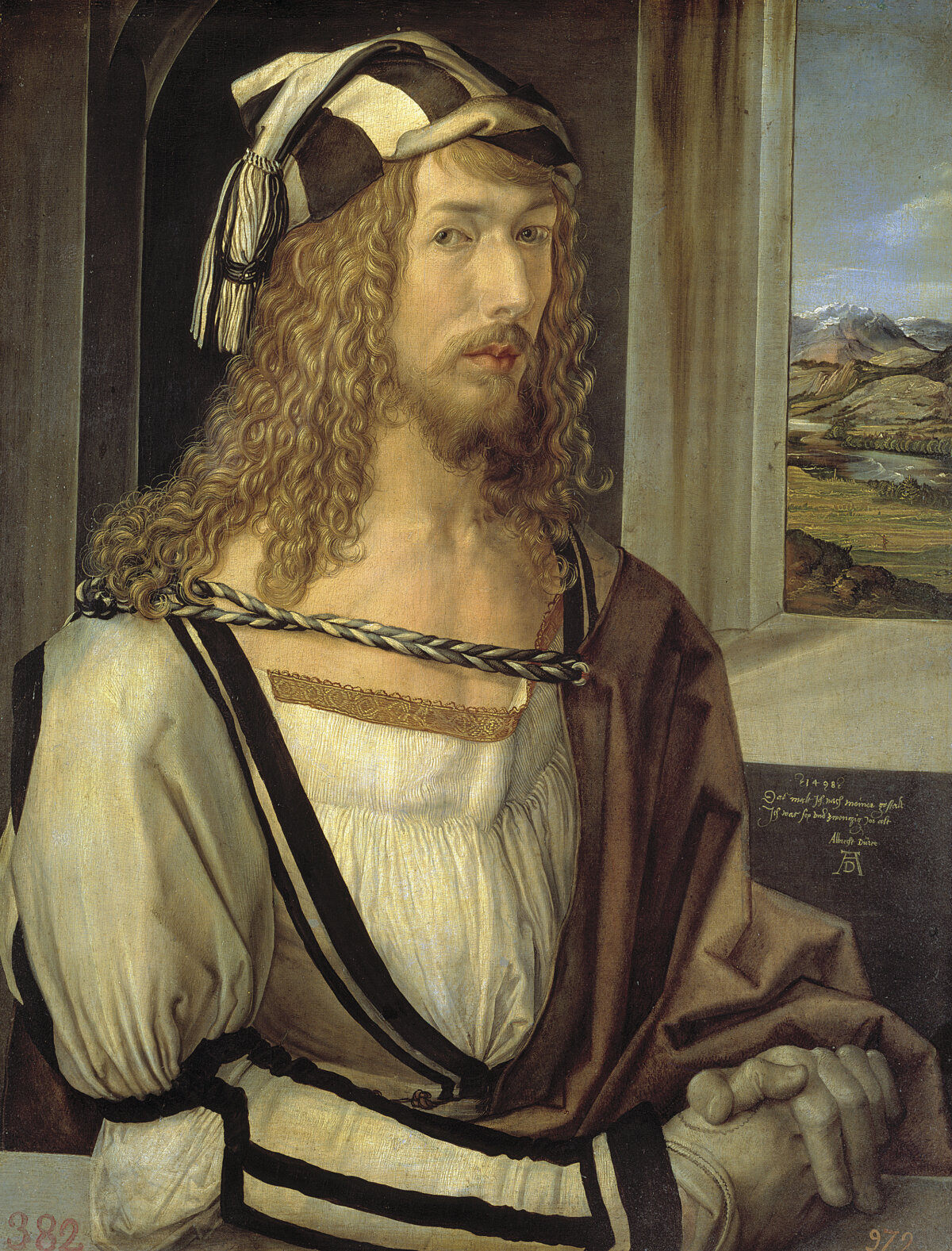
The National Gallery’s Titian portrait may also reflect the artist’s knowledge of portrait prints by the German Albrecht Dürer. In Dürer’s 1498 self-portrait at Madrid’s Prado Museum, he depicts himself leaning on a foreground ledge.
“Portrait of Gerolamo (?) Barbarigo” was for a period of time thought to be a Titian self-portrait. Before that, the painting was long believed to depict the Italian Ludovico Ariosto (1474–1533), one of the most famous Renaissance poets. Nowadays, scholars think that it is probably an image of a member of the aristocratic Venetian Barbarigo family. The most likely candidate is Gerolamo di Andrea Barbarigo. Grandson of a doge, Gerolamo traveled in intellectual circles and had a prestigious career as a politician and diplomat.

Titian’s sitter turns over his right shoulder and looks directly at the viewer with a raised brow. The man’s body forms a triangle at the canvas’s center. His elbow rests on a parapet that Titian has inscribed with his initials. Portrait predecessors with a parapet usually cut the sitter at bust level. Here, Titian goes lower, breaking at the waist, which emphasizes the man’s blue sleeve.
The artist was highly adept at painting fabrics. The particular sartorial choice of a voluminous sleeve projecting into the viewer’s space gives the figure a heightened monumentality. Originally, the textile would have appeared more purple as it was painted over a pink ground and threaded with red lines. The red lake pigment has faded over the centuries.
On closer inspection, it seems that the man’s right hand is in a fur muff, but it is difficult to make out definitely. The NG noted: “The merging of the shadowed portions of the figure with the grey atmospheric background was, however, certainly intended, and is one of the most innovative and influential aspects of the portrait.”
Model for Successors
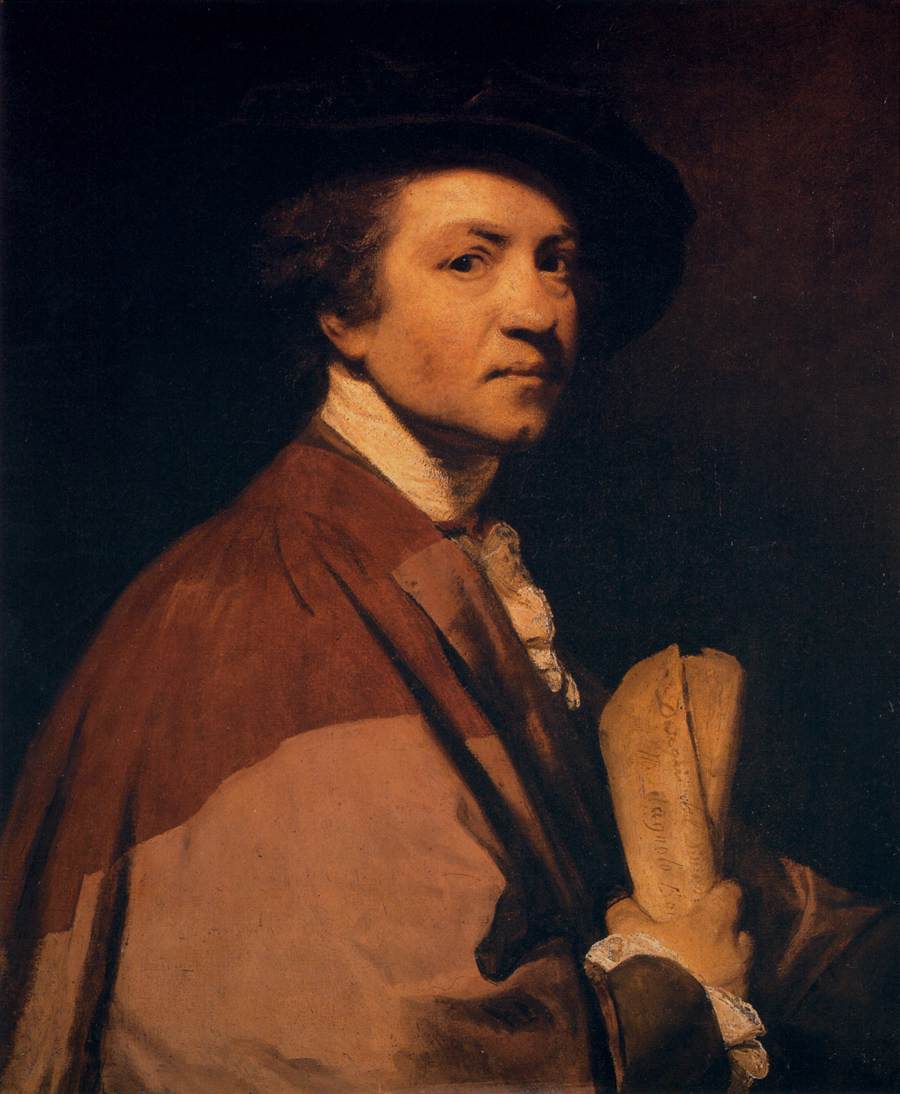
Titian was a touchstone for virtually all 17th-century European artists. This painting, with its decisive bodily turn and head tilt, was a model for artworks in that era and beyond. An 18th-century example is a self-portrait by Sir Joshua Reynolds (1723–1792), now in Florence’s Uffizi Gallery.
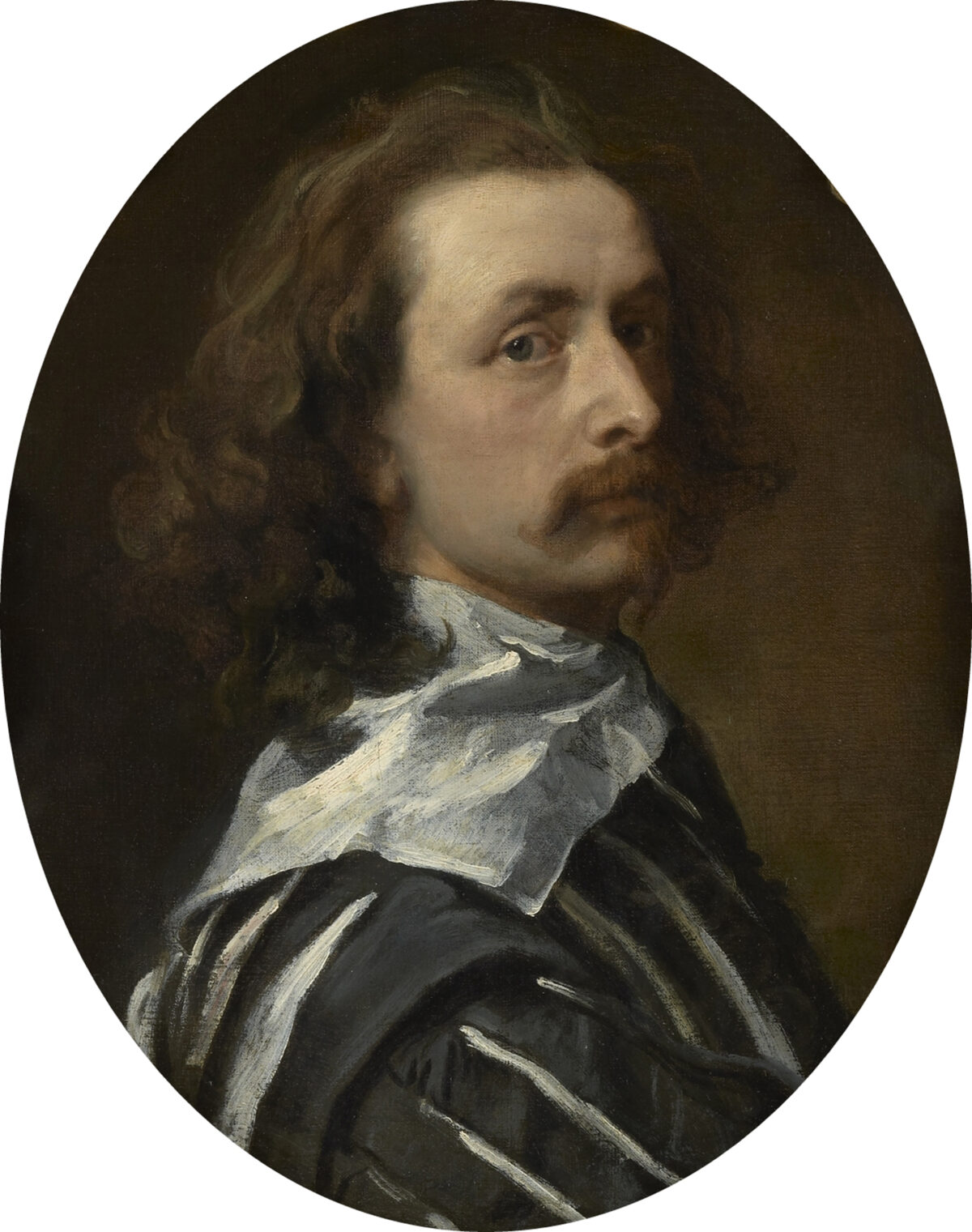
In a 1640 self-portrait that is now part of London’s National Portrait Gallery, the Flemish Sir Anthony van Dyck (1599–1641) depicts himself in fashionable attire but seemingly in the midst of painting. The positioning of his right shoulder and sleeve suggests that his unseen raised hand is applying paint to a canvas.

The most famous artwork to descend from this Titian painting’s lineage is “Self Portrait at the Age of 34” by the Dutch artist Rembrandt (1606–1669). Rembrandt painted dozens of self-portraits over his career. In this example, he presents himself as prosperous and self-assured. While he painted it in 1640, Rembrandt elected to depict himself in the fur and velvet clothes of a 1520s gentleman. The positioning of his arm on a parapet harkens to Titian’s painting as well as Dürer’s self-portrait.
Both of these artworks were briefly in Amsterdam in the 1630s, so it is possible that Rembrandt studied them in person. Otherwise, he likely had access to copies. By citing these titans of art, including references to a specific Raphael portrait, Rembrandt is declaring himself their equal. Fortuitously, “Self Portrait at the Age of 34” is also housed at the National Gallery, so visitors may admire both masterpieces on the same visit.
What arts and culture topics would you like us to cover? Please email ideas or feedback to features@epochtimes.nyc