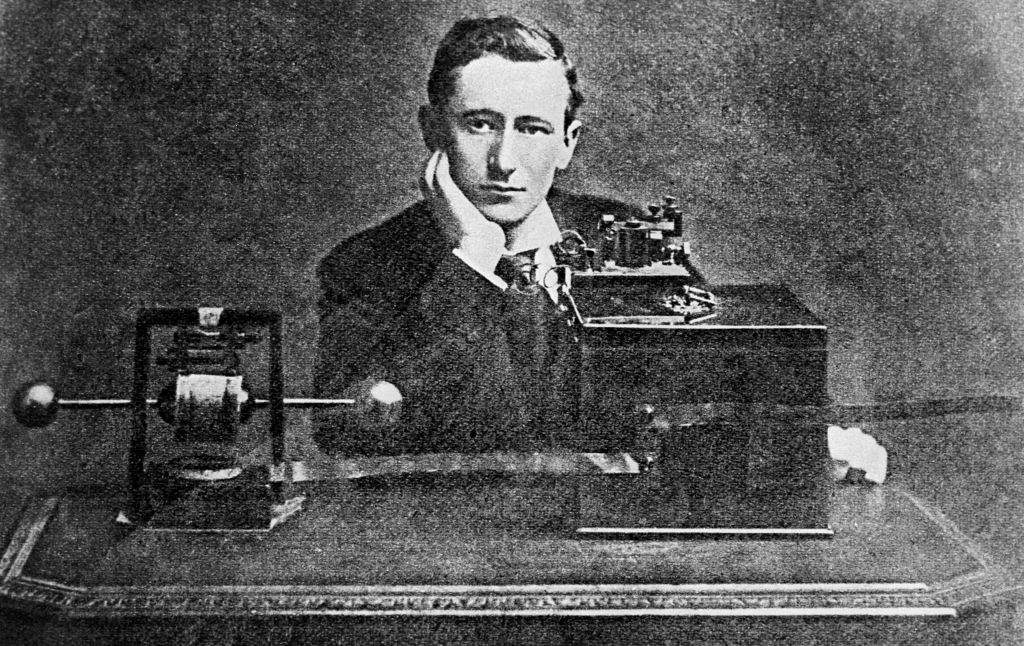
Sometimes scientific breakthroughs occur when people challenge popular belief. When scientists thought that radio waves could not travel long distances because of the Earth’s curvature, Guglielmo Marconi proved them wrong. He conducted the first successful wireless communication from England to North America. He accomplished the feat without a formal university education, and admitted when he accepted the Nobel Prize in physics that he did not fully understand how his own invention worked.
Marconi was born April 25, 1874, in Bologna, Italy. His father, Giuseppe Marconi, was Italian, and his mother, Annie Jameson, was an heir to the Jameson whiskey family in Ireland. He spent about half of his childhood in Italy, and the other half in England, where he learned the language.
Although he never formally attended a university, Marconi received a private education from tutors and academies. As a young student, he enjoyed studying physics and electrical science. When he was 13 and attending the technical institute in Livorno, Italy, he became fascinated by the work of German physicist Heinrich Hertz, who demonstrated that electromagnetic waves could travel through space from one point to another. Marconi believed these waves could carry signals.
At 20, Marconi began experimenting with Hertz’s radio waves in the attic of his father’s estate in Pontecchio, Italy. In the summer of 1894, Marconi and his butler built a storm alarm that consisted of an electric bell that rang when lightning was detected from a distance. That December, Marconi amazed his mother when he made a bell ring from across the room.
From Backyard Signals to Miles
His father soon became impressed with Marconi’s ideas and began financing further experiments. Marconi first figured out how to send a signal from one side of his father’s house to the other. He then extended the signal through the house’s walls and into the garden. Soon he could send signals a mile and a half away. His signals could even transmit from one side of a hill to the other.
Marconi first approached the Italian government with his invention to ask for support, but officials rejected his proposal. With his mother’s help, he moved to London, where he was introduced to William Preece, chief electrical engineer of the General Post Office. Preece was impressed with the young inventor’s accomplishments and helped fund further experiments.
Through continued experimentation, Marconi steadily increased the distance he could send Morse code signals. In his early experiments in England, Marconi successfully transmitted signals nine miles across the Bristol Channel in southwest Britain. In 1899, Marconi proved his signals could travel even farther when he transmitted a signal across the English Channel from Britain to France. That same year, Marconi gained publicity when he sailed to the United States to use radio transmissions to report on the America’s Cup yacht races off the coast of Sandy Hook, New Jersey.
Signals Across Water
Marconi wanted to accomplish the unthinkable: sending a signal across the Atlantic Ocean. He first attempted to send a signal from Poldhu, Cornwall, England, to Cape Cod, Massachusetts, but failed. He then tried a shorter distance and set up a receiver on Signal Hill in St. John’s, Newfoundland.
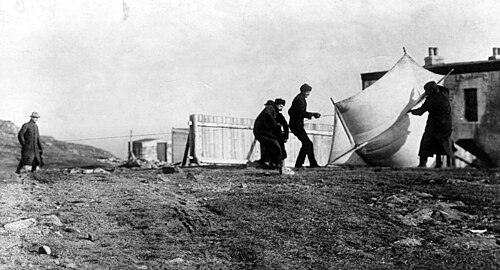
In Cornwall, Marconi’s team turned the radio transmitter up so high that the antenna emitted foot-long sparks from its tip. In St. John’s, Marconi first tried to receive the signal by attaching the receiver to a balloon, but it flew away. He then attached the receiver to a kite and was able to pick up three Morse code dots—the letter S—from about 2,200 miles away. The successful transmission was remarkable because many scientists believed radio waves could not travel beyond the horizon due to the Earth’s curvature.
Even before proving signals could be sent across the Atlantic Ocean, Marconi’s wireless communication system had already demonstrated its value in saving lives. In 1899, the Marconi wireless system saved its first life when the East Goodwin lightship was rammed by a steamship in dense fog. The crew used the wireless system to call for a lifeboat. In 1909, Marconi’s communication system was credited with helping save 1,700 lives when the SS Republic collided with another ship.
The Radio Age Begins
That same year, Marconi shared the Nobel Prize in physics with German physicist Ferdinand Braun for their contributions to the development of wireless telegraphy.
Marconi’s systems continued to grow in popularity. In 1912, wireless operators used Marconi equipment for rescue efforts after the sinking of the Titanic, saving hundreds of passengers. After the disaster, wireless communication systems became mandatory on many ships around the world.
Marconi continued improving his communication systems for the rest of his life. On June 15, 1920, a song recital by Dame Nellie Melba broadcast over a 15-kilowatt Marconi telephone transmitter became the first advertised public radio broadcast heard in several countries. In 1921, Marconi’s company transmitted one of the first regular public entertainment broadcasts.
After Marconi died July 20, 1937, in Rome, wireless stations around the world went silent for two minutes to honor the man whose experiments helped usher in the age of radio.
What arts and culture topics would you like us to cover? Please email ideas or feedback to features@epochtimes.nyc