



NEW YORK—The old adage to never judge a book by its cover proves to be true in the Mint Theater Company’s resurrection of Harold Brighouse’s “Zack.” First staged in 1916, the work presents a comedic look at Edwardian era morality.
In the country village of Little Hulton in the English county of Lancashire, the widowed Mrs. Munning (Melissa Maxwell) shares a home with her two adult sons. The no-nonsense Paul (David T. Patterson) who helps her run their struggling catering business and Zack (Jordan Matthew Brown), the seeming black sheep of the family.
Zack’s idiosyncrasies have long since caused Paul and his mother to see him as little more than an embarrassing afterthought. The two have also forbidden Zack to attend any events they cater as he tends to drop plates when nervous.
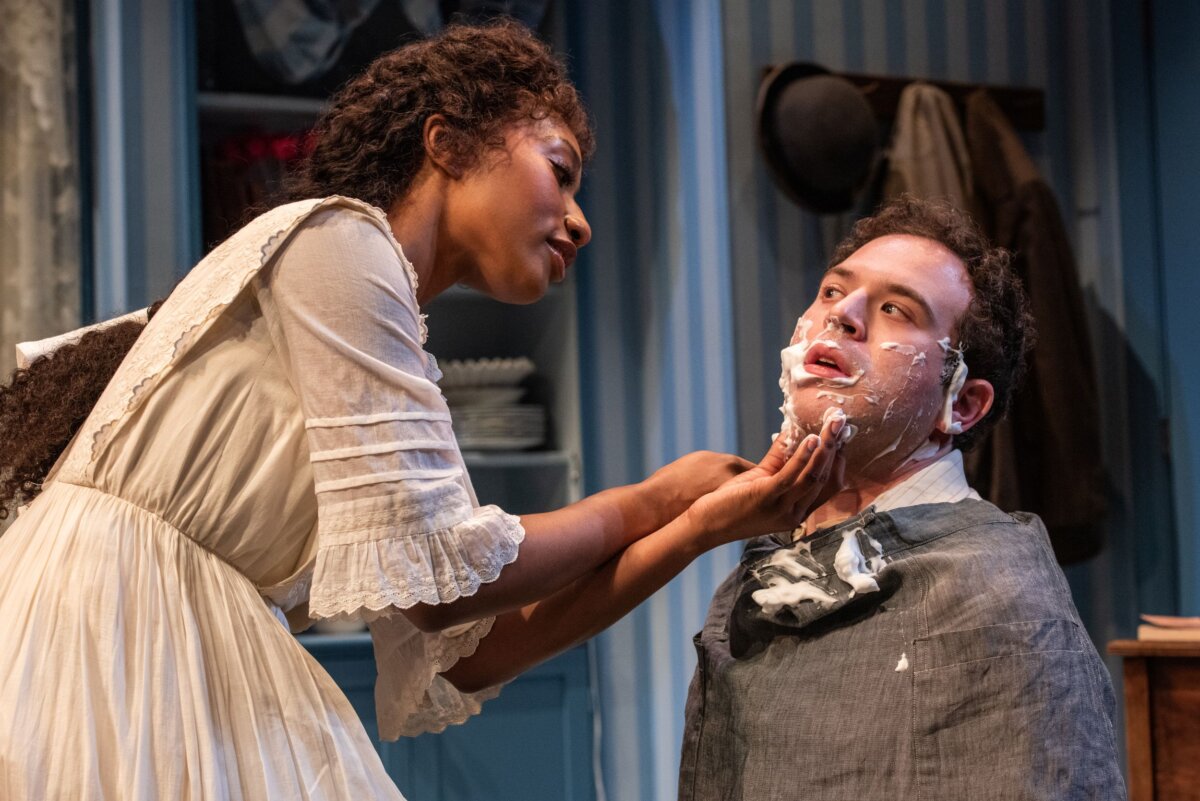
Looking rather unkept when we first see him, Zack also has the habit of speaking the truth about any subject raised, including those others may not want to hear—a penchant which brings him constantly into conflict with his socially obsessed mother. For her, appearances mean everything.
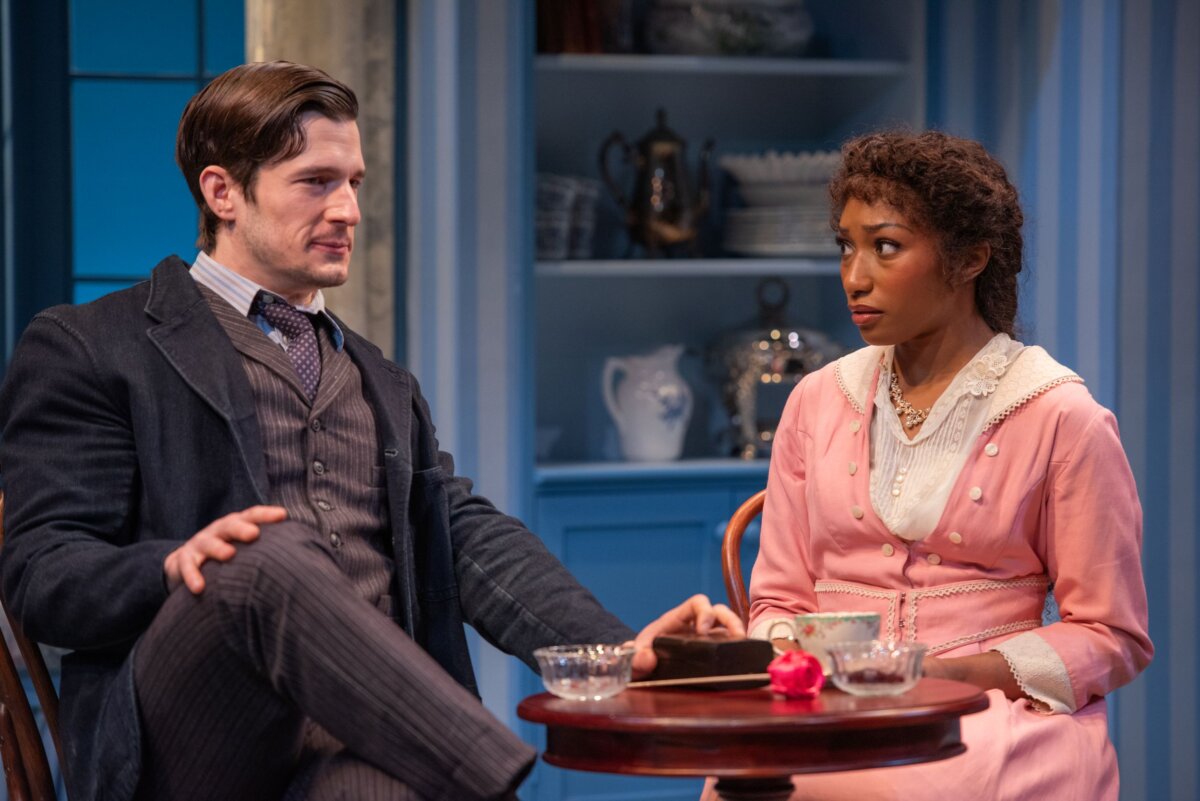
Zack’s eating habits are also not the best. This is demonstrated during a hastily arranged tea party for Virginia Cavender (Cassia Thompson), a young woman with money and a relative of Mrs. Munning. Virginia has come for a visit to recuperate in the country air after a minor health crisis. Yet despite Zack’s seeming unsuitability in polite society, Virginia sees something special in him and the two quickly develop a quiet bond.
Another of Zack’s qualities is his eagerness to help those in need, a practice which threatens to become his undoing. When Joe Wrigley (Sean Runnette), a disgruntled former employee, learns of Zack’s interactions with his daughter Martha (Grace Guichard), he demands the two marry. Martha, who has her own social ambitions, is more than willing, though Zack clearly is not.
In a flash of inspiration, Mrs. Munning tries to turn the situation to her own advantage and urges Paul to court Virginia and, through their union, insure an influx of cash for the catering business.
With “Zack,” the Mint continues its mission of unearthing forgotten, if not always memorable plays. Billed as “a character comedy” the playwright explores the idea that love and business are not always mutually exclusive and how moral rules can suddenly become flexible when commerce is concerned.
Most important is the message that a person’s innate qualities are what can make them truly special. Several influential villagers understand this when it comes to Zack, even though Paul and his mother do not. The play also presents an interesting dynamic on the subject of romance, showing how small gestures can mean far more than a grand pronouncement.
Brown is perfect as Zack, a somewhat shy soul who today would probably be considered an introvert or on the autism spectrum. He battles with a crippling insecurity. Coupled with this is his need to avoid any type of confrontation and an attempt to please all in such situations, even at his own expense. It takes his deepening relationship with Virginia to make him begin to realize his true worth. Credit also goes to Brown, as well as to director Britt Berke for never allowing Zack to be portrayed as anything less than a fully formed individual.
Thompson shows Virginia to be a strong woman and one ahead of her time in a period where the main task of her ilk was to find a socially suitable husband. Polite and courteous to a fault, she’s not afraid to speak her mind, when doing her best to prevent what she sees to be a clear injustice to someone she’s begun to care about. Her actions eventually earn her grudging admiration from Mrs. Munning, who perhaps sees in Virginia certain elements of herself.
Maxwell and Patterson acquit themselves well in the rather limited roles of Mrs. Munning and Paul. Two characters who, in lesser hands, could easily come off as belonging in a melodrama. Special mention must go to Caroline Festa’s comic performance as the Munning’s temporary maid, hired so Virginia does not suspect the family’s financial straits but who is quite obviously unsuited to the job.
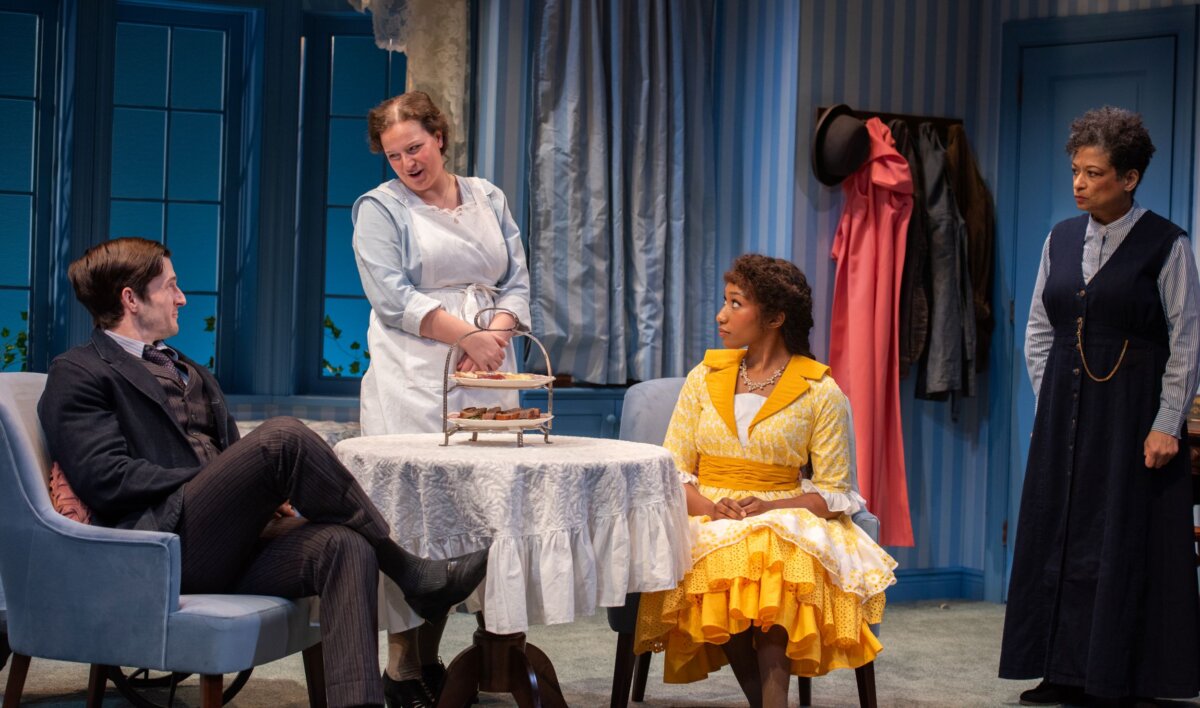
Berke is deftly able to tie the show’s various elements together, making good use of the performance space and keeping the story moving smoothly as the gentler comedic and romantic moments merge with those more dramatic and confrontational. Brittany Vasta’s set of the Munning’s parlor works well. The costumes by Kindall Almond fit the period with some of the outfits worn by Virginia adding a nice bit of color.
“Zack” doesn’t cover any new ground, at least from the viewpoint of someone watching the play today, but the show is well executed and one can’t help root for the good-hearted underdog that the title character is. At the same time, one hopes those who do not have his best interests at heart get exactly what they deserve.
