



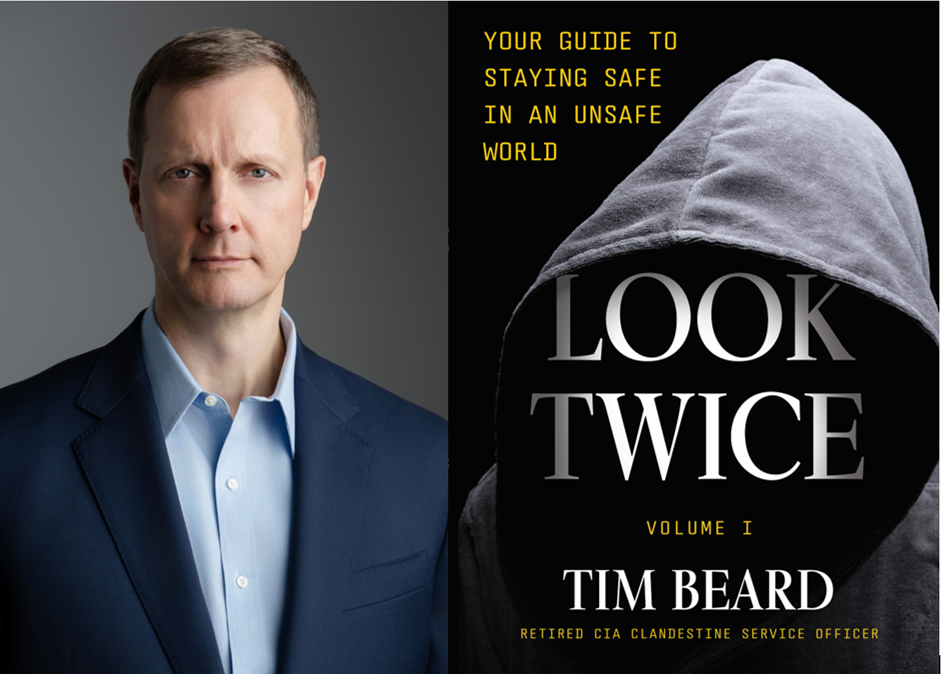
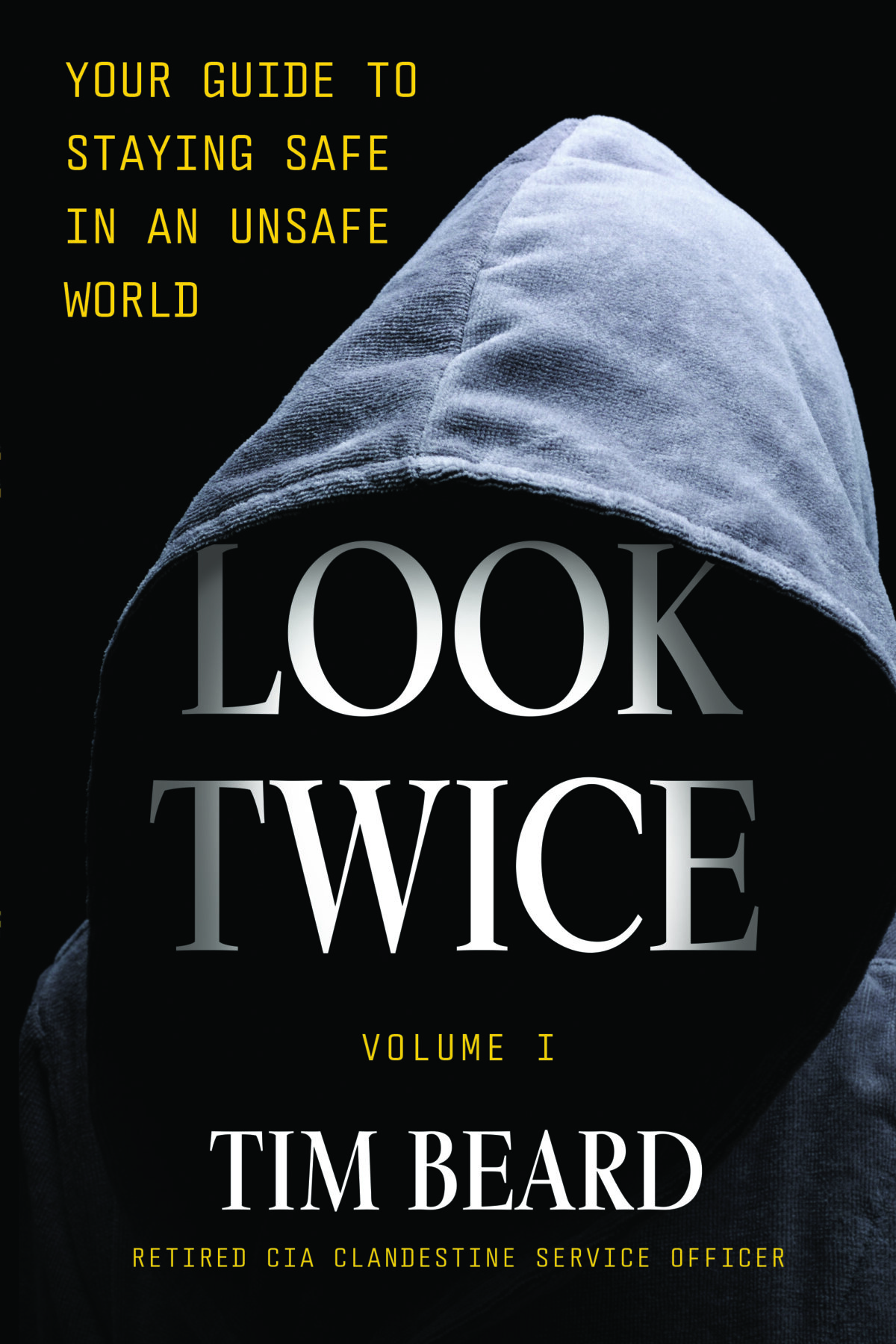
The cover of “Look Twice: Your Guide to Staying Safe in an Unsafe World” is enough to make one look over his or her shoulder. This is something author Tim Beard, former U.S. Marine and CIA intelligence officer, wants us to do.
In this first book of a three-part series, Beard focuses on staying safe while performing everyday tasks in a variety of typical, real-life scenarios. The intent is to have readers incorporate security concepts and strategies he’s learned throughout his career—not to have us live in fear but to inspire us to live our best lives.
It’s not an easy task to encourage this level of caution without causing readers to go into full-blown paranoia. With that said, forewarned is forearmed. Beard does keep the language light, the examples relatable, and the instructions clear.

Specific Locations
The book is divided into six parts, each representing a specific location; the sections note where the potential for danger lies and then explain how to apply the author’s tips to the situation.
Beard starts off with general tips on staying alert and aware of surroundings, which is what he’s dubbed the “look twice mindset.” Other chapters focus on personal security at home, at work, and out in the neighborhood. There are also traveling tips for different modes of transportation, including, yes, planes, trains, and automobiles.
Beard has niched it down even further to cover safety in hospitals, parking lots, schools, and when out for a night on the town. It’s in the places we frequent often that we drop our guard. “Many of us are used to taking security for granted,” he writes, “but this has become more and more difficult in this increasingly challenging world.”
ATM Visits
When using ATMs, for instance, he recommends using ones inside the banks or in their vestibules, where cameras are located. He advises making your ATM deposit or withdrawal when out with friends rather than alone. Avoid the stand-alone ones in convenience stores. Pay strict attention when in the drive-thru line, where criminals can rob you of the cash you’ve just withdrawn and make a quick getaway.
Beard combines his years of experience in military and government security with suggestions that may seem obvious, but they’re worth repeating. Perhaps it takes a few times hearing “identify exits when entering buildings” to make it a habit. Personal safety and situational awareness, he notes, are as much our responsibility as local law enforcement’s.
His use of security terminology lends the necessary gravitas to the subject and adds a level of credibility not many authors can offer. For example, when out in the world, we should aim to make ourselves a “hard target”—the term for someone a criminal wouldn’t want to engage with. We also should “mitigate risk,” which means striving to make plans that offer the lowest level of potential danger.
Change Up Routine
In this book, we’re introduced to the phrase “pattern of life,” which is our everyday routine, like waking up at the same time, stopping at the same coffee shop, and taking the same route to work. Others may become aware of that schedule and use that knowledge against you. His advice: Change your day around, making alternative choices which, in turn, force you to pay more attention and lessen the chances of your becoming a target.
Despite the specific details and use of tactical language, Beard doesn’t advocate for special equipment, advanced training, physical strength, or expensive security systems. That’s what makes this book relevant for all readers, regardless of gender or age.
He says this book is designed “for mothers and fathers, brothers and sisters, grandparents, and aunts and uncles.” It’s also for young adults who are moving out on their own, going off to college, or commuting to a big city.
It’s the mental preparedness, he says, that builds self-reliance and allows us to remain calm during an emergency. Even at a restaurant, for example, the simple act of facing the door when possible may mean noticing that something’s not right.
‘Listen to Your Gut’
Though another phrase, “listen to your gut,” may seem trite, Beard says we need to pay attention to it. “As you build experience in life, you start to establish an idea of what is normal, what is unusual, and what may be of concern.”
Our subconscious stores those experiences. It can set off an internal awareness of a developing situation that may require us to heighten our observation skills or change course altogether.
Beard has explained the terms used in the chapters, but he steps it up a notch by including an easy-to-review glossary in the back of the book. Readers can see expanded definitions of terms. They can become more familiar with terms to apply without hesitation should the need arise.
There are two additional volumes in the series. Volume II focuses on staying safe with technology, travel, and natural disasters; Volume III is a guide to dealing with danger when it occurs at home, when traveling, or if living abroad.
Beard’s experience with the CIA’s Clandestine Service has placed him in risky situations “in the most dangerous places on earth,” giving him an extra layer of expertise.
Ultimately, we have no control over bad things happening, but we can control how we handle them. With “Look Twice,” Beard adds another service to his resume: helping readers understand that safety isn’t about living in fear but about seeing the world with improved clarity to avoid unnecessary risks.
‘Look Twice: Your Guide to Staying Safe in an Unsafe World, Volume I’
By Tim Beard
Stillwater River Publications: Jan. 1, 2026
Softcover, 234 pages
What arts and culture topics would you like us to cover? Please email ideas or feedback to features@epochtimes.nyc
