



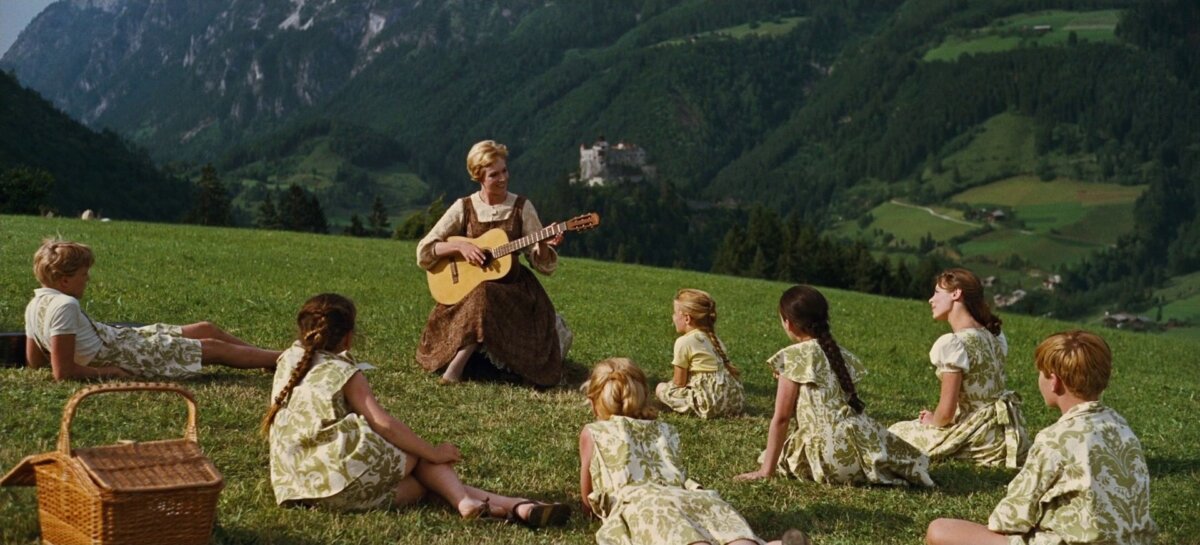
So much has been written about this Rodgers-Hammerstein classic’s plot and cast, its backstory, production, and legacy, that its beating heart of timeless, even spiritual, values seems lost. Here, the majestic Alpine mountains come close to doubling for the divine, as if reverentially, the film begins high on those mountainous shoulders. It also ends there.
It’s late 1930s Austria, as the thick clouds of Nazism are about to darken the hills. A spirited Maria (Julie Andrews) sings, “the hills are alive,” with songs they have sung “for a thousand years.” This is code for eternity. The hills fill her heart with the sound of music.
It feels natural, like something she’s heard before. Mirroring the overflowing nature of love she’s received, her grateful, “blessed” heart wants to share it, to sing every song it hears.
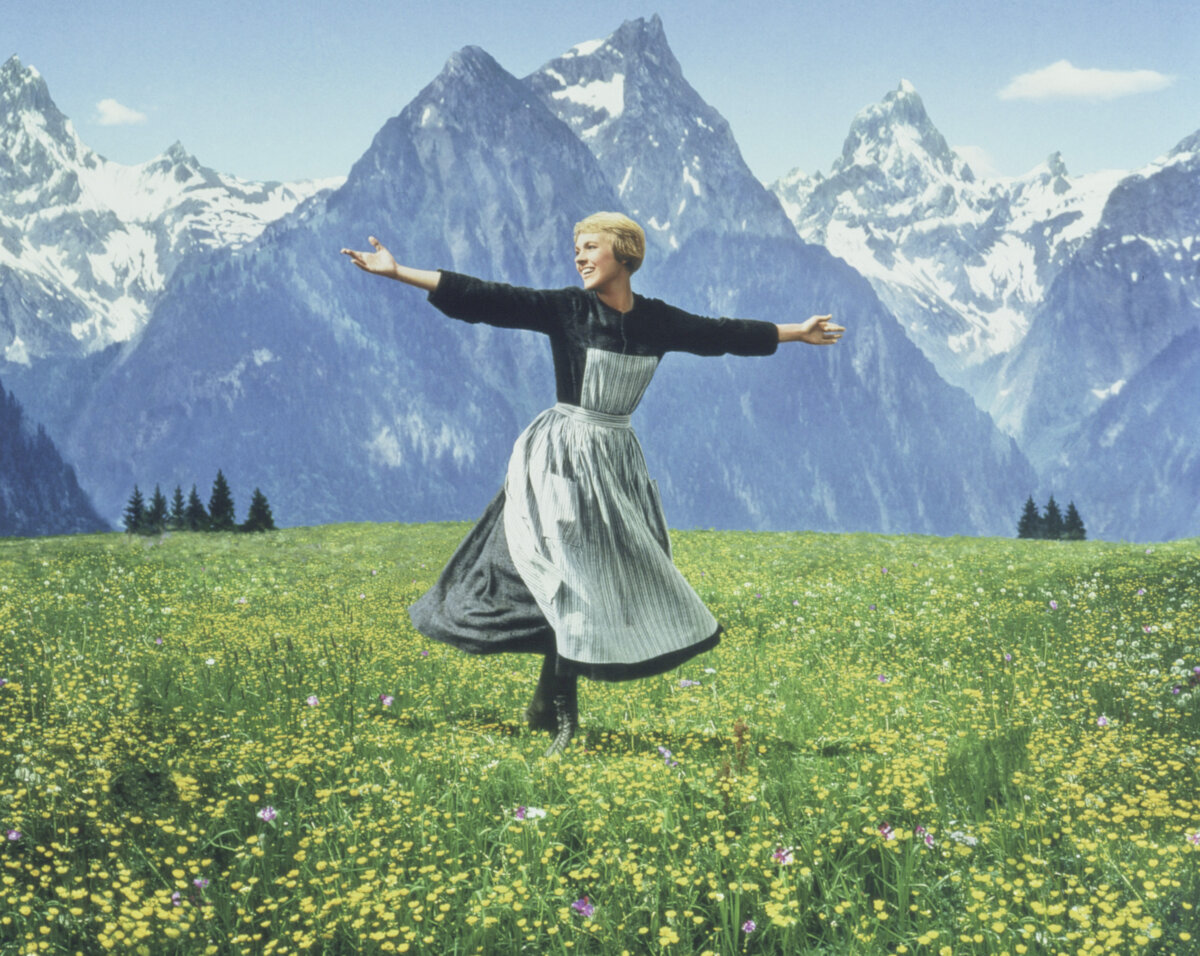
But the hills have other plans. The song they have in mind for her is singular, the song of her life and love. She’s about to hear and share it in unlikely places. First, she believes it’s in a convent, as a nun. Later she discovers it’s in a household, as governess to the seven children of widower Captain von Trapp (Christopher Plummer). Does her fulfillment lie, after all, in being a loving wife and a caring mother?
Music here embodies not just “Something Good” as Maria and the captain sing, but everything good. Since his wife’s death, the captain has forbidden singing in the house. But Maria’s coming, her song, has brought back love and life into that house, making it a home.
This cinematic ballad to femininity and masculinity suggests it takes only a few false notes for either to be twisted into what they aren’t. But when both hit the right notes? They create an irresistible harmony.
Men Stand Up
The three principal male characters represent choices men can make when challenged to become better versions of themselves. Asked to choose between Nazism and the upholding of human dignity, young Rolfe (Daniel Truhitte) must pick a side. Uncle Max (Richard Haydn) ponders the attractions of sitting on the fence.
But Captain Von Trapp is broader-shouldered than both. The respect he commands flows not so much from his military rank but from the restraint and responsibility with which he wields authority.
Of course, it takes Maria to show him he’s better off treating his children as children, not as cadres in a military academy. They’d much rather hear his voice than answer to his whistle, and much rather play than march, and wear clothes than uniforms.
Realizing he’s out of line, the captain responds with the most powerful words a virtuous woman can hear from a contrite man, “I behaved badly, I apologize.” His words resonate when they allow love’s sounds and silences to make its music.
Feminine Differences
The three principal female characters represent choices open to women: Elsa (Eleanor Parker), Maria, and Liesl (Charmian Carr). All fear losing the love of their life. Aristocratic Elsa has the captain within reach but just outside her grasp, what with the angelic Maria in the wings.
Maria worries that aristocratic living will rob her of what she believes is her true love: the austere life of a nun. Young Liesl suspects that her beloved Rolfe is too swayed by Nazism to see her as she is. Of course it takes Maria and a chastened captain to show others and each other that true femininity and masculinity entail humility, courage, character.
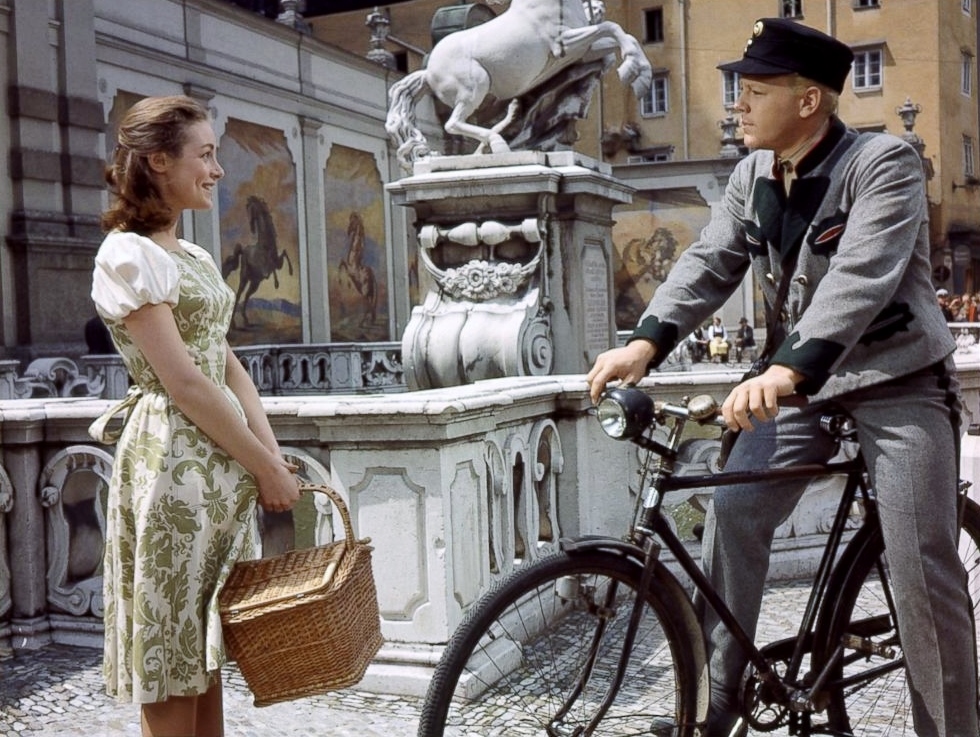
It also takes the Mother Abbess (Peggy Wood) to show Maria that God may be leading her away from vows in Holy Orders toward vows in Holy Matrimony: “The love of a man and a woman is holy, too.” The convent can’t be an escape from the world; if anything, it must help her face the world, and climb every mountain.
“Sound of Music” is a commentary on the hollowness of feminist self-loathing. There were countless critics who trashed this film; those most remembered for their contempt of it were women: New York Times movie critic Pauline Kael, writer Joan Didion, and film critic Judith Crist.
Even if they privately loved it, they felt compelled to fashionably appear as if they couldn’t stand a virtuous female-led film that celebrates marriage, children, and family. So, they looked for excuses to tear into it.
In a nutshell, they rejected the film because it was too good to be true. But can we deny that its star Andrews is one of the greatest singers because she sings, well, too well? In her prime, she had a four-octave vocal range and pronounced every vowel and consonant as if it were the only one.
For her impeccable diction alone, people might have paid for tickets to hear her read the telephone book or a series of car license plates. She was that good. Here, she is like the alpine flower, Edelweiss, gracing every scene she’s in, making this film a thing of lasting beauty.
Happily, it’s a woman, Barsukova Ol’ga, who wrote a lengthy tribute, finding enough to praise in the film’s musicality alone.
To dismiss this treasure as a trifling musical or to mock it as a mere children’s film is to miss its universal point. It’s about growing up and letting go of self-indulgence. It’s about shunning escapism and paying a price for moral conviction. Everyone is offered a chance to grow up: Maria, Elsa, Liesl, the Captain, Uncle Max, and Rolfe. Only some do.
Music That Resonates
Here’s the thing. If this film doesn’t resonate, something’s off. When the children sing “So Long, Farewell” to the captain’s party guests, they’re merely saying goodnight because they are heading to bed. But the guests find them so endearing that they wave and chorus back the final word, “Goodbye.”
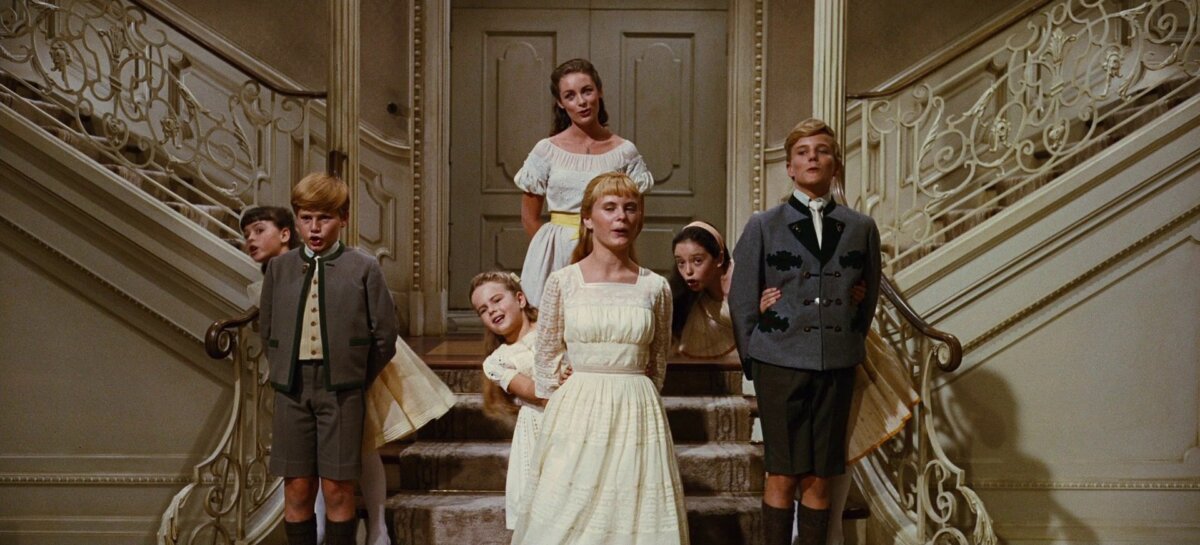
The guests see something exceedingly good, yes, perhaps too good. But they can’t help responding, with goodness. Moved, one guest steps up to the captain and asks, “Is there a more beautiful expression of what is good … than the innocent voices of children?” Smiling, the captain doesn’t answer. He doesn’t need to.
Strumming her guitar to the opening bars of “Do-Re-Mi,” Maria starts with open string notes (not fretting any) as she teaches the children to sing. In doing so, she’s breaking music down to its simplest form, stripping it of its often daunting complexity.
But if you listen and watch carefully enough, she’s teaching them a different kind of music, too. Through her courageous, principled choices, she’s giving them “notes” or tools to life and love.
Once they master those tools, she says, they can build a million tunes by “mixing them up” to create their own harmonies through their lives as loving and responsible adults.
Watch the children gaze at Maria singing “My Favorite Things” or at the captain singing “Edelweiss.” If there’s a more wholehearted, joyful, tender onscreen expression of loving and being loved, go ahead, find it.
You can watch The Sound of Music on Prime Video, Apple TV and DVD.
‘The Sound of Music’
Director: Robert Wise
Starring: Julie Andrews, Christopher Plummer
MPAA Rating: G
Running Time: 2 hours, 54 minutes
Release Date: March 2, 1965
Rated: 5 stars out of 5
What arts and culture topics would you like us to cover? Please email ideas or feedback to features@epochtimes.nyc
