
In December 1971, 7-year-old Randy Liberty joined his mother and three brothers on a journey to Maine State Prison for a Christmas party. There, they received presents from Santa Claus, or a reasonable facsimile. The Liberty family’s attendance was due to the presence of Inmate #12939, Randy’s father, Ronnie Liberty.
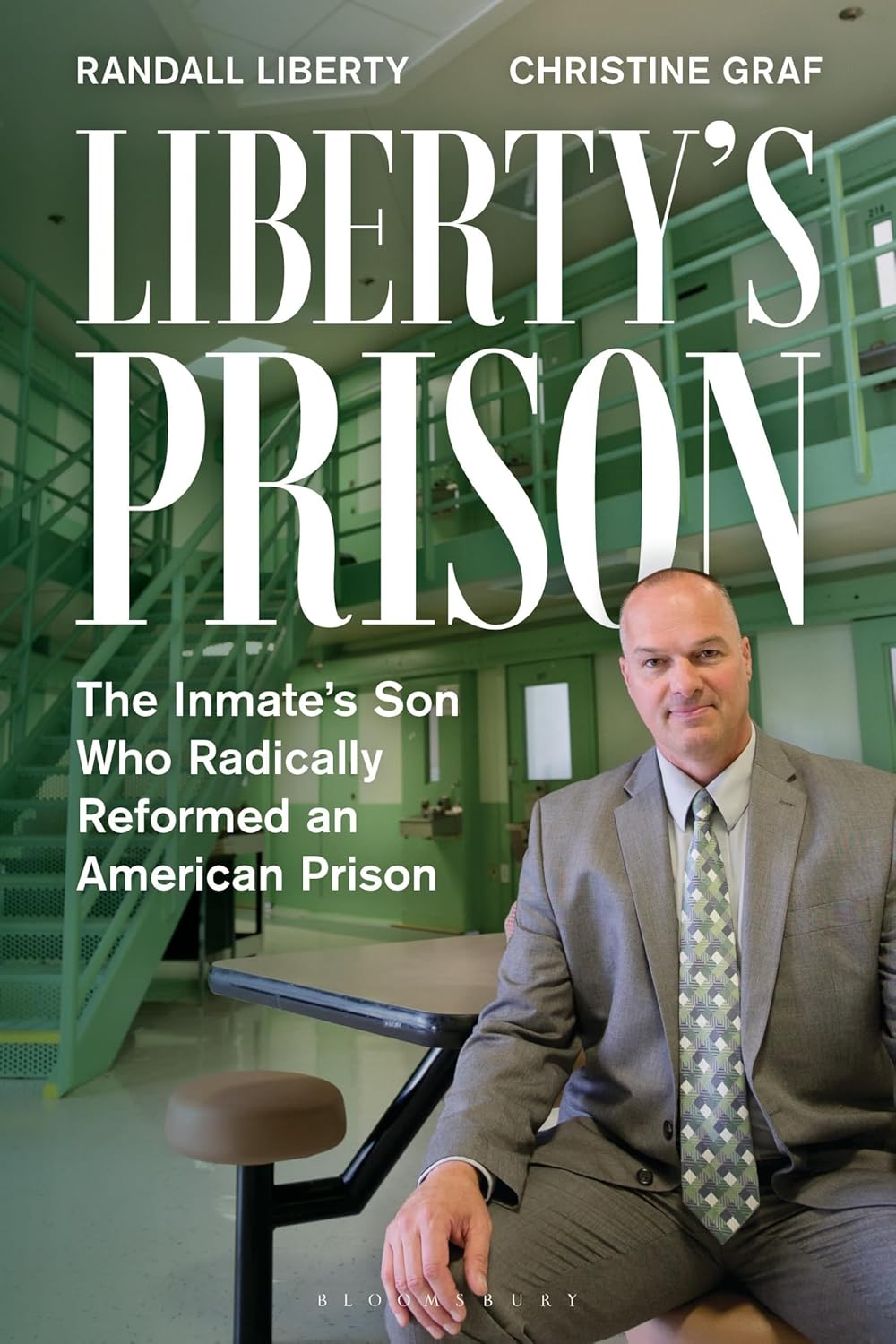
Randy grew up and returned to Maine State Prison as the facility’s warden and later received an appointment as the state’s commissioner of corrections. His unlikely odyssey is recalled in this autobiography, “Liberty’s Prison: The Inmate’s Son Who Radically Reformed an American Prison,” which Liberty co-wrote with Christine Graf.
Strangely, Liberty opts to tell his story in the third person. Throughout the book, he treats his journey as if this is a stranger’s tale, never acknowledging the actions are his own. He even separates himself by name, using Randall for the author’s credit and Randy for the central character.
A Challenging Childhood
The most jolting aspect of the book involves Liberty’s childhood in rural Maine. His father, Ronnie, was an abusive alcoholic with a penchant for petty crime. On a few occasions, the elder Liberty was arrested by his brother Gene, a police officer.
The father’s antics left his family living in poverty within a ramshackle, unheated trailer. The author recalls he was embarrassed at having to use food stamps to buy groceries for his family. His mother eventually divorced his father and remarried, but Liberty’s stepfather never created a financially comfortable life for them.
After high school, he joined the U.S. Army and became a military policeman. He was thrilled to be in a setting where his family’s embarrassing history was unknown to his peers.

Half-Told Stories
After his Army stint, Liberty studied criminal justice at the University of Maine at Augusta. He secured a part-time job as a guard at the Somerset County Jail, where one of the inmates was his father.
At this point, the book goes awry. Any emotion Liberty experienced in this strange reunion is steamrolled by a flat narration. He quotes himself saying, “As crazy as it sounds, I remember it as some of the best times I spent with him,” but there is no follow-up on why he felt this way. Nor is there consideration of how father and son viewed their warped prisoner-jailer relationship.
As the book progresses, Liberty lists several accomplishments that occur without explanation. He founds a nonprofit in 1989 that established a community garden to help those facing food insecurity, but he never says where the idea came from or how he ran this endeavor with no previous experience in gardening or nonprofit management.
Shortly after Liberty joins the Kennebec County Sheriff’s Department in 1991, he is assigned to K9 duty with a German shepherd named Bosko, who was twice returned to the kennel for lacking obedience. Liberty claims to have trained the violently unruly dog but offers no clue to the secret of his canine success.
But at least Bosko gets time in the spotlight. Liberty never reveals that he was married with two daughters until he joined the sheriff’s department. His marriage ended in divorce, but he never cites his ex-wife’s name or provides insight on his domestic life. A second wife, Jodi, abruptly turns up as a passenger in a 2009 road rage incident, along with one of her sons from a previous marriage. Another of Jodi’s sons appears in a photo but is ignored in the text.
Liberty looks back on his 2003 military service during the war in Iraq with a misty-eyed fondness he never showers on his wives or children. “The relationships I built in combat are different from anything I ever experienced, and we developed a deep love for one another,” he writes about his fellow soldiers, without explaining why.
Life Behind Bars
Liberty’s book succeeds in his detailing of the venal environment created within the Maine State Prison before he took over as warden in 2015.
While few people will deny that being a correction officer is a dangerous and thankless job, Liberty zeroes in on the nasty culture at the prison. Some behavior was petty, such as a surly correction officer who refused to shake his hand when he first arrived. Other behavior was more extreme, such as prisoners sealed up in solitary confinement for weeks just because they crossed paths with a guard having a grumpy day.
As warden, Liberty aggressively attacked the roots of the problems that created the prison population. He investigated untreated post-traumatic stress disorder among prisoners who were veterans. He pushed for a better diet for prisoners, improved educational and vocational opportunities, and pursued strategies to erase recidivism. Not every prisoner appreciated Liberty’s holistic approach, but many were able to redirect their lives because of him.
Readers with an interest in the criminal justice system will appreciate this aspect of “Liberty’s Prison,” where the author forcefully addresses how to fix the problems in the penal system. It is a shame his book didn’t focus exclusively on this topic, for this is where Liberty’s storytelling skills work best.
‘Liberty’s Prison: The Inmate’s Son Who Radically Reformed an American Prison’
By Randall Liberty and Christine Graf
Bloomsbury Academic: Feb. 5, 2026
Hardcover, 248 pages
What arts and culture topics would you like us to cover? Please email ideas or feedback to features@epochtimes.nyc