



Legend has it that on Oct. 31, 1517, Martin Luther hammered his 95 Theses onto the door of the Castle Church in Wittenburg. His intention was to spark an academic debate, not a violent uprising. He argued that idolatry should be stopped in the heart, not by destroying sacred works of art.
He denounced the iconoclasm that took over the Reformation and did not live to see the tidal wave of violence that swept across Northern Europe, destroying countless masterpieces of Catholic heritage.
It was a time in which the Catholic Church was forced to rebrand its image and its artwork. In doing so, it sought artists willing to pick up the pieces and reimagine the church’s relevance in the lives of its congregations.
Born in the middle of this conflict was Peter Paul Rubens (1577–1640), who became the most celebrated artist of his time—not only by reimagining the church’s iconography with insights from antiquity and classicism, but also by using his influence as a court painter to help negotiate peace treaties between warring Catholic and Protestant powers. His florid, lush, and visionary style reflected both artistic brilliance and intellectual discipline, qualities that also informed his work as a diplomat.
In the Wake of the Beeldenstorm
From August through October 1566, thousands of Calvinists marched across the Low Countries, destroying Catholic cathedrals, churches, monasteries, convents, and hospitals. The violence spread from Steenvoorde, in what is today northern France, to Ghent, Antwerp, and as far north as Amsterdam. The mobs often left buildings intact, destroying only the religious items, statues, and altar pieces.
What became known as the “Beeldenstorm,” or “image storm,” spurred the Counter-Reformation’s efforts to commission new, more grand, and captivating artworks to replace all that had been destroyed.
Navigating the political tides of the Netherlands under Spanish rule, Rubens’s father sided with the Reformation and converted to Calvinism, which eventually forced the family to flee Antwerp for Cologne to avoid persecution. His father’s subsequent affair with Anne of Saxony led to his imprisonment and exile in Siegen until 1578.
Nearly 20 years later, and after his father’s death, his family returned to Antwerp and reconverted to Catholicism. His mother claimed to have always remained a Catholic at heart. With renewed stability, Rubens began his artistic training.
A Pupil Surpassing Many Teachers
Studying under three masters in Antwerp, Rubens studied not only landscapes, Mannerist figure painting, and Romanist traditions, but also the rules of courtly etiquette and diplomacy. His ease in both painting and communication signaled to early patrons that his talents extended beyond the artist’s workshop.
That versability became evident during his first extended stay in Italy. Under the patronage of Duke Vincenzo Gonzaga of Mantua, Rubens traveled to Florence to copy works by Leonardo, Michelangelo, and Raphael. He then delivered paintings to Philip III in Valladolid to strengthen Gonzaga’s relationship with the Spanish court.
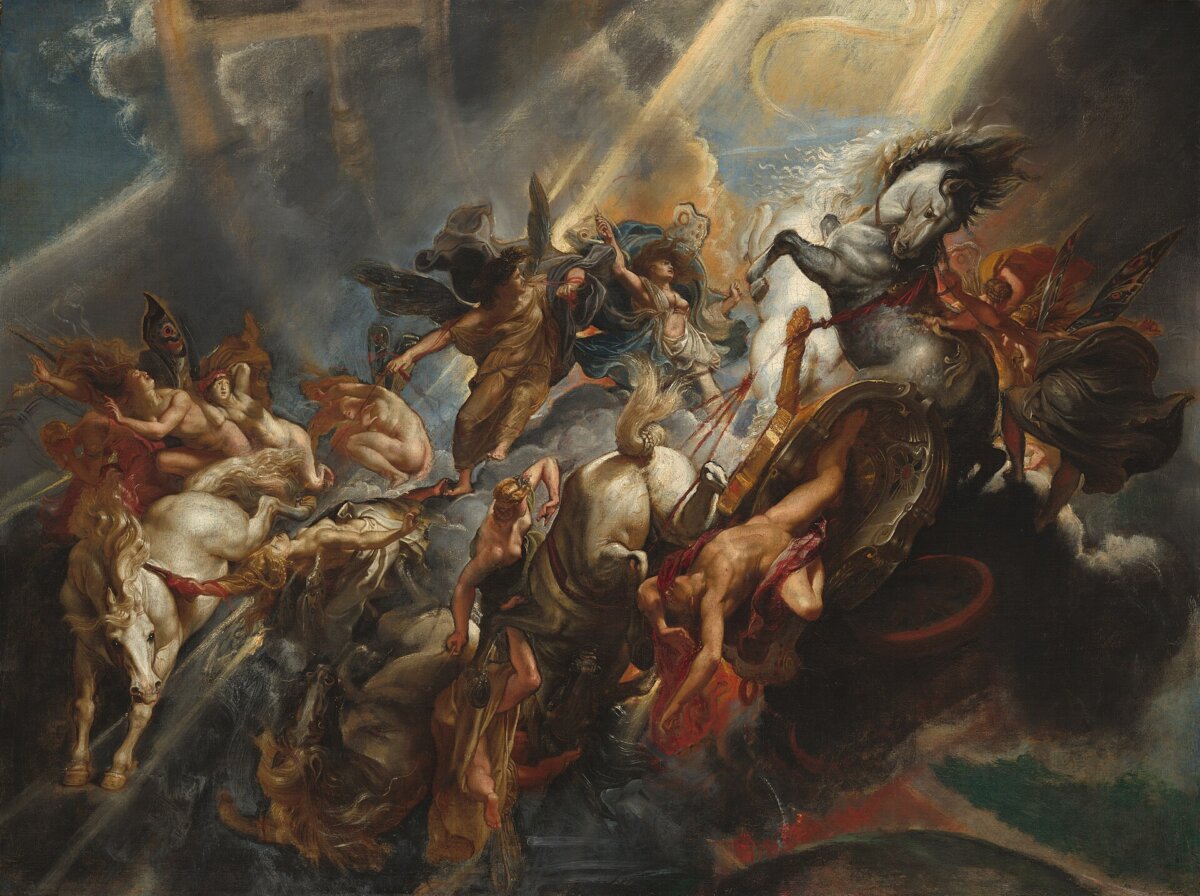
One painting, “The Fall of Phaeton” (1604–1612), reveals the artist’s continued experimentations and revisions over a decade. The painting depicts Ovid’s description of Phaeton, son of Helios, attempting to drive the sun god’s chariot before losing control of the horses and being struck down by Zeus’s thunderbolt to save the earth.
In the summer of 2019, the Journal of Historians of Netherlandish Art published a technical analysis of Rubens’ revisions to his early painting, “The Fall of Phaeton.” Using x-radiography and false-color infrared reflectography, the team identified three separate phases over nearly a decade in which Rubens returned to the work and made significant changes to the coloring and detailing throughout the entire painting.
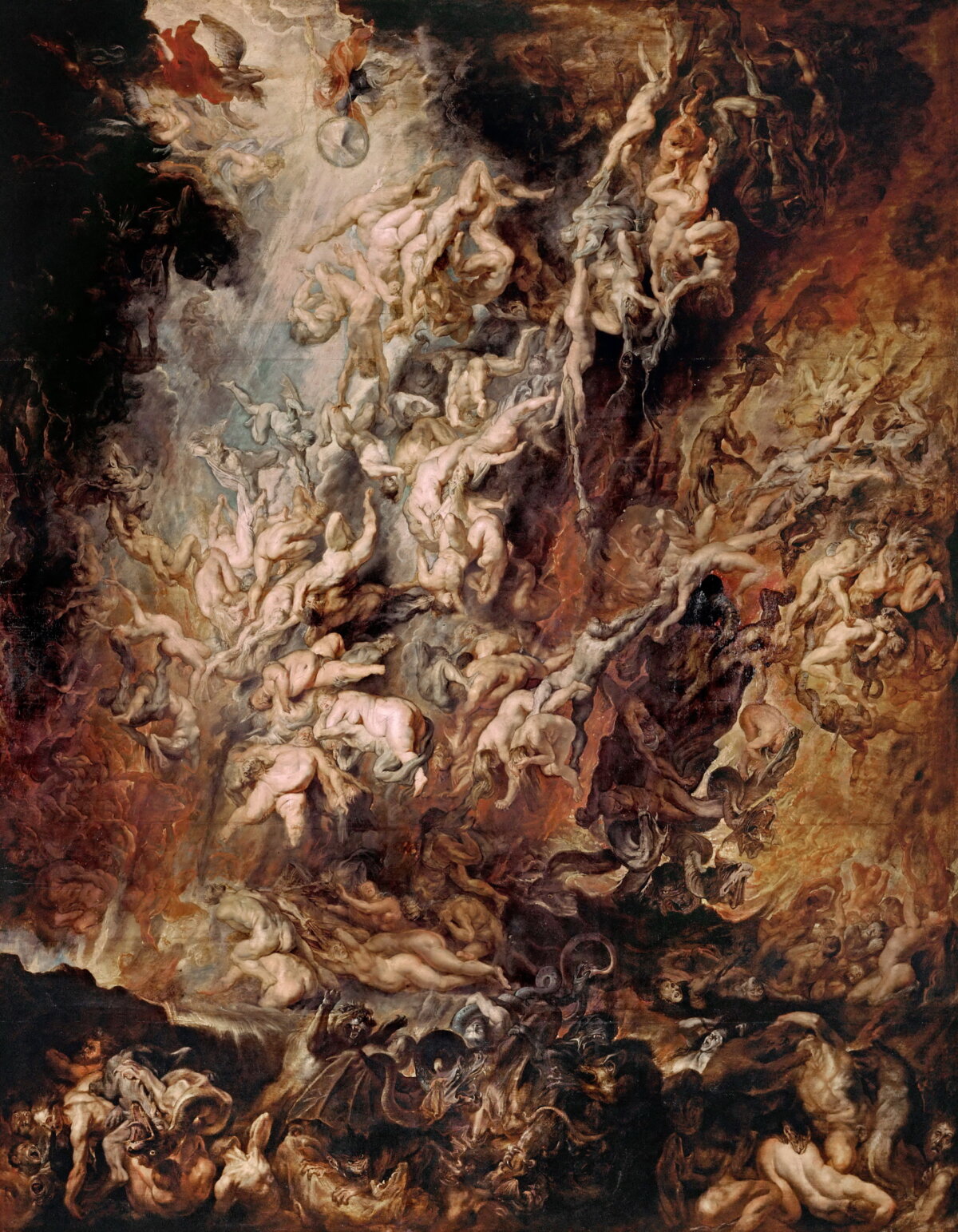
While historians have compared Rubens’s use of color here to Tintoretto, and his modeling of the horses after Leonardo’s in his sketches for the Battle of Anghiari, this extensive experimentation with a single painting over eight years demonstrates his commitment to developing his ambitious style. His increasingly complex, almost labyrinthine compositions sometimes include hundreds of intertwined human figures, such as in his depiction of “The Fall of the Damned” (1621). He managed to blend complex liturgical and mythological allegories with mesmerizingly detailed scenes, all the while maintaining a diplomat’s composure.
Painting and Peace Offering
Between 1628 and 1629, Rubens spent eight months in the Madrid court of Philip IV. Though he spent much of the time making a new study of Titian’s paintings and befriending and mentoring the young court painter, Diego Velasquez, his visit had a much more significant and political agenda.
By this time, Spain and England had been at war for five years and both sides were looking for options to make peace without admitting defeat. Philip knew that the war had been costly for England, and he knew that King Charles I was also a great admirer of Rubens’s work. He saw in this situation a unique opportunity to combine the best of Rubens’s artistry and diplomacy.
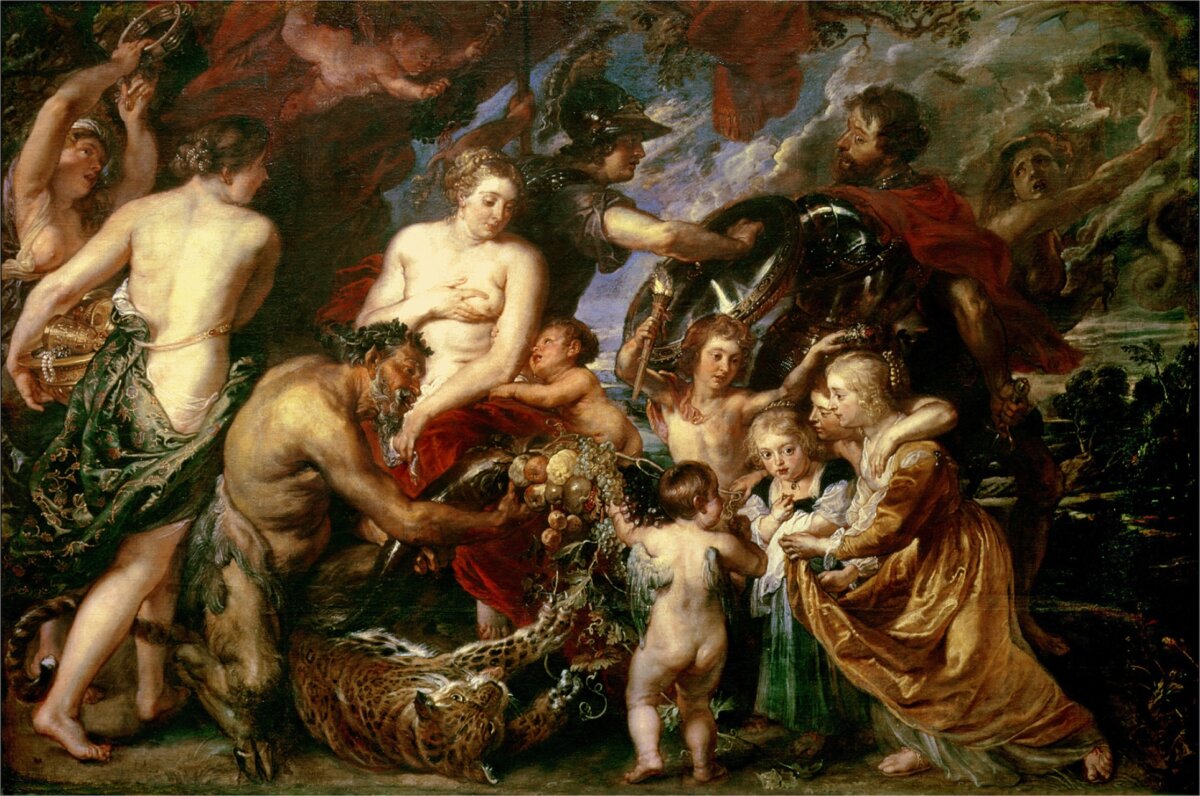
First, Rubens was sent as an envoy rather than a formal diplomat, allowing him to meet directly with Charles and bypass typical court protocols. Second, he brought with him a painting—”Minerva Protects Pax from Mars,” also known as “Peace and War” (1629).
The painting depicts an allegory of Minerva, Roman goddess of wisdom and strategy, protecting Pax, the goddess of peace, from Mars, the god of war. Above Minerva is a small angel, or “putto,” holding an olive wreath and a caduceus, symbols of peace and negotiation. The children receiving a cornucopia of fruit are believed to represent the family of Sir Balthasar Gerbier, Charles’s diplomat and Rubens’s host in London.
Presented alongside Philip IV’s proposed terms, the painting reinforced the promise of peace and prosperity. Charles accepted the terms and knighted Rubens in recognition of his achievement.
Ruben’s cleverness was so impressive that during his lifetime, his royal patrons sent him on diplomatic missions across England, Spain, France, Italy, and the Netherlands. Despite all his travels, his studio in Antwerp continued to produce over 2,500 paintings, altarpieces, tapestries, sculptures, and prints from his designs, making him the most prolific and celebrated artist of his time.
His genius and tact not only restored much of the art desecrated during the Reformation but also spared many of its human casualties. His service to the Spanish court continues today, with the largest collection of his works on display at the Prado in Madrid.
What other arts and culture topics would you like us to cover? Please email ideas or feedback to features@epochtimes.nyc
