In her short story “North of Fifty-Three,” Mary Woodbury Caswell explores the amazing power of courage, which seeks to recall a sense of justice in an unjust and disordered situation. Caswell inspects courage through the story of a young woman who is abducted and must find a way to escape captivity.
Alaskan Winter
Gertrude lives in Alaska with her brother, Bob, and her fiancé, Keith, whom she came to help nurse after he shattered his shoulder. And, on this particularly fine, wintry Alaskan morning, she decides to take her habitual walk through the snow
Keith immediately grows anxious when he hears of her plan: “Since Jacques told us of that outlaw who threatened to kidnap a white girl for his wife, I don’t like to have Gertrude get out of sight.” Gertrude reassures her fiancé that she doesn’t believe Jaques’s drunken tale, then sets off, laughing to herself about Keith’s worry.
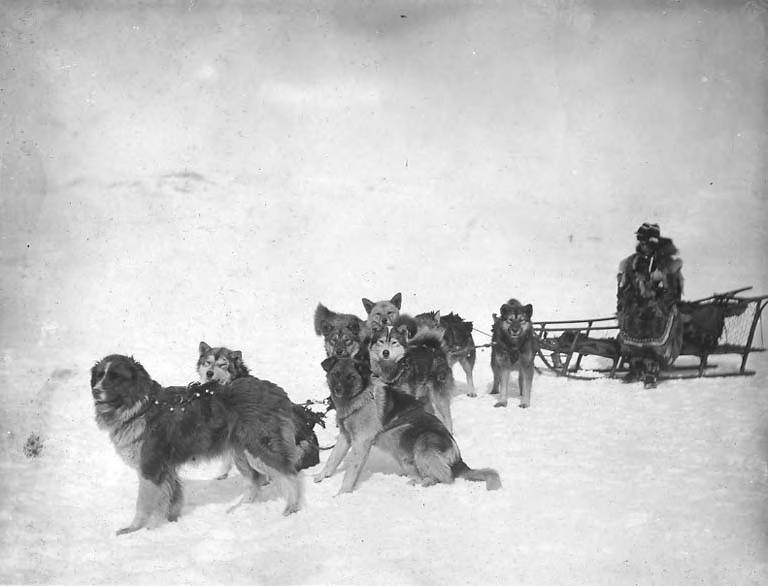
Wearing her snowshoes, she passes over and behind the adjacent hill. In the distance, she notices a sled dog team approaching. She smiles, thinking about Keith’s mythical outlaw. Yet, as the sled passes her, she catches a glimpse of the driver and grows apprehensive. He’s nothing like the other men she’s seen in the Alaskan wild.
Her fears grow when the driver turns the sled around and stops beside her: “Can you tell me, mademoiselle, how near I am to some residence?” Alarmed, Gertrude responds that their house is on the other side of the hill.
With lightning reflexes, the driver throws a blanket over Gertrude, forces her onto the dog sled, and drives away. They ride along for a while and finally stop at the mysterious driver’s house, where he carries her inside and finally removes the blanket.

Gertrude finds herself alone with this stranger in an unfamiliar cabin with a ferocious dog guarding her. The man suddenly says, “I do myself the honour, mademoiselle, to offer you marriage.” Stunned, Gertrude refuses this proposal and asks to go home.
He acknowledges her refusal, but insists that she must remain with him. She responds stubbornly: “Not alive.” She quickly grabs a whip and hits his dog, which lunges at her, biting her arm.
The man, frantic and alarmed, struggles to restrain the dog. Little does Gertrude know the remarkable effect her courage has on the wild man or what events she has set into motion.
Through this story, Caswell comically highlights the beauty and power of courage in the face of a seemingly hopeless situation. Such courage, she demonstrates, is as powerful as an avalanche and quickly becomes a catalyst for truth, stoppling injustice and covering it with a renewing, truthful snow.
Like Harper Lee in “To Kill a Mockingbird,” Caswell suggests that real courage isn’t found in a man with a gun. Rather, it’s the grit of knowing you’re licked before you begin yet choosing to see it through to the end. In this way, Caswell shows that courage is a beautiful and admirable virtue to cultivate. It combats untruth with truth, injustice with justice, and cowardice with bravery. Courage serves as the lantern that carries hope through the darkness.
What arts and culture topics would you like us to cover? Please email ideas or feedback to features@epochtimes.nyc