NEW YORK CITY—The three titans of the Italian Renaissance—Leonardo, Michelangelo, and Raphael—have been ranked in varying orders since the 1500s. For more than three centuries, Raphael (1483–1520), painter, draftsman, and architect, was at the top, venerated as the incarnate of artistic perfection. Aspiring artists throughout Europe were taught to emulate his style. In the modern era, the critical consensus had reassigned Raphael to the rear, categorizing his art as saccharine, formulaic, emotionally sterile, and too idealized.
The Metropolitan Museum of Art’s new blockbuster exhibition “Raphael: Sublime Poetry” challenges this assessment by assembling an astonishing grouping of his drawings, paintings, and tapestries that attest to the artist’s mastery of the interplay of vibrant color, light, space, and geometry.
Carmen Bambach, the Marica F. and Jan T. Vilcek Curator in The Met’s Department of Drawings and Prints, has convinced over 60 prominent public and private collections to lend their precious Raphaels. Due to the fragile nature of much of the art, The Met will be the only venue. It presents a once-in-a-lifetime opportunity to see a comprehensive Raphael show in the United States. Indeed, it is the first major Raphael exhibition of its kind to be staged in the country.
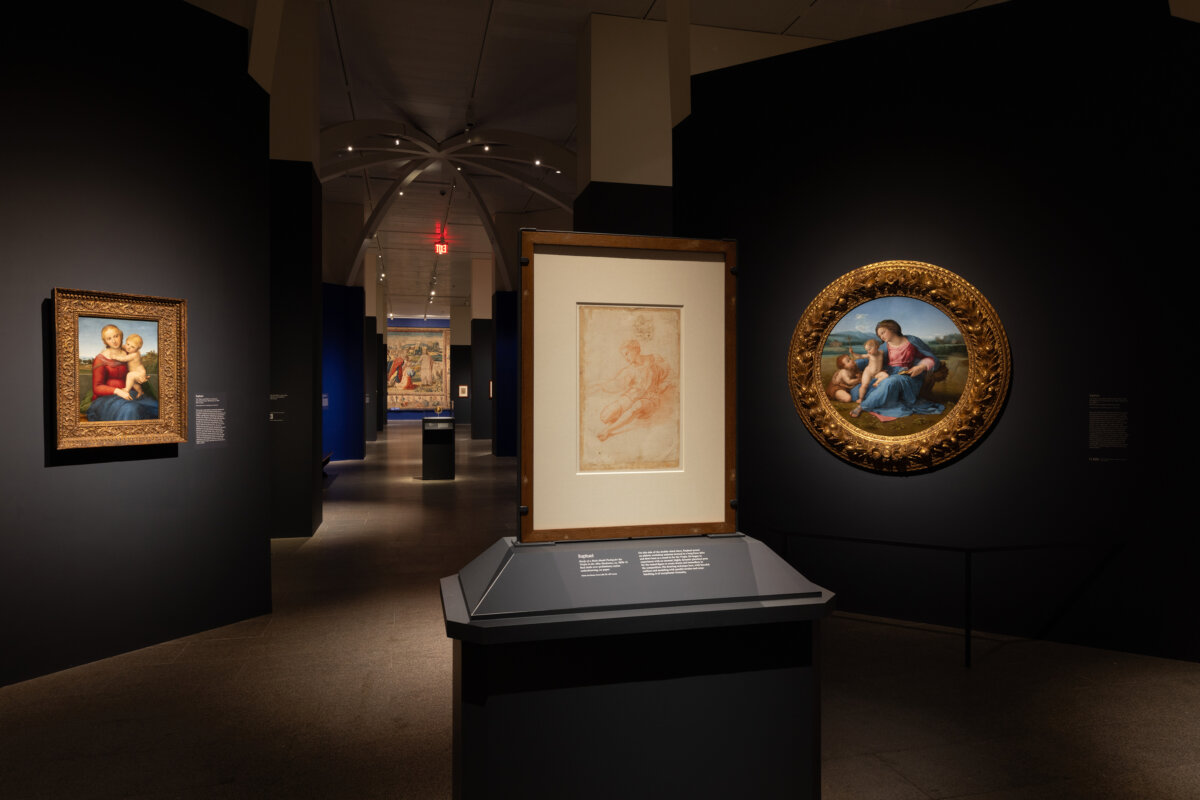
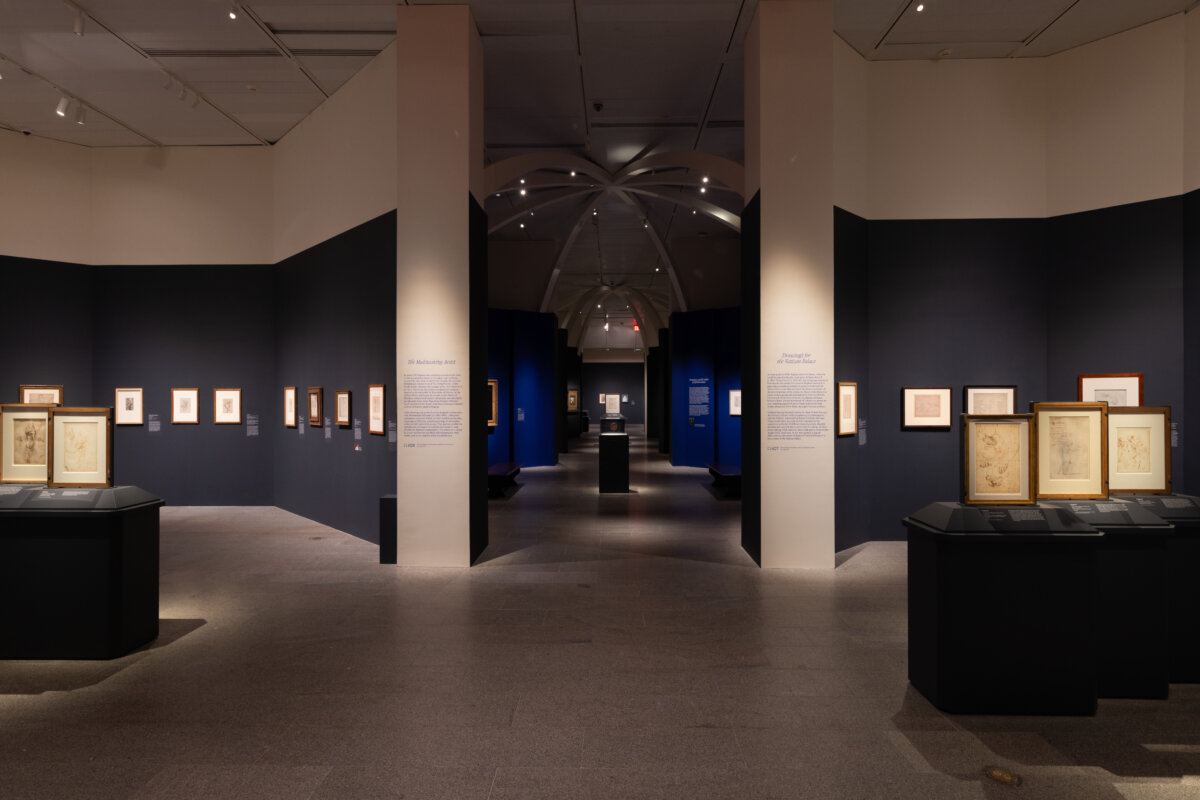
Organized roughly by chronology, the enormous exhibition includes 237 objects, including art by Raphael’s teachers, assistants, and contemporaries. There are 175 Raphael works, with the majority, at 142, being drawings in diverse media, including black chalk, pen and ink, and metalpoint. The object labels explain various techniques and processes. The remaining 33 paintings include some of his most famous images, from secular portraits and historical scenes to devotional works featuring his emblematic subject Madonna and Child. Bambach advises visitors to “wear sneakers!”
While the characteristics of beauty, harmony, and technical perfection ascribed typically to Raphael’s work are on display in the exhibition, the curation also highlights Raphael’s constant experimentation and innovation. Drawing was integral to the development of his practice. The exhibition’s emphasis on the humanity, psychological presence, dynamism, emotional depth, and narrative infused in much of his art may be revelatory to viewers.
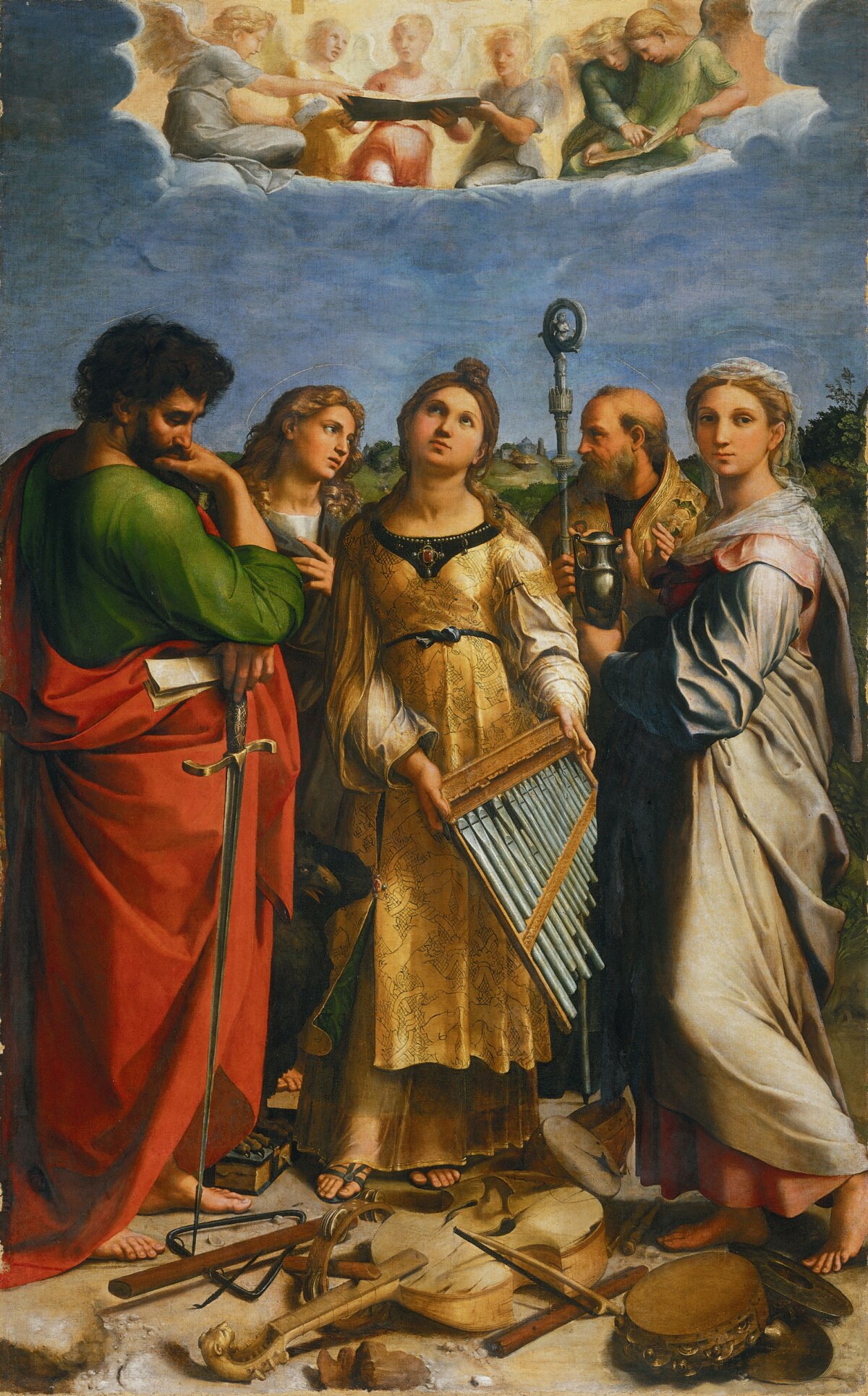
The intellectual Raphael, versed in the art of antiquity, also absorbed lessons from the elder Leonardo and Michelangelo, whose work he studied in Florence and Rome. He learned to boldly express spirit, strength, and sculptural monumentality, but with his own grace. Bambach makes the case that Raphael should be reassessed as every bit the equal of these two artists.
The Artist’s Formative Years
Raphael (Raffaello di Giovanni Santi) was born in Urbino, a hill town in the east central Italian region of Marche. The rhythmic, harmonious architecture of the town and in the art of its painters is echoed by the exhibition’s design. Raphael’s father, Giovanni Santi, was both a painter and a poet. From him, Raphael received his first artistic instruction.
A child prodigy—Raphael is compared to Mozart as both men had early meteoric careers but lives cut short in their 30s—he was soon brought to study with Pietro Perugino. From Perugino, Raphael learned elegance, superior technique, and meticulous compositional development.
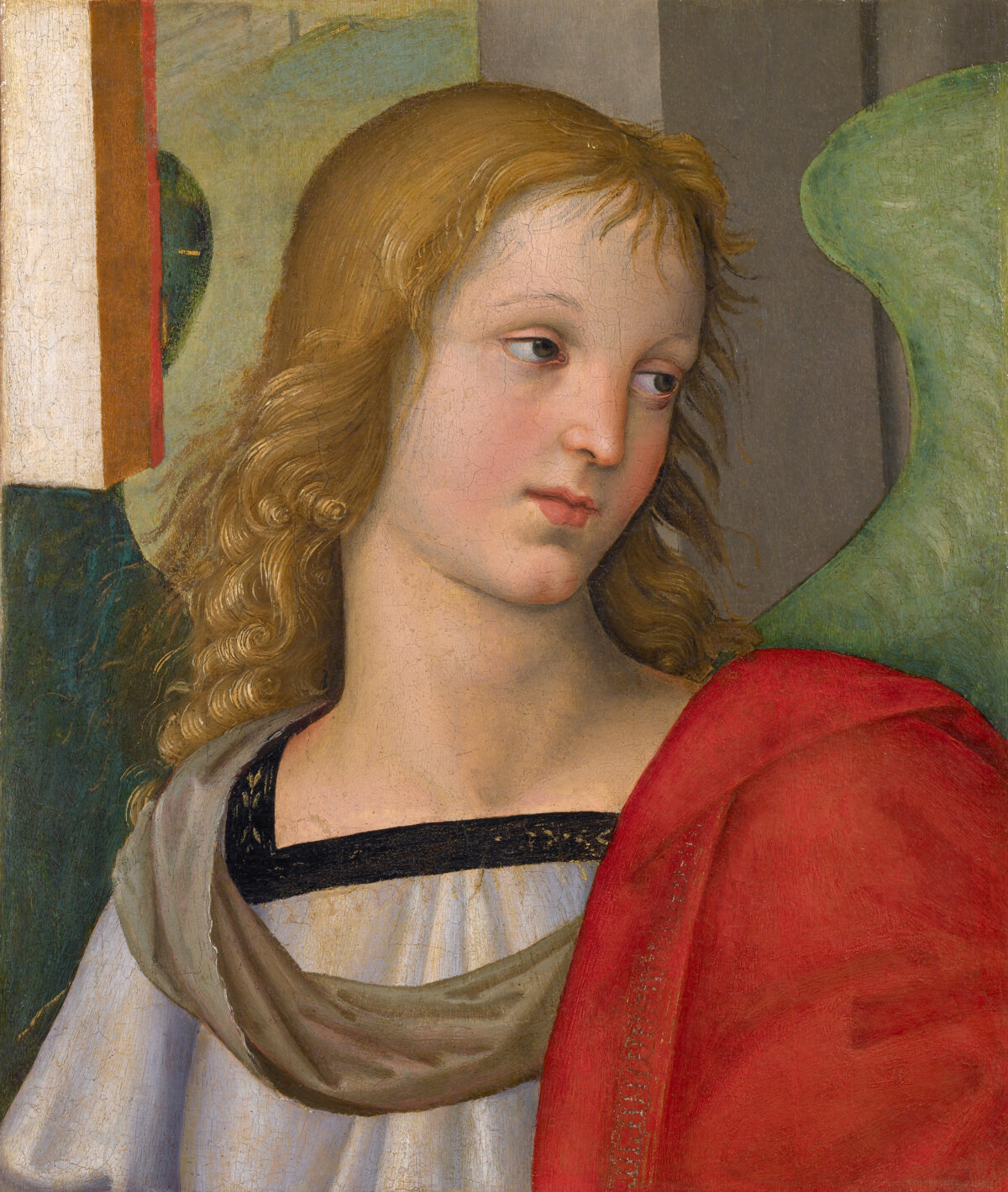
Excitingly, Raphael’s first painting done fully in his own hand has been confirmed by recent conservation treatment and is in the exhibition, along with other newly reattributed pieces and conserved artworks. They are a poignant contrast to a circa 1500–1501 fragment of a superbly rendered angel solely by Raphael’s hand from the Pinacoteca Tosio Martinengo collection in Brescia, Italy. This is one of three surviving fragments from a massive main panel that a 17-year-old Raphael, along with an older artist, was commissioned by a wool merchant to paint. In the contract, Raphael is identified as a master for the first time. Hung in a chapel in the church of Sant’Agostino in Città di Castello, this “Baronci Altarpiece” suffered repeated earthquake damage, with severe destruction in 1789.
Iconic Tondo
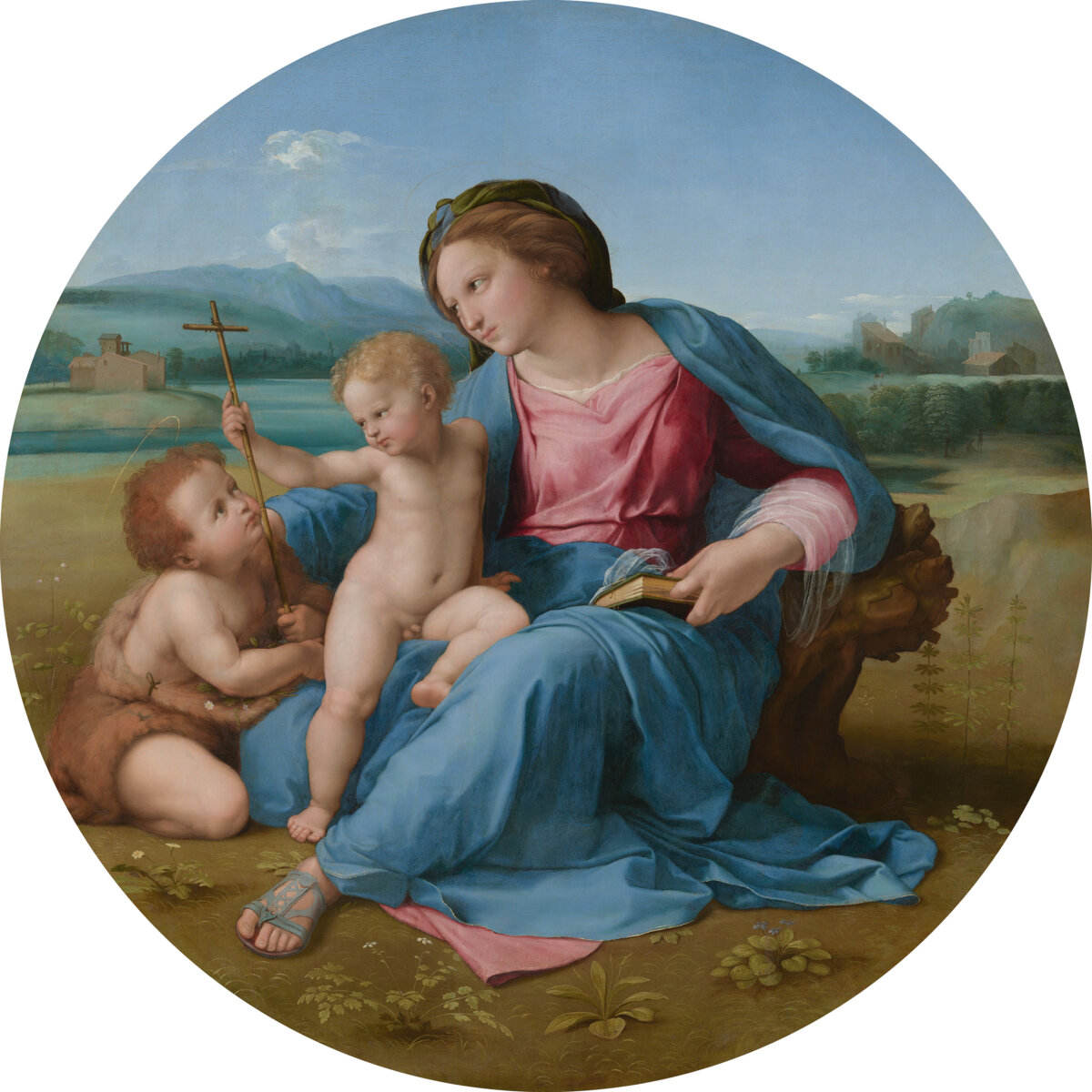
A number of works exemplify Raphael’s celebrated portrayals of the Madonna and Child. A centerpiece is the circa 1509–1511 “The Virgin and Child With the Infant Saint John the Baptist in a Landscape (The Alba Madonna),” from the National Gallery of Art in Washington. It is reunited with two preparatory drawings housed at the Palais des Beaux-Arts in Lille, France. Raphael’s subject can be traced to the Early Christian church, and he imbued such scenes with tenderness, anatomical realism, and multifaceted moods.
“The Alba Madonna” is in a round format, called a tondo, which was popular with Florentine artists between 1450 and 1515. Instead of being enthroned, Mary sits on the ground. This iconography is known as the Madonna of Humility. The action revolves around the reed cross that the Christ Child is taking in hand. It harkens to the crucifixion and the triumph of the resurrection. The Met writes, “Tender gazes, exchanged along a diagonal, unlock an equally arresting psychological world” as Mary accepts her son’s fate. Also softening the scene is the lush countryside. In fact, Raphael was highly talented in painting landscapes, an attribute not well known.
Renowned Portraits
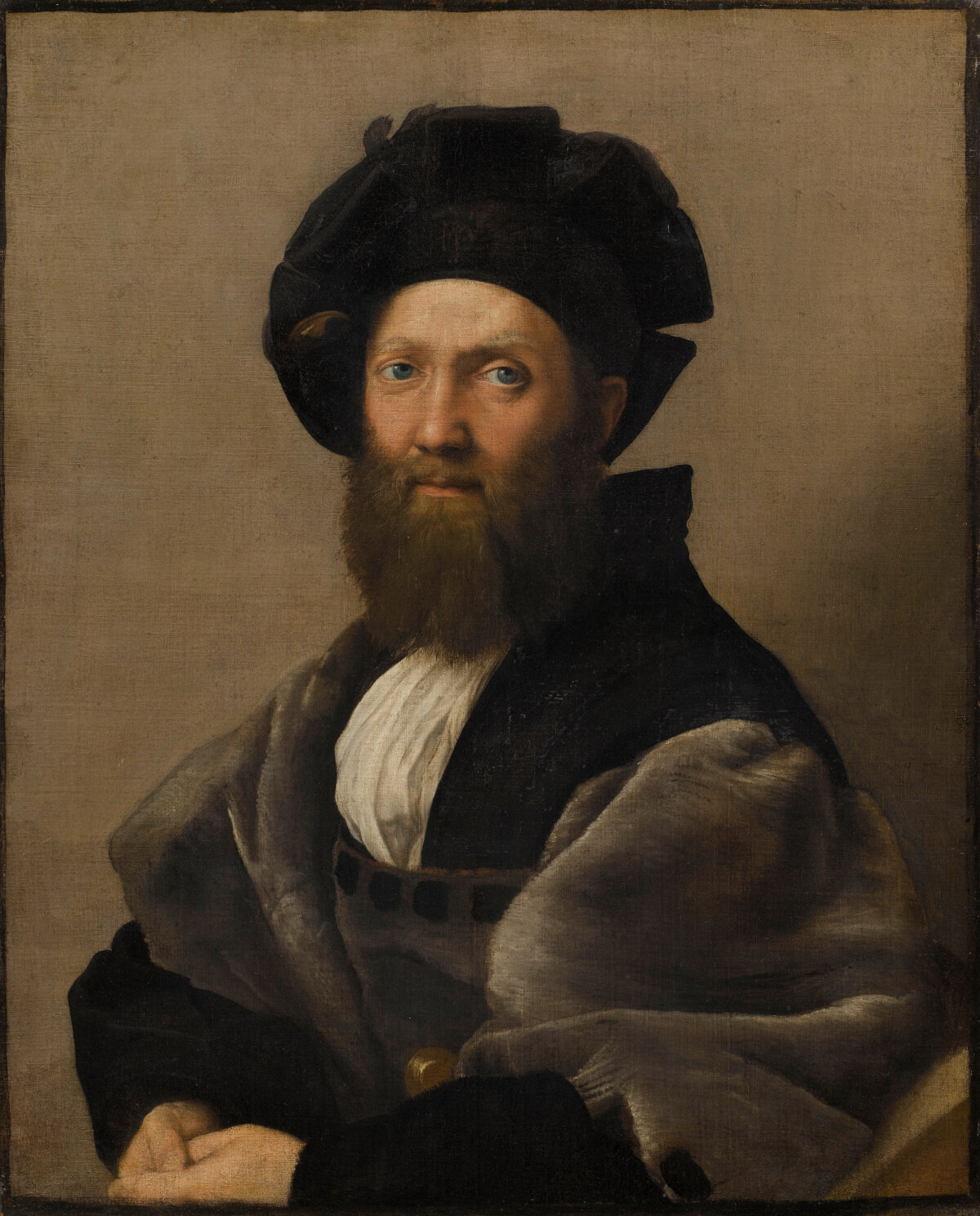
It is a thrill to see one of the most famous portraits of the High Renaissance in the exhibition, Raphael’s refined 1514–1516 portrait of Baldassarre Castiglione lent by the Louvre, Paris. Castiglione’s important “Book of the Courtier” codified “sprezzatura,” nonchalant but nevertheless elegant and graceful manners for nobles. A friend of Raphael (the artist engaged with Rome’s foremost intellects), Castiglione is portrayed in black velvet and gray fur, reflecting the then fashion for dark, understated clothes.
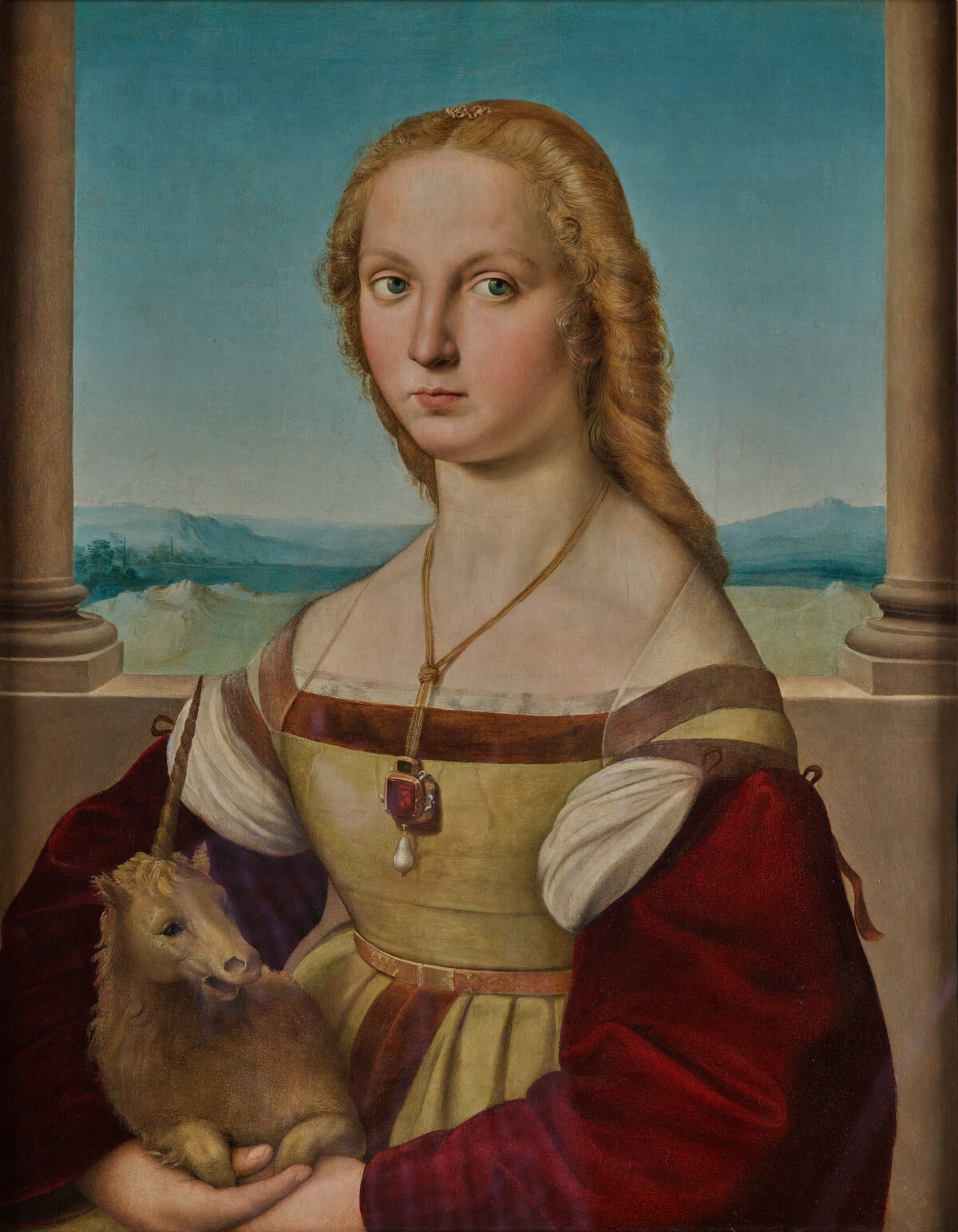
A Mona Lisa-esque painting is the enigmatic 1505–1506 “Portrait of a Lady With a Unicorn” from the Galleria Borghese, Rome. As in Leonardo’s oil, Raphael uses a three-quarter view with the female sitter’s head turned to the left with hands at her waist. The background is a landscape. The occasion for the portrait is believed to have been a betrothal or marriage, and the figure may be Laura Orsini della Rovere, whose family emblem was the unicorn. With her blond hair and pale skin, this luxuriously dressed woman embodies Renaissance ideals of beauty.
Papal Commissions
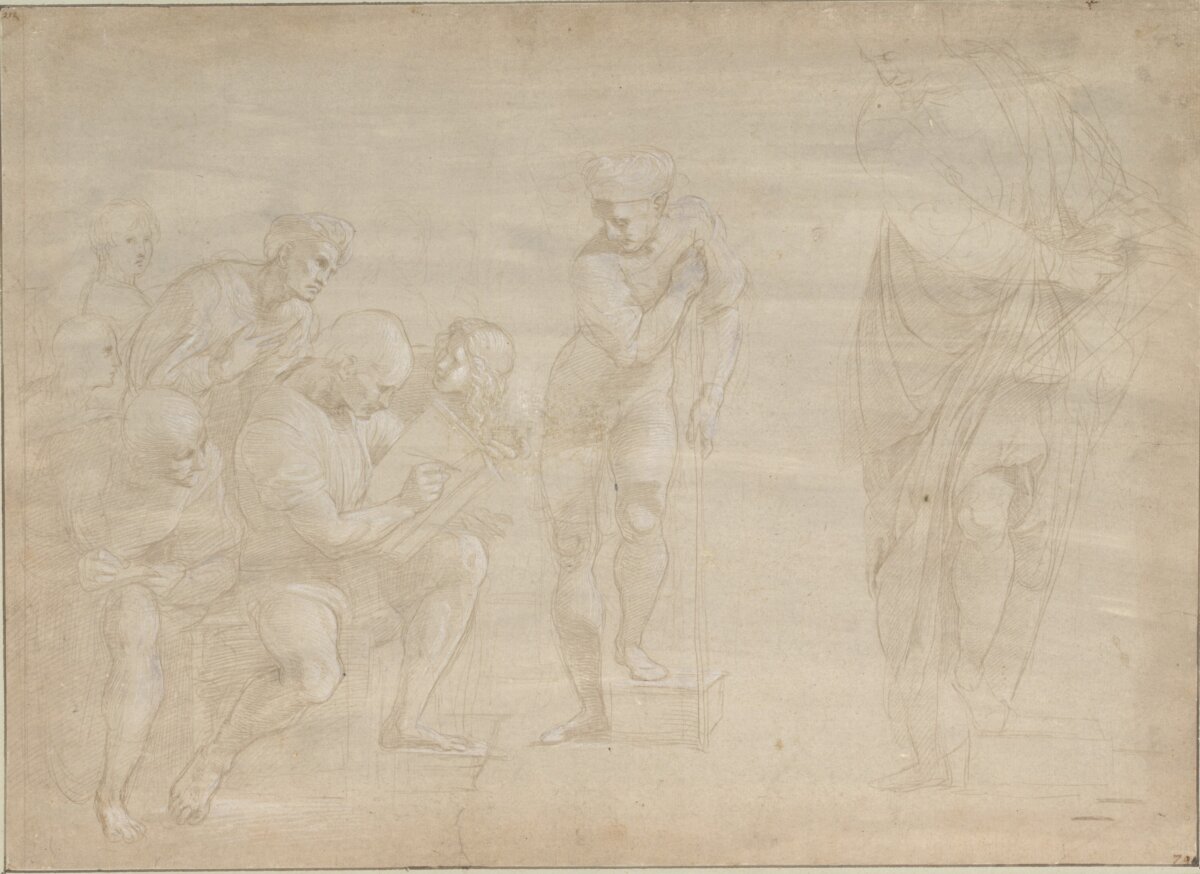
Raphael’s most productive years, necessitating the use of workshop assistants, were spent in Rome, in service to Popes Julius II and his successor Leo X. Arriving in 1508, the 25-year-old artist became quickly the papal favorite, superseding his elders due to his talent and networking. He was tasked with the fresco decoration of a suite of four rooms at the Vatican Palace. The Stanza della Segnatura’s “The School of Athens” is world-renowned, and the exhibit’s circa 1509–1510 “Studies of Pythagoras and His Disciples” sheet from the Albertina Museum in Vienna is a rare surviving composition drawing for it. Additional preparatory studies for the other three fresco cycles are exhibited, and a large-scale digital video shows images of the four finished rooms.
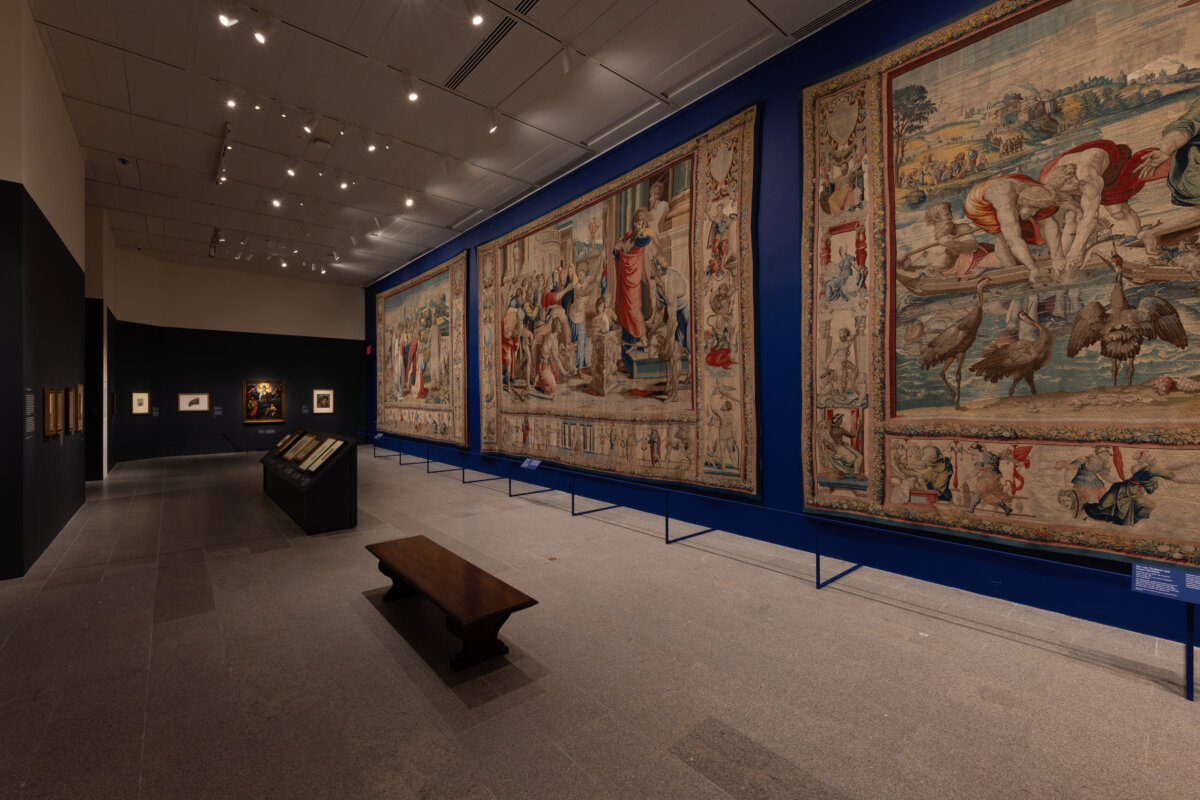
Another important papal commission was for monumental tapestries that would adorn the Sistine Chapel, famously frescoed by Michelangelo, during special occasions. Beginning in 1515, Raphael created the designs and was then assisted by his workshop in the making of full-scale cartoons that would guide its weavers in Brussels. Hugely expensive, these inventive and striking tapestries contributed to the papacy’s bankruptcy. Covetous royals commissioned second editions, and three exquisite, well-preserved examples from a set owned by King Philip II of Spain have left Madrid for the first time for the exhibition.
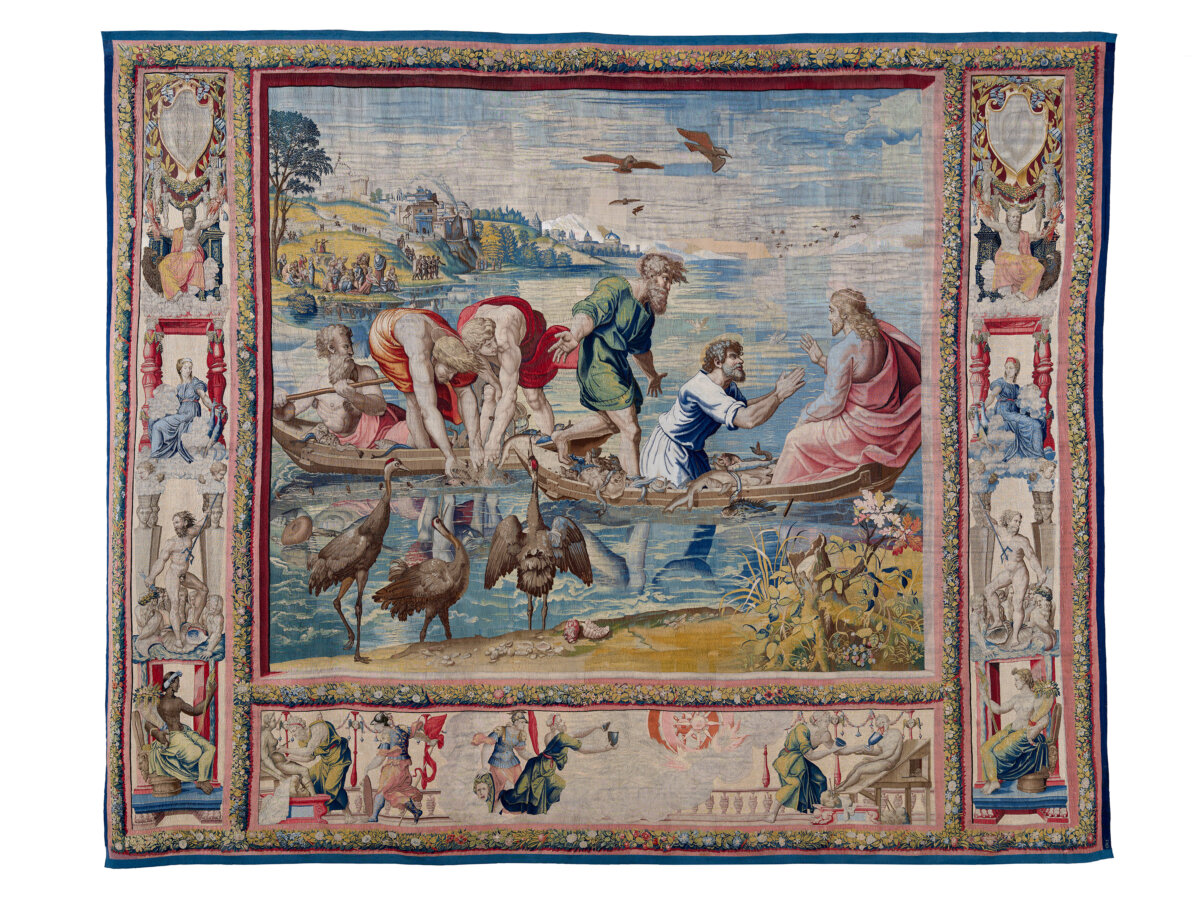
In the tapestry “The Miraculous Draught of the Fishes,” Raphael’s advanced storytelling skills are on display. The Met explains that his “composition conflates a long narrative sequence into one picture as the action unfolds. He would revisit this strategy in several late works, including his last altarpiece, the Transfiguration.” After Raphael’s death, when his body was laid out in state, “Transfiguration” was hung at his head.
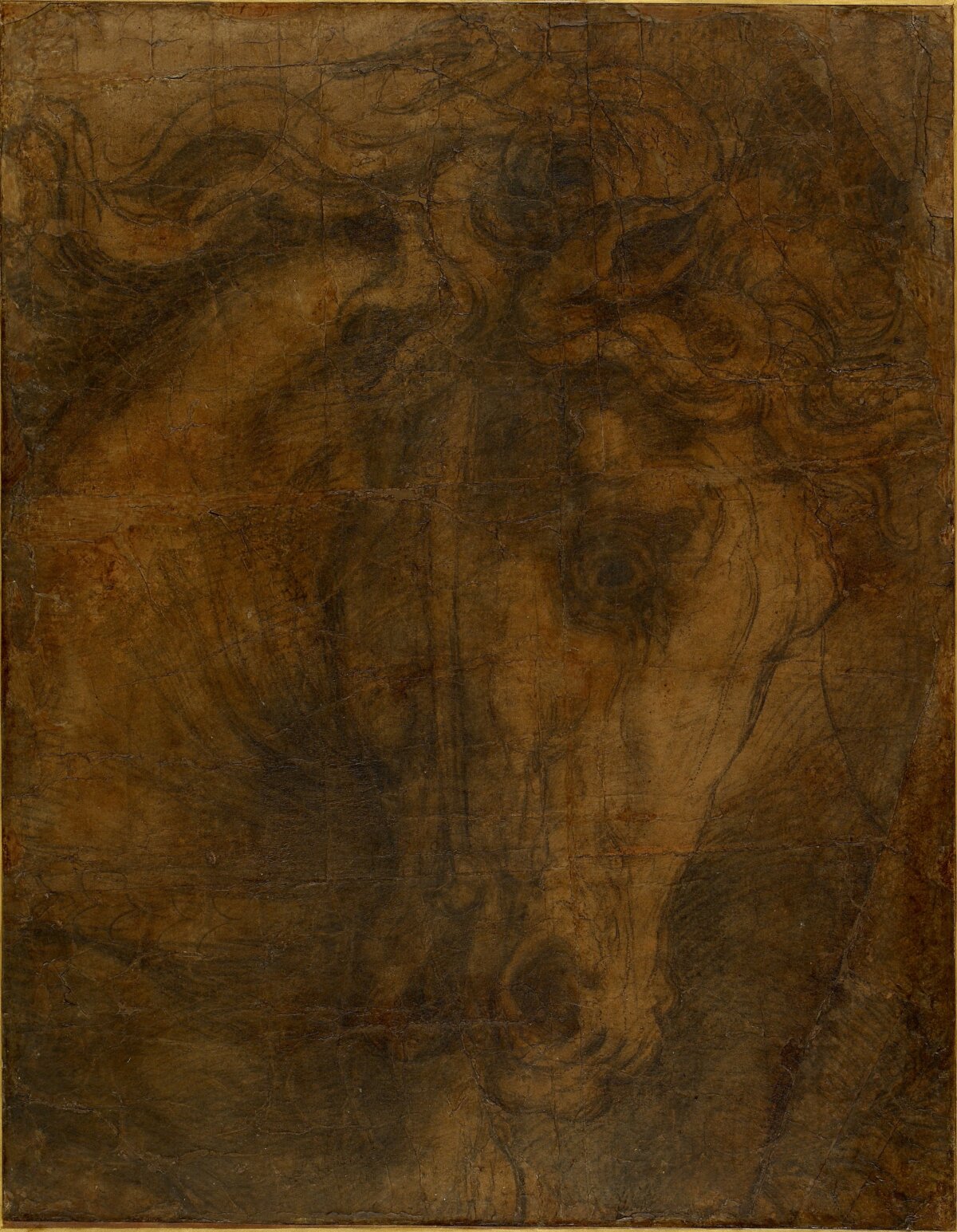
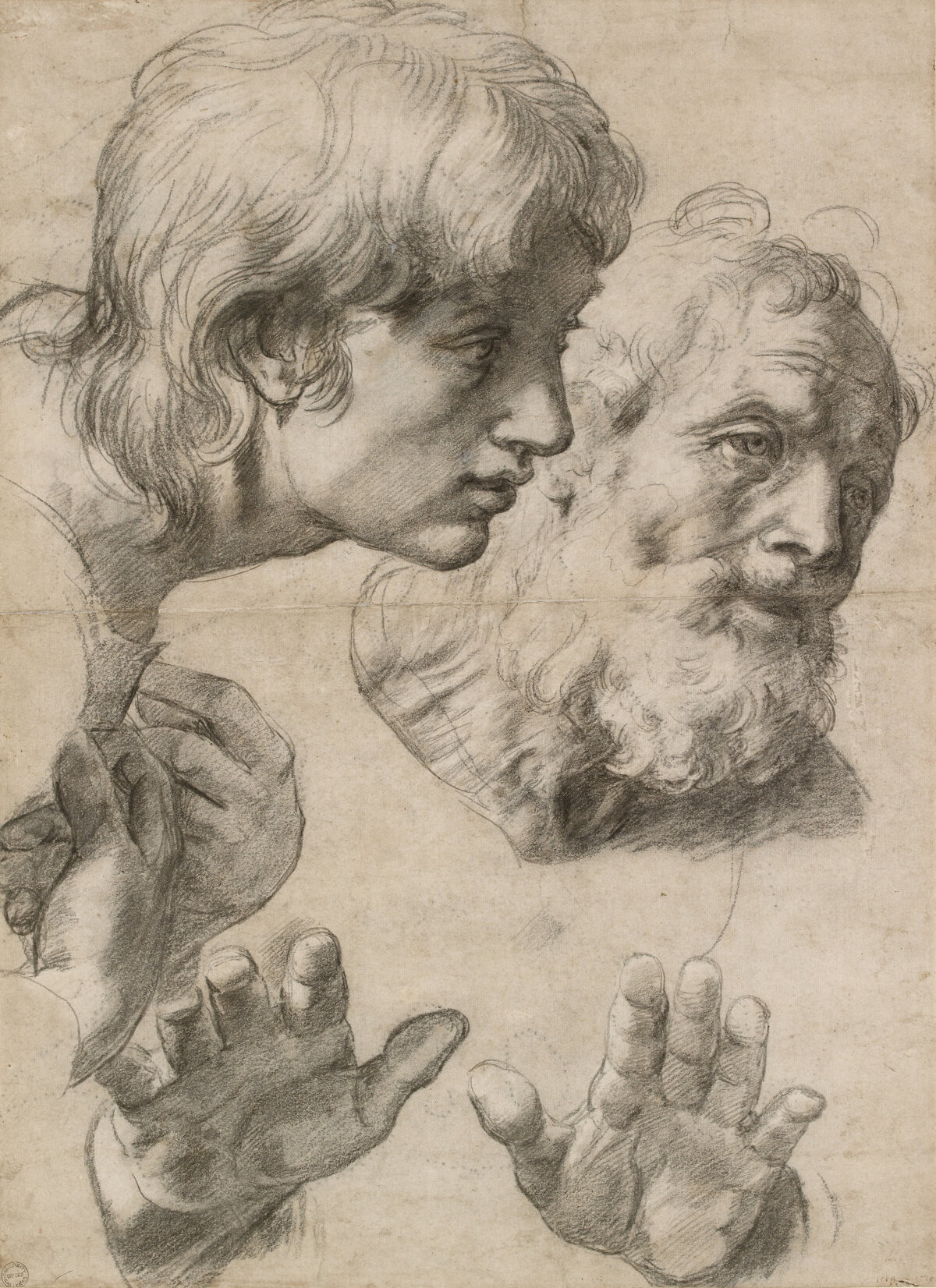
This ambitious, complex altarpiece remains in the Vatican City. However, breathtaking drawings that represent the zenith of Raphael’s draftsmanship convene from around the world to dazzle the viewer. One example is “The Head of an Apostle (‘Auxiliary Cartoon’ for the Transfiguration).” Lent from a private collection, it was auctioned in 2012 for a record-breaking $47.8 million.
Another wonder from circa 1519–1520 in black chalk has been sent by the Ashmolean Museum at the University of Oxford. It shows the differing reactions of Saints John and Peter to Christ’s revealed divinity. The museum in Oxford describes how “Raphael worked up the passages of flesh to a high polish but left the shoulders, torsos, and sleeves as nearly blank paper—and yet, those forms have a significant visual impact.”
In his lifetime, the professionally and financially successful Raphael was exalted as the “prince of painters.” One wonders how his art would have evolved had he lived longer, since the exhibition connects his dramatic late works to the subsequent style known as Mannerism. The wide dissemination of his art via engravings was integral to Raphael’s seismic influence for generations. “Raphael: Sublime Poetry” allows viewers to evaluate his genius by viewing his original masterpieces themselves.
“Raphael: Sublime Poetry” exhibition at The Metropolitan Museum of Art in New York City is on view through June 28, 2026. To learn more, visit metmuseum.org.
What arts and culture topics would you like us to cover? Please email ideas or feedback to features@epochtimes.nyc