
If I played the first movement of Ludwig van Beethoven’s Piano Sonata No. 14 in C-sharp minor, Opus 27, No. 2, subtitled “Quasi una fantasia,” you would immediately recognize it.
Title doesn’t ring a bell? Trust me. You’d recognize it.
The gently rocking triplets beneath a one-pitch dotted-rhythm (long-short/long) melody gives it away inside three seconds. You’d name it in an instant, even though you wouldn’t call out its proper name. Instead, you’d call out its most improper, yet irrevocably ingrained-in-the-consciousness name. You’d call out Moonlight Sonata.
The common moniker for this eerily beautiful piece of solo piano music from 1801 is in reality a nickname added decades after Beethoven composed it. The nickname has caught the fancy of millions since first gaining acceptance in the 1830s. When we hear the piece, whether moonlight is explicitly evoked or not, we are led to appreciate the score’s atmospheric qualities.
Beethoven was 30 in 1801 (born Dec. 16, 1770), a watershed year that saw the first evidence of encroaching deafness, a calamity that would plague him the rest of his life. It was also the year in which Beethoven fell in love, not for the first time, with a noble woman far above him in societal station. Her name was Julie Guicciardi, a Polish-born Austrian countess with an Italian name. In 1800, her family moved from Trieste—an Austrian city at the time but with a largely Italian population and culture—to Vienna. As most young ladies of the era did, she sought piano lessons, and the best teacher in Vienna at the time was young Ludwig van Beethoven.
Beethoven later confessed to biographer Anton Schindler that he came under a romantic spell. In a letter to a friend dated Nov. 16, 1801, Beethoven wrote of an unnamed love interest that was likely her:
“My life is once more a little more pleasant. I’m out and about again, among people – you can hardly believe how desolate, how sad my life has been since these last two years; this change was caused by a sweet, enchanting girl, who loves me and whom I love.”
But it wasn’t to be, for as Beethoven concluded in his letter, “unfortunately she is not of my station.” Falling in love with women whose higher social rank made marriage impossible was a recurrent theme in the composer’s life. While the implications of that are best left to speculative psychology, artistically this provided a string of romantic inspirations for music.
The Moonlight Sonata was composed at the time of his infatuation with the countess. He dedicated the published score to “Giulietta Guicciardi,” employing the more accepted Italian form of her first name. Might she, and the love he felt for her, have been the real inspiration behind the music, or at least the slow opening movement?
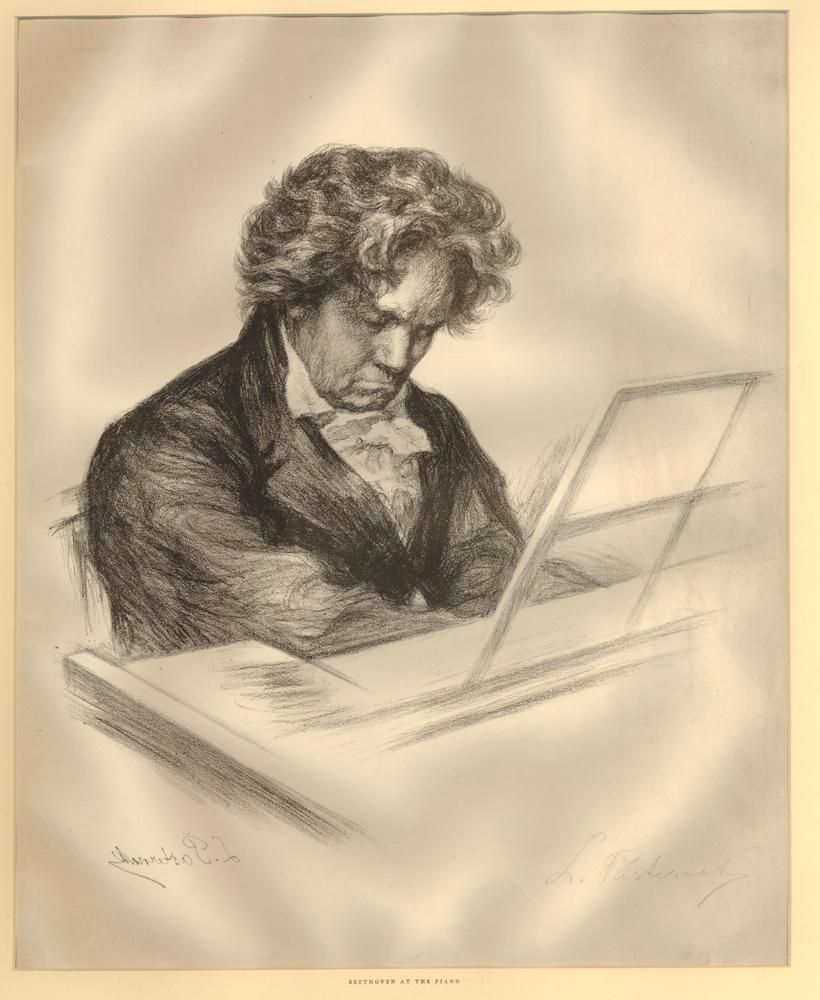 Portrait of Beethoven, 1920, by Leonid Pasternac. British Museum, London. (PD-Art)
Swirling Emotions
Without the baggage of the “Moonlight” label and it’s possible to hear the sonata’s first movement as a plaintive love song, full of yearning and weighted with the knowledge that the lovers’ feelings could not last.
Listen to a performance by Daniel Barenboim in the Palais Kinsky in Vienna.
Only the first movement conjures moonlight; the second is sprightly and the third is a volcano. How did “Moonlight” come to rest on the 69 measures of quietreflective piano music in C-sharp minor, marked “Adagio sostenuto,” or “slow and sustained” that opens Beethoven’s three-movement score?
In 1824, poet and critic Ludwig Rellstab published the following comments regarding the Adagio sostenuto: “The lake reposes in twilit moon-shimmer, muffled waves strike the dark shore; gloomy wooded mountains rise and close off the holy place from the world.”
From this, publishers derived the sobriquet “Moonlight.” By the late 1830s, the name was commonplace.
The strictly musical aspects of the piece are revolutionary. In 1801, sonatas always began with a fast movement that was followed by a slow movement, then ended with another fast movement. In the “Moonlight,” Beethoven opted to begin with a slow movement, progress to a moderately fast tempo, and end with a movement played at breakneck speed. This moved the weight of the sonata to the last movement, a fact underlined by the sheer size of the finale, which is roughly the length of the first two movements combined.
The “Moonlight” sonata marked the end of Beethoven’s early period. The stage was now set for the exploration of musical form in sonatas, string quartets, symphonies and concertos that would continue the great tradition of Western art music, moving it to a new and higher plateau of expressive content.
What arts and culture topics would you like us to cover? Please email ideas or feedback to features@epochtimes.nyc