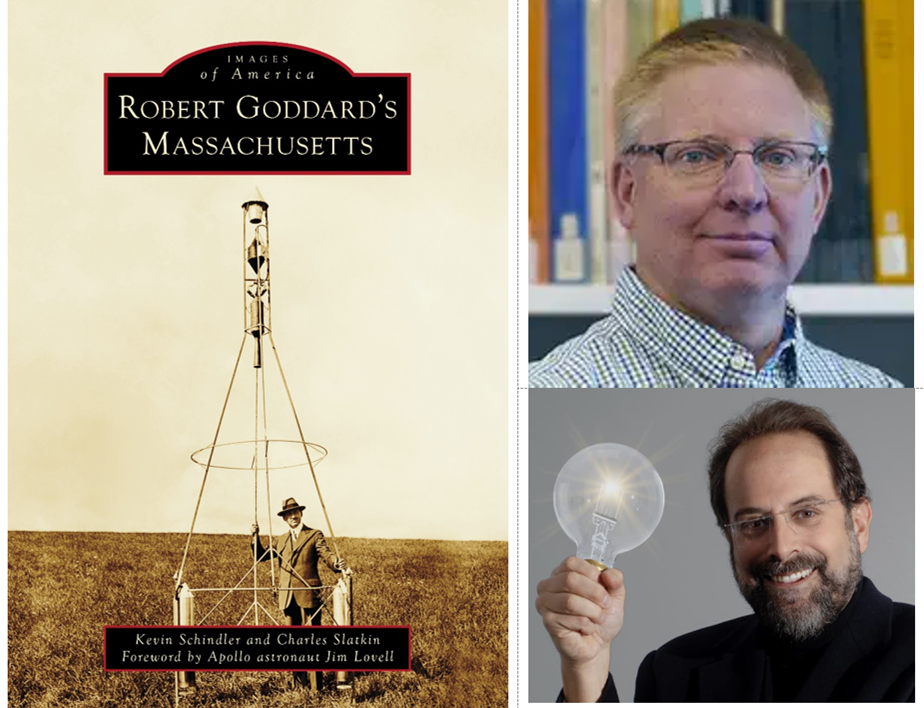
On March 16, 1926, the physicist Robert Goddard successfully launched the world’s first liquid-fueled rocket. This historic event occurred at a somewhat unlikely location: his aunt’s farm in rural Auburn, Massachusetts.
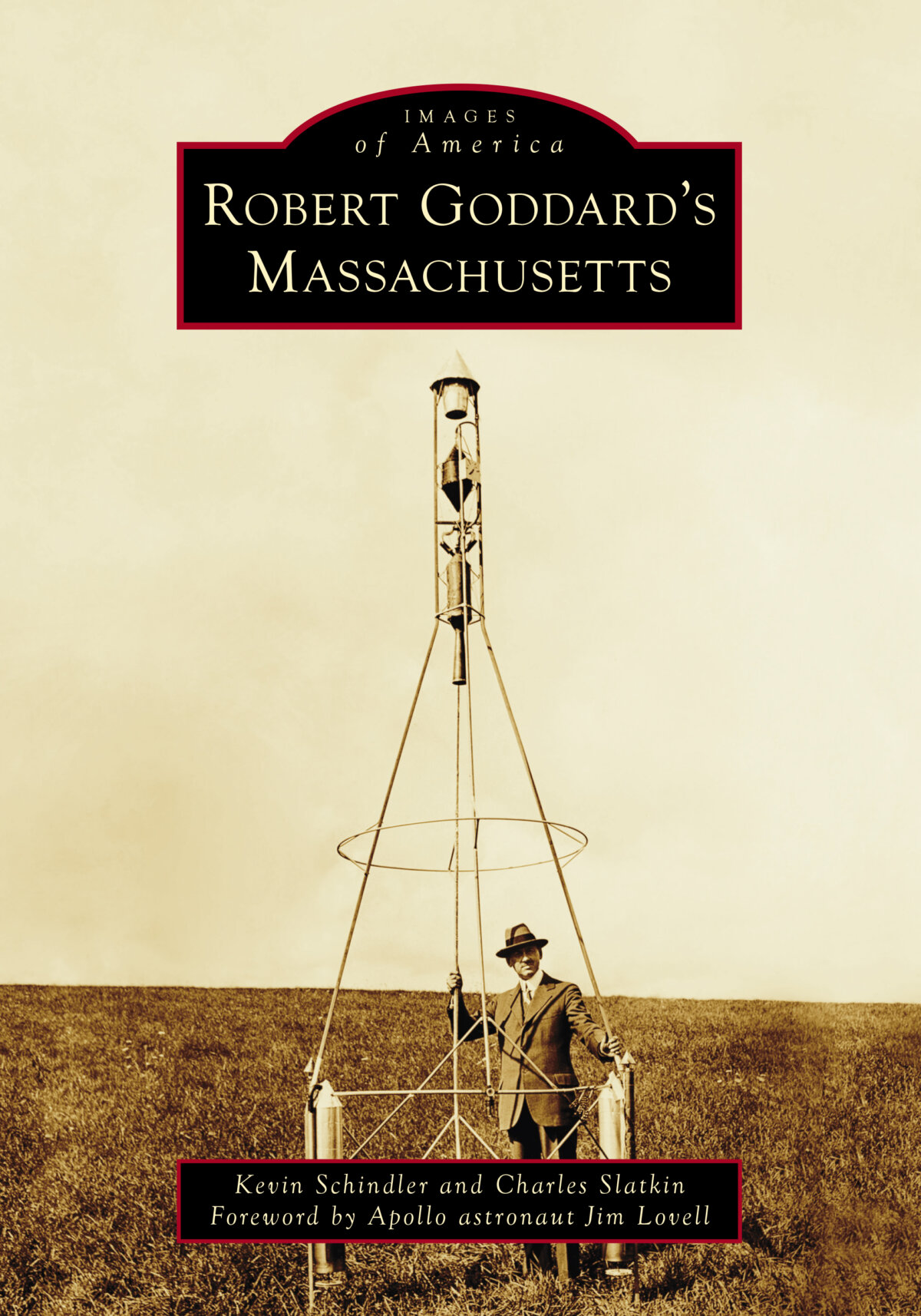
Kevin Schindler and Charles Slatkin’s new book, “Robert Goddard’s Massachusetts,” highlights how Massachusetts shaped Goddard’s life experiences. Released as part of Arcadia Publishing’s “Images of America” series, this book taps into an extraordinary quantity of rarely seen photographs that document Goddard’s life from childhood to international scientific fame.
Considering that a new chapter in moon exploration is now underway, this book celebrating the scientist credited as “the father of the space age” is being released at a most serendipitous time.
Goddard’s Formative Years
Goddard was born in Worcester on Oct. 5, 1882. His paternal ancestors could trace their Massachusetts roots back to English immigrants arriving in 1666. His maternal family came across the Atlantic in 1683, and their lineage included Levi Pease (1739–1824), who operated the first American stagecoach lines.
Goddard’s parents moved across the state to Roxbury less than a year after his birth. In his childhood years, the precocious Goddard made extensive use of the Roxbury Public Library. The authors credit his family’s outings to nearby harbors for ship viewing as “stirring Robert’s fascination with engineering and motion.”
After his mother contracted tuberculosis in 1898, the family moved back to Worcester. As a teenager, Goddard was invigorated by H.G. Wells’s interplanetary invasion epic “War of the Worlds.” The Boston Post serialized the work, which was later published in book form.
Goddard would claim that his life changed forever on Oct. 19, 1899, when he climbed a cherry tree behind his family’s barn to trim the branches. According to the authors, he experienced “a dreamlike vision of devising a method of travelling to space, specifically to Mars.”
The beauty of this book is that readers can scan through multiple photographs of Goddard during this formative period. It includes photos of the inspirational cherry tree, which was destroyed during the Great New England Hurricane of 1938. Its loss devastated Goddard, who later wrote in his diary, “Must go on alone.”
An Academic Focus
Poor health plagued the young Goddard, causing his education to be delayed to the point that he graduated from high school at the age of 21. In 1904, he enrolled at Worcester Polytechnic Institute and studied physics and chemistry. He later completed his graduate and doctorate studies in physics at Clark University in Worcester.
Goddard remained at Clark as an honorary fellow in physics before leaving for New Jersey in 1912 to accept a position at Princeton University. However, he contracted tuberculosis while at Princeton and returned to Worcester the following year. Upon his recovery, he decided to stay in Massachusetts and teach at Clark.
Remaining at Clark instead of pursuing a Princeton career may have been a blessing in disguise. Clark gave him the freedom to conduct propulsion experiments in the school’s physics lab, and he used the school’s facilities to test prototypes of flight instruments and pursue various aspects of rocketry.
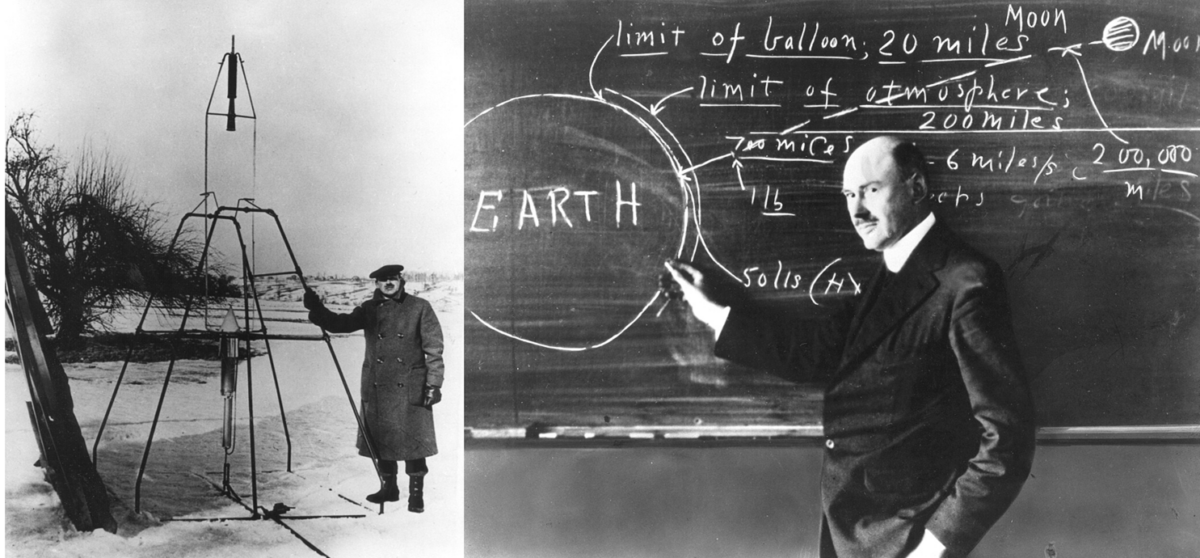
The photographs of Goddard during these years show the extraordinary level of trial and error in his tests, with error mostly reigning until the fateful 1926 rocket test. These pictures present a confident Goddard posing next to his inventions, and some of those contraptions look like the absurdly convoluted inventions popularized in Rube Goldberg’s comic strips. There are also photographs of the distinguished Clark faculty who encouraged his endeavors.
Gaining Wider Respect
However, working in Worcester made Goddard something of an outsider to the academic and media power circles of the day. As a result, many important people looked down on his efforts. Most notably, a 1920 editorial in The New York Times scoffed at his talk of reaching the moon by rocket, disparaging his theories with crass insults about his intellect.
But Goddard was media-savvy before that term was invented. To create a record of the 1926 launch of his rocket, he tasked his wife, Esther, to film the event using a 35mm motion picture camera. He also coordinated newspaper coverage of his successful tests, which furthered his reputation.
Goddard’s Massachusetts-based work attracted the attention of aviator Charles Lindbergh in 1929. Through Lindbergh’s connections, financier Daniel Guggenheim gave Goddard the funds to pursue research independent of his teaching job. The scientist left Massachusetts for New Mexico, where the expansive desert surroundings were more conducive to rocketry testing than densely wooded Massachusetts.
During World War II, Goddard relocated to Maryland to work with the U.S. Navy. But his already fragile health frayed during this period. He died in Baltimore on Aug. 10, 1945, and his body was returned to Worcester for burial.
This book extensively documents the many tributes and memorials that Goddard’s legacy generated, and perhaps the most amazing is a photo of Goddard’s autobiography that astronaut Buzz Aldrin carried to the moon aboard Apollo 11 in 1969.
At a slender 128 pages, this marvelous book is ideal for young adults eager to gain an introductory knowledge regarding Goddard’s genius and for older readers looking for an inspiring biography that can be enjoyed in a leisurely single sitting.
‘Robert Goddard’s Massachusetts’
By Kevin Schindler and Charles Slatkin
Arcadia Publishing: March 3, 2026
Paperback, 128 pages
What arts and culture topics would you like us to cover? Please email ideas or feedback to features@epochtimes.nyc