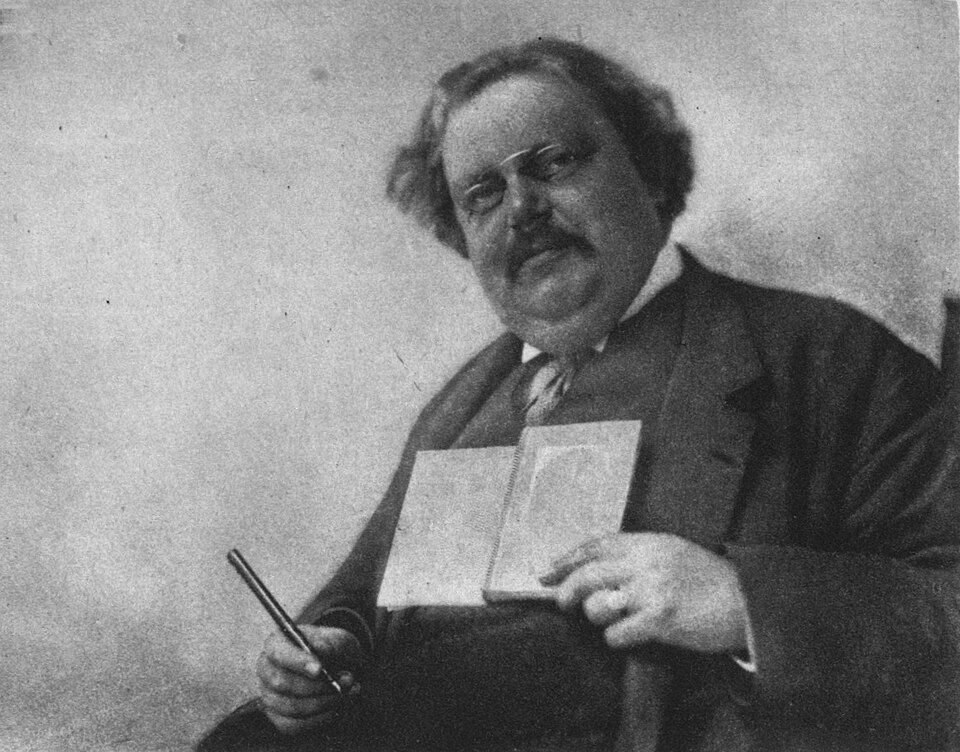
“A paradox might wake men up to a neglected truth,” says the poet and policeman Gabriel Syme in G.K. Chesterton’s 1908 novel “The Man Who Was Thursday.” As it turns out, that’s a pretty good description of what Chesterton himself was up to when he wrote the book. Chesterton has been rightly called the “prince of paradox,” and indeed, paradoxes that point to forgotten truths run through much of his work.
The surrealist novel “The Man Who Was Thursday” is no exception. It’s a rollicking adventure in which appearances constantly deceive and the ground is always shifting beneath the characters’ (and reader’s) feet. Writing for “TIME Magazine’s Summer Reading List,” Kate Christensen described the novel as “a whacky, nightmarish, deliriously well-written adventure story for grownups in which nothing is what it seems and everyone wears a mask, whether figurative or literal.”
Yet under the shifting, bewildering, coruscating surface of the novel, Chesterton deals with serious philosophical issues, particularly the paradox of order and chaos in the world, and whether this strange dream we call life really has any meaning.
The novel’s setup is relatively simple: Gabriel Syme is recruited by a special police force to help defeat an anarchist and nihilist plot to take over the world. Syme manages to infiltrate the anarchists’ Supreme Council, where each member is named for a day of the week, and there he encounters the enigmatic, larger-than-life figure of the anarchist leader known as Sunday. He seems to be all-knowing and undefeatable.
Syme also learns of a plot to assassinate important world leaders and embarks on a quest to foil it. One by one, the other members of the Supreme Council turn out to be undercover policemen like Syme and join him in his quest to foil the plot against the world. This ultimately leads to a feverish and frenetic scramble after the only “anarchist” remaining: Sunday himself.

Like much of Chesterton’s fiction, this story has embedded within it a philosophical debate. In this case, it’s the debate between order and chaos. The debate is laid out clearly in the opening chapter in a conversation between Syme (the poet of law) and an anarchist named Lucian Gregory (the poet of chaos).
“You say you are a poet of law; I say you are a contradiction in terms,” Gregory tells Syme. “An artist is identical with an anarchist. … You might transpose the words anywhere. … The man who throws a bomb is an artist, because he prefers a great moment to everything. … An artist disregards all governments, abolishes all conventions. The poet delights in disorder.”
Syme replies to Gregory’s manifesto in favor of chaos with an ode to the magic and beauty of order: “Chaos is dull; because in chaos the train might indeed go anywhere, to Baker Street or to Bagdad. But man is a magician, and his whole magic is in this, that he does say Victoria [Station], and lo! It is Victoria.”
Chesterton encapsulates these conflicting worldviews through a comparison between a lamppost and a tree. The anarchic poet Gregory points to a lamppost and then a tree and says, “There is your precious order, that lean, iron lamp, ugly and barren; and there is anarchy, rich, living, reproducing itself—there is anarchy, splendid in green and gold.” And Syme replies, “All the same … just at present you only see the tree by the light of the lamp.”
The image is important for two reasons: first, because it highlights the limitations of both of the men’s perspectives; second, because it returns at the end of the novel in a way that helps us to understand the harmony inherent in the seeming conflict between order and chaos.
First, what does the lamppost-tree comparison tell us about these men’s perspectives? Through it, we see that Syme’s worldview, for all its noble qualities, is a little lifeless, a little mechanical, like the lamppost. Someone so obsessed with order that he fails to see the beautiful vitality of the tree, with its inexact and organic development, has too narrow a view of the world.
Yet, at the same time, Syme rightly points out that Gregory can “only see the tree by the light of the lamp”; in other words, even anarchy only makes sense in light of order. Pure anarchy would be pure meaninglessness. Even a wild thing like a tree can only exist because of the ordered interaction of its parts (roots, bark, branches, leaves, cells, the process of photosynthesis, etc.).
This point is driven home even further when we learn that the underground anarchist group Gregory is a part of has all sorts of elaborate rules and a kind of sense of honor. It’s funny and ironic, but it points to a real truth: even an anarchist or nihilist cannot be completely anarchic or nihilistic because he wouldn’t even be able to live. The anarchists are too good and too human to be completely faithful to their principles. The anarchist group cannot function without some order and hierarchy. This is a law of nature.

Having sketched out this philosophical framework, Chesterton then sends his hero, Syme, on a bizarre and dizzying adventure with many unexpected turns. The overall impression, in fact, is one of chaos and absurdity. Syme’s sense of the orderliness of reality is profoundly challenged and stretched. Yet it is not completely broken, because in the final scenes, when the bewildered policemen confront Sunday and ask him why he has led them on such a wild goose chase, there’s a sense that it wasn’t for no reason after all. There’s a sense that the events of the plot appear chaotic only because they contain a logic too transcendent for the characters to understand. The policemen end up feeling that Sunday has played some kind of colossal joke on them; yet, at the same time, it appears to be a good joke, a happy deception that conceals a glorious truth.
The larger point Chesterton is making here is not just about Syme’s adventure but about the nature of reality and the world itself. As Syme puts it,
“I think of Sunday as I think of the whole world. … When I see the horrible back, I am sure the noble face is but a mask. When I see the face but for an instant, I know the back is only a jest. Bad is so bad, that we cannot but think good an accident, good is so good, that we feel certain that evil could be explained. … Shall I tell you the secret of the whole world? It is that we have only known the back of the world. We see everything from behind, and it looks brutal. … If we could only get round in front—”
Syme essentially realizes that the seeming evil and chaos in his journey—and in the world—only disguise some greater order and meaning; or, to put it another way, that the chaos is itself part of a larger law.
Why is it important that some larger law exists? Because if the world is ultimately anarchy, then it has no meaning, which would confirm the suspicions of the deepest skepticism, “which can find no floor to the universe,” as Chesterton puts it. At bottom, the world would have no bottom—nothing to stand on, no grounding, merely a swirling void of meaninglessness and despair.
At the same time, if the world had no chaotic (or seemingly chaotic) elements, then it would be completely knowable, completely quantifiable, like a huge machine. Yet Chesterton is too wise a writer to affirm this position either. He knows that there’s a wild mystery at the heart of things, something that will always be inscrutable and unexplainable about the world. The very order of the universe has something strange and unpredictable about it—something chaotic.
As Sunday says to his pursuers toward the end of the novel—speaking as the voice of the world, or perhaps as God Himself, “I tell you this, that you will have found out the truth of the last tree and the topmost cloud before the truth about me. You will understand the sea, and I shall be still a riddle; you shall know what the stars are, and not know what I am.” And indeed, he goes on to do unexpected and unaccountable things, just as the world contains unexpected and unaccountable things.
This brings us back to the tree and the lamppost. In one of the protagonists’ attempts to escape what he thinks are malevolent pursuers, he drives a car into a lamppost. Chesterton describes it this way: “A tall lean lamp-post that had stood up straight on the edge of the marine parade stood out, bent and twisted, like the branch of a broken tree.” It’s a brilliant use of a recurring symbol. The lamppost and tree, representing order and anarchy at the beginning of the novel, have now been blended. The symbol has been altered to reflect what the novel has revealed: that order and chaos are not so neatly divisible as we might think, that both express something true and necessary about the world. It is paradoxically both orderly and meaningful, and at the same time, wildly surprising and almost absurd, like a divine joke.
This sense of a heavenly humor, higher than laughter, perhaps best embodies the spirit of the book as well as Chesterton’s understanding of God. It can be summed up in the words of one of Syme’s companions, Dr. Bull: “Moderate strength is shown in violence, supreme strength is shown in levity.”
What arts and culture topics would you like us to cover? Please email ideas or feedback to features@epochtimes.nyc