



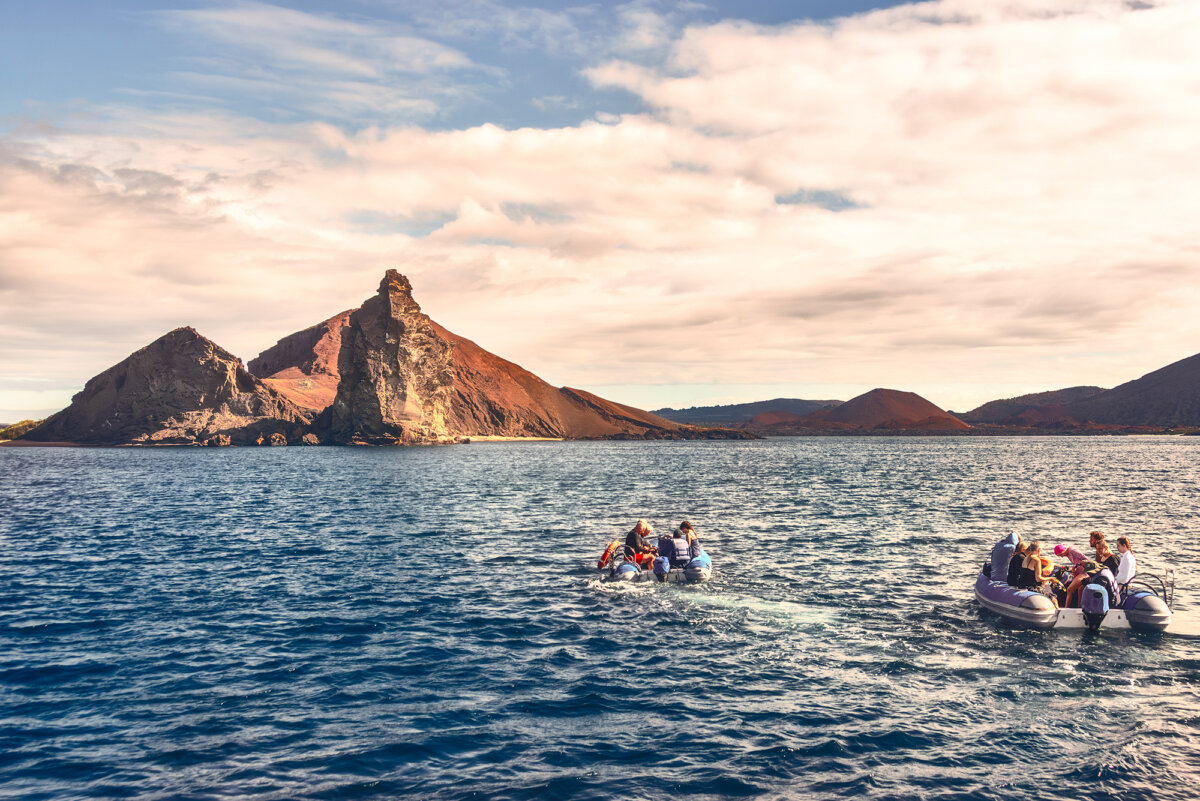
Our first glimpse of the Galápagos Islands from the plane window showed small smudges on the horizon prickling the calm of the Pacific, barely discernible from the bleary merging of sea and sky.
On arrival, the initial impression was bleak. The barren landscape and scrubby vegetation gave little inkling of abundant life. It evolved in quiet isolation, spawning fascinating creatures such as swimming iguanas, equatorial penguins, and centenarian tortoises found nowhere else on Earth.
The islands are largely safeguarded by the Galápagos National Park, so tourism is balanced with preservation. The ecosystems have remained remarkably unchanged; 95 percent of the pre-human biodiversity is intact, nurturing wildlife endemic to specific islands.
Colonial Charm and Seamless Sail
Before embarking on our Galápagos Islands adventure from Ecuador’s capital, my wife, Maria, and I embraced Quito’s colonial charm, staying two nights in a beautifully renovated 17th-century manor. The Illa Experience Hotel is internationally recognized for its commitment to immersive guest experiences that celebrate Ecuadorian heritage. The tour operator Latin Trails (https://www.latintrails.com), a sister company of the boutique hotel, arranged our accommodations and Galápagos cruise on an affiliated luxury yacht.
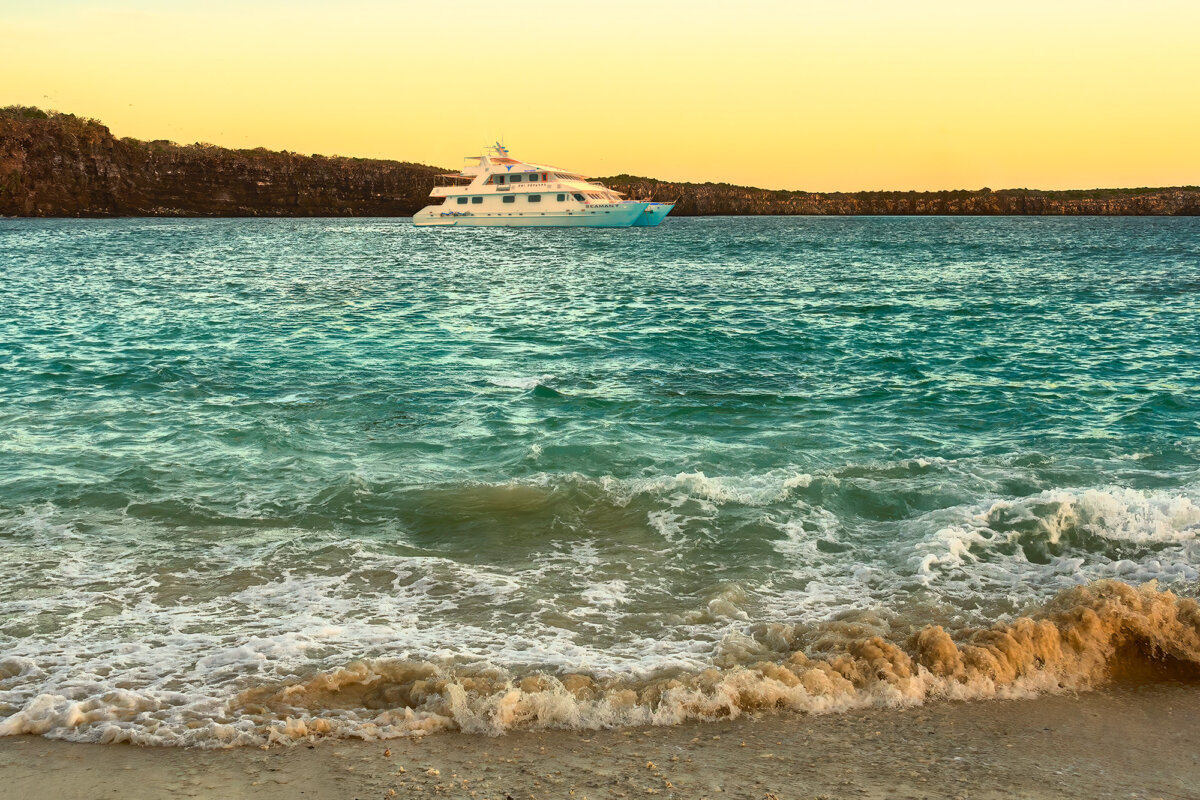
The family-owned business saw us personally escorted to the airport for a domestic flight to the volcanic archipelago that straddles the equator 600 miles from the coast of Ecuador. Four of the 18 main islands are inhabited by about 33,000 people, most of whom are on Santa Cruz and San Cristóbal. The equatorial climate is tempered by ocean breezes. To avoid the high seasons, visit from late April to early June and from September to November.
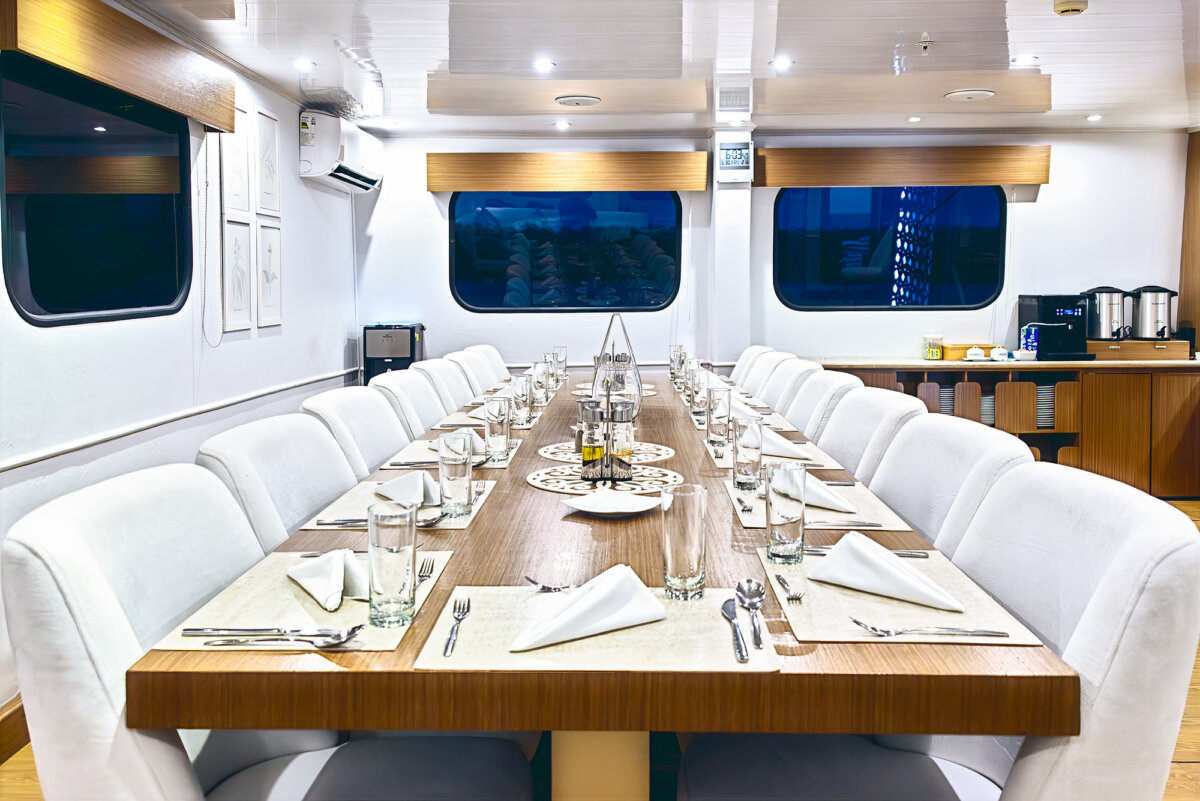
We flew 3.5 hours with a stopover in Guayaquil to tiny Baltra Island and boarded the Seaman Journey for a five-day cruise to eight islands. The eight-cabin catamaran accommodates up to 16 guests in an intimate atmosphere with an attentive crew. Ninety feet in length, the deluxe yacht features spacious staterooms, a comfortable dining room and lounge, indoor and outdoor bars, a sundeck, and an observation deck, where at times it seemed we were the only ones onboard.
One of the primary advantages of an expedition yacht is access to the more remote islands out of reach of day trips. The ultra-stable, twin-hulled Seaman Journey moved seamlessly among the islands, sparing hours of sometimes bumpy speedboat rides of land-based tours. Eco-tourism need not involve rushing or roughing it.
Chivalrous Captain and Creative Cuisine
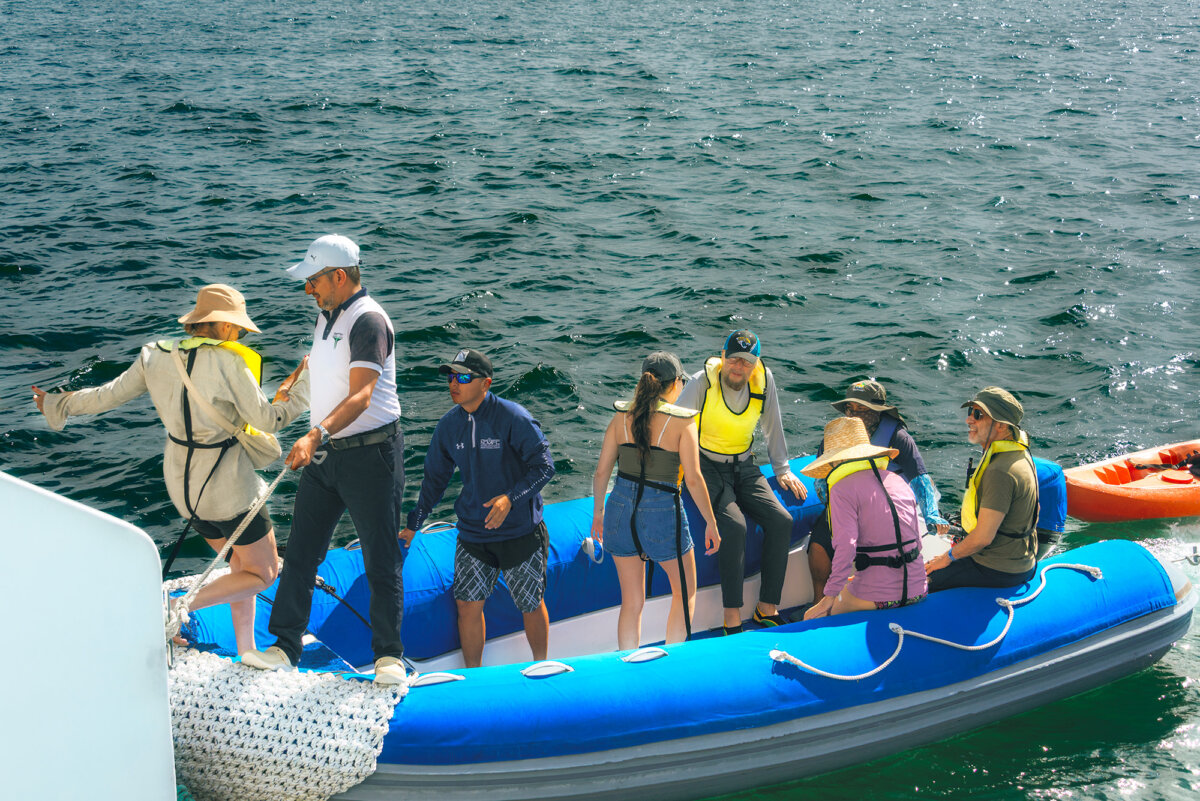
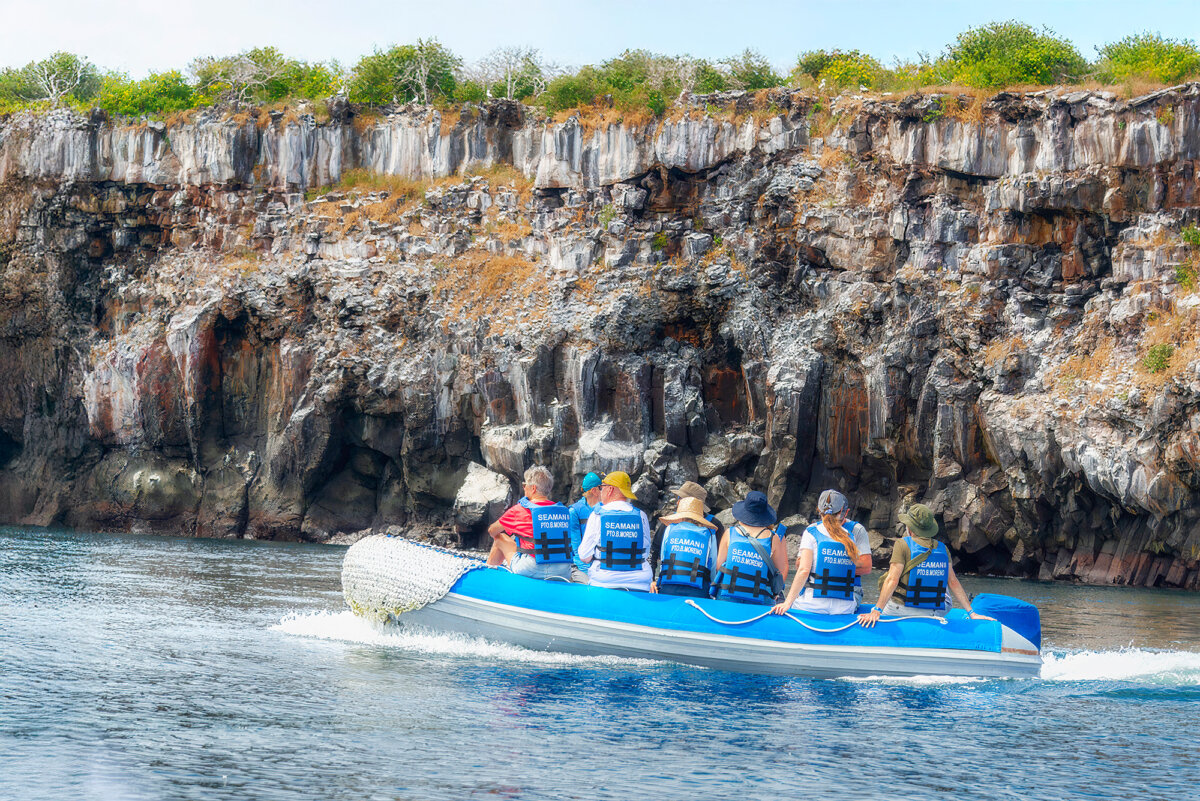
We would sail overnight and awake at daylight to a new island landscape and wildlife. Most days, we set foot on two islands and were often able to snorkel or kayak. For both land and water excursions, our naturalist guide was joined by at least one other trained crew member. Capt. Carlos Beliz and company stood at the stern smiling and ready to help us back aboard, where we were welcomed with hors d’oeuvres and a specialty beverage.
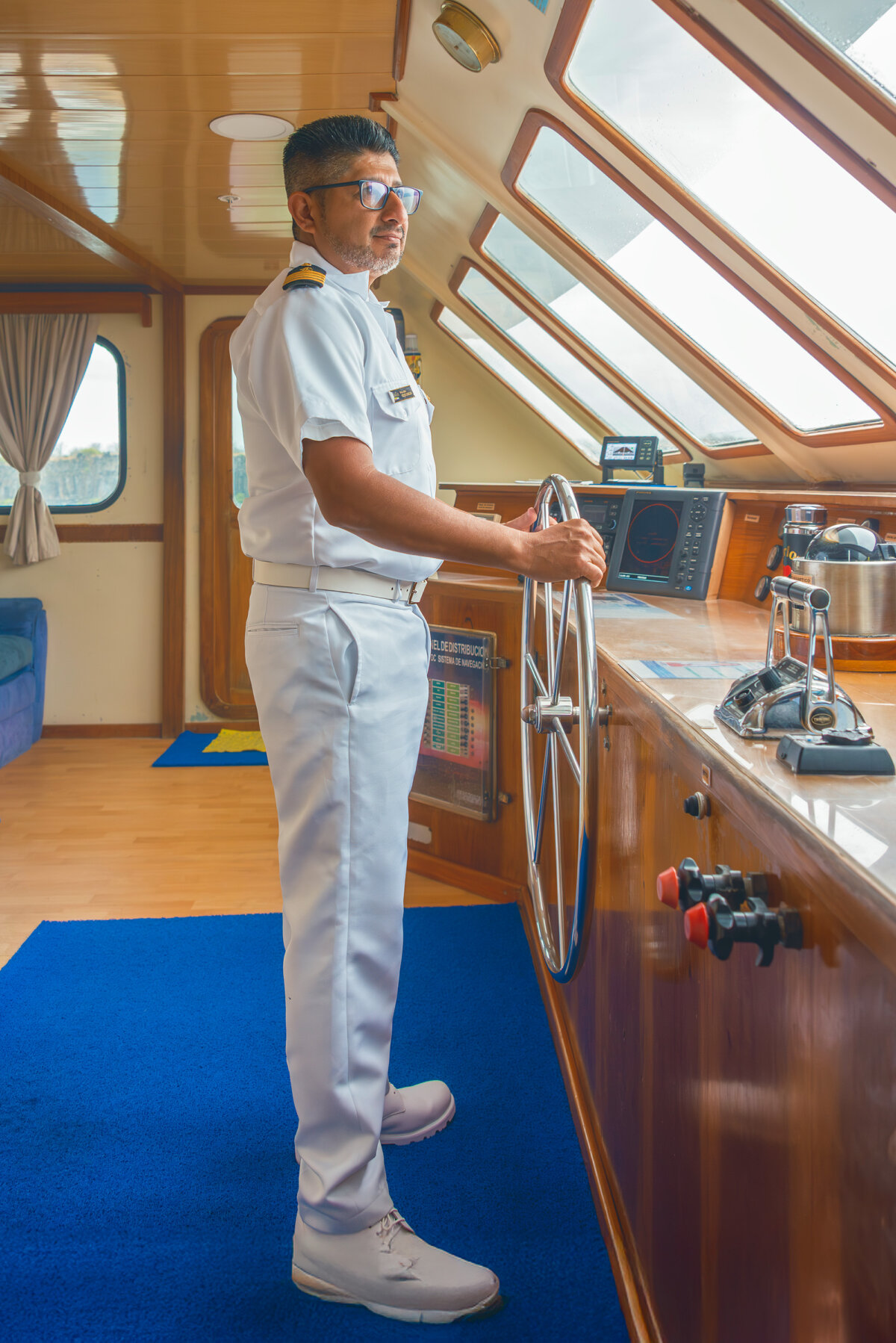
Maria and I spoke on the bridge with the 46-year-old Seaman Journey captain, who is a former Ecuadorian marine and veteran navigator of the archipelago.
“I started preparing for the job of captain at age 4,” Beliz confided, smiling.
The buffet-style cuisine was fresh and flavorful with a nod to Ecuadorian culinary tradition. The chef created delectable specialties such as coconut fish with rice, boneless chicken with oregano, and tequila-marinated prawns. The organic fruits and vegetables came from an exclusive hydroponic nursery on San Cristóbal Island.
The long, communal dining table was conducive to getting to know our 12 shipmates from Australia, Europe, Israel, and the United States. As we lingered in the lounge after dinner, our certified national park guide Marco Vizcaíno, 38, recapped the day and prepped us for the next adventures.
Dynamic Testament and Extraordinary Scenarios
The Galápagos Islands were spat from the Pacific in fiery chunks several million years ago. The continuous seismic and volcanic activity serve as a dynamic testament to the geological forces that shaped them. The rugged terrain dominated by petrified lava, craggy cliffs, and haggard scrub is hauntingly beautiful.
The island species arrived from South America through extraordinary good fortune. Seeds were blown by the wind or carried in the stomachs of birds, while small tortoises drifted for months on ocean currents or on rafts of kelp before blindly bumping up against the new land. Because there were no predators to fear, the wildlife is not only remarkably unperturbed by people’s presence but also decidedly inquisitive about us.
Curious Creatures and Bizarre Behavior
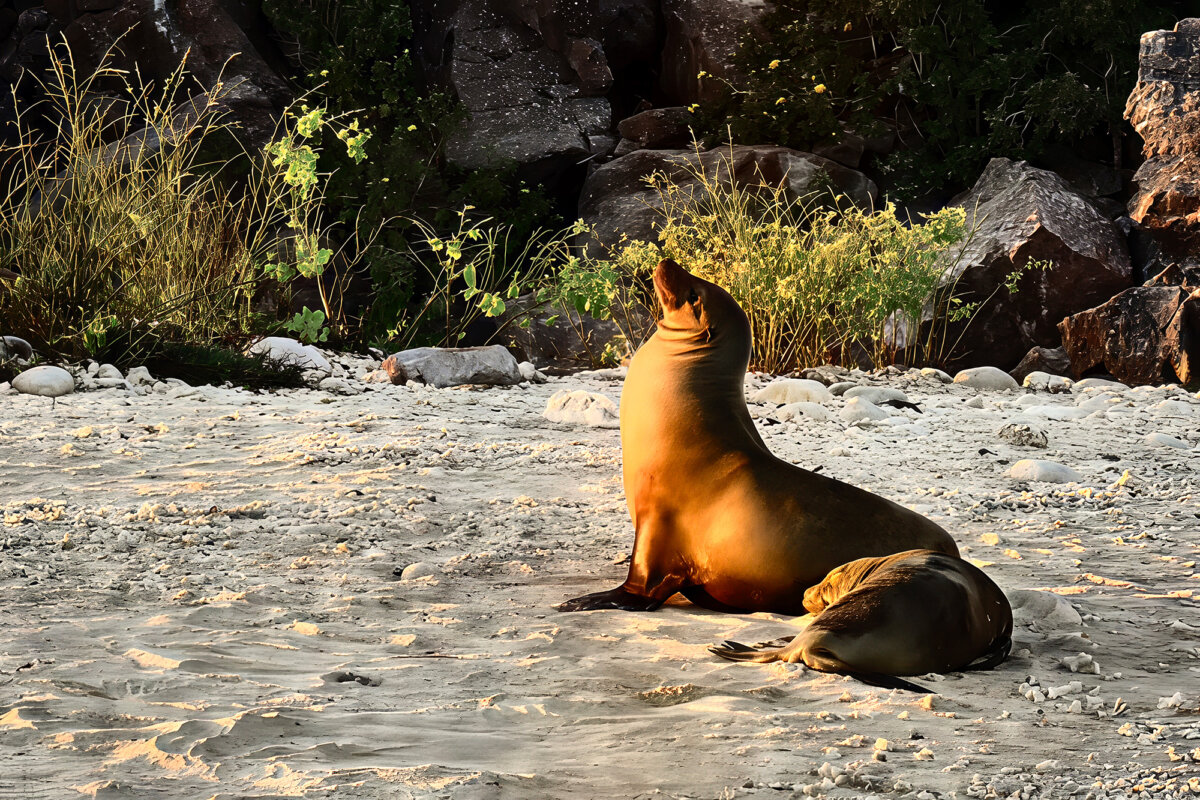
A slew of sea lion pups on a Mosquera Islet beach scooted to and fro before snuggling up to their nursing mothers. Adults weighing more than 500 pounds basked in the sun, barely moving a muscle. But once in the water, they appeared akin to affectionate, frolicking puppies. While snorkeling, I came face-to-face with a frisky, whiskery bull. He stared at me with big, liquid brown eyes under long lashes for several moments before barrel-rolling and somersaulting away.
Snorkeling off Genovesa Island, a clutch of us encountered a shiver of white-tipped sharks resembling silver-gray torpedoes. Generally considered harmless, they are still unnerving. Jaws slack in a thin crack of a smile, they had black, fathomless eyes seemingly riveted on us. With steely skin smooth as vinyl and a sweeping tail, the spectral predators swam silent as shadows and stealthily slipped away.
Something streaked by me, leaving a sparkling stream of bubbles. “What was that?” my mind screamed. As I flipped around, the flash of motion sped from the opposite direction. After another pass, it zigzagged to the sandy sea floor, then beelined back to the surface and bobbed around me. Anxiously tearing off my mask, I beheld an ostensibly befuddled seabird, displaying distinctive black and white plumage in the fashion of formal evening wear.
Such a happenstance scores high on the improbability scale—a bird swimming underwater, much less a penguin close to the equator. The Galápagos penguin is the second smallest of the species, standing about 20 inches tall, and the only one that lives in a tropical latitude, made possible by the cool currents around the islands.
On the shore of North Seymour Island, Maria pointed out to me statue-still marine iguanas sunbathing on porous rock as black as their bodies. The world’s only seagoing lizards can stay submerged for 15 to 30 minutes grazing on algae. Scaly and slithering with crusty white heads and a mane of horny spikes running down their neck and back, they clearly illustrate why naturalist Charles Darwin called them “imps of darkness.” Their scampering cousin, land iguanas—you could trip over them if not careful—are yellowish in color with sharp talons to tackle prickly pear cactus.
Baby Powder and Rock Star
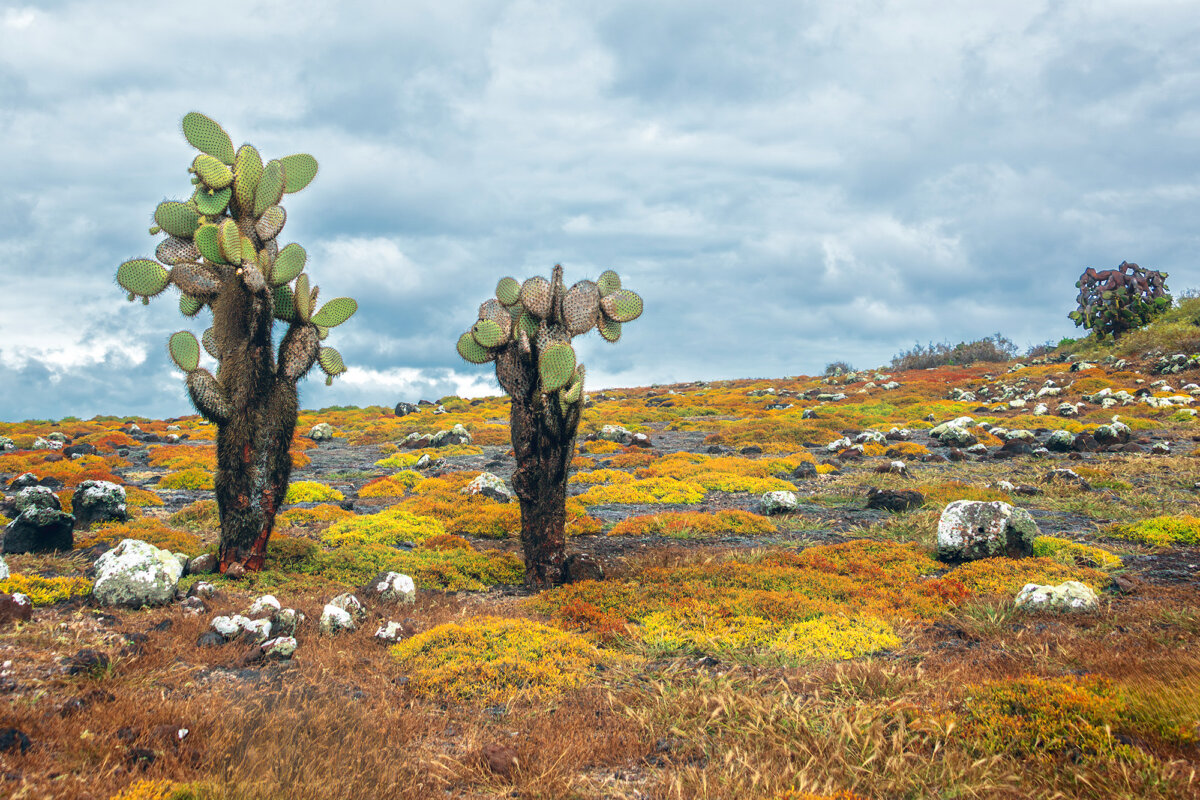
The lure of the Galápagos lies not only in the wildlife but also in the landscape. Volcanic formations rise dramatically from shimmering, turquoise sea lapping onto pristine, baby powder or cocoa-colored beaches silky soft underfoot. While some islands are stark deserts, others burst with color. Reddish-brown, igneous cliffs complement green cacti with creamy-white or pale-pink blooms and bright yellow and orange carpetweed beneath a cloud-flecked, blue sky.
The archipelago’s rock star is a 374-foot-high obelisk that sculpts the skyline and stands sentinel over Sullivan Bay, separating Bartolomé from the larger island of Santiago. Clinging to Pinnacle Rock at water’s edge were spidery, orange-and-blue Sally Lightfoot crabs supposedly named by a lovesick sailor for a sultry dance hall girl.
Beguiling Birds and Quirky Courtships
Among the most beguiling birds in the Galápagos are the boobies. Red-footed boobies, polymorphic in plumage, colonize the outer islands, particularly Genovesa, nicknamed “Bird Island.” We were amazed by the slim-winged seabird’s agility at harnessing the wind in flight and were amused by its awkward takeoffs and landings. Tucked into thick tree branches were tangles of the booby nests, each with a fluffy, white marshmallow of a chick watched over in turn by its parents.
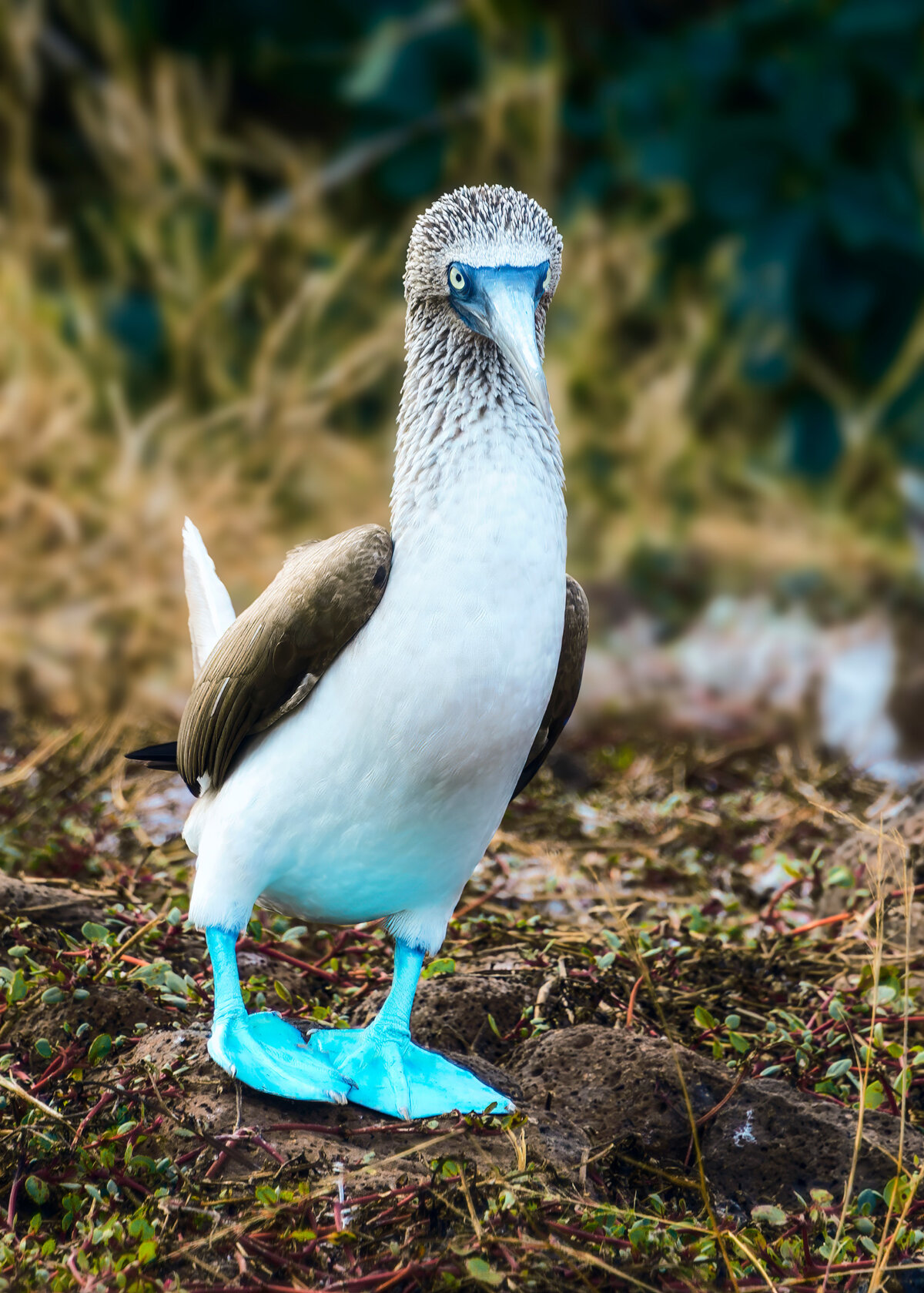
The unofficial mascot of the Galápagos Islands is the closer-at-hand blue-footed booby. Decked out in what resembles a brown bolero and white shirtfront, the boobies waddle on comically big, robin’s egg-blue webbed feet. They stared at us with close-set, lemon-yellow eyes that gave them the appearance of amiable but slightly demented professors.
In their whimsical courtship ritual, the male rocks back and forth, lifting one flapping foot after another. In turn, the show-off suitor then spreads its wings wide, points its beak at the sky, and whistles breathily, as if blowing on a toy flute. For the finale, the female grunts and totters up to the male, mimicking his movements; then they loudly clack bills, as if an act of applause.
Soaring effortlessly above South Plaza Island were black frigatebirds that eerily echo ancient pterodactyls with an up to eight-foot wingspan and demonic, deeply forked tail. These master aerialists are pirates of the sky, stealing food from other birds in midair. But we found the frigatebird’s bizarre mating behavior its most remarkable trait. The male puffs out its throat pouch that looks like a heart-shaped, red balloon and produces drumming sounds by clapping its bill against the pouch, further enhancing the courtship display.
Tortoise Tourists and Sunset Bravado
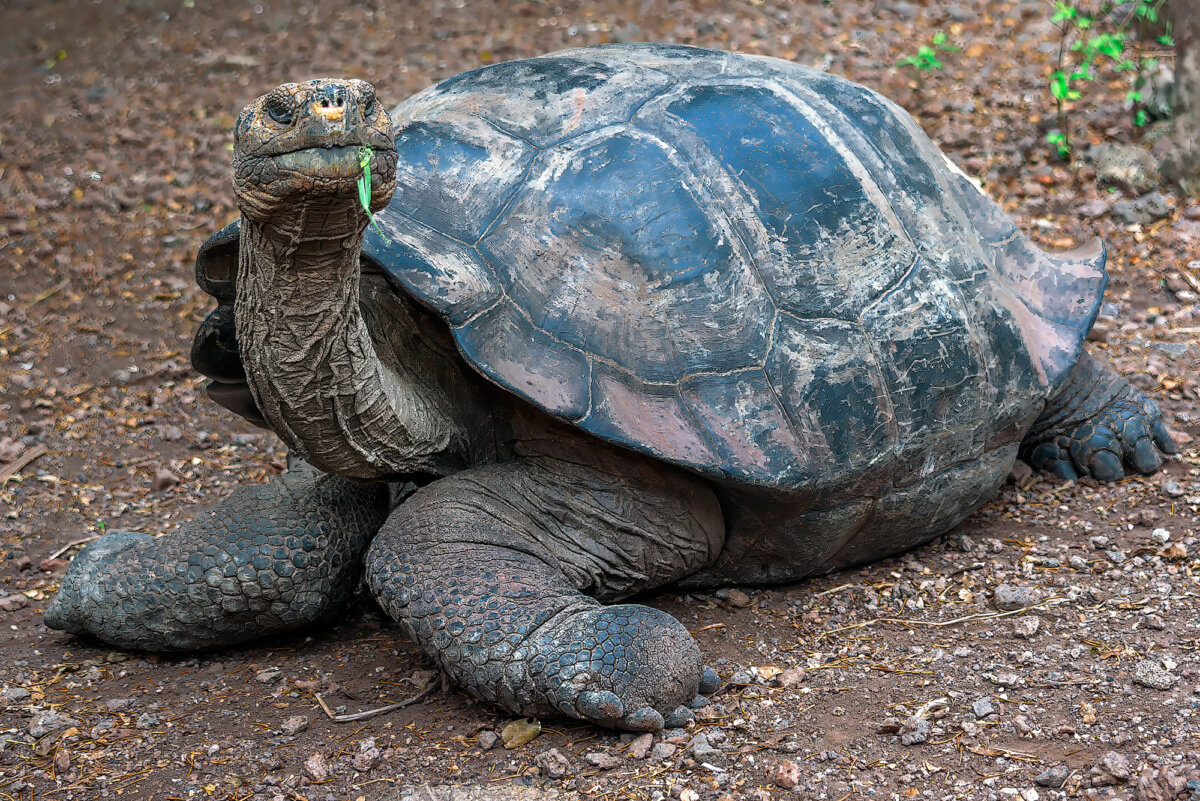
On our last outing, we visited a breeding center for the largest living tortoise species, secluded in the forested highlands of San Cristóbal Island. Touring the nursery, we saw their hatchlings the size of billiard balls that will spend five years in the national park reserve before being released into the wild.
As we were strolling among manzanillo trees on a path in the habitat, a venerable, giant tortoise galumphed toward us. We crouched and watched as it slowly extended a long, wrinkled neck, black eyes glimmering with awareness in the dun-colored, knuckle-like head. Nearby, a creep of tortoises munching on a prepared lunch of leaves bumped into one another, their shells sounding like coconuts knocked together.
The sun sets quickly near the equator; there is no lingering twilight. On our farewell evening in the islands, the sun painted the clouds carmine and tangerine in a final show of bravado before being swallowed by the horizon. The moon soon rose, casting a strange silver glow on the sea that shone like liquid metal and reflected on the Seaman Journey.
World Unto Itself
Unlike most wildlife destinations, where binoculars and patience are a prerequisite, the intimacy of the Galápagos captivates you long after returning home. It is not just the images captured in your photographs but also the enchantment of stepping into a realm of natural wonder. The privilege of witnessing creatures up close that exist nowhere else in a place like nowhere else—a world unto itself.
