Many classic tales have made a strong impression on society. How often do we see casual references to Leroux’s Phantom, Stevenson’s dual-natured Dr. Jekyll, or the original rags-to-riches heroine Cinderella? Meanwhile, some stories that aren’t instantly recognizable by title or tale have rich histories dating back hundreds of years and present timeless morals.
Such is the case with the medieval legend “Our Lady’s Juggler.” Anatole France popularized the tale in his 1890 short story “Le Jongleur de Notre-Dame.” The French title refers not to the famed Paris cathedral or the respected university but to a title for the Blessed Virgin Mary, translated as Our Lady (“notre dame”).
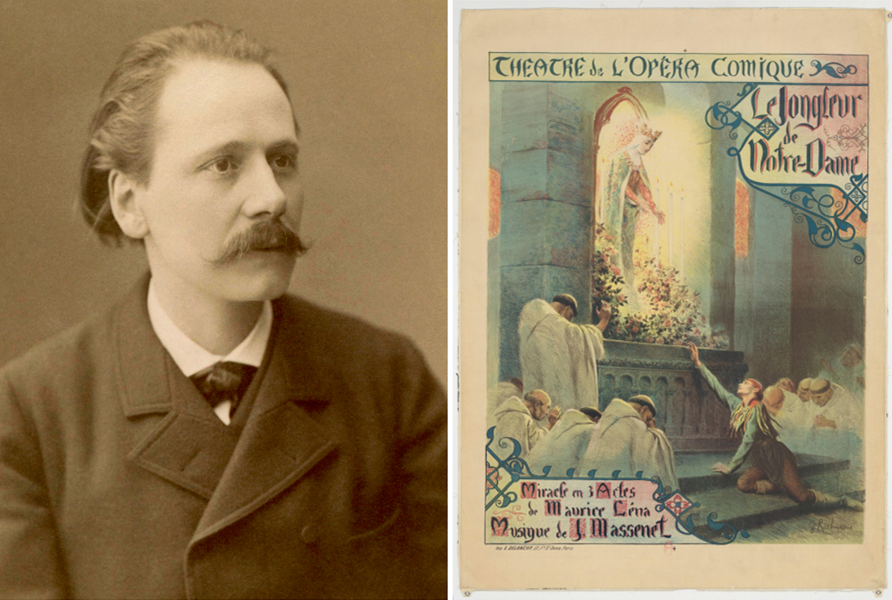
Since its origins in the 13th century, this story has inspired dozens of adaptations and spinoffs. It truly came into its own in French composer Jules Massenet’s 1902 opera.
The Legend
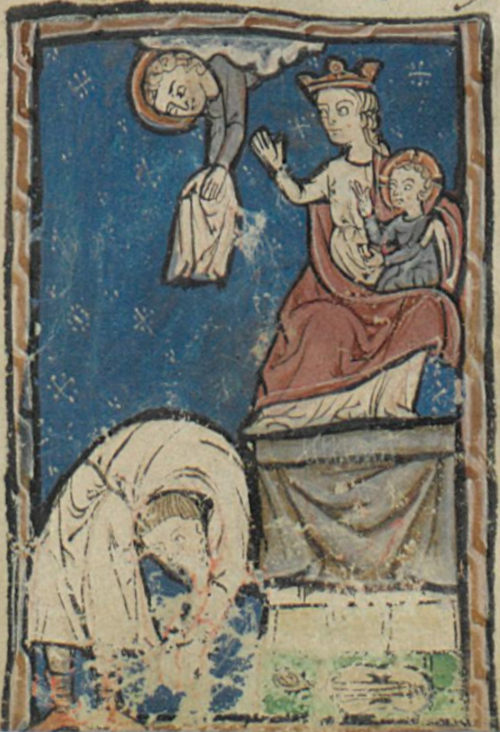
The story of the juggler is a simple one. A humble street performer gives up his life of entertaining to join a monastery. Illiterate and uneducated, he finds himself unable to join in any of his brothers’ religious activities. At last, he decides to praise God in the only way he can: with his old act. He is rewarded for his meek offering by an apparition of the Virgin Mary.
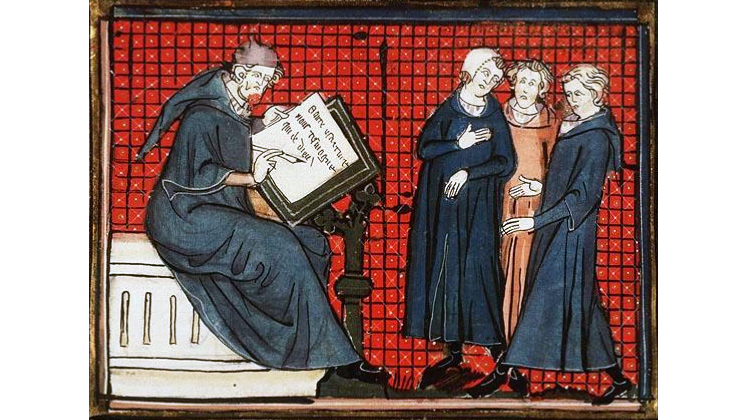
This story’s origin is uncertain. The earliest recorded version is either a medieval French poem or a Franciscan exemplum, a simple moral tale that could be expanded into a sermon. Benedictine monk Gautier de Coinci wrote the vast Marian poetry collection “Miracles of Our Lady” in the 13th century. The story may have also originated from “The Table of Exempla, in Alphabetical Order.”
Although the poem appears to have been written first, its opening stanza credits the story to an exemplum, prompting some to speculate that the latter actually came first. Was it pure fiction from the start or was it inspired by a real-life miracle long forgotten by church history?
The story has captured people’s fancy since it first appeared. From Anatole France’s short story to a 1942 short film to a 1982 Christmas film, the juggler who so loved the Virgin Mary has danced and tumbled his way through countless retellings.
The story has come to be associated with Christmastime, with many adaptations presenting the juggler’s performance as his Christmas gift to the Virgin Mary. Its theme may bring to mind the popular Christmas tale “The Little Drummer Boy,” originated by composer Katherine Kennicott Davis in her 1941 song “Carol of the Drum.”
Although the song reportedly came to her one afternoon as she napped, partly inspired by the French song “Patapan,” the undeniable similarity between the stories has led many to speculate that juggler’s miracle influenced her tale, as well.
The Opera ‘Le jongleur de Notre-Dame’
In the original manuscript of his opera, Massenet loosely quotes the Beatitudes: “Blessed are the simple, for they will see God. (“Heureux les simples, car ils verront Dieu.”).
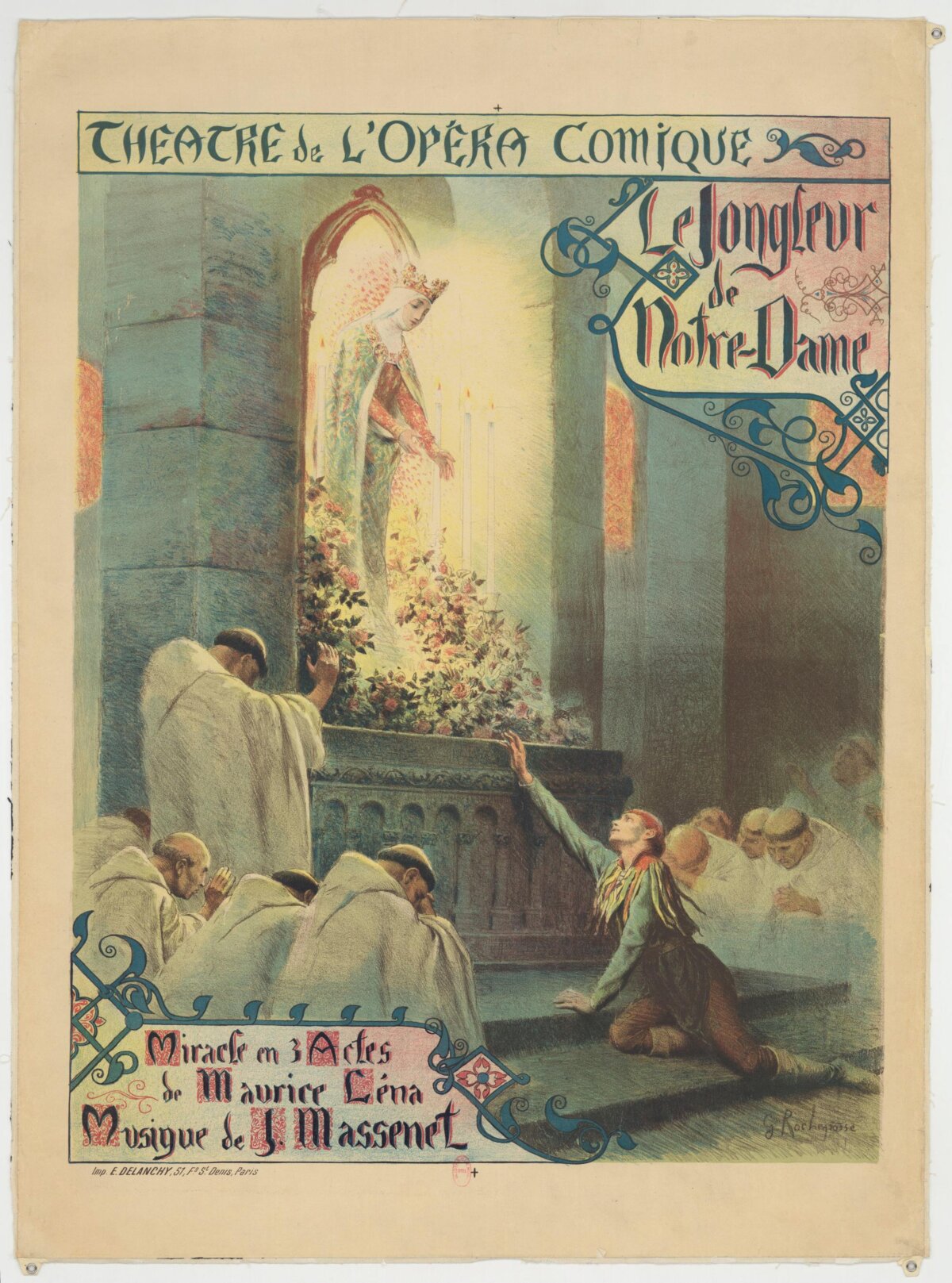
The juggler, originally unnamed but most commonly called Barnaby, here dubbed Jean, is a pious man, devoted to God and especially to the Virgin Mary. However, the opera strengthens his character by portraying him as less pious in the opening scene.
At the opera’s start, we see the juggler trying his best to entertain a crowd in front of a priory. When nothing he suggests pleases the audience, he reluctantly acquiesces to their demands for a drinking song, “In Praise of Wine” (“Alleluia du Vin,”) after asking the Virgin Mary to pardon him for this offence.
The prior comes upon the scene and upbraids Jean. He frightens him into joining the priory with threats of dying on the streets in winter and facing eternal damnation.
Similar to Massenet’s far better-known opera “Thais,” this work doesn’t shy away from showing how easily religion can forget the simple faith Christians are called to exercise, falling instead into temptations of pride over one’s own holiness.
The monks are shown competing with one another over the superiority of their respective arts and even mocking Jean for his simplicity. Only Boniface, the priory cook, sees the beauty of Jean’s simple love for God. Attempting to cheer his sad friend, Boniface sings the opera’s most well-known excerpt, “Legend of the Sage” (“Légende de la Sauge”).
This song tells the apocryphal tale of the simple sage bush that sheltered Mary and the baby Jesus from Herod’s soldiers during their flight to Egypt, after the rose and clove both refused for fear of being trampled. This story inspires Jean’s performance to honor a new statue of the Virgin Mary.

In the original poem, the juggler’s performances for Mary continue for an indefinite period. Monks observe both the Virgin and angels visiting him, while he is unaware of the miracles. Eventually, the physical strain is too much, and he dies, at last seeing Mary as she takes him to heaven. In France’s short story, only one such performance is recorded, and the aftermath isn’t discussed.
Massenet combines the best of both. Jean gives one performance only. We still see his human failings, as he continually slips back into old habits inappropriate for the setting and must ask his holy audience’s pardon.
Unbeknown to him, he’s watched by the other monks. Just as they’re about to seize him and punish him for blasphemy, the statue of Mary comes to life and blesses him. Realizing he’s been discovered, Jean begs the prior’s pardon, oblivious to the miracle happening around him.
When he finally sees it, his soul is overcome by the beauty and majesty of the sight. Recalling his earlier lament over his ignorance, he tells the awestruck prior, “At last I understand Latin,” before dying in the throes of religious ecstasy and ascending to heaven with his Blessed Mother.
A Timeless Moral
Anyone familiar with Catholic church history or the lives of saints will find the nature of this story familiar. It would be easy to believe that Saint Jean is the canonized patron saint of jugglers.
Massenet’s telling, more than any other, brings the character of the juggler close to our hearts. His continual failure, his temptation toward sacrilege, and his lack of self-worth all serve to make him so achingly human and thus relatable.
More than simply showing that God will accept even the simplest gift, it shows that heaven can forgive and overlook flaws. At every attempt, Jean fails, yet his attempts are seen, appreciated, and rewarded.
No matter which version of this story one chooses to read, watch, or listen to, readers will find it a touching tale about the beauty of simple faith. If we bring what we can to the altar of God, whether it be big or small, we will be blessed.
What arts and culture topics would you like us to cover? Please email ideas or feedback to features@epochtimes.nyc