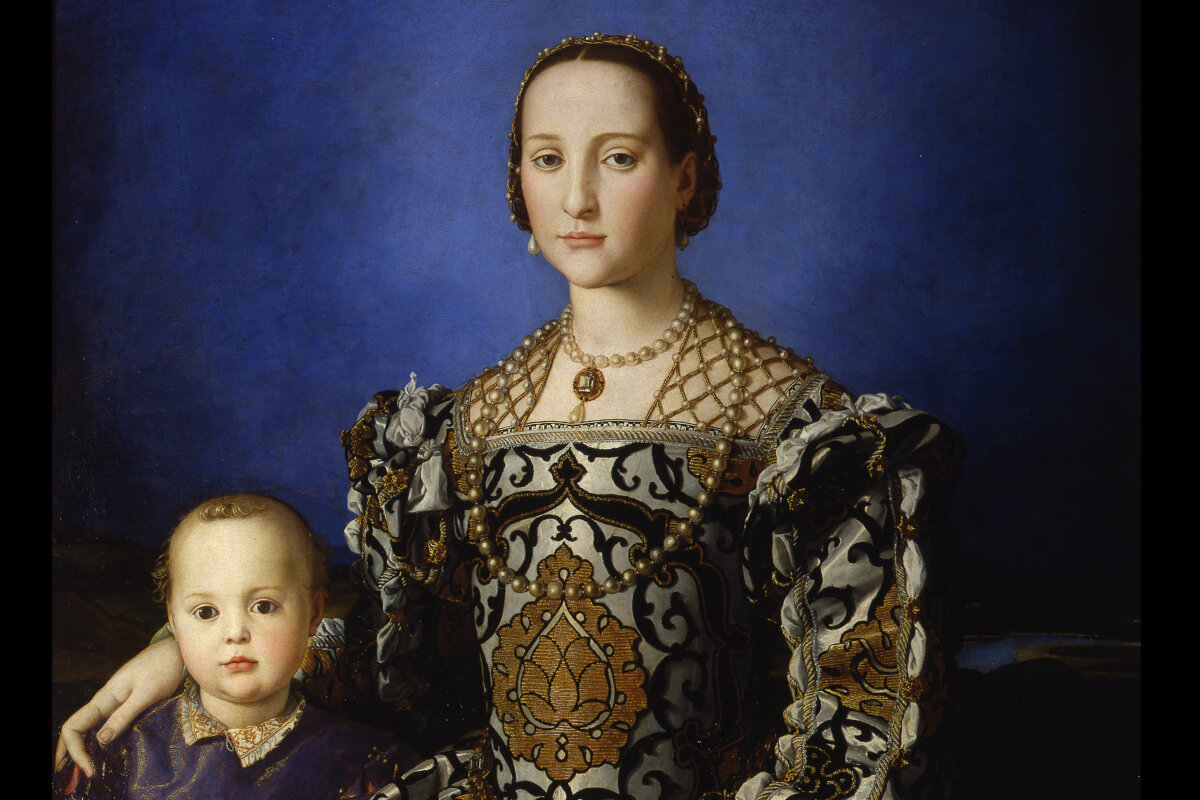
Bronzino’s circa 1545 “Portrait of Eleonora di Toledo With Her Son Giovanni” is a superlative 16th-century artwork due to its sumptuous details and enigmatic nature.
It is considered one of the artist’s greatest masterpieces and a high point of Mannerism. This artistic movement, which lasted from 1520 to 1600, occurred between the High Renaissance and Baroque periods, and it was characterized by a refined, elegant, and artificial style. As court painter to Cosimo I de’ Medici (1519–1574), the grand duke of Tuscany, Bronzino made numerous official portraits of the duke, his wife Duchess Eleonora of Toledo (1522–1562), their children, and courtiers.
Florence’s Leading Portraitist
Agnolo di Cosimo, known as Bronzino (1503–1572), was born in Florence, Italy. The son of a butcher, he studied with Jacopo Pontormo, a leading early Mannerist painter. By around 1530, Bronzino had established a career marked by his own interpretation of the style. While he painted religious works, he is best known for his portraiture. In Florence, he was the leading artist in this genre.
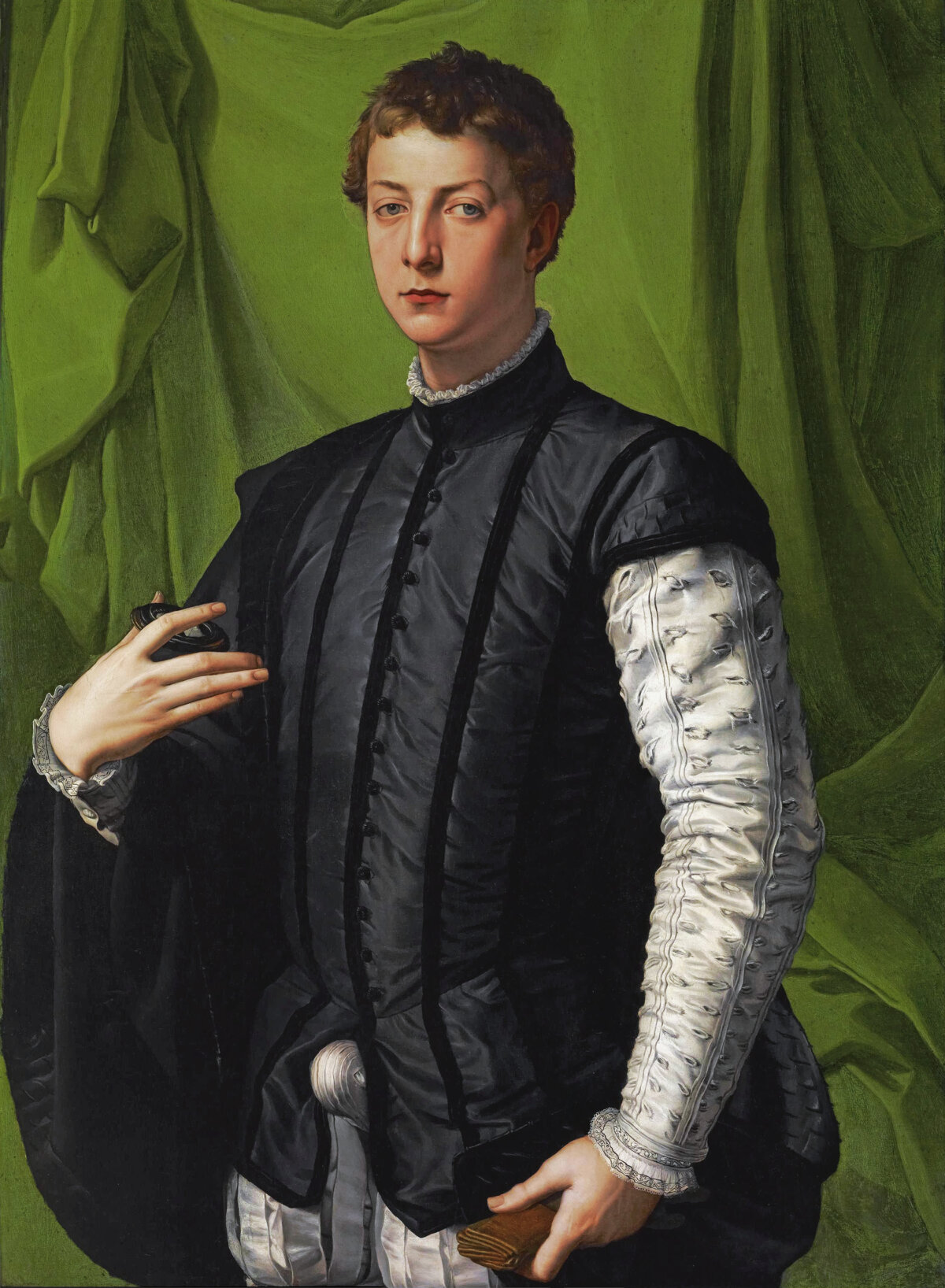
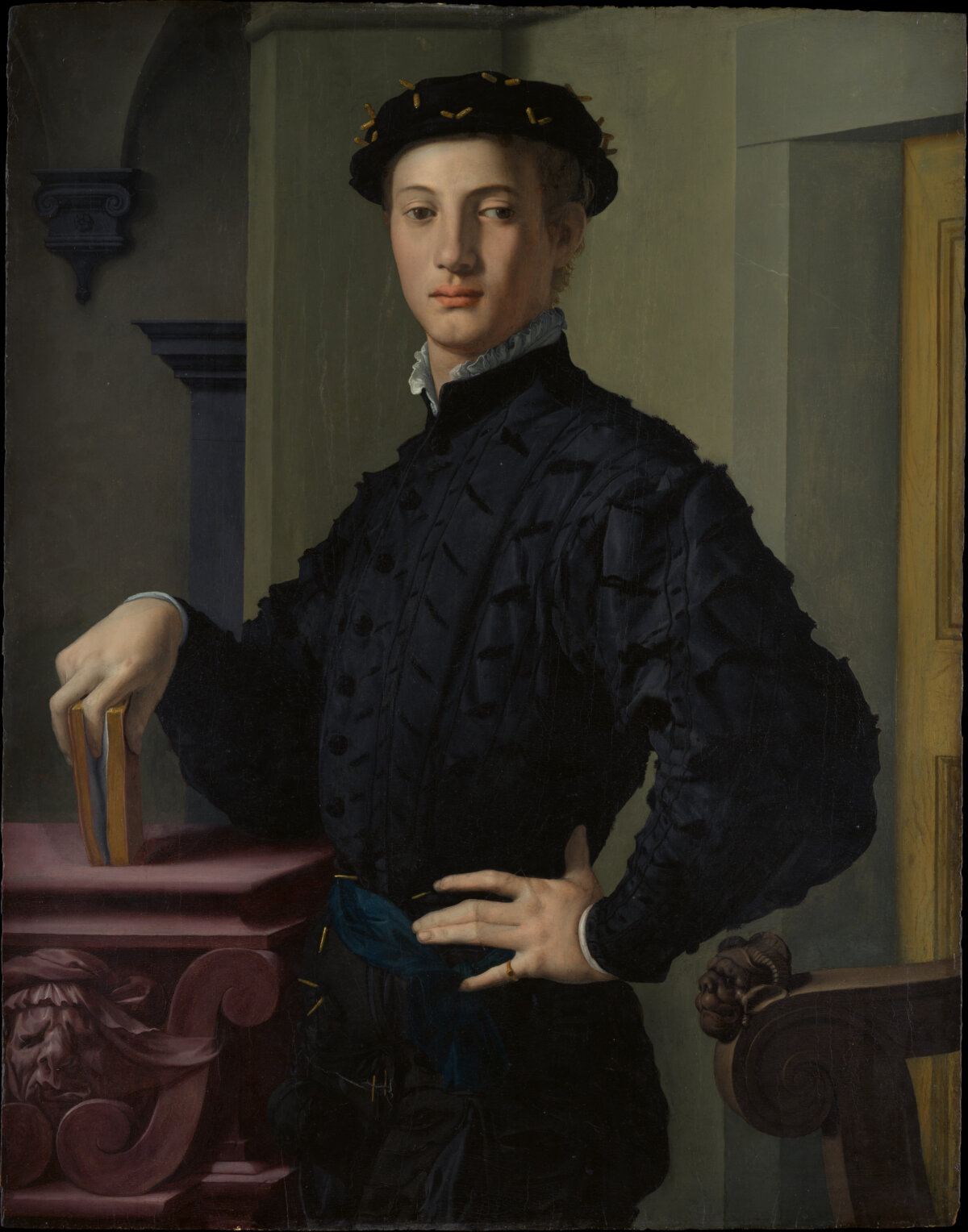
Bronzino’s sophisticated portraits present their sitters with a public mask of dignity, grace, and restraint as befitting their social standing. They do not reveal inner psychology. His technically polished likenesses focus on the minutiae of material goods, from textiles to accessories. Enamel-like colors, often in a cool palette, heighten the works’ decorative nature.
Bronzino’s aloof, glacial style drew on sculptural influences, and his portraits reflect the latest innovations in the genre, inspired by the likes of Leonardo and Raphael, to compose idealized beauty.
Florence flourished under Cosimo I’s rule. The duke, a descendant of a secondary branch of the Medici family rather than the main line, was eager to prove himself during his reign. Eleonora, from a prominent Spanish aristocratic family and daughter of the viceroy of Naples, was a powerful partner to his ambitions. She was a skilled strategist, stateswoman, and administrator.
Since Eleonora brought Spanish fashion to the Florentine court, she was also a trendsetter. She founded the Boboli Gardens, was an ardent patroness of the arts, and was even entrusted by her husband to serve as regent when he traveled.
In 14 years, they had 11 children, eight of whom survived to adulthood, thus securing the succession of the Medici dynasty.

The couple married in 1539, and it is believed that Bronzino’s first portrait of Eleonora, now at the National Gallery of Prague, was made around that year to mark the occasion. Her red dress is one of the signifiers of her wealth and new family: Obtaining red dye was a difficult and expensive process, and the Medicis favored this color.
To the modern eye, what stands out most as reflecting exalted status is her plethora of pearls, from her Spanish-style snood to earrings and upper bodice netting. These pearls were a wedding gift from Cosimo.

In the era, an organic gemstone symbolized female beauty and purity. The intaglio ring on her pinky finger depicts an ancient marriage symbol. When Eleonora’s remains were exhumed, this ring was found in her tomb. According to legend, she was buried in the dress she wore in the “Portrait of Eleonora di Toledo With Her Son Giovanni,” but this was determined to be false.
Mother and Son Portrait

Bronzino’s repeated portraits of Eleonora were purposefully similar so that her public persona would remain consistent. In “Portrait of Eleonora di Toledo With Her Son Giovanni,” she wears the same type of earrings, netting, and hairpiece as in the circa 1543 oil on panel. In the later circa 1545 painting, there are prominent jeweled additions: two impressive pearl necklaces, one of which has a large table cut diamond pendant, and a sumptuous belt with both cut and cabochon gems and a pearl tassel.
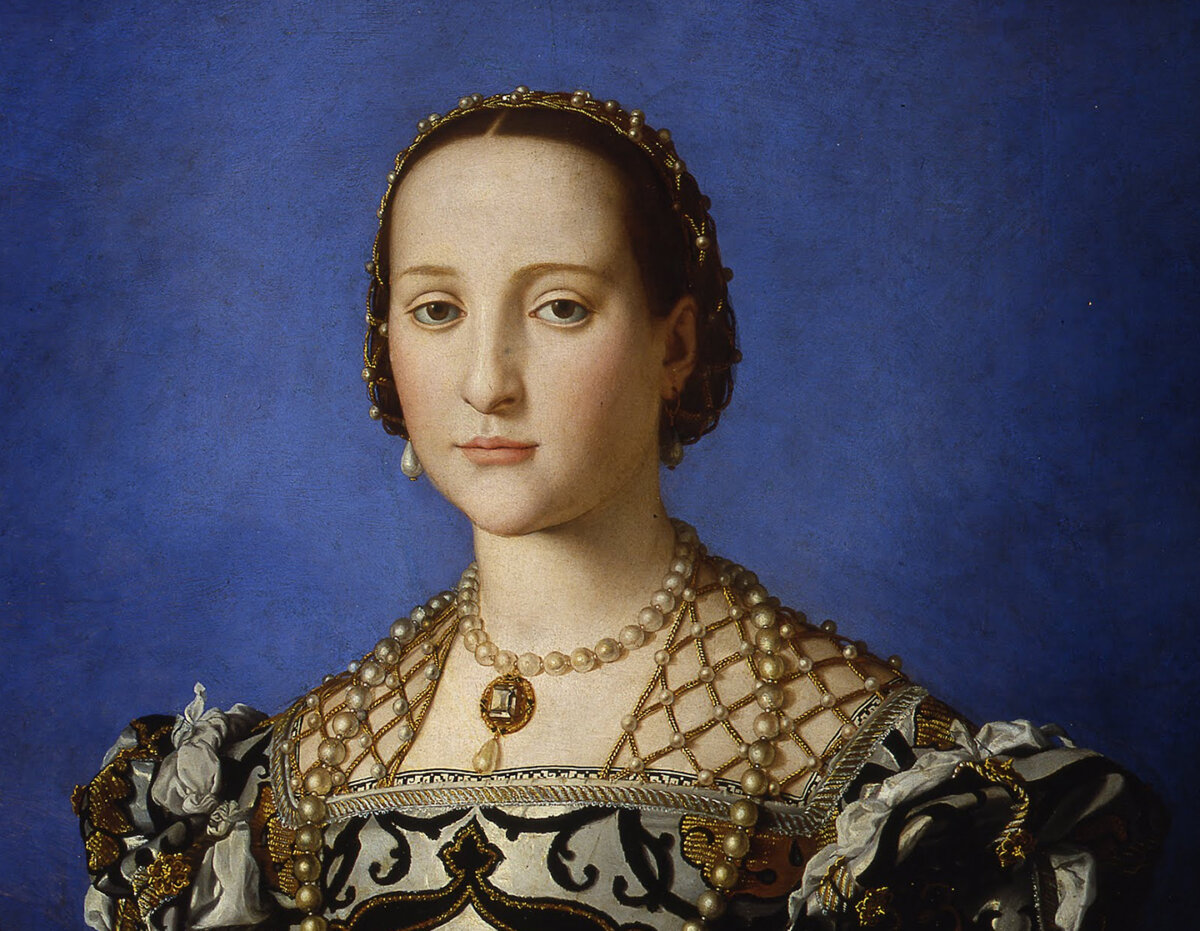
Eleonora is imbued with an aura of majesty, both religious and secular. There is a halo-like glow around her head, which is set against a vibrant blue background, a color equated with the Madonna. Bronzino used the most expensive pigment, lapis lazuli, which was more costly than gold, for this swath of the panel. This material would have been used for the Virgin’s cloak in a religious work.
Eleonora’s dress is a silk brocade woven with gold threads, the most expensive fabric of the day that was often used for liturgical vestments. It was popular at the Spanish court and a forte of the Florentine textile industry. Text by Bruce Edelstein and Patrizia Naldini on the Uffizi Gallery website elaborates: “The repeated motifs of the fabric, the pomegranate and pinecone, are Christian symbols of resurrection and regeneration, which allude to the Duchess’ fertility.”
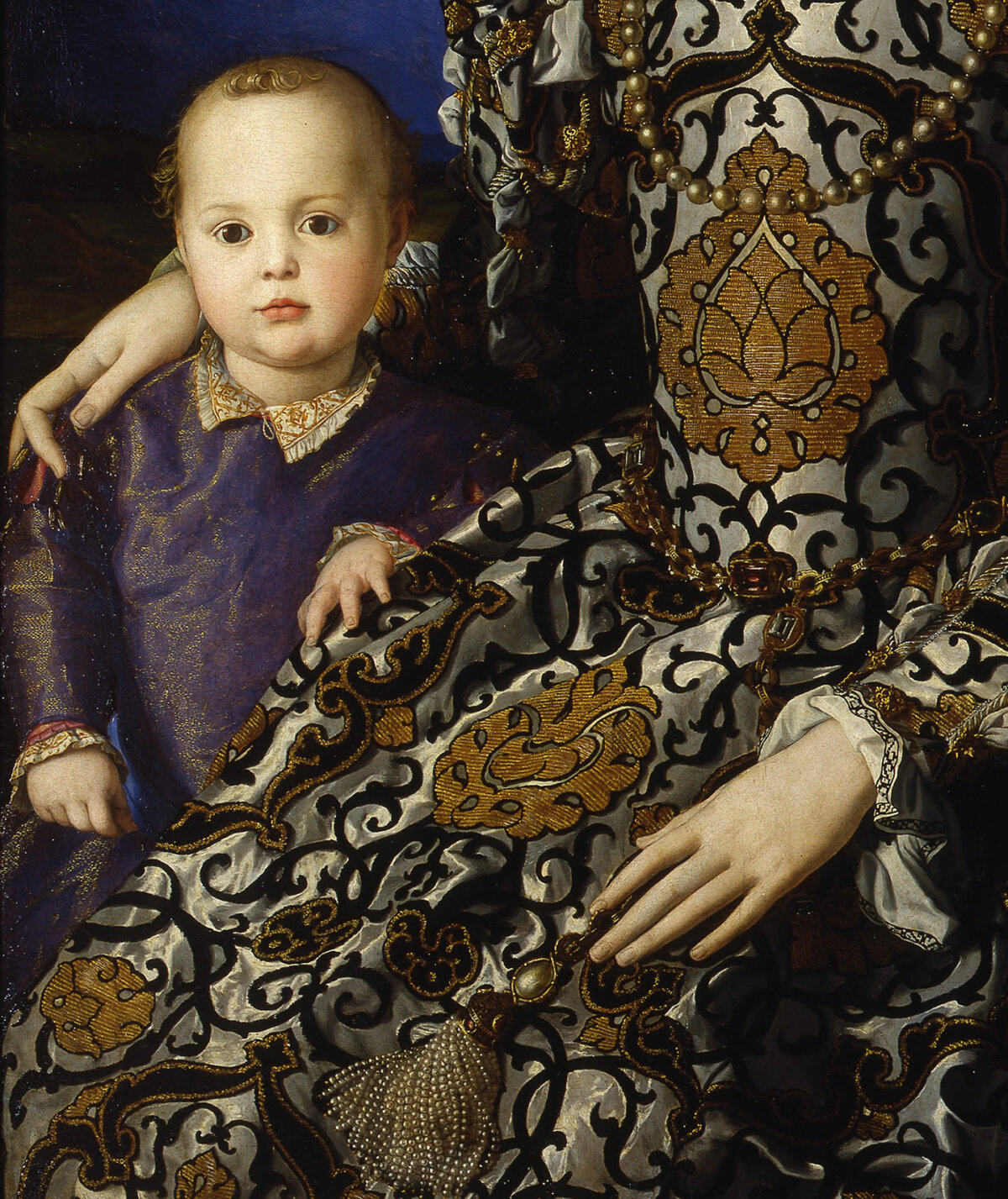
While there is an air of formality to Eleonora’s portrayal, mother and son are also affectionate. She has placed a protective arm around her 2-year-old son Giovanni (1543–1562), who would become a cardinal, and his left hand rests on her dress. Little Giovanni’s namesake was Giovanni di Lorenzo de’ Medici, who became Pope Leo X in 1513.
Bronzino’s format expands upon the half-length portrayal in “Mona Lisa.” He evokes Raphael’s “Portrait of Leo X with Cardinals Luigi de’ Rossi and Giulio de’ Medici,” as both works show their sitter up to their knees. Many of Bronzino’s greatest artworks remain in Florentine collections, and the austerely beautiful portrayal of Eleonora and her second eldest son at the Uffizi Galleries is considered his crown jewel.

What arts and culture topics would you like us to cover? Please email ideas or feedback to features@epochtimes.nyc