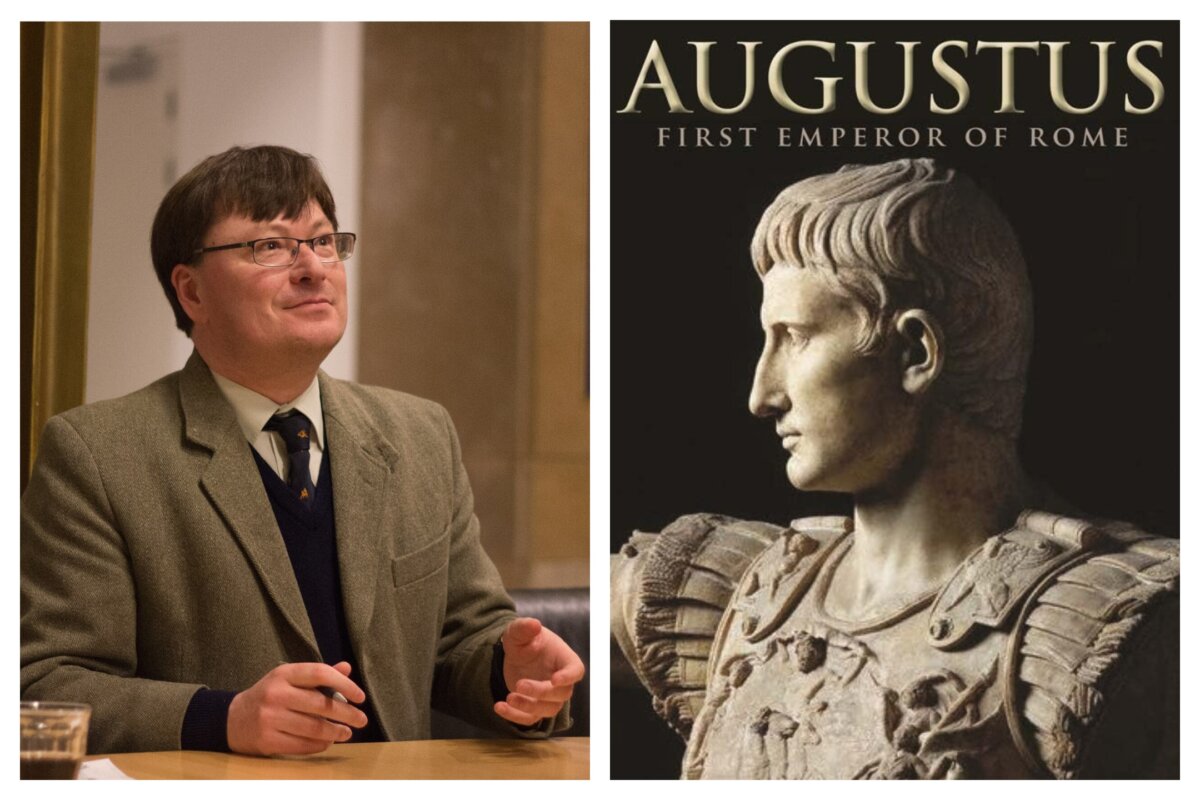
Do people really think about the Roman Empire every day? This claim, which has made the rounds over the past few years, might very well be true. With podcasts, YouTube channels, and endless commentaries on Rome, the empire seems to remain very much alive. Adrian Goldsworthy, the Oxford-educated historian, has assisted in driving this trend—both for Rome as an republic and an empire.
Goldsworthy’s biography, “Augustus: First Emperor of Rome,” gives readers a glimpse of the rise of Octavius, the adopted son—the Roman legal equivalent of a natural son—of Julius Caesar, who was made Caesar’s heir. The author chose the antique “Octavius” over the modern “Octavian,” although he became known in Rome and to history as Caesar Augustus.
The author, who has also written a well-received biography of Julius Caesar, begins with Octavius’s early years as merely the nephew of Rome’s leading man.
Goldsworthy provides pertinent information about Octavius’s personal upbringing and the politically chaotic environment of Rome during that time. He was born around the middle of the 1st century B.C., when Rome had become a city-state of turmoil, raging from one civil war to the next. His uncle had survived one civil war—Sulla’s Civil War 83 to 82 B.C.—and had come to power through a civil war he instigated with the famous “crossing of the Rubicon.”
The Rise of Augustus
The assassination of Caesar by Roman senators led to another civil war between republicans and those loyal to Caesar. When the latter, led by Marcus Antonius (Mark Antony), triumphed, it ultimately resulted in a triumvirate. Thanks to Caesar’s will, which dictated that Octavius was his heir, the trio was made up of Antony, Octavius, and Marcus Lepidus, a Roman general and statesman. After named Caesar’s heir, Octavius changed his name from Caius Octavius to Caius Julius Caesar. Later, he adopted the name Augustus.
Goldsworthy demonstrated how soldiers chose between Antony and Augustus, and that more of them eventually sided with the latter. The author makes it clear that Caesar’s wealth and name played a decisive role in Augustus’s ability to build up his army. It was during this time that Augustus, while still quite young, demonstrated a capacity for industry, diplomacy, and brutality.
The young statesman—he had become Rome’s youngest consul at 19—was knowledgeable and wise enough to understand that all triumvirates had an expiration date. The trick was to be the most powerful of the three when it reached its conclusion. Another civil war, between Antony (backed by Egypt’s Cleopatra) and Augustus, resulted in Antony’s death, Lepidus’s eventual exile (though he retained the title of Pontifex Maximus), and Augustus’s ascension to the top.
The Man on Top
As Goldsworthy suggests, remaining on top was anything but easy. Threats inside and outside of Rome still existed, though it helped that Romans of every stripe appeared to be weary of civil war. They were prepared to allow Augustus to seize power in exchange for peace and stability. This was quite the about-face compared to the time of Julius Caesar, whose enemies chose assassination (and thus another period of violent chaos) rather than to allow one man to seize such power.
Certainly, Augustus became the most powerful man in Rome. Since he was considered the son of a god (Julius Caesar had been deified), one could claim that he was all-powerful. Even with this power, the ruler understood the necessity of alliances. The book explains this necessity and how Augustus achieved and maintained these alliances, most predominantly through marriages, as well as adoptions and political-military relationships.
The greater alliance was between him and the Roman people and its senators. It was an alliance built on the faith that Augustus would rule to benefit the “res publica” (the commonwealth). One way Augustus attempted to prove his beneficence was to resign as ruler of Rome—a resignation the Senate refused to accept. It seems he pulled from his uncle-father’s playbook: Julius Caesar refused a crown twice before a crowd of Romans—at least ostensibly refusing a kingship.
 Adrian Goldsworthy, at the Dutch presentation of “Augustus: First Emperor of Rome.” (1Veertje/CC BY-SA 4.0)
For the Sake of Rome
The life of Augustus and his rule, though maintained by power, was not simply about power. It was about what was best for Rome. The books points out that the Senate maintained its position and its integrity, with Augustus often sitting in on sessions. And the size of the government, that is, its administrative positions, expanded.
The man considered the first emperor of Rome was, as Goldsworthy convincingly conveys, most occupied with Rome’s peace, security, and prosperity. His concern is substantiated by his constant visits to provinces, addressing petitions, working to eliminate corruption in elections, encouraging the arts and written histories, and helping to ensure citizens and allies inside and outside of Rome received justice in political and social matters. He maintained these efforts, while he suffered from ill health for a long period of his life.
Of course, not all went well with Augustus. Even the best laid plans fall apart. His two adopted sons, Caius and Lucius, died within a year of each other. His stepson (though not adopted), Drusus, who had become a promising general and a young Roman hero, died. His grandson, Agrippa Postumus, and his daughter, Julia, had to be exiled. Tiberius, his adopted stepson who had seemed to be the heir apparent, resigned from Roman life and exiled himself to Rhodes; he was eventually allowed to return to Rome as a private citizen. This decision hurt Augustus, who felt betrayed; but Tiberius eventually took Augustus’s place as emperor.
A Life Worth Studying
The life of Caesar Augustus is a life worth knowing and understanding. His methods of rule and statesmanship reveal a vast understanding of how the world worked. The world still works much the same way.
More importantly, for students of history, and specifically political history, Goldsworthy didn’t indulge in silly presentism. Rather, he judged Augustus according to his time and the political and social environment of Ancient Rome. In comparison to ancient rulers, as well as many succeeding Roman emperors (and one will dare say, many modern leaders), Augustus proved not only a capable leader, but a good one.
“The mature statesman hailed as ‘father of his country’ controlled the army and kept it loyal to him alone. Everything else he achieved in his life was based on his success as a warlord and we should never forget this, but nor should we deny that, as military dictators go, Caesar Augustus was not such a bad one, at least in the sense that, once established, he ruled well.”
For readers who can’t stop thinking about Rome’s republic or empire, “Augustus: First Emperor of Rome” is a must-read. It would be difficult not to call it a must-read regardless of a reader’s interests. It’s a well-constructed biography that provides not only immense detail about the Roman himself, but also information about the world of Rome during the first centuries B.C. and A.D. This world transitioned from chaos and violence into one of peace and prosperity, thanks in very large part to the efforts of one man.
‘Augustus: First Emperor of Rome’
By Adrian Goldsworthy
Yale University Press, Sept. 29, 2015
Paperback, 640 pages
What arts and culture topics would you like us to cover? Please email ideas or feedback to features@epochtimes.nyc