
Today, the term “artificial intelligence” springs up on all sides. Books, videos, and articles alternately praise it as a harbinger of freedom and prosperity or bemoan it as the first rumblings of a looming apocalypse. The term “AI” is used sweepingly and somewhat carelessly to refer to entities as diverse as an automated tool in design software to a chatbot like ChatGPT and the fabled “AGI”—artificial generalized intelligence—which will allegedly be able to think with human-like flexibility across a limitless range of topics and problems. All this makes for a fog of confusion around the concept of machine intelligence.
Can a computer have intelligence in the way that a human being does? In what ways does a machine mind replicate a human mind–and what are its limitations?
To answer these questions, we must analyze the word “intelligence.” The “Oxford Universal Dictionary” defines intelligence as “The faculty of understanding; intellect” and “the action or fact of mentally apprehending something; understanding, knowledge, comprehension.” Intelligence isn’t merely the ability to spit out letters or numbers in a somewhat coherent stream or run calculations on datasets; it refers to the power of understanding what those letters or numbers mean and the ability to form and connect abstract concepts. In this sense, humans have intelligence, but machines don’t.
The “thought” of an AI—even a highly sophisticated one like ChatGPT—is in an entirely different category from the thought of a human being. A chatbot isn’t conscious of a conversation. Instead, it’s an intricate and convincing text generator that gives the impression of engaging a user in a conversation. According to rules and algorithms created by human programmers, and drawing on an immense body of training data, a chatbot makes statistical predictions of what words typically go together in human speech. So if a user prompts the chatbot with a sentence, it blindly spits out a combination of words that statistically relate to the ones you gave it, based on the enormous database of human-written texts it has scanned.
A Blind Advisor
ChatGPT has no idea what the words mean. Meaning requires abstraction and consciousness, the ability to entertain intangible concepts and a general awareness of the world, which the machine lacks. Indeed, since ChatGPT is nothing other than a very complicated algorithm, where would it store such intangible ideas?
Because ChatGPT is a mind-bogglingly advanced text generator, it gives the impression of knowing what it’s talking about. Our tendency to project human qualities onto advanced machines—known as the Eliza effect—aggravates the problem.
But the limits of machine “knowledge” become clear when we consider a simpler machine. Does a desktop calculator “know” math or have awareness of anything? Of course not. Neither does ChatGPT, which is simply a very elaborate text calculator. It convincingly simulates a consciousness engaged in conversation, but there is no more awareness in ChatGPT than there is in a calculator.
In both cases, the output is produced blindly and automatically, according to rules programmed by a human mind. This isn’t intelligence. The term “artificial intelligence” is a misnomer. “Ultra-advanced computation” might be more accurate.
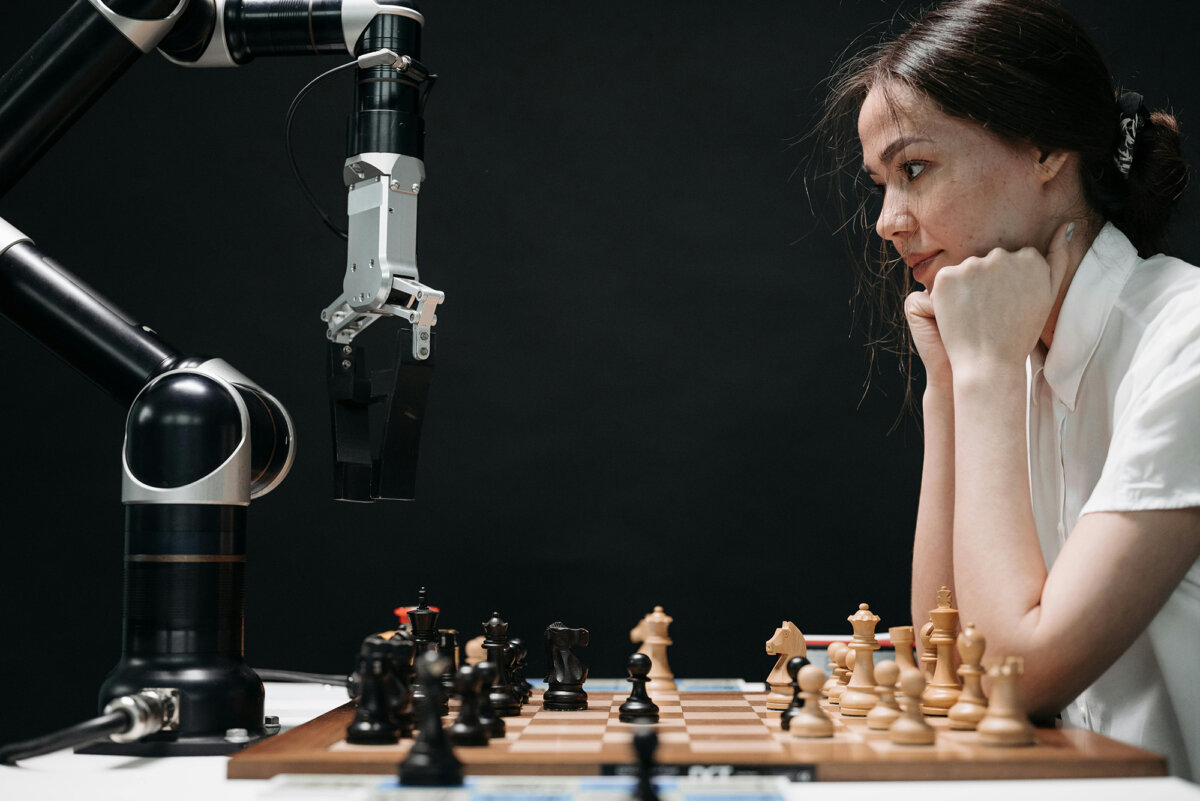
Not Quite An Assembly Line
Confusion between machine intelligence and human intelligence derives partly from the false perception that the human mind and the human being are themselves machines—”meat machines,” perhaps, but machines nonetheless. The creator of the first chatbot, Joseph Weizenbaum, went to great lengths to point this out. He argued that the modern fascination with artificial intelligence and its capabilities developed from a flawed understanding of the human being as merely a biological machine.
“These [AI-promoting] authors, among others, are propagating an extremely dangerous image of man at the threshold of the millennium,” he told Bernhard Pörksen in a 1998 interview. He explained:
“It is based on the idea that man is a machine that can – in principle and in the near future – be understood and decoded to correct it and improve it. The central dogma of this view of man is the idea that every aspect of life is computable, meaning it can be broken down into calculable and formalizable processes.”
Weizenbaum’s point is that AI proponents believe the human being is no more than the sum of its parts, and if those parts are fully understood, the human being can be decoded. If human nature can be decoded, then it can be encoded into a machine.
If a human mind is nothing other than the firing of neurons in a physical brain—a complicated chemical and electrical process that gives rise to consciousness—then why can’t a sufficiently complex computer achieve the same thing? After all, both the mind and the machine are made of the same stuff: atoms.
One’s attitude toward artificial intelligence depends on the philosophical framework one adopts. The belief that a sufficiently complex machine could achieve consciousness and genuine intelligence arises only from a materialistic mindset. A more spiritual perspective on human intelligence and consciousness recognizes an untraversable gulf between mind and matter, between machine and human. If the mind is immaterial, no amount of complex circuitry will create a machine that thinks. As Mario Beauregard and Denyse O’Leary wrote in “The Spiritual Brain: A Neuroscientist’s Case for the Existence of the Soul,” “Computers, however cleverly we build them, do not become spiritual machines, nor can they shed light on the spiritual nature of the human.”
A Spiritual Construct
Human intelligence involves much more than mere computation, and no machine will ever be able to copy the spiritual powers of the human mind. “The human brain is not a calculating machine,” wrote Beauregard and O’Leary. Abstraction, intuition, imagination, emotion, consciousness, and conscience all intersect in human thought. Computers have only calculating power. In that sense, they lack intelligence because they lack personhood. It’s misleading to call anything a machine does “intelligence.”
Something undeniably spiritual happens inside the human mind, something completely untethered from mere chemical reactions or electrical brain signals. Consider, for example, the free will we all experience. It can’t be accounted for in a materialistic conception of the mind. If all our actions result from blind interactions of impersonal biochemical forces, there would be no choice involved in our actions; each action would result from blind chance. Yet day-to-day living completely defies that explanation. An immaterial part of ourselves seems to be choosing and directing our actions, which then play out through the biological part of our being, from the brain on down, after we’ve made a decision.
Similarly, well-documented Near Death Experiences (NDEs) indicate that human intelligence and consciousness exist beyond and independently of our physical brains. NDEs prove that awareness continues even when neurological activity ceases in the brain.

Our understanding of AI has more to do with philosophy and spirituality than it does computer science. For those of us who believe that a spiritual component is essential to genuine intelligence, the idea of “artificial intelligence” is absurd.
That’s not to say that computers won’t continue to advance, that they won’t get better at simulating human thought, or that they can’t accomplish calculations that humans are incapable of. All that may well be true. The immense positive and negative potential of AI’s power is real. However, since computers are mere matter, they will never make the leap from computation to genuine human intelligence.
Is all this just hair-splitting? What does it matter whether we call these machines “artificial intelligence” or “ultra-advanced computers”? It matters because blurring the line between man and machine is a dangerous game. It both elevates machines beyond their rightful place and degrades human beings from their rightful position.
Weizenbaum saw great danger in placing humans and machines on the same level. Equalizing the two undercuts human dignity and respect for life, turning human bodies into mere “meat machines.” As Weizenbaum put it:
“We can learn from the history of this century, perhaps the most brutal century, what a decisive role the image of man played in the crimes of the past, remembering that the most atrocious crimes were made possible because the perpetrators denied the humanity of the victims.”
Let’s not repeat the mistake.